Banks
Apple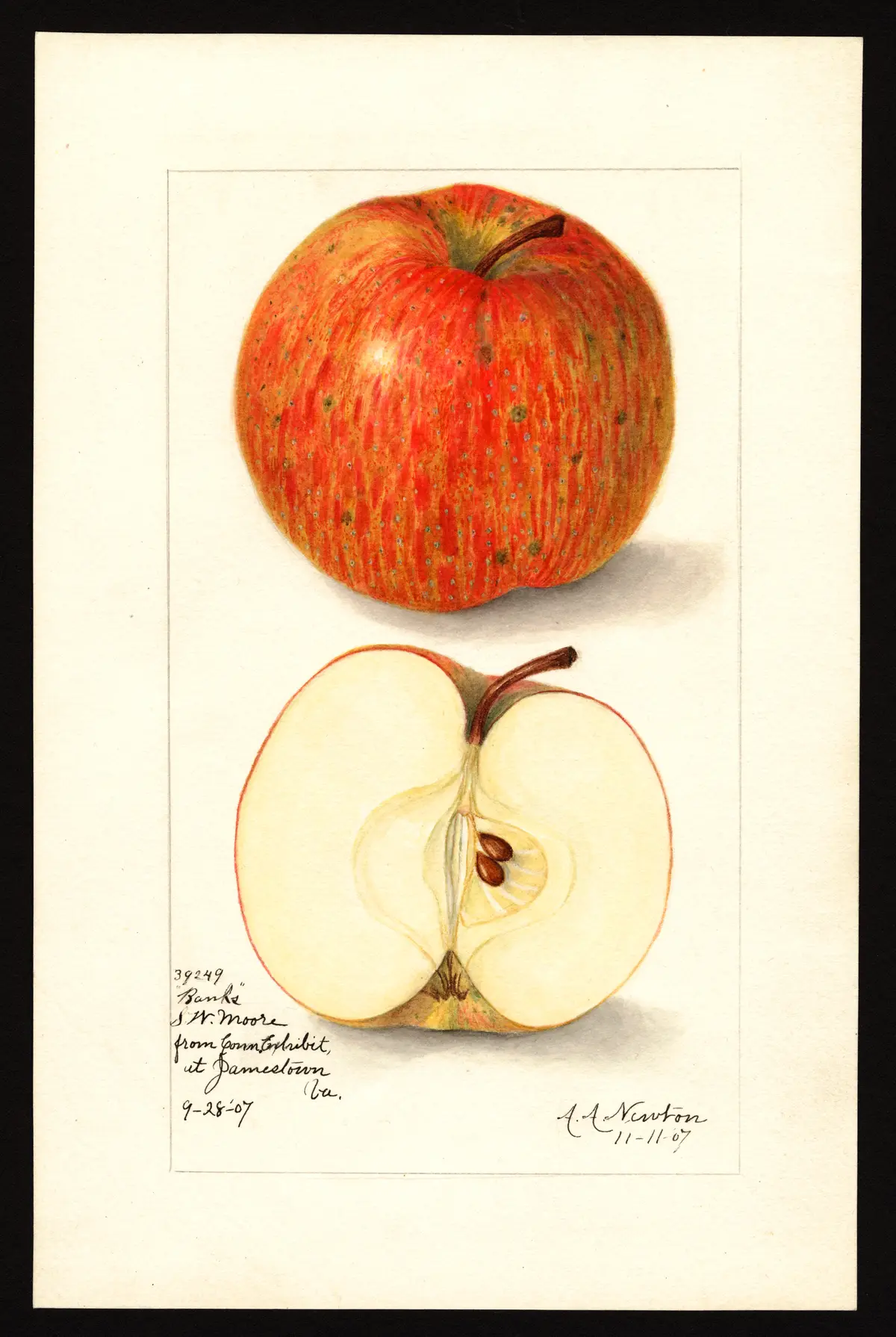
USDA Pomological Watercolor Collection
Banks
Origin/History
Banks is a bud sport from Gravenstein, first noticed and propagated by C. E. Banks, of Berwick, Kings County, Nova Scotia. The sport first came into bearing about 1880. In 1903, R. W. Starr of Wolfville, Nova Scotia, presented to the American Pomological Society the following account: "A bud sport from Gravenstein, much the same in season and flavor, but bright red, less ribbed, more regular in shape, and generally a little smaller in size. First noticed and propagated by C. E. Banks, of Berwick, Kings Co., N. S. It is well liked and is being quite largely planted." In 1899, Sears observed that Banks "is gaining in popularity because it combines with the superior quality of the ordinary Gravenstein the bright red color which people demand who judge the apple by its appearance alone." As of 1905, Banks had not yet been planted to any considerable extent in New York.
Tree
Large, vigorous, upright-spreading, open (Hedrick). Beach, noting that Banks appears identical with Gravenstein except in color and form, refers the reader to the Gravenstein description for a full technical account of the tree.
Fruit
Size and Form: Large, uniform in size but not in shape; oblate or round, somewhat irregular, broad at the base, angular, narrow to broad (Hedrick). Both Beach (via Starr's 1903 report) and Hedrick note that some observers find Banks generally a little smaller than Gravenstein, less ribbed, and more regular in shape; however, Hedrick's own description still characterizes the fruit as somewhat irregular.
Stem: Not described in source.
Cavity: Not described in source.
Calyx: Large, open or closed; lobes large, long, very broad, acute. Calyx tube large, conical; stamens median.
Basin: Irregular, wide, obtuse to abrupt, wrinkled.
Skin: Thin, tender, rough, irregularly russeted; ground color greenish-yellow or orange-yellow overlaid with broken stripes of light and dark red; dots few, small, light; prevailing effect yellow striped. Both sources identify the bright red coloration as the primary distinguishing feature from Gravenstein.
Flesh and Flavor: Yellow, firm, fine, crisp, tender, juicy, sprightly subacid, aromatic. Quality very good to best.
Core and Seeds: Core medium in size, strongly abaxile; cells open; core-lines clasping the funnel cylinder; carpels broad-ovate, emarginate. Seeds large, long, plump, acute, brown.
Season
Late September to early November.
Uses
Not described in source.
Subtypes/Variants
Not described in source.
Other
Beach explicitly notes that Banks is identical with Gravenstein in all respects except those above described — coloration, degree of ribbing, and regularity of shape — and directs the reader to the Gravenstein description for the complete technical account of tree and fruit.
Book Sources
Described in 2 period pomological works
Nursery Catalog Sources
Found in 5 catalogs (1906–1913) from Illinois, Missouri
- Stark Bros. Nurseries & Orchards Co. , Louisiana , Missouri — 1906 — listed as Banks Red Gravenstein
- Stark Bros. Nurseries & Orchards Co. , Louisiana , Missouri — 1910 — listed as Banks Red Gravenstein
- Stark Bros. Nurseries & Orchards Co. , Louisiana , Missouri — 1911 — listed as Banks Red Gravenstein
- Stark Bros. Nurseries & Orchards Co. , Louisiana , Missouri — 1912 — listed as Banks Red Gravenstein
- Benjamin Buckman (personal inventory) , Farmingdale , Illinois — 1913 — listed as Banks Gravenstein
View original book sources (2)
— S.A. Beach, The Apples of New York, Vol. 2 (1905)BANKS.
REFERENCES. 1. Craig and Allen, Can. Hort., 16:420. 1893. fig. 2. Nova Scotia Fr. Gr. Assn. Rpt., 1894:81, 129. 3. Sears, Can. Hort., 22:476. 1899. 4. Caston, Ont. Fr. Stas. An. Rpt., 9:55. 1902. 5. Am. Pom. Soc. Rpt., 1903:166.
SYNONYMS. BANKS (2, 3, 4, 5). BANKS GRAVENSTEIN (2). BANKS RED GRAVENSTEIN (1). Banks Red Gravenstein (4). Red Gravenstein (3).
In 1903 R. W. Starr, Wolfville, Nova Scotia, presented to the American Pomological Society the following report concerning this variety (5). "A bud sport from Gravenstein, much the same in season and flavor, but bright red, less ribbed, more regular in shape, and generally a little smaller in size. First noticed and propagated by C. E. Banks, of Berwick, Kings Co., N. S. It is well liked and is being quite largely planted."
It appears that this sport first came into bearing about 1880 (1). In 1899 Sears (3) remarked, "The Banks or Red Gravenstein is gaining in popularity because it combines with the superior quality of the ordinary Gravenstein the bright red color which people demand who judge the apple by its appearance alone."
Except in the points of difference above noted Banks appears to be identical with Gravenstein and the reader is referred to the description of that variety for a technical account of the tree and fruit. So far as we can learn this variety is not yet planted to any considerable extent in New York.
— U.P. Hedrick, Cyclopedia of Hardy Fruits (1922)BANKS. Banks Gravenstein. Banks is a bright red Gravenstein, differing in no other important particular than color. Some say that the apples are smaller, less ribbed, and more regular in shape. Banks is a bud-variation of Gravenstein, first noticed and propagated by C. E. Banks, Berwick, Kings County, Nova Scotia, about 1880. Tree large, vigorous, upright-spreading, open. Fruit large, uniform in size but not in shape, oblate or round, somewhat irregular, broad at the base, angular, narrow to broad, irregularly russeted; calyx large, open or closed, with lobes large, long, very broad, acute; basin irregular, wide, obtuse to abrupt, wrinkled; skin thin, tender, rough, greenish-yellow or orange-yellow overlaid with broken stripes of light and dark red; dots few, small, light; prevailing effect yellow striped; calyx tube large, conical; stamens median; core medium in size, strongly abaxile; cells open; core-lines clasping the funnel cylinder; carpels broad-ovate, emarginate; seeds large, long, plump, acute, brown; flesh yellow, firm, fine, crisp, tender, juicy, sprightly subacid, aromatic; very good to best; late September to early November.