Beurré Bachelier
Pear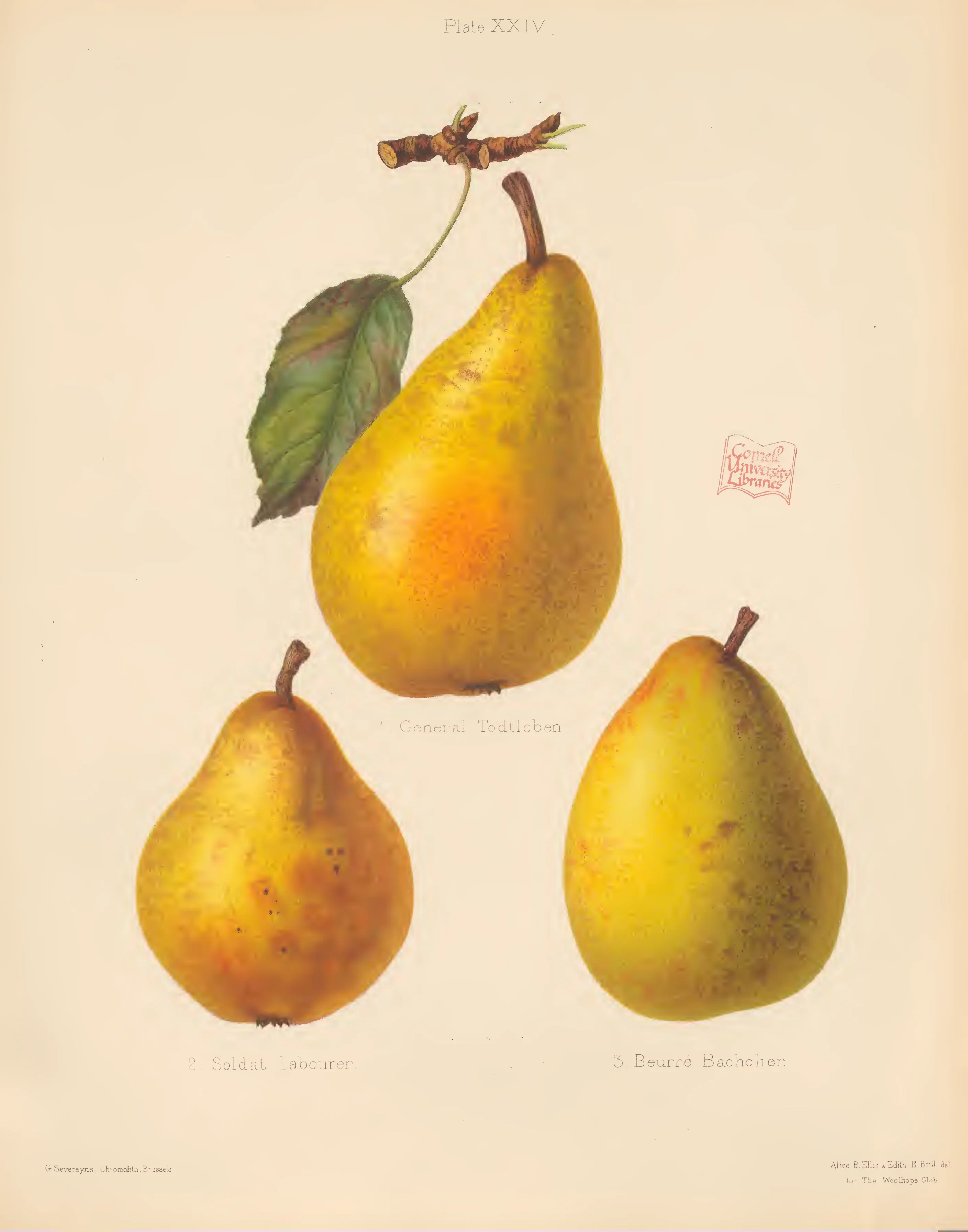
Beurré Bachelier
Origin / History
A French pear ("Foreign," Elliott), raised by Bachelier in the North of France in 1845. Downing gives 1845 as the year of introduction. Bunyard gives it as the year of first fruiting.
The raiser and place are given two ways. Bunyard gives M. Bachelier of Capelle-Brouck. Hedrick gives Louis-François Bachelier, commune of Cappellebourg, Canton of Bourbourg.
Hedrick calls it "this splendid pear." Bunyard calls it "a valuable fruit but suffers from being in at the same season as Doyenne du Comice."
Tree
Tree vigorous (Downing), with vigorous shoots (Thomas). Bunyard gives growth as medium, upright spreading.
Young wood rich dark brown (Downing); shoots reddish-yellow (Thomas). Bark of the tree cracks (Thomas). Leaf small, round, flat or a little folded, finely serrate (Bunyard).
Fertility good, and a little subject to scab (Bunyard).
Fruit
Size: Medium to very large, the accounts spread evenly across the range. Bunyard gives medium, 3 by 3½. Elliott alone calls it very large.
Form: Oblong, obovate, obtuse pyriform. Hedrick gives it as oblong-turbinate, very obtuse and swelled, mammillate at summit. Large, well-grown specimens are sometimes nearly Bartlett-shaped, and small ones approach roundish-obovate (Thomas). Thomas calls it irregular; Bunyard calls it even. Bunyard alone gives the form as round conical, flattened at stem.
Stem: Short to shortish, stout, woody, set obliquely. Downing describes it as very much inclined by a lip.
Cavity: A moderate depression to deep, often deepish (Bunyard).
Calyx: Eye large (Bunyard), partially or nearly closed.
Basin: Shallow or slight.
Skin: Smooth (Bunyard). Green to pale yellow green or greenish yellow, with a patch of russet next the stalk. Hedrick describes it as russeted and streaked with fawn around the stalk.
Dots: Small, brown or russet.
Flesh and flavor: Flesh white (Hedrick) or yellowish (Bunyard), fine, buttery, melting, juicy. Hedrick gives the juice as very abundant. Elliott alone calls the flesh firm.
Flavor brisk, vinous, aromatic, sweet or sugary. Bunyard calls it "pleasantly flavoured with a slight acidity." Hedrick calls the juice "sweet, acid, vinous, delicate and aromatic." Thomas gives the flavor as "moderate."
Downing rates it "very good"; Hedrick rates it "first."
Core and seeds: Not described in source.
Season
The recorded season runs from October to December, centering on November and December. Hedrick opens it in October. Bunyard says it should be gathered a little before it is ready to part from the tree.
Uses
Dessert (Bunyard).
Subtypes / Variants
Not described in source.
Other
Figured as item 3 on Plate XXIV of the Herefordshire Pomona, cited by Bunyard as Her. Pom. I. 24. Elliott credits his account to Hovey's Magazine. Hedrick cites Pomologie de la France (1864, No. 49, Pl. 49) and Downing (1869).
Book Sources
Described in 6 period pomological works
Nursery Catalog Sources
Found in 2 catalogs (1900–1911) from England
- Central Experimental Farm , Dominion Department of Agriculture, Agassiz, British Columbia (under test; Bulletin No. 3, Second Series) — 1900
- James Veitch & Sons , Ltd., Royal Exotic Nursery, Chelsea, London (also Coombe Wood, Langley, and Feltham) , England — 1911
View original book sources (6)
— F.R. Elliott, The Western Fruit Book (1865)Beurre Bachelier.
Foreign. Fruit, very large, oblong, obovate pyriform, greenish yellow ; stem, stout ; cavity, deep ; flesh, firm, sugary. December. (Hov. Mag.)
— Woolhope Naturalists Field Club, The Herefordshire Pomona (1885)[Text description not captured in provided pages. Beurre Bachelier appears as item 3 on Plate XXIV (page 388). The text page (page 390) was truncated after the Soldat Labourer entry (item 2); the Beurre Bachelier description would follow on page 390 or 391.]
— A.J. Downing, The Fruits and Fruit Trees of America (1900)Beurre Bachelier.
Bachelier. Chevalier.
A French Pear, introduced in 1845. Tree vigorous. Young wood rich dark brown.
Fruit medium or above, obovate obtuse pyriform. Skin greenish yellow, with brown dots and patch of russet next the stalk. Stalk shortish, very much inclined in a moderate depression by a lip. Calyx partially closed, set in a shallow basin. Flesh buttery, juicy, melting, with a brisk, vinous, aromatic flavor. Very good. November and December.
— John J. Thomas, The American Fruit Culturist (1903)Bachelier. Rather large, obovate, pyriform, irregular; green; stalk rather short, obliquely set; calyx partly closed, basin shallow; buttery, melting, vinous, aromatic, flavor moderate. November, December. Shoots reddish-yellow, vigorous. Large, well-grown specimens are sometimes nearly Bartlett-shaped, small ones approach roundish-obovate. Bark of the tree cracks.
— E.A. Bunyard, A Handbook of Hardy Fruits (1920)BEURRE BACHELIER. Her. Pom. I. 24. G. Bachelier's Butterbirne. (Chevalier.) Dessert, November to December, medium, 3 by 3½, round conical, flattened at stem, even. Skin, smooth. Colour, green to pale yellow green, with small russet dots. Flesh, yellowish, fine, melting, juicy and pleasantly flavoured with a slight acidity. Eye, large, nearly closed in a slight basin. Stem, short, woody, often in a deepish cavity. Growth, medium, upright spreading; fertility good. Leaf, small, round, flat or a little folded, finely serrate. Origin, obtained by M. Bachelier of Capelle-Brouck in the North of France, and first fruited in 1845. This is a valuable fruit but suffers from being in at the same season as Doyenne du Comice. A little subject to scab. It should be gathered a little before it is ready to part from the tree.
— U.P. Hedrick, The Pears of New York (1921)Beurré Bachelier.
- Pom. France 2:No. 49, Pl. 49. 1864. 2. Downing Fr. Trees Am. 673. 1869. This splendid pear was obtained by Louis-François Bachelier, commune of Cappellebourg, Canton of Bourbourg, Fr., in 1845. Fruit large, oblong-turbinate, very obtuse and swelled, mammillate at summit, greenish-yellow, with brown dots, russeted and streaked with fawn around the stalk; flesh white, fine, melting; juice very abundant, sweet, acid, vinous, delicate and aromatic; first; Oct. to Dec.