Beurré Langelier
Pear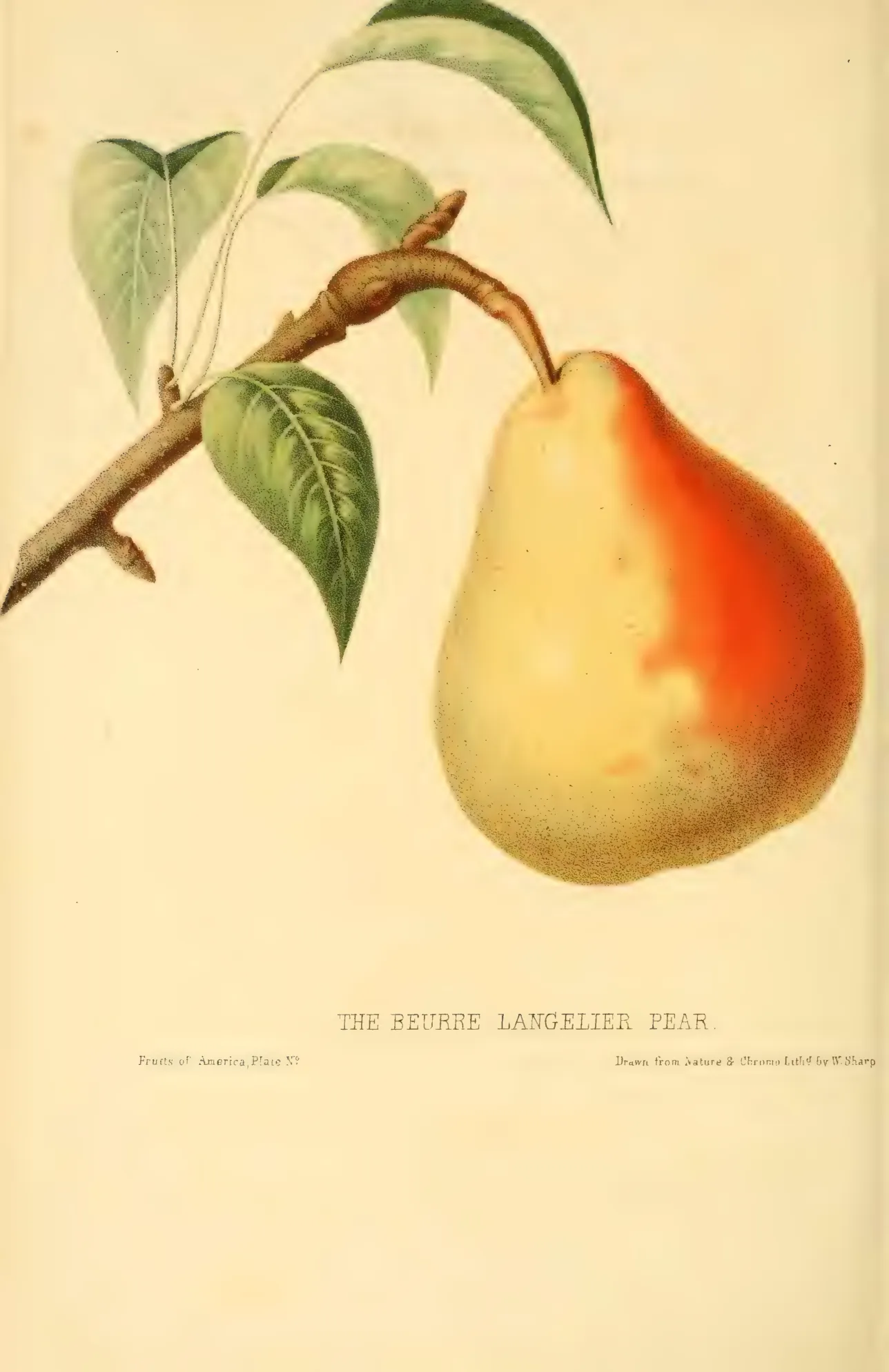
Beurré Langelier
Origin / History
Beurré Langelier was raised by M. (René) Langelier of Jersey, British Channel Islands, about 1840. Hovey states it was first introduced to the notice of cultivators by M. Langelier of Jersey, who is presumed to have raised it from seeds, "though it may have been produced by some of the French or Belgian pomologists, and placed in his hands for sale." M. Langelier issued a circular in 1844, when he first offered the trees for sale, in which he "begs leave to draw the attention of pear growers to his new pear, of first rate merit; perfectly melting, ripe in January, of fine Beurre shape, larger than Napoleon, bears well as a standard, trees very vigorous, and one of the best in cultivation." Hovey ranks it among the best, if not the finest, of its season, alongside such late winter varieties as the Winter Nelis, Glout Morceau, Beurre d'Aremberg, Passe Colmar, Easter Beurre, Lawrence, and Lewis.
Tree
Very vigorous, upright, with slightly diverging branches, making a regular and symmetrical head. Productive. Annual shoots of moderate length, straight and strong. Succeeds well both on the quince and pear stock. Does not come into bearing very early; Hovey, after fruiting it on young trees for three years (and those unfavorable ones to the pear), states it promises to be an abundant bearer. The fruit adheres firmly until late in the season.
Wood. Dark glossy brown (Hovey), or dull yellow brown (Downing, referring to young wood), distinctly dotted with large, round, grayish specks, stout and rather short-jointed; old wood dull brown, with conspicuous horizontal specks.
Buds. Medium size, roundish ovate, erect, with moderately large shoulders. Flower-buds good size, obovate, and slightly woolly.
Leaves. Medium size, roundish ovate, smooth, thick, dark glossy green (large and glossy), largest about the middle, narrowing to each end, little wavy and recurved on the midrib, very indistinctly and obtusely serrated, with prominent nerves; petioles long, nearly two inches, and moderately stout.
Flowers. Small; petals roundish, cupped.
Fruit
Size. Large — about three to three and a half inches long, and two and a half to three inches in diameter (Desportes: three inches high by two and a half broad; Hovey: about three and a half inches long and three inches in diameter). Downing and Hedrick describe the fruit as medium.
Form. Obovate pyriform / obtuse-pyriform / obtuse pyramidal, somewhat Bon Chretien shaped (Hovey), slightly contracted in the upper part or about the middle, and ending or terminating obtusely at the stem.
Stem. Medium length, about one inch or more long, rather slender. Inserted without much depression, generally upright but occasionally on one side (Desportes); obliquely inserted in a small, shallow, contracted cavity (Hovey); angularly inserted, without depression (Elliott); short and fleshy, inserted often by a lip without depression (Downing).
Cavity. Small, shallow, contracted (Hovey); little or no depression at the insertion of the stem.
Calyx / Eye. Medium size, small, closed or partially open (Hovey: small, closed; Downing: open or partially closed, segments persistent); segments of the calyx short.
Basin. Small, shallow, and somewhat irregular or open; furrowed/plaited (Hovey: small furrowed basin; Desportes: coarsely plaited cavity; Elliott: shallow, plaited; Downing: somewhat irregular, shallow, and open).
Skin. Fair, smooth, clear light green, becoming pale lemon yellow (or pale greenish-yellow) when mature, with a broad tinge of pale blush, dull blush, or crimson cheek on the sunny side, dotted with numerous small grey/russet specks, and (per Downing) blotched with russet.
Flesh. Yellowish white (Hedrick: white), fine, fine-grained, buttery, tender, melting, and very juicy; somewhat granular (Downing).
Flavor. Sprightly, sub-acid, rich, vinous, and delicious, with a fine aroma / a little perfume. Hovey: "rich, vinous and delicious, with a fine aroma." Desportes: "sprightly, sub-acid, rich, excellent, with a little perfume." Downing: "very brisk, rich, vinous." Elliott: "sub-acid, slight perfume." Hedrick: "rich and vinous." Quality rated "very good" to "best."
Core. Medium size.
Seeds. Medium size (Hovey); long, ovate pyriform (Elliott).
Season
A winter pear. Ripe from December to January (Desportes, Hedrick); November to January (Downing, Elliott); December to February (Hovey). Keeps well; the fruit adheres firmly to the tree until late in the season.
Uses
Dessert pear of the highest rank; a capital winter variety.
Subtypes / Variants
Not described in source.
Other
Not described in source.
Book Sources
Described in 5 period pomological works
- The Horticulturist (1855) — listed as Beurre Langlier
- Downing, Fruits and Fruit Trees of America (1900)
- Elliott, The Western Fruit Book (1865)
- Hedrick, The Pears of New York (1921)
- Hovey, The Fruits of America (1852) — listed as THE BEURRE LANGELIER PEAR
Nursery Catalog Sources
Found in 1 catalog (1864) from Oregon
- St. Helena Nursery , Howell's Prairie, Marion County , Oregon — 1864 — listed as Beurre d'Angelier
View original book sources (5)
— B. Desportes, The Horticulturist (1856)Beurre Langlier. — Size — large, three inches high by two and a half broad. Form — obovate pyriform, contracted in the upper part, and terminating obtusely at the stem. Stem — one inch or more in length, inserted without much depression, generally upright, but occasionally on one side. Calyx — medium size, sunk in coarsely plaited cavity. Color — handsome light green, assuming at maturity a pale yellow, with a dull blush or red cheek on the sunny side, and covered with numerous grey russet dots. Flesh — yellowish white, melting, juicy and fine grained. Flavor — sprightly, sub-acid, rich, excellent, with a little perfume. Season — December to January. Quality — "very good" to "best."
The tree is of a very strong vigorous habit, and succeeds well both on the quince and pear stock. The fruit adheres firmly until late in the season, keeps well, and promises to sustain its high reputation as a capital winter variety.
— A.J. Downing, The Fruits and Fruit Trees of America (1900)Beurre Langelier.
Langelier's Beurre.
Raised by M. Langelier of Jersey. Tree vigorous, productive. Young wood dull yellow brown.
Fruit medium, obovate obtuse pyriform. Skin pale yellow, slightly shaded with crimson and blotched with russet, and covered with russet dots. Stalk short and fleshy, inserted often by a lip without depression. Calyx open or partially closed. Segments persistent. Basin somewhat irregular, shallow, and open. Flesh white, juicy, melting, somewhat granular, with a very brisk, rich, vinous flavor. Very good. November to January.
— U.P. Hedrick, The Pears of New York (1921)Beurré Langelier.
i. Hogg Fruit Man. 523. 1884.
Raised by René Langelier, Jersey, British Channel Islands, about 1840. Fruit medium, obtuse-pyriform, pale greenish-yellow, crimson blush on the side next the sun, covered with russet dots; flesh tender, buttery and melting, with rich and vinous flavor; excellent; Dec. and Jan.
— C.M. Hovey, The Fruits of America (1852)THE BEURRE LANGELIER PEAR.
Beurré Langelier. Magazine of Horticulture, vol. xii. p. 336.
Notwithstanding the great number of new pears which have been brought to notice the last twenty years, there is still only a limited number of late winter varieties of really first rate excellence. The Winter Nelis, Glout Morceau, Beurre d'Aremberg, Passe Colmar and Easter Beurre, among foreign kinds, and the Lawrence and Lewis, among our American seedlings, comprise almost the entire list. It is gratifying, therefore, to every pomologist, to record the accession of such a superior fruit as the Beurre Langelier, which must be classed among the best, if not the finest, of its season. It has all the characteristics of a fine pear. Of large size, handsome form, beautiful appearance, delicious flavor, ripening freely and keeping well, it at once claims the highest rank ; and if we add to these qualities a vigorous and healthy growing tree, of unexceptionable habit and large glossy foliage, a correct idea may be obtained of its excellence.
The Beurre Langelier was first introduced to the notice of cultivators by M. Langelier, of Jersey, who, we presume, raised it from seeds, though it may have been produced by some of the French or Belgian pomologists, and placed in his hands for sale. M. Langelier, in a circular issued in 1844, when he first offered the trees for sale, "begs leave to draw the attention of pear growers to his new pear, of first rate merit; perfectly melting, ripe in January, of fine Beurre shape, larger than Napoleon, bears well as a standard, trees very vigorous, and one of the best in cultivation." To say it has proved all this is doing no more than justice to M. Langelier.
The Beurre Langelier grows freely both upon the pear and quince stock ; it does not come into bearing very early, and it has not yet fruited sufficiently to test its qualities for productiveness. But, so far as we can form an opinion, after fruiting it on young trees for three years, and those unfavorable ones to the pear, it promises to be an abundant bearer.
Tree. — Very vigorous, upright, with slightly diverging branches, making a regular and symmetrical head ; annual shoots of moderate length, straight and strong.
Wood. — Dark glossy brown, distinctly dotted with large, round, grayish specks, stout and rather short-jointed ; old wood, dull brown, with conspicuous horizontal specks; buds, medium size, roundish ovate, erect, with moderately large shoulders : Flower-buds, good size, obovate, and slightly woolly.
Leaves. — Medium size, roundish ovate, smooth, thick, dark glossy green, largest about the middle, narrowing to each end, little wavy and recurved on the midrib, very indistinctly and obtusely serrated, with prominent nerves ; petioles, long, nearly two inches, and moderately stout.
Flowers. — Small; petals, roundish, cupped.
Fruit. — Large, about three and a half inches long, and three inches in diameter : Form, obtuse pyramidal, somewhat Bon Chretien shaped, slightly contracted about the middle, and ending obtusely at the stem : Skin, fair, smooth, clear light green, becoming pale lemon yellow when mature, with a broad tinge of pale blush on the sunny side, and dotted with numerous small russet specks : Stem, medium length, about one inch long, rather slender, and obliquely inserted in a small, shallow, contracted cavity : Eye, small, closed, and rather abruptly sunk in a small furrowed basin ; segments of the calyx short : Flesh, yellowish white, fine, buttery, melting and very juicy : Flavor, rich, vinous and delicious, with a fine aroma : Core, medium size : Seeds, medium size.
Ripe from December to February.
— F.R. Elliott, The Western Fruit Book (1865)Beurre Langelier.
A foreign pear, newly introduced ; it has fruited but few times in this country, but may safely be placed as "best."
Fruit, large, obovate pyriform, contracted toward, and terminating obtusely at, stem ; color, light green, becoming, at maturity, pale yellow, with a dull red cheek in sun, and numerous gray russet dots; stem, one inch, or more, long, angularly inserted, without depression ; calyx, medium ; basin, shallow, plaited : core, medium ; seeds, long, ovate pyriform : flesh, yellowish white, melting, juicy, fine-grained, sub-acid, slight perfume. November to January.