Napoleon
Pear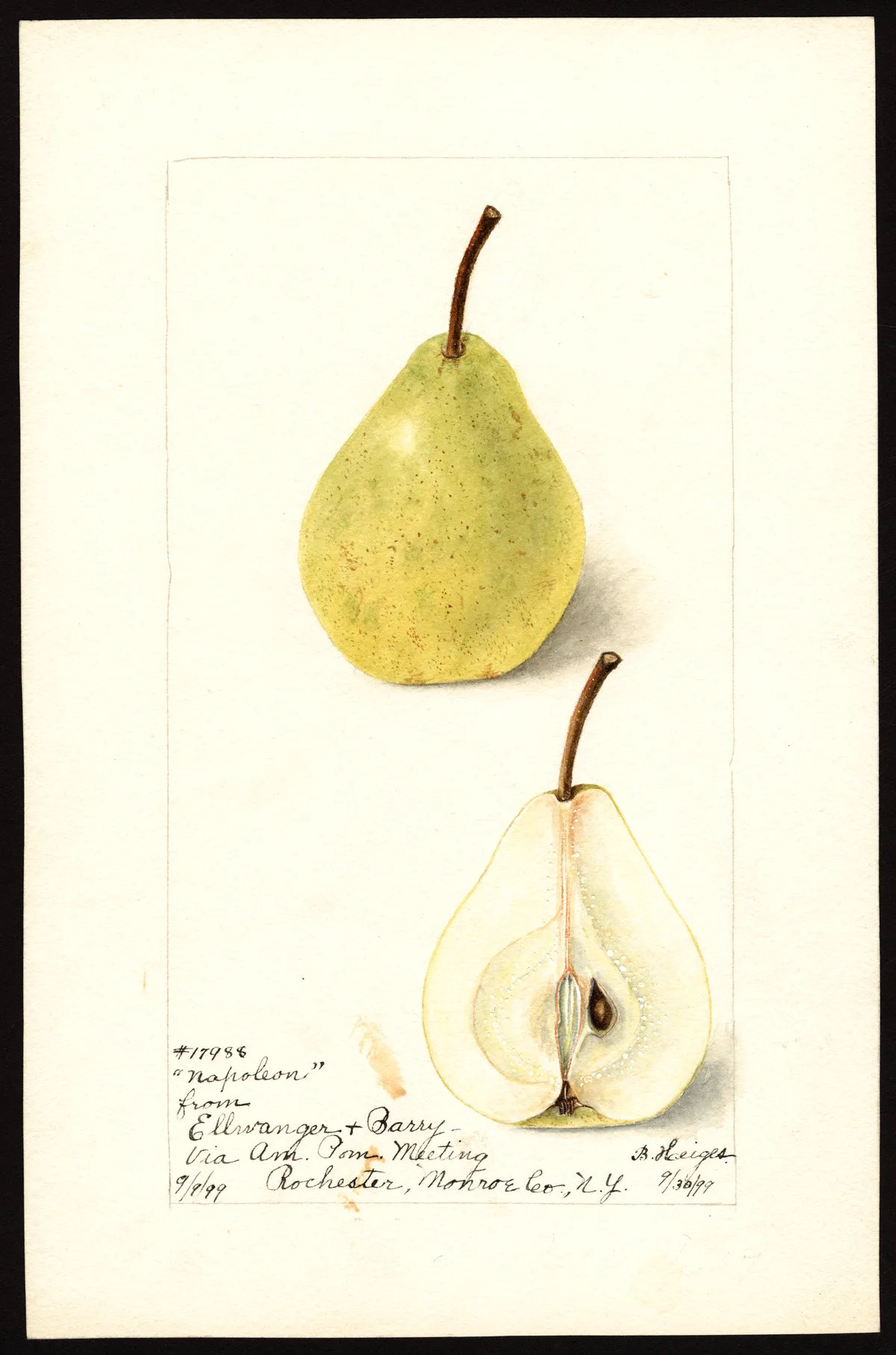
USDA Pomological Watercolor Collection
Napoleon
Origin / History
Raised from seed in 1808 by M. Liard, gardener at Mons, Belgium. Bunyard spells the name Liart. He adds that the tree was purchased by l'Abbe Duquesne for 33 francs and named Napoleon by him. Bunyard says its numerous other names, among them Roi de Rome, Gloire de l'Empereur and Captif de St. Helene, "tell their story of Imperial ambitions and their result." Elliott lists it simply as foreign. Budd and Hansen record it as grown in the southeastern States. Bunyard calls it "a valuable fruit"; Hedrick calls it "a valuable dessert pear."
Tree
Hardy, thrifty, and a vigorous grower. Shoots upright, olive-colored; Thomas calls them rather erect. Bunyard alone calls the growth moderate.
Very productive. Downing says it bears abundant crops even while very young. Bunyard calls the fertility good.
Leaf rather large, little upfolded, down-curved, turning orange-red and falling early (Bunyard).
Best on warm, light soils (Thomas). Elliott finds the fruit largest and finest on Quince. Bunyard calls the tree "hardly strong enough on Quince for most soils."
Fruit
Size: Medium to large, mostly given as large or pretty large. Thomas gives medium or rather large. Bunyard gives 3 by 3¼.
Form: Obtuse-pyriform, variable in shape, swelled toward the base (Hedrick). Thomas calls it conic-pyriform, obtuse. Elliott gives obtuse to obovate and rounded pyriform.
Stem: Pretty stout to stout, varying in length from one-half inch to an inch. Elliott calls it varying, usually stout. Bunyard calls it short and stout.
Cavity: Stalk set in a slight depression or slightly sunk, or under a swollen lip; Budd and Hansen describe the lip as raised on one side. Bunyard alone gives a rather deep and irregular cavity.
Calyx: Medium and open (Elliott). Bunyard calls the eye closed.
Basin: Of moderate depth (Downing), rather large (Thomas). Bunyard gives a very deep, narrow basin.
Skin: Thin (Hedrick) and smooth. Clear or bright green at first, becoming pale yellowish green or greenish yellow at maturity. Russet patches around the eye and stem (Bunyard). Seldom blushed (Hedrick).
Dots: Numerous, russet (Bunyard) or brown (Hedrick).
Flesh and flavor: Flesh white, fine-grained, tender and melting. Bunyard calls it a little gritty; Hedrick calls it rather granular. Very juicy: "uncommonly juicy" (Thomas), "extraordinarily juicy" (Bunyard).
Flavor sweet, sprightly, refreshing and brisk. Hedrick calls it very saccharine and aromatic; Thomas calls it moderately rich. Downing finds it astringent only in poor soils or unfavorable exposures. Thomas calls it "often astringent and worthless."
Quality "good" by most authors; Hedrick rates it "first."
Core and seeds: Not described in source.
Season
The recorded season runs from September into winter. Most authors give mid-autumn, from October or about mid-October into November or December, or "till winter." Downing alone gives September. Thomas says it needs ripening in a warm room.
Uses
Dessert pear. Elliott calls it "valuable as a market sort on Quince."
Subtypes / Variants
Elliott reports River's opinion that the Napoleon d'Hiver "is not sufficiently distinct to be retained."
Other
Bunyard notes a different pear named Napoleon III, "equally distinct as were the two Emperors."
Book Sources
Described in 6 period pomological works
Nursery Catalog Sources
Found in 8 catalogs (1845–1911) from England, Massachusetts
- Winship's Nursery (Brighton Nurseries , operated by the Winship family), Brighton (Boston) , Massachusetts — 1845
- Hovey & Co. , Cambridge , Massachusetts — 1849 — listed as Captif St. Helene
- Hovey & Co. , Cambridge , Massachusetts — 1849
- Hovey & Co. , Cambridge , Massachusetts — 1849 — listed as Napoleon d'Hiver
- Joseph Breck & Co. , Boston , Massachusetts — 1855
- St. Helena Nursery , Howell Prairie, Marion County, OR (Marion Co., Ogn.) — 1864
- Central Experimental Farm , Dominion Department of Agriculture, Agassiz, British Columbia (under test; Bulletin No. 3, Second Series) — 1900
- James Veitch & Sons , Ltd., Royal Exotic Nursery, Chelsea, London (also Coombe Wood, Langley, and Feltham) , England — 1911
View original book sources (6)
— F.R. Elliott, The Western Fruit Book (1865)Napoleon.
Médaille, | Roi de Rome.
Foreign. Tree, vigorous, upright grower, olive-colored shoots, fruit largest and finest on Quince, very productive. Fruit, large, obtuse to obovate, and rounded pyriform ; greenish yellow, smooth ; stem, varying, usually stout ; calyx, medium, open ; flesh, white, tender, juicy ; "good." Valuable as a market sort on Quince. River says the Napoleon d'Hiver is not sufficiently distinct to be retained. October.
— A.J. Downing, The Fruits and Fruit Trees of America (1900)Napoleon.
Medaille. Melon. Sucree Doree. Beurre d'Autien. Poire Liard. Liart. Roi de Rome, erroneously. Mabille. Bonaparte. Mailanderin Grosse Grune. Belle Canaise Napoleon d'Hiver. Charles. Bois Napoleon. Poire Napoleon. Napoleon Vrai. Gloire de l'Empereur. Bon Chretien Dore'. Captif de Sainte Helene.
The Napoleon is hardy, thrifty, and bears abundant crops, even while very young. In poor soils, or unfavorable exposures only, it is astringent. The tree is thrifty, and a vigorous grower. Shoots upright, olive colored. It was raised from seed, in 1808, by M. Liard, gardener at Mons.
Fruit pretty large, obtuse pyriform, clear green at first, but becoming pale yellowish green at maturity. Stalk varying from half an inch to an inch long, pretty stout, set in a slight depression or under a swollen lip. Calyx set in a basin of moderate depth. Flesh white, melting, juicy, sweet, sprightly. Good. September.
— John J. Thomas, The American Fruit Culturist (1903)Napoleon. Medium or rather large; conic-pyriform, obtuse, variable; green becoming pale yellowish-green; stalk an inch long, stout, slightly sunk; basin rather large; flesh uncommonly juicy, melting, moderately rich, good, often astringent and worthless. From mid-autumn till winter. Needs ripening in a warm room. Very productive, thrifty, hardy. Shoots rather erect. Belgian. Best on warm, light soils.
— J.L. Budd & N.E. Hansen, American Horticultural Manual, Part II: Systematic Pomology (1914)Napoleon.—Medium to large, conic pyriform, obtuse, but variable in shape; color yellowish green when mature; stalk one-half to one inch long, inserted in slight cavity, with raised lip on one side. Flesh white, melting, juicy, sweet, refreshing, good. Grown in southeastern States. Belgium.
— E.A. Bunyard, A Handbook of Hardy Fruits (1920)NAPOLEON. Her. Pom., II., 38. (Medaille, Liart, etc.) Dessert, October to November, large 3 by 3¼, pyriform. Skin, smooth. Colour, yellowish-green with numerous russet dots and russet patches around eye and stem. Flesh, white, fine grained, a little gritty, extraordinarily juicy, sweet, and briskly flavoured. Eye, closed in a very deep narrow basin. Stem, short and stout in a rather deep and irregular cavity. Growth, moderate; fertility good. Leaf, rather large, little upfolded, down curved, turns orange red, falls early. Origin, raised by M. Liart, a gardener at Mons, in 1808. The tree was purchased by l'Abbe Duquesne for 33 francs, and by him named Napoleon. There is a pear also named Napoleon III., equally distinct as were the two Emperors. Its numerous synonyms, such as Roi de Rome, Gloire de l'Empereur and Captif de St. Helene, tell their story of Imperial ambitions and their result. A valuable fruit, hardly strong enough on Quince for most soils.
— U.P. Hedrick, The Pears of New York (1921)Napoleon.
- Downing Fr. Trees Am. 819. 1869. 2. Bunyard Handb. Hardy Fr. 189. 1920. Napoleon I. 3. Leroy Diet. Pom. 2:453, fig. 1869. Napoleon Butterbirne. 4. Mathieu Nom. Pom. 257. 1889.
Napoleon was raised in 1808 by M. Liard, a gardener at Mons, Bel. Fruit large, obtuse-pyriform, swelled toward the base; skin thin, smooth, bright green changing to greenish-yellow, covered with numerous brown dots, seldom blushed; flesh white and fine, tender, melting, rather granular, very juicy, with a very saccharine, refreshing and aromatic flavor; first, a valuable dessert pear; mid-Oct. or nearly Nov. to Dec.