Beurré Superfin
Pear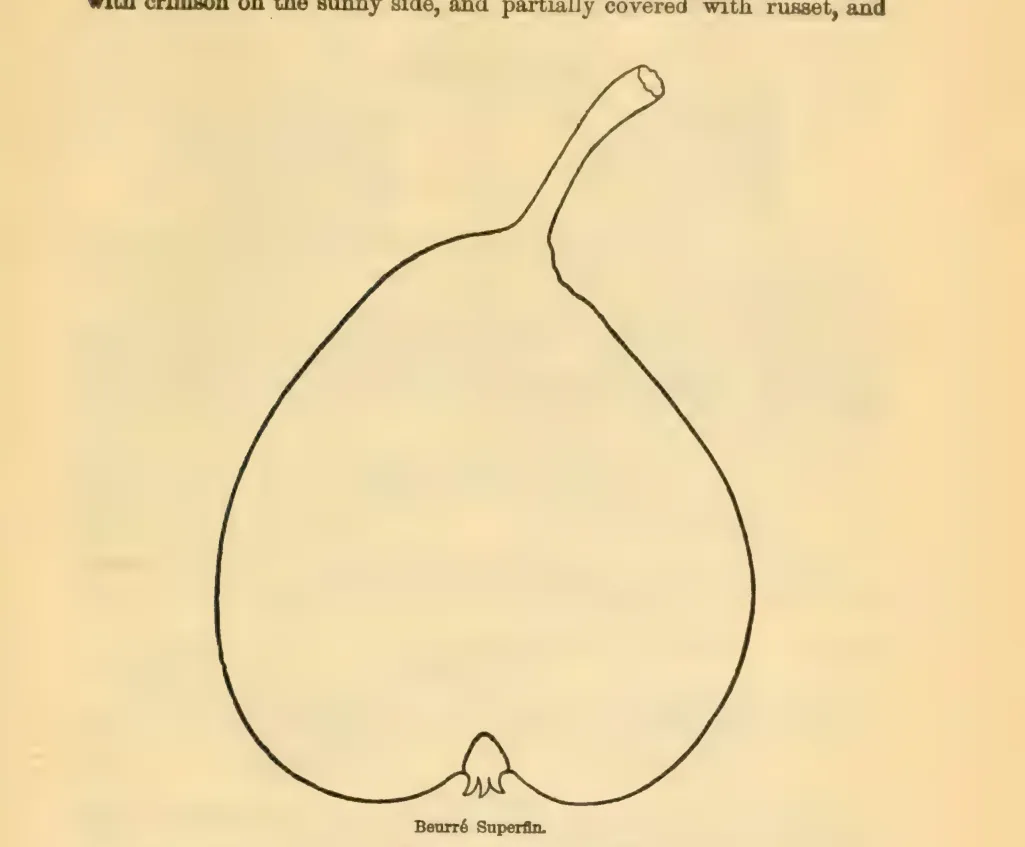
Beurré Superfin
Origin / History
Raised at Angers, France, by M. Goubault, "a well-known pomologist" (Hedrick), from a bed of pear seeds. Bunyard places the raising at Mille Pieds, near Angers, and spells the raiser's name Goubalt. Downing and Hedrick date the origin to 1837; the Herefordshire Pomona says the seed was sown about the year 1830. The parent tree first bore fruit in 1844. That year the Committee of the Horticultural Society of Maine-et-Loire was requested to report on its merits, and M. Millet, president of the society, named it Beurré Superfin (Hedrick). Desportes records that it "received a special premium at Angers, in France, for its excellence." Elliott lists it as "foreign." Introduced in America about 1850. Placed on the fruit catalog-list of the American Pomological Society in 1858 (Hedrick).
The Herefordshire Pomona calls it "this excellent pear," and Downing calls it "this really good Pear." Bunyard ranks it "one of the best half-dozen pears, by some preferred to Doyenne du Comice." George Bunyard & Co. call it "one of the best pears," and Veitch calls it "a great favourite on account of its superior quality." Hedrick writes that "few other sorts so admirably supplies those who want choicely good fruits." He calls it a valuable variety for home orchards, "especially in New York where it grows exceptionally well." He adds that the pear-growers of a generation earlier in America recommended it as one of the good sorts to work on the quince. Budd and Hansen say it is much grown on the quince as a dwarf in several States.
Tree
Large, upright-spreading, dense-topped, hardy. Healthy, "even as regards blight" (Hedrick); Downing calls it very healthy. Vigorous (Herefordshire Pomona, Hedrick) to moderately vigorous, with Downing and Bunyard giving moderate growth.
Trunk stocky and rough; Hedrick's Cyclopedia calls it "unusually stocky, roughish." Branches thick, rough and shaggy, zigzag, dull brownish red, overspread with gray scarf-skin, and sprinkled with numerous elongated lenticels. Branchlets slender, light brown, glossy, smooth, glabrous, with small, raised, inconspicuous lenticels (Hedrick). Young shoots slender, light yellow-brown (Downing).
Leaf-buds small, short, conical, pointed, plump, appressed or free; leaf-scars prominent. Flower-buds conical, pointed, plump, free, borne singly on short branches and short spurs (Hedrick).
Leaves 3½ in. long, 1½ in. wide (1¾ in. in Hedrick's Cyclopedia), stiff. Apex abruptly pointed; margin tipped with small glands, coarsely serrate; petiole 1½ in. long (Hedrick). Bunyard gives the leaf as oval, pale green, held nearly flat, a little twisted, irregularly crenate.
Not an early bearer, but a good bearer at full age and regular once bearing begins. Productive to very productive and prolific; Bunyard alone gives fertility as moderate to good. Elliott found it "with some very fine, others unproductive."
Easily suited as to soils (Hedrick). Succeeds as a standard on the pear stock or as a pyramid on the quince (Herefordshire Pomona). Elliott and Bunyard both say it does well on the quince. In Europe it is commonly and successfully grown as a dwarf (Hedrick). Suitable for walled and open gardens, and "fine for walls" (George Bunyard & Co.).
Fruit
Size: Medium to large; Budd and Hansen give medium to quite large, and George Bunyard & Co. "large, medium." Above medium size, 3 in. wide and a little more high (Herefordshire Pomona). Hedrick measures it at 3½ in. long and 2½ in. wide; his Cyclopedia gives 3¼ in. long and 2⅞ in. wide. Desportes writes that the fruit "is represented as very large," but with him it attained no larger size than the Louise Bonne d'Jersey.
Form: Roundish obovate, obovate or turbinate, roundish pyriform, or round-conical, tapering to the stem, with a narrow neck (Budd and Hansen). Hedrick calls it roundish-oblate, with a short, thick, rounded neck, and symmetrical. The Herefordshire Pomona calls the surface somewhat uneven or bossed, and Bunyard a little uneven.
Stem: Stout to very thick, and fleshy at the base. It is joined to the fruit by fleshy folds or a fleshy enlargement, "always with some fleshy wrinkles at base" (Bunyard). Over an inch long (Herefordshire Pomona), 1½ in. long and curved (Hedrick), and rather long (Downing); Bunyard alone calls it short.
Cavity: Very shallow and narrow or lacking, the stem inserted without depression. The flesh tapers into the stem or is wrinkled in a fleshy fold about its base, often lipped (Hedrick).
Calyx: Small to very small. Closed, with stiff, incurved, toothlike segments (Herefordshire Pomona); partially closed (Downing); closed or a little open (Bunyard). Hedrick calls it open, the lobes separated at the base and broad, with "narrow" added in The Pears of New York. Calyx-tube short, wide, conical (Hedrick).
Basin: Deep, round, and uneven (Herefordshire Pomona; Bunyard, deep and round). Downing calls it abrupt and small. Hedrick calls it narrow, obtuse, gently furrowed, and symmetrical.
Skin: Thin and tender. Hedrick calls it very granular and smooth; Bunyard calls it a little rough. Ground color greenish yellow, becoming more yellow at maturity; dull pale green (Desportes) to yellow, dull yellow (Hedrick's Cyclopedia), or golden yellow (George Bunyard & Co.). Partially to considerably covered with traces, veins, and patches of fine, light, cinnamon russet, netted and streaked. Dull brown or brownish cheek, by Hedrick often a slight brownish-russet cheek; Downing alone gives it slightly shaded with crimson on the sunny side. Hedrick finds the pears "not as attractive in appearance as might be wished," which his Cyclopedia shortens to "not attractive." Veitch calls the fruit "handsome."
Dots: Numerous, small, russet, conspicuous (Hedrick). Downing gives the skin as thickly sprinkled with minute dots.
Flesh and flavor: Yellowish white, pale yellow, or tinged with yellow; George Bunyard & Co. call it white. Fine-grained (Herefordshire Pomona) or granular (Hedrick). Juicy to very juicy, Downing saying "exceedingly juicy"; buttery; melting to very melting. Sweet, with a brisk, rich, vinous flavor; Downing gives "brisk vinous or subacid," and Budd and Hansen a "rich pleasant flavor." Perfumed and aromatic: a "slight aroma" (Desportes), "a delicate perfume," "pleasant perfume," "deliciously perfumed." Hedrick finds the pears "hardly surpassed in flavor in their season." Veitch and George Bunyard & Co. call the flavor excellent. Quality "very good," with Downing extending it to "very good to best" and Budd and Hansen rating it "good to very good."
Core and seeds: Core large, closed, with clasping core-lines. Seeds large, wide, long, plump, acute (Hedrick).
Season
The recorded season runs from the middle of September (Desportes) into November (Veitch). Most authors give October, Downing "ripe all of October." Desportes and the Herefordshire Pomona close the season at the beginning of October, while Elliott places it at the middle to last of October.
Should be gathered before it parts readily and carefully watched in the fruit room. It should be eaten while the skin still seems fairly firm, as it begins to ripen at the core (Bunyard).
Uses
A dessert pear; the Herefordshire Pomona calls it "a very fine dessert pear." Tender in skin and delicate in flesh, its product is not for the markets (Hedrick).
Subtypes / Variants
Not described in source.
Other
Hedrick's references begin with the Magazine of Horticulture (1854) and the Horticulturist (1855). They continue through Downing's Fruits and Fruit Trees of America (1857), the American Pomological Society report of 1858, Leroy's Dictionnaire de Pomologie (1867, figured), and Hogg's Fruit Manual (1884), together with the German pomologies of Lauche (1883, plate 59) and Gaucher (1894, plate 60). Bunyard cites the Herefordshire Pomona, vol. II, p. 22.
Book Sources
Described in 8 period pomological works
- Bunyard, A Handbook of Hardy Fruits (1920)
- Downing, Fruits and Fruit Trees of America (1900)
- Hedrick, The Pears of New York (1921)
- Budd & Hansen, Systematic Pomology (1914) — listed as Superfin
- Hedrick, Cyclopedia of Hardy Fruits (1922)
- The Herefordshire Pomona (1876–1885)
- The Horticulturist (1855)
- Elliott, The Western Fruit Book (1865) — listed as Beurre Superfine
Nursery Catalog Sources
Found in 24 catalogs (1849–1917) from Arkansas, California, England, Massachusetts, Oregon, Washington
- Hovey & Co. , Cambridge , Massachusetts — 1849 — listed as Beurré Superfine
- Felix Gillet , Barren Hill Nursery, Nevada City , California — 1884
- Felix Gillet , Barren Hill Nursery, Nevada City , California — 1888
- Felix Gillet , Barren Hill Nursery, Nevada City , California — 1889
- Felix Gillet , Barren Hill Nursery, Nevada City , California — 1890
- Felix Gillet , Barren Hill Nursery, Nevada City , California — 1891
- Woodburn Nurseries , Woodburn, Marion Co. , Oregon — 1894
- Felix Gillet , Barren Hill Nursery, Nevada City , California — 1895
- Felix Gillet , Barren Hill Nursery, Nevada City , California — 1897
- Kelway & Son , Langport, Somerset , England — 1897
- George Bunyard & Co. , Royal Nurseries, Maidstone, Kent , England — 1900
- Central Experimental Farm , Dominion Department of Agriculture, Agassiz, British Columbia (under test; Bulletin No. 3, Second Series) — 1900
- Yarbrough Bros. , Stephens , Arkansas — 1901
- Island Nurseries & Fruit Farm , Vashon (Vashon Island) , Washington — 1910 — listed as Superfin
- James Veitch & Sons , Ltd., Royal Exotic Nursery, Chelsea, London (also Coombe Wood, Langley, and Feltham) , England — 1911
- Island Nurseries & Fruit Farm , Vashon (Vashon Island) , Washington — 1911 — listed as Superfin
- Ballygreen Nurseries , Hanford , Washington — 1912 — listed as Superfin
- Thomas Rivers & Son , Sawbridgeworth, Hertfordshire , England — 1913
- George Bunyard & Co. , Royal Nurseries, Maidstone, Kent , England — 1914
- Island Nurseries & Fruit Farm , Vashon (Vashon Island) , Washington — 1914 — listed as Superfin
- Island Nurseries & Fruit Farm , Vashon (Vashon Island) , Washington — 1915 — listed as Superfin
- Island Nurseries & Fruit Farm , Vashon (Vashon Island) , Washington — 1916 — listed as Superfin
- George Bunyard & Co. , Royal Nurseries, Maidstone, Kent , England — 1917
- Island Nurseries & Fruit Farm , Vashon (Vashon Island) , Washington — 1917 — listed as Superfin
View original book sources (10)
— B. Desportes, The Horticulturist (1856)Beurre Superfin. — This variety received a special premium at Angers, in France, for its excellence. The fruit is represented as very large, but with me it has not attained a larger size than the Louise Bonne d'Jersey. Color, dull pale green, with traces and patches of russet, and dull brown cheek. Flesh, juicy, melting, and with slight aroma. Ripens from the middle of September to the first of October.
— F.R. Elliott, The Western Fruit Book (1865)Beurre Superfine.
Foreign; with some very fine, others unproductive. Fruit, large, pale green, traces, and patches of russet, dull brownish cheek; flesh, juicy, melting, slight aroma; "very good." Succeeds on Quince. Middle to last October.
— Woolhope Naturalists Field Club, The Herefordshire Pomona (1885)
- BEURRÉ SUPERFIN.
This excellent pear was raised at Angers, by M. Goubault, from seed sown about the year 1830, and it first bore fruit in 1844.
Description.—Fruit: above medium size, three inches wide, and a little more high; obovate, or turbinate, somewhat uneven or bossed on its surface. Skin: thin, considerably covered with patches of cinnamon covered russet; on the shaded side the ground colour is greenish yellow, which becomes more yellow at maturity, covered with small patches or veins of russet. Eye: very small and closed, with stiff, incurved, toothlike segments, and set in a deep, round and uneven basin. Stalk: over an inch long, fleshy at the base, and united to the fruit by fleshy folds. Flesh: yellowish white, fine grained, buttery and melting, very juicy, brisk and sweet, with a delicate perfume.
A very fine dessert pear, in season in the end of September and beginning of October.
The tree is a vigorous grower, hardy and prolific. It succeeds well as a standard on the pear stock, or as a pyramid on the Quince stock.
— A.J. Downing, The Fruits and Fruit Trees of America (1900)Beurre Superfin.
This really good Pear originated in France, in 1837. The tree is very healthy, hardy, and moderately vigorous, not an early, but a good bearer when at full age. Young shoots slender, light yellow brown.
Fruit medium, roundish pyriform. Skin yellow, slightly shaded with crimson on the sunny side, and partially covered with russet, and thickly sprinkled with minute dots. Stalk stout, rather long, inserted without depression by a fleshy enlargement. Calyx partially closed, in an abrupt, small basin. Flesh exceedingly juicy, buttery, melting, with a brisk vinous or subacid flavor. Very good to best. Ripe all of October.
— J.L. Budd & N.E. Hansen, American Horticultural Manual, Part II: Systematic Pomology (1914)Superfin. — Medium to quite large, roundish obovate, with narrow neck tapering to the stem; color greenish yellow, with considerable russet and brown cheek. Flesh juicy, melting, with rich pleasant flavor, good to very good. Much grown on the quince as a dwarf in several States. France.
— E.A. Bunyard, A Handbook of Hardy Fruits (1920)BEURRE SUPERFIN. Her. Pom. II., 22. Dessert, October, medium, round conical, tapering to stem, a little uneven on surface. Skin, a little rough. Colour, yellow with many patches of fine russet. Flesh, pale yellow, very melting, sweet and deliciously perfumed. Eye, small, closed, or a little open, in a deep round basin. Stem, short, very stout and fleshy, always with some fleshy wrinkles at base. Growth, moderate; fertility, moderate to good. Leaf, oval, pale green, held nearly flat, a little twisted, irregularly crenate. Origin, raised by M. Goubalt at Mille Pieds, near Angers, France. First fruited in 1844. One of the best half-dozen pears, by some preferred to Doyenne du Comice. Does well on quince. Should be gathered before it parts readily and carefully watched in the fruit room. Requires to be eaten when the skin seems fairly firm as it begins to ripen at the core.
— U.P. Hedrick, The Pears of New York (1921)BEURRÉ SUPERFIN
- Mag. Hort. 20:8, 135. 1854. 2. Horticulturist N. S. 5:88. 1855. 3. Downing Fr. Trees Am. 465. 1857. 4. Am. Pom. Soc. Rpt. 231. 1858. 5. Leroy Dict. Pom. 1:432, fig. 1867. 6. Hogg Fruit Man. 529. 1884.
Hochfeine Butterbirne. 7. Lauche Deut. Pom. II: No. 59, Pl. 59. 1883. 8. Gaucher Pom. Prak. Obst. No. 47, Pl. 60. 1894.
Superfin. 9. Am. Pom. Soc. Cat. 40. 1883.
Tender in skin and delicate in flesh, the product of this variety is not for the markets, but that of few other sorts so admirably supplies those who want choicely good fruits. The pears are not as attractive in appearance as might be wished, but are hardly surpassed in flavor in their season. The flesh is notable for juiciness, rich vinous flavor, and pleasant perfume. The trees are large, healthy even as regards blight, very productive, and are easily suited as to soils. The trees do not bear early, but are regular in bearing after this life event begins. In Europe, the variety is commonly and successfully grown as a dwarf, and the pear-growers of a generation ago in America recommend this variety as one of the good sorts to work on the quince. The variety is a valuable one for home orchards, especially in New York where it grows exceptionally well.
Beurré Superfin was raised from a bed of pear seeds made at Angers, France, by M. Goubault, a well-known pomologist, in 1837. The parent tree so produced bore fruit in 1844 and the Committee of the Horticultural Society of Maine-et-Loire was requested to report on its merits, which it did in that year, and M. Millet, president of the society, named it Beurré Superfin. It was introduced in America about 1850. The variety was placed on the fruit catalog-list of the American Pomological Society in 1858.
Tree large, vigorous, upright-spreading, dense-topped, hardy, very productive; trunk stocky, rough; branches thick, rough and shaggy, zigzag, dull brownish-red, overspread with gray scarf-skin, sprinkled with numerous elongated lenticels; branchlets slender, light brown, glossy, smooth, glabrous, with small, raised, inconspicuous lenticels.
Leaf-buds small, short, conical, pointed, plump, appressed or free; leaf-scars prominent. Leaves 3½ in. long, 1½ in. wide, stiff; apex abruptly pointed; margin tipped with small glands, coarsely serrate; petiole 1½ in. long. Flower-buds conical, pointed, plump, free, singly on short branches and short spurs.
Fruit matures in October; large, 3½ in. long, 2½ in. wide, roundish-oblate, with a short, thick, rounded neck, symmetrical; stem 1½ in. long, very thick, curved; cavity very shallow and narrow or lacking, the flesh tapering into the stem or wrinkled in a fleshy fold about the base of the stem, often lipped; calyx open; lobes separated at the base, broad, narrow; basin narrow, obtuse, gently furrowed, symmetrical; skin very granular, tender, smooth; color yellow, netted and streaked with light russet, often with a slight brownish-russet cheek; dots numerous, small, russet, conspicuous; flesh tinged with yellow, granular, melting, buttery, very juicy, sweet yet with a rich, brisk, vinous flavor, aromatic; quality very good. Core large, closed, with clasping core-lines; calyx-tube short, wide, conical; seeds large, wide, long, plump, acute.
— U.P. Hedrick, Cyclopedia of Hardy Fruits (1922)BEURRE SUPERFIN. Fig. 77. Superfin. Tender in skin and delicate in flesh, the product of this variety is not for the markets, but that of few other sorts, however, so admirably supplies those who want choicely good fruits. The pears are not attractive in appearance, but are hardly surpassed in flavor in their season. The flesh is notable for juiciness, rich, vinous flavor, and pleasant perfume. The trees are large, healthy, very productive, and are easily suited as to soils. The trees do not bear early, but are regular in bearing after this life event begins. In Europe, the variety is successfully grown as a dwarf, and the pear-growers of a generation ago in America recommend this variety as one of the good sorts to work on the quince. The variety is a valuable one for home orchards. Beurre Superfin was raised from a bed of pear seeds made at Angers, France, by M. Goubault in 1837.
Tree large, vigorous, upright-spreading, dense-topped, hardy, very productive; trunk unusually stocky, roughish; branches thick, rough and shaggy, zigzag, dull brownish-red, sprinkled with numerous, elongated lenticels. Leaves 3½ inches long, 1¾ inches wide, stiff; apex abruptly pointed; margin tipped with small glands, coarsely serrate; petiole 1½ inches long. Fruit matures in October; large, 3¼ inches long, 2⅞ inches wide, roundish-oblate, with a short, thick, rounded neck, symmetrical; stem 1½ inches long, very thick, curved; cavity very shallow and narrow or lacking, the flesh tapering into the stem or wrinkled in a fleshy fold about the base of the stem, often lipped; calyx open; lobes separated at the base, broad; basin narrow, obtuse, gently furrowed, symmetrical; skin very granular, tender, smooth; color dull yellow, netted and streaked with light russet, often with a slight brownish-russet cheek; dots numerous, small, russet, conspicuous; flesh tinged with yellow, granular, melting, buttery, very juicy, sweet, rich, with brisk vinous flavor, aromatic; quality very good; core large, closed, with clasping core-lines; calyx-tube short, wide, conical; seeds large, wide, long, plump, acute.
— James Veitch & Sons, Veitch's Fruit Trees (1911) (1911)large and handsome, buttery, melting and juicy. Excellent flavour; a great favourite on account of its superior quality October & Nov.
— George Bunyard & Co., George Bunyard Catalog of Fruit Trees (1914) (1914)Oct.; large, medium; golden yellow colored with cinnamon and russet; flesh white, very juicy, buttery and sweet; excellent flavored. One of the best pears; very prolific; hardy productive; suitable for walled and open gardens. Fine for walls.