Louise Bonne De Jersey
Pear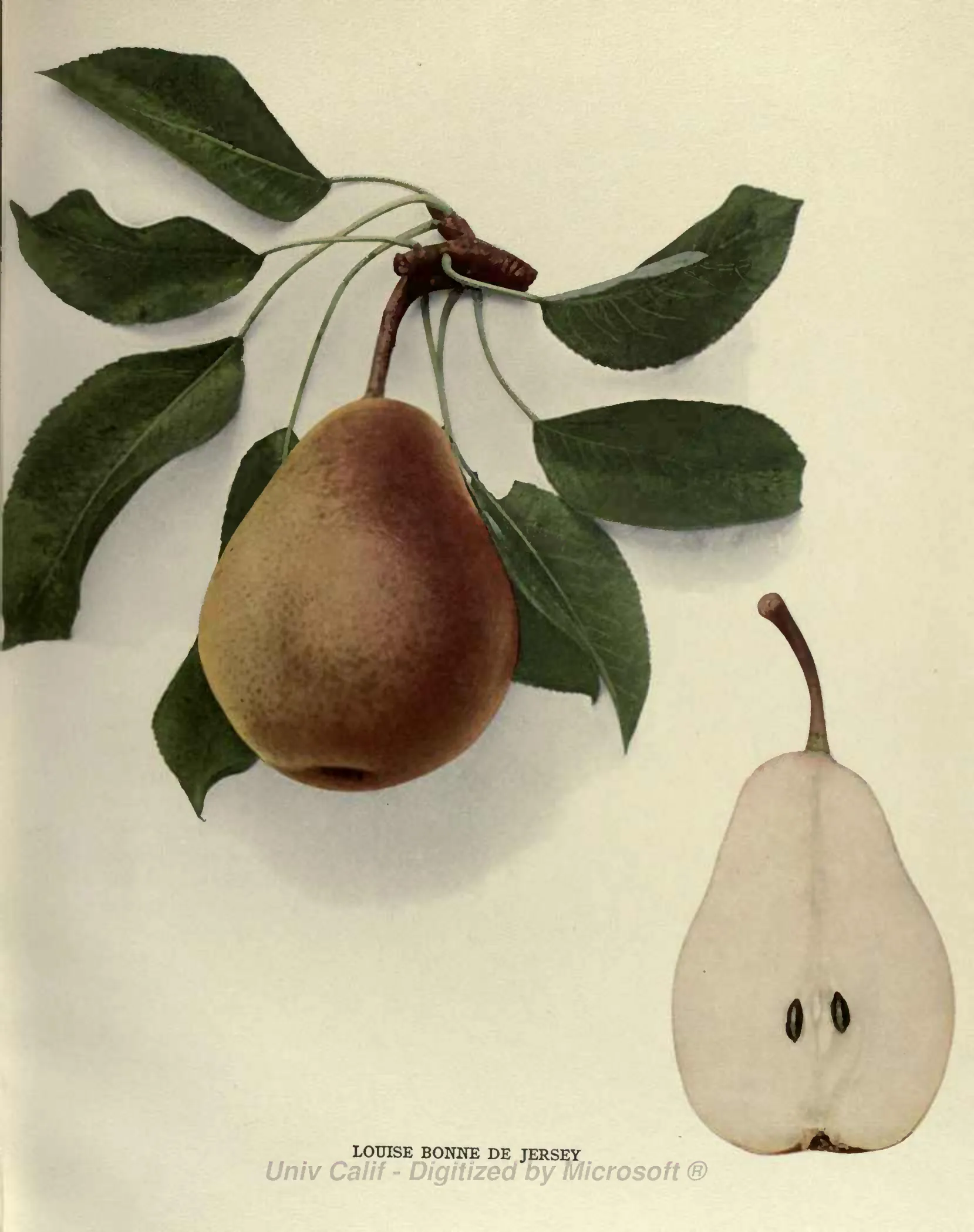
Louise Bonne De Jersey
Origin / History
A French pear, "without much doubt" French according to Hovey, raised at or near Avranches, Normandy, by M. de Longueval. Hovey, citing French writers, and the Herefordshire Pomona date it 1788. Hedrick, who says the parent tree was raised from seed, and Bunyard give about 1780.
The early naming is variously recorded. Hovey's French writers give the original name as Beurre de Longueval. The Herefordshire Pomona says Longueval first named it simply "Louise," later added "Bonne," and that it thenceforth became known as "Bonne Louise d'Avranches." Hedrick reports that some authorities say it was first named Bonne de Longueval, and others that M. de Longueval immediately dedicated it to his wife as Bonne Louise de Longueval. He adds that the Pomological Congress later adopted Bonne Louise d'Avranches, by which it became more generally known. Hovey says it was "somewhat extensively disseminated" as Louise Bonne d'Avranches, which became its popular title among French cultivators and "one which it ought to retain." He found it under that name in all the principal nurseries around Paris in the autumn of 1844. The Herefordshire Pomona (1885) states that the original tree was then still in existence in the garden where it was raised.
It was cultivated with great success in the island of Jersey, and came to England from there (Herefordshire Pomona). Hedrick says it "presumably" found its way to England through the Channel Islands. According to Hovey, the London Horticultural Society first received it from Jersey in 1820 and so named it to distinguish it from the old Louise Bonne of pomologists. Hovey's own synonymy cites the Society's Catalogue, 3rd edition, 1842. Bunyard likewise notes another Louise Bonne of older date. Elliott renders the name the "Good Louise of Jersey." Hedrick says the variety "rather unfortunately" became widely disseminated in England as Louise Bonne de Jersey. He retains that name to distinguish it from at least eight other varieties having Louise as the whole or part of the name.
It was brought to the United States early in the nineteenth century. Hedrick's earliest American citation is Kenrick's American Orchardist (1841). In 1852 it entered the recommended list of the American Pomological Society, and in 1897 the Society shortened the name to Louise, by which it is now known in America. Budd and Hansen say it is grown across the continent. Hedrick calls it an old pear.
Hovey (1852) called it one of the finest pears recently introduced. He predicted it would undoubtedly become as popular as the widely disseminated and justly esteemed Williams's Bon Chrétien. He wrote that "few varieties of the pear combine all the good characteristics of this." He praised its size, beauty, productiveness, keeping, and hardiness. He quoted Mr. Thompson that it "more than rivals the Marie Louise," one of the richest pears, even in the climate of England. After several years' experience he recommended it as "an indispensable addition to even the smallest collection." Elliott found it "one of the best pears grown on the quince stock in this country." The Herefordshire Pomona called it "this valuable pear" and said it should take its place in every garden. Bunyard thought it "very highly to be recommended for its quality and regular cropping habits." Thomas calls it "this fine variety."
Downing rated it "not of the first quality, but profitable." Thomas wrote that, like the Bartlett, it is "hardly of the highest quality, but is eminently valuable for its large, fair fruit, free upright growth, and great productiveness." Hedrick found its many excellent qualities of fruit and tree "not sufficiently above the average to give it high place in the list of pears for the market." He still called it a standard pear for home collections, finding favor in many commercial orchards in New York.
Tree
Vigorous, upright, very productive. Hedrick gives it as large, very tall, dense-topped, and long-lived, with a stocky trunk. Hovey gives a very erect and regular habit, the branches at first slightly diverging but afterwards erect, forming a beautifully shaped tree even without any pruning. Bunyard calls the growth upright, spreading, and the tree rather large and well-shaped. At Agassiz, British Columbia, trees planted in spring 1890 proved vigorous growers and productive.
Hovey calls it "of the most hardy character," and Elliott and the Herefordshire Pomona call the tree hardy. Hedrick lists it as hardy in his technical description, but his introduction calls the trees "precariously hardy and somewhat subject to blight."
Young wood is dull olive brown (Downing). Hovey describes the wood as dull brownish olive, slightly reddish on the sunny side, and dotted with whitish specks. In his account it is moderately stout and rather long-jointed, the annual growth long with but few lateral shoots, the old wood grayish brown. Thomas gives the shoots as dark brown or purple. Hedrick describes the branches as slightly zigzag, reddish brown mingled with very dark grayish scarfskin, with numerous raised lenticels. His branchlets are slender, long, dark reddish brown, nearly smooth, and glabrous, with few small, slightly raised lenticels. Buds are medium-sized, rather long, inclined toward the branch, and rather sharply pointed (Hovey); Hedrick gives the leaf-buds as pointed, semi-free. Flower-buds are medium-sized (Hovey), or small, conical or pointed, and free (Hedrick).
Leaves are rather small, oblong-oval, slightly acuminate, and nearly flat in Hovey's account. They are rather coarsely and obtusely serrate, on slender petioles about an inch long; Thomas also calls the serratures rather coarse. Hedrick gives the leaves as oval and leathery, much curled under at the margins, with a slightly taper-pointed apex and a glandless, finely serrate margin. In his Pears of New York they measure 3½ inches long and 1½ inches wide, on a slender petiole 1½ inches long. His Cyclopedia gives 3¾ by 1¾ inches, with a petiole 1¾ inches long. Bunyard describes the leaf as narrow, little upfolded, and very boldly crenate, turning very dark yellow-brown.
Flowers are large, with roundish, thick, finely cupped petals (Hovey). Hedrick's Pears of New York gives them as 1¼ inches across, with a disagreeable odor. They are white or tinged with pink along the edge of the petals, averaging 6 buds in a cluster, on slender, pubescent, light green pedicels 1¼ inches long. His Cyclopedia gives 1½ inches across, white or sometimes faintly tinged with pink, averaging 4 buds in a cluster.
Very productive. The Herefordshire Pomona calls it a very good bearer, and Bunyard calls its fertility great and its cropping regular. On the quince it succeeds perfectly or admirably, and Thomas says it is mostly grown on that stock. Hovey says that on the quince it bears very young and produces abundant crops. He finds it admirably adapted to a pyramidal tree or to growing en quenouille. Downing says it forms a fine pyramid on the quince. The Herefordshire Pomona considers the pyramid on quince its best form. Downing says the fruit is of better quality on the quince than on the pear. Hedrick reports that in Europe prominent pomologists agree the fruit is better and the trees more productive on the quince. In America it is considered one of the best varieties for dwarfing.
Fruit
Size: Large in most accounts. Veitch's entry reads "large and handsome, medium." The Herefordshire Pomona, Bunyard, and the Agassiz station call it medium, and Hedrick medium to large, uniform in size and shape. Hovey gives about 3¼ inches long by 2½ inches in diameter. Hedrick's Pears of New York gives 2½ inches long by 2¼ wide, and his Cyclopedia "often 2¾ inches long, 2¼ inches wide." Bunyard gives "2¾ by 4½." Elliott notes that his drawings, made before the fruit had swollen its full size, are not more than half size.
Form: Pyriform, most authors giving oblong-pyriform. Hovey calls it pyramidal, large at the crown and gradually tapering to the stem, near which there is a slight contraction. Thomas describes it as tapering slightly to an obtuse or flattened crown. Hovey calls it nearly regular, occasionally a little angular, and Bunyard long conical, oval, and even. Against this, Downing calls it a little one-sided and Thomas slightly one-sided. Hedrick calls it somewhat irregular with unequal sides, and Budd and Hansen also give the sides as unequal.
Stem: About an inch long in most accounts. Thomas gives an inch to an inch and a half, the Herefordshire Pomona three-quarters of an inch, and Budd and Hansen half an inch. Bunyard calls it fairly long and woody. Curved, a little curved (Elliott), or usually curved (Hedrick). Stout or moderately stout (Hovey, Elliott), though Hedrick calls it slender. Hovey gives it as smooth, pale brown, with a few grayish specks. Fleshy and enlarged at the base. Hovey says it is often so in large specimens, swollen and slightly wrinkled at its junction with the fruit. He adds that it is forced into an oblique direction by a projection on one side. The Herefordshire Pomona calls it obliquely inserted and Downing rather obliquely inserted. Budd and Hansen place it at one side of the neck.
Cavity: None or very slight; the stem is inserted without depression, little sunk, or on a level with the surface. Bunyard allows a slight cavity. Hedrick describes the cavity as obtuse, very shallow, and very narrow, furrowed and wrinkled, often lipped, the flesh folded up around the stem.
Calyx: Open. Small (Herefordshire Pomona), medium (Hovey, Bunyard), or large (Hedrick). Hovey gives the segments as medium length, stiff, projecting, and rounded. Elliott calls them large and reflexed, and Hedrick calls the lobes broad and acute. Hedrick gives the calyx tube as short, wide, and conical.
Basin: Shallow in most accounts, uneven (Downing, Hedrick), obtuse and furrowed (Hedrick). Hovey has the eye "moderately sunk in an open, furrowed cavity," and the Herefordshire Pomona gives a rather deep basin. Bunyard calls the basin even, regular, and russeted.
Skin: Smooth, fair, glossy; Hedrick calls it granular. The ground is green to pale green in the shade, or pale yellowish green, becoming yellower when mature. The Herefordshire Pomona gives yellow on the shaded side, and Hedrick pale yellow. The sunny side is most often described as overspread or cheeked with brownish red. The Agassiz station calls it a dull red cheek, and Hedrick a dull red blush on the exposed cheek with streaks of russet. Hedrick's Cyclopedia calls the blush dull pinkish red. Hovey describes it as very broadly suffused with bright glossy red on the sunny side, shading off abruptly. The Herefordshire Pomona calls it crimson and Bunyard a red flush. The Herefordshire Pomona says the fruit is colored as highly as its own plate shows only in very sunny seasons. Handsome.
Dots: Numerous, gray or russet. Hedrick calls them small and conspicuous. Hovey describes the surface as covered with large grayish russet specks, each rayed or margined with red. The Herefordshire Pomona describes crimson and russety dots, and Bunyard prominent red spots.
Flesh and flavor: Flesh white, yellowish white, or greenish white. Fine (Hovey), somewhat granular (Hedrick). Melting, very melting (Bunyard), buttery, tender. Very juicy; Hovey calls it "exceedingly juicy." Flavor rich: "rich and excellent" (Downing), very rich (Budd and Hansen). Hovey calls it "rich, brisk, agreeably perfumed and delicious," and the Herefordshire Pomona "rich, sugary, and brisk vinous." Hedrick finds it sweet and vinous, aromatic, rich, and Bunyard sweet and delicious. Thomas gives "rich, faintly sub-acid, fine," and Veitch fragrant. Elliott also calls it delicious, and the Herefordshire Pomona "a very delicious pear."
Quality runs from good to very good. Hedrick rates it "very good," of "excellent quality," and Downing "good to very good." Veitch calls it "one of the finest dessert pears." Downing nonetheless calls it "not of the first quality," and Thomas "hardly of the highest quality."
Core and seeds: Core medium-sized (Hovey) or small (Elliott). Hedrick gives it as closed, with clasping core lines. Seeds medium-sized and light brown (Hovey). Elliott describes them as long, ovate, and pointed, and Hedrick as large, wide, long, plump, and acute.
Season
Autumn, September and October. Most authors give October. Hovey says it keeps well for four or five weeks, and Hedrick says it keeps and ships well. Thomas gives mid-autumn, with late autumn in the far North and early autumn at Cincinnati.
Uses
A dessert pear (Bunyard, Veitch), recommended for home collections and gardens. Downing calls it profitable. Hedrick says its keeping and shipping qualities have given it "some preëminence as a pear for the export trade."
Subtypes / Variants
Not described in source.
Other
The Herefordshire Pomona notes that an outline of the fruit is given in the Transactions of the Horticultural Society (London), Vol. II, p. 42.
Book Sources
Described in 9 period pomological works
- Bunyard, A Handbook of Hardy Fruits (1920)
- Hedrick, The Pears of New York (1921)
- Budd & Hansen, Systematic Pomology (1914)
- Downing, Fruits and Fruit Trees of America (1900)
- Elliott, The Western Fruit Book (1865)
- Hedrick, Cyclopedia of Hardy Fruits (1922)
- The Herefordshire Pomona (1876–1885)
- Hovey, The Fruits of America (1852) — listed as THE LOUISE BONNE OF JERSEY PEAR
- Thomas, The American Fruit Culturist (1903) — listed as Louise Bonne of Jersey
Nursery Catalog Sources
Found in 69 catalogs (1845–1920) from Alabama, California, England, Illinois, Maryland, Massachusetts, Missouri, Nebraska, New Jersey, Oregon, Pennsylvania, Virginia, Washington
- Winship's Nursery (Brighton Nurseries , operated by the Winship family), Brighton (Boston) , Massachusetts — 1845
- Hovey & Co. , Cambridge , Massachusetts — 1849 — listed as Louise Bonne of Jersey
- Azell Bowditch (Nursery / Fruit Catalog) , Boston , Massachusetts — 1850
- Joseph Breck & Co. , Boston , Massachusetts — 1855
- St. Helena Nursery , Howell Prairie, Marion County, OR (Marion Co., Ogn.) — 1864
- Hutchison Nursery , James Hutchison, Oakland , California — 1881
- Felix Gillet , Barren Hill Nursery, Nevada City , California — 1884
- Huntsville Wholesale Nurseries (Jessie S. Moss , Proprietor; W.F. Heikes, Manager), Huntsville , Alabama — 1886
- Felix Gillet , Barren Hill Nursery, Nevada City , California — 1888
- California Nursery Co. , Niles , California — 1889
- Felix Gillet , Barren Hill Nursery, Nevada City , California — 1889
- Felix Gillet , Barren Hill Nursery, Nevada City , California — 1890
- William H. Moon Co. , Morrisville, Bucks County , Pennsylvania — 1890
- Felix Gillet , Barren Hill Nursery, Nevada City , California — 1891
- Missouri Nursery Co. , Louisiana , Missouri — 1891
- Puyallup & Yakima Nurseries , Puyallup, Washington (Lock Box 191) and North Yakima , Washington — 1892
- Rogers Nursery Co. , Moorestown , New Jersey — 1893
- Sherwood Hall Nursery Co. , Timothy Hopkins (Menlo Park Nurseries), San Francisco / Menlo Park , California — 1893
- Multnomah Nurseries , Russellville , Oregon — 1894
- The Vineland Nurseries (Kelsey & Co. , Proprietors), St. Joseph, Missouri (Office: 13th and Atchison Sts., 2 Blocks East of the Citizens St. Car Line) — 1894
- Woodburn Nurseries , Woodburn, Marion Co. , Oregon — 1894
- Felix Gillet , Barren Hill Nursery, Nevada City , California — 1895
- The Lovett Company , Little Silver , New Jersey — 1896
- Stark Bros. Nurseries & Orchards Co. , Louisiana , Missouri — 1896
- Felix Gillet , Barren Hill Nursery, Nevada City , California — 1897
- Kelway & Son , Langport, Somerset , England — 1897
- The Salem Nursery (John A. Francis , Proprietor), Salem , Virginia — 1897
- J.V. Cotta (Cotta Nursery) , Carroll County , Illinois — 1898
- Reading Nursery , Jacob W. Manning, Proprietor, Reading , Massachusetts — 1898
- Stark Bros. Nurseries & Orchards Co. , Louisiana , Missouri — 1898
- Brown Brothers Co. , Continental Nurseries, Rochester, NY (also operated from Toronto, Canada) — 1899
- Alabama Nursery Co. , Huntsville , Alabama — 1900
- George Bunyard & Co. , Royal Nurseries, Maidstone, Kent , England — 1900
- Central Experimental Farm , Dominion Department of Agriculture, Agassiz, British Columbia (under test; Bulletin No. 3, Second Series) — 1900
- Central Experimental Farm , Dominion Department of Agriculture, Agassiz, British Columbia (under test; Bulletin No. 3, Second Series) — 1900 — listed as Louise d'Avranches
- Washington Nursery Co. , Toppenish , Washington — 1901
- Benjamin Buckman (personal inventory) , Farmingdale , Illinois — 1901
- Brown Brothers Co. , Continental Nurseries, Rochester, NY (also operated from Toronto, Canada) — 1901
- Mountain Grove Nurseries (Tippin & Moore , Proprietors; Geo. T. Tippin, J. W. Tippin, J. C. Moore), Mountain Grove , Missouri — 1901
- S.L. Watkins , Grizzly Flats, El Dorado County , California — 1901
- Forestville Nurseries , T.J. True, Forestville , California — 1902
- Russellville Nursery Co. , Russellville, OR (three miles east of Portland, one mile from Montavilla car line) — 1903
- Phoenix Nursery Company (W. E. Rossney , President; Sidney Tuttle, Vice-President), Bloomington , Illinois — 1904
- Henderson Luelling / Traveling Nursery (historical recall) , Oregon — 1904
- Russellville Nursery Co. , Montavilla Station, Portland, OR (three miles east of Portland, one mile from Montavilla car line) — 1907 — listed as Louis Bonne de Jersey
- J.B. Pilkington , Portland , Oregon — 1907
- Carlton Nursery Co. , Carlton , Oregon — 1909
- Milton Nursery Co. (A. Miller & Sons , Proprietors), Milton , Oregon — 1909
- Wm. J. Corse (successor to Robert Sinclair / Sinclair Nurseries) , Baltimore , Maryland — 1909
- Washington Nursery Company , Toppenish , Washington — 1909
- C.F. Lansing , Salem , Oregon — 1910
- Island Nurseries & Fruit Farm , Vashon (Vashon Island) , Washington — 1910
- Galbraith Nursery Co. (DeWitt Hansen , Pres.-Mgr.), Fairbury , Nebraska — 1911
- Island Nurseries & Fruit Farm , Vashon (Vashon Island) , Washington — 1911
- James Veitch & Sons , Ltd., Royal Exotic Nursery, Chelsea, London (also Coombe Wood, Langley, and Feltham) , England — 1911
- Ballygreen Nurseries , Hanford , Washington — 1912
- Pacific Nursery Company , Portland , Oregon — 1912
- Vineland Nurseries Company , Clarkston , Washington — 1912
- Washington Nursery Company , Toppenish , Washington — 1912
- Thomas Rivers & Son , Sawbridgeworth, Hertfordshire , England — 1913
- Van Holderbeke Nursery Co. , Incorporated, Spokane, Washington (nurseries at Otis Orchards WA, Pasadena WA, Kennewick WA) — 1913
- George Bunyard & Co. , Royal Nurseries, Maidstone, Kent , England — 1914
- Island Nurseries & Fruit Farm , Vashon (Vashon Island) , Washington — 1914
- Island Nurseries & Fruit Farm , Vashon (Vashon Island) , Washington — 1915
- Island Nurseries & Fruit Farm , Vashon (Vashon Island) , Washington — 1916
- George Bunyard & Co. , Royal Nurseries, Maidstone, Kent , England — 1917
- Island Nurseries & Fruit Farm , Vashon (Vashon Island) , Washington — 1917
- Fancher Creek Nurseries , George C. Roeding, Fresno , California — 1918
- Oregon Nursery Co. , Orenco , Oregon — 1920
View original book sources (11)
— C.M. Hovey, The Fruits of America (1852)THE LOUISE BONNE OF JERSEY PEAR.
Louise Bonne of Jersey. Hort. Soc. Catalogue, 3d Ed. 1842. Louise Bonne d'Avranches, } Beurré ou Bonne Louise Auranches, } Hort. Soc. Cat. 3d Ed. 1842. William the Fourth, } Bergamot d'Avranches, } of some French Collections. Poire de Jersey, }
The Louise Bonne of Jersey is one of the finest pears which has been recently introduced, and it will undoubtedly become as popular a variety as the now widely disseminated, and justly esteemed, Williams's Bon Chrétien. It has not only the qualities of size, beauty, productiveness, and keeping well, but it is of the most hardy character; and, according to Mr. Thompson, "more than rivals the Marie Louise," one of the richest pears, even in the climate of England. So far as it has been proved here, after several years' experience, it can be recommended as an indispensable addition to even the smallest collection.
The Louise Bonne of Jersey is, without much doubt, a French pear. The London Horticultural Society first received it from the Island of Jersey, in 1820, and so named it to distinguish it from the old Louise Bonne of pomologists. According, however, to French writers, it was originated at Avranches, in 1788, by M. de Longueval, and its original name was Beurre de Longueval; but as it was somewhat extensively disseminated under the name of Louise Bonne d'Avranches, that became its popular title among French cultivators, and one which it ought to retain. Under this name we found it cultivated in all the principal nurseries around Paris, in the autumn of 1844.
Few varieties of the pear combine all the good characteristics of this. It is admirably adapted for cultivation as a pyramidal tree, or for growing en quenouille. It has, naturally, a very erect and regular habit, and, even without any pruning, forms a beautiful-shaped tree. It succeeds perfectly upon the quince, bearing very young, and producing abundant crops.
Tree.—Vigorous, of an erect and upright habit, the branches at first slightly diverging, but afterwards erect.
Wood.—Dull brownish olive, slightly reddish on the sunny side, dotted with whitish specks, moderately stout, and rather long-jointed; annual growth long, with but few lateral shoots; old wood grayish brown; buds medium size, rather long, inclined towards the branch, and rather sharply pointed: Flower-buds medium size.
Leaves.—Rather small, oblong oval, slightly acuminate, nearly flat, rather coarsely and obtusely serrated; petioles slender, and about an inch in length.
Flowers.—Large; petals roundish, thick, and finely cupped.
Fruit.—Large, about three and a quarter inches long, and two and a half in diameter: Form, pyramidal, nearly regular, occasionally a little angular, large at the crown, and gradually tapering to the stem, near which there is a slight contraction: Skin, fair, smooth, yellowish green, becoming yellower when mature, very broadly suffused with bright glossy red on the sunny side, which shades off abruptly, the surface being covered with large, grayish russet specks, each speck rayed or margined with red: Stem, medium length, about an inch long, stout, smooth, pale brown, with a few grayish specks, often, in large specimens, fleshy, swollen, and slightly wrinkled at its junction with the fruit, and forced into an oblique direction by a projection on one side: Eye, medium size, open, and moderately sunk in an open, furrowed cavity; segments of the calyx medium length, stiff, projecting, rounded: Flesh, yellowish white, fine, melting, buttery, and exceedingly juicy: Flavor, rich, brisk, agreeably perfumed and delicious: Core, medium size: Seeds, medium size, light brown.
Ripe in October, and keeps well for four or five weeks.
— F.R. Elliott, The Western Fruit Book (1865)Louise Bonne de Jersey.
Louise Bonne d'Avranches, Beurre or Bonne Louise d'Araudore, William the Fourth.
The "Good Louise of Jersey," from the Isle of Jersey, proves one of the best pears grown on the quince stock in this country. Tree, hardy, very productive, shoots vigorous, upright.
Fruit, large, (our drawings were made ere the fruit had swollen its full size, and are not more than half size,) oblong pyriform; skin, glossy, smooth, green in shade, brownish red in sun, dotted with gray dots; stem, about one inch long, moderately stout, a little curved, fleshy enlargement at base; calyx, open, segments large, reflexed; basin, shallow; core, small; seeds, long, ovate pointed; flesh, white, juicy, melting, delicious. October.
— Woolhope Naturalists Field Club, The Herefordshire Pomona (1885)
- LOUISE BONNE OF JERSEY.
[Syn: Beurré d'Avranches; Bonne d'Avranches; Louise d'Avranches; Bonne de Longueval; Bonne Louise d'Avrandore; William the Fourth.]
This valuable pear was raised at Avranches about the year 1788 by M. Longueval, who at first named it simply "Louise" but subsequently added "Bonne" and it thenceforth became known as "Bonne Louise d'Avranches." The original tree is still in existence in the garden where it was raised. It is cultivated with great success in the island of Jersey, and coming to England in this way, received the name it now bears.
Description.—Fruit, medium sized, pyriform, skin, smooth, yellow on the shaded side, but crimson next the sun, covered with crimson and russety dots. Eye, small and open, set in a rather deep basin. Stalk, three quarters of an inch long, obliquely inserted without depression. Flesh, white, buttery and melting, with a rich, sugary, and brisk vinous flavour.
A very delicious pear—ripe in October. The tree is hardy, and a very good bearer. Its best form of growth is as a pyramid on the quince stock and in this form it should take its place in every garden.
The colouring of this pear on the Plate was very true to the specimen, but it is only coloured so highly in very sunny seasons. An outline of it is given in the Transactions of the Horticultural Society (London,) Vol. II., p. 42.
— A.J. Downing, The Fruits and Fruit Trees of America (1900)Louise Bonne of Jersey.
Bonne de Longneval. Louise Bonne d'Avranches. Louise Bonne de Jersey. Beurré or Bonne Louise d'Araudore. William the Fourth. Bergamotte d'Avranches. De Jersey. Beurré d'Araudore. Bonne Louise d'Araudore. Beurré d'Avranches. Bonne d'Avranches. De Louise. William.
Originated in France, near Avranches, succeeds admirably on the quince, forming a fine pyramid — not of the first quality, but profitable. Tree vigorous, upright, very productive. Fruit of better quality on the quince than on the pear. Young wood dull olive brown.
Fruit large, oblong pyriform, a little one-sided, glossy, pale green in the shade, but overspread with brownish red in the sun, and dotted with numerous gray dots. Stalk about an inch long, curved, rather obliquely inserted, without depression, or with a fleshy, enlarged base. Calyx open, in a shallow, uneven basin. Flesh greenish white, very juicy and melting, with a rich and excellent flavor. Good to very good. September and October.
— John J. Thomas, The American Fruit Culturist (1903)Louise Bonne of Jersey. See Louis Bonne.
[Additional entry in this volume: "Louise Bonne", pp. 546–546]
Louise Bonne.* (Louise Bonne de Jersey, Louise Bonne d'Avranches.) Large, pyriform, tapering slightly to obtuse or flattened crown; slightly one-sided; surface smooth, pale yellowish-green, with a brownish red cheek; stalk an inch to an inch and a half long, often fleshy at insertion, little sunk; basin shallow; flesh yellowish-white, very juicy, buttery, melting, rich, faintly sub-acid, fine. Ripens mid-autumn; late autumn far North, early autumn at Cincinnati. Very productive; succeeds admirably and is mostly grown on quince stocks. Shoots dark brown or purple; serratures of the leaves rather coarse. This fine variety, like the Bartlett, is hardly of the highest quality, but is eminently valuable for its large, fair fruit, free upright growth, and great productiveness. France. Fig. 704.
— J.L. Budd & N.E. Hansen, American Horticultural Manual, Part II: Systematic Pomology (1914)Louise Bonne de Jersey. — Large, oblong pyriform, with sides unequal; skin glossy, pale green, with brownish red in the sun; dots gray and numerous; stalk half an inch long, curved, and inserted at one side of neck without cavity; basin shallow, uneven. Flesh greenish white, juicy, melting, with very rich flavor, good to very good. Season, autumn. Grown across the continent. France.
— E.A. Bunyard, A Handbook of Hardy Fruits (1920)LOUISE BONNE OF JERSEY. Her. Pom., I., 9. F. Louise Bonne d'Avranches. G. Gute Louise van Avrauches. Dessert, October, medium, 2¾ by 4½, long conical, oval, even. Skin, smooth. Colour, yellowish-green, with red flush and prominent red spots. Flesh, white, very melting, sweet and delicious. Eye, medium, open, in an even, regular russeted basin. Stem, fairly long, woody, in a slight cavity, or on level with surface. Growth, upright, spreading ; fertility great. Leaf, narrow, little upfolded, very boldly crenate, turns very dark yellow-brown. Origin, raised by M. Longueval, of Avranches, France, about 1780. There is another Louise Bonne of older date than this. This is known in France as Louise Bonne d'Avranches. It makes a rather large, well-shaped tree, very highly to be recommended for its quality and regular cropping habits.
— U.P. Hedrick, The Pears of New York (1921)LOUISE BONNE DE JERSEY
- Kenrick Am. Orch. 148. 1841. 2. Am. Pom. Soc. Rpt. 53. 1852. 3. Field Pear Cult. 218, fig. 81. 1858.
Louise Bonne of Jersey. 4. Downing Fr. Trees Am. 397, fig. 174. 1845. 5. Hovey Fr. Am. 1:39, Pl. 1851. 6. Jour. Hort. N. S. 38:161, fig. 26. 1880. 7. Hogg Fruit Man. 606. 1884.
Gute Louise von Avranches. 8. Dochnahl Führ. Obstkunde 2:138. 1856. 9. Mathieu Nom. Pom. 229. 1889.
Bonne Louise d'Avranches. 10. Ann. Pom. Belge 6:29, Pl. 1858. 11. Pom. France 2: No. 21, Pl. 21. 1863. 12. Mas Le Verger 3: Pt. I, 67, fig. 32. 1866-73. 13. Leroy Dict. Pom. 1:482, fig. 1867. 14. Guide Prat. 286. 1876.
Louise. 15. Am. Pom. Soc. Cat. 23. 1897. 16. Ont. Dept. Agr. Fr. Ont. 170, fig. 1914.
Now known in America as Louise, a name given it by the American Pomological Society, this variety is described under the name given it in England to distinguish it from at least eight other varieties having Louise as the whole or a part of the name. The pear is an old one, having many excellent qualities of fruit and tree, which, however, are not sufficiently above the average to give it high place in the list of pears for the market. The pears are medium to large, handsome, of excellent quality, and keep and ship well. These qualities have given it some preëminence as a pear for the export trade. The trees are precariously hardy and somewhat subject to blight, but very vigorous, productive, and long-lived. In Europe, the testimony of prominent pomologists agrees that the fruits are better and the trees more productive when worked on the quince, and in America the variety is considered one of the best for dwarfing. This pear is a standard one for home collections, and finds favor in many commercial orchards in New York.
The parent tree of this pear was raised from seed about 1780 by M. de Longueval, Avranches, Normandy. Some authorities say that the variety was first named Bonne de Longueval; others, that M. de Longueval immediately dedicated the pear to his wife and called it Bonne Louise de Longueval. Later still, the Pomological Congress adopted the name of Bonne Louise d'Avranches, by which it became more generally known, though in England, it rather unfortunately became widely disseminated as Louise Bonne de Jersey, having, presumably, found its way there through the Channel Islands. The variety was brought to the United States early in the nineteenth century, and in 1852 was entered in the recommended list of fruits of the American Pomological Society. In 1897, this Society shortened the name to Louise.
Tree large, vigorous, upright, very tall, dense-topped, hardy, productive, long-lived; trunk stocky; branches slightly zigzag, reddish-brown mingled with very dark grayish scarfskin, with numerous raised lenticels; branchlets slender, long, dark reddish-brown, nearly smooth, glabrous, with few small, slightly raised lenticels.
Leaf-buds pointed, semi-free. Leaves 3½ in. long, 1½ in. wide, much curled under at the margins, oval, leathery; apex slightly taper-pointed; margin glandless, finely serrate; petiole 1½ in. long, slender. Flower-buds small, conical or pointed, free; flowers with a disagreeable odor, 1¼ in. across, white or tinged with pink along the edge of the petals, averaging 6 buds in a cluster; pedicels 1¼ in. long, slender, pubescent, light green.
Fruit matures in October; medium to large, 2½ in. long, 2¼ in. wide, uniform in size and shape, oblong-pyriform, somewhat irregular, with unequal sides; stem 1 in. long, slender, usually curved; cavity obtuse, very shallow and very narrow, furrowed and wrinkled, often lipped, the flesh folded up around the stem; calyx open, large; lobes broad, acute; basin obtuse, furrowed and uneven; skin granular, smooth; color pale yellow, marked on the exposed cheek with a dull red blush and with streaks of russet; dots numerous, small, grayish or russet, conspicuous; flesh yellowish-white, somewhat granular, tender and melting, very juicy, sweet and vinous, aromatic, rich; quality very good. Core closed, with clasping core-lines; calyx-tube short, wide, conical; seeds large, wide, long, plump, acute.
— U.P. Hedrick, Cyclopedia of Hardy Fruits (1922)LOUISE BONNE DE JERSEY. Louise. Now known in America as Louise, this variety is described here under the name used in English and American pomologies to distinguish it from at least eight other varieties having Louise as the whole or a part of the name. The variety has many excellent qualities of fruit and tree, which, however, are not sufficiently above the average to give it high place in the list of pears for the market. The fruits are medium to large, handsome, of excellent quality and keep and ship well. The trees are precariously hardy and somewhat subject to blight, but very vigorous, productive, and long-lived. In Europe, the fruits are better and the trees more productive when worked on the quince, and in America the variety is considered one of the best for dwarfing. This pear is a standard one for home collections, and finds favor in many commercial orchards.
The parent tree of this pear was raised from seed about 1780 by M. de Longueval, Avranches, Normandy.
Tree large, vigorous, upright, very tall, dense-topped, hardy, productive, long-lived; trunk stocky; branches slightly zigzag, reddish-brown, with numerous raised lenticels. Leaves 3¾ inches long, 1¾ inches wide, much curled under at the margin, oval, leathery; apex slightly taper-pointed; margin glandless, finely serrate; petiole 1¾ inches long, slender. Flowers with a disagreeable odor, 1½ inches across, white or sometimes faintly tinged with pink along the edge of the petals, averaging 4 buds in a cluster. Fruit matures in October; medium to large, often 2¾ inches long, 2¼ inches wide, oblong-pyriform, somewhat irregular; stem 1 inch long, slender, usually curved; cavity obtuse, shallow, narrow, furrowed and wrinkled, often lipped, the flesh folded up around the stem; calyx open, large; lobes broad, acute; basin obtuse, furrowed and uneven; skin granular, smooth; color pale yellow, marked on the exposed cheek with a dull pinkish-red blush and with streaks of russet; dots numerous, small, grayish or russet, conspicuous; flesh yellowish-white, tender and melting, very juicy; sweet, aromatic, rich; quality very good; core closed, with clasping core-lines; calyx-tube short, wide, conical; seeds large, wide, long, plump, acute.
— Central Experimental Farm, Central Experimental Farm, Agassiz BC — Catalogue of Fruit Trees under Test (Bulletin No. 3, 1900) (1900)Planted Spring 1890. Tree a vigorous grower and productive. Fruit of medium size, oblong, pyriform. Skin pale green with a dull red cheek in the sun. Flesh greenish white, juicy, melting, flavour rich. Season September and October.
— James Veitch & Sons, Veitch's Fruit Trees (1911) (1911)large and handsome, medium, melting, juicy and fragrant One of the finest dessert pears Sept. & Oct.