Frederick Clapp
Pear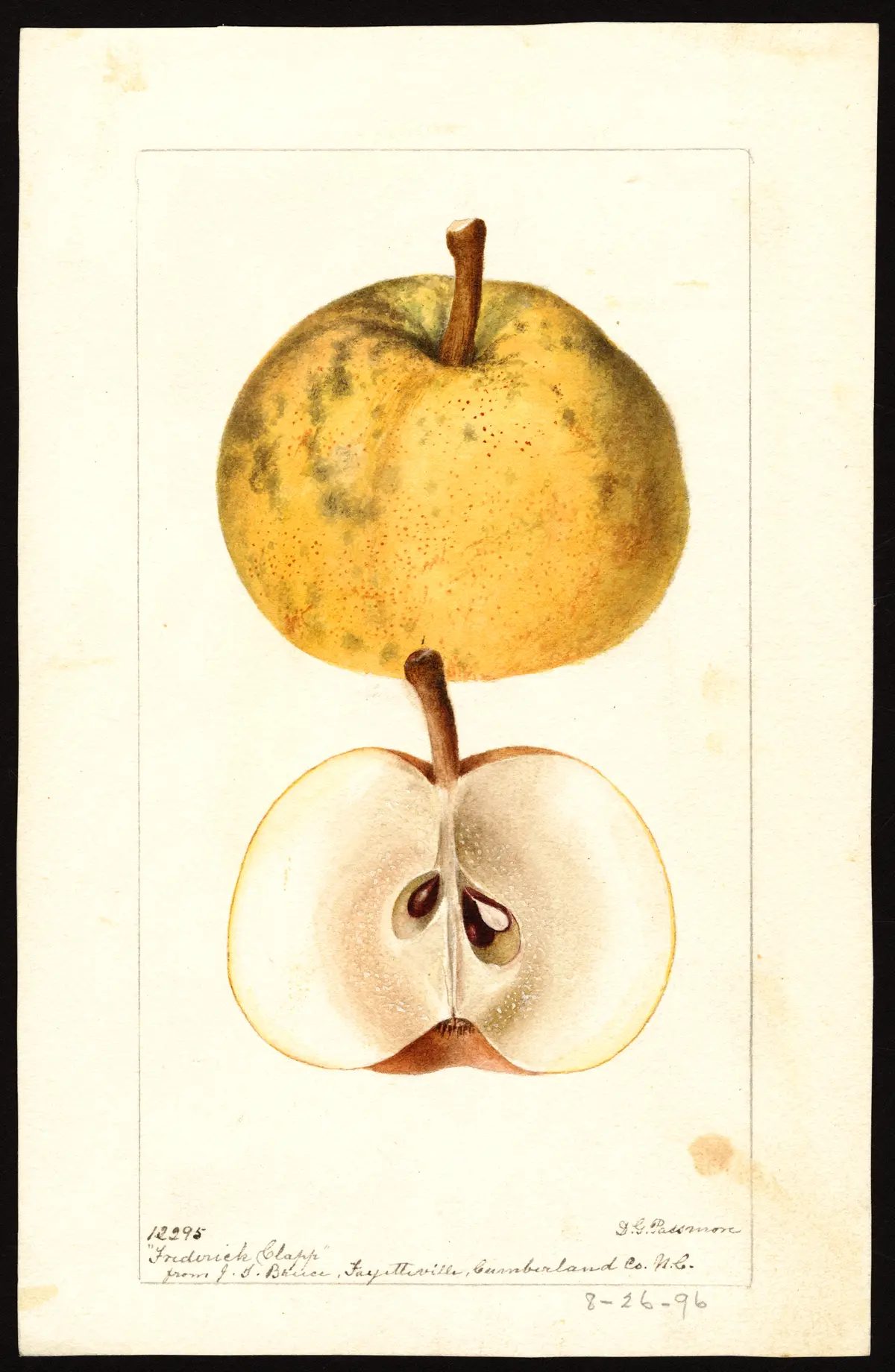
USDA Pomological Watercolor Collection
Frederick Clapp
Origin / History
Raised about 1870 (Hedrick) by Lemuel Clapp of Dorchester, Massachusetts. He grew it on the same farm as his brothers, the late Frederick and Thaddeus Clapp, who produced Clapp's Favorite pear (Downing). Hedrick says all three brothers produced large numbers of pear seedlings, several of which have been named. Downing gives the parentage as Urbaniste crossed with Beurré Superfin; Hedrick calls it "in all probability" a cross between those two. It appears as Clapp's No. 22 in the Massachusetts Horticultural Society reports of 1872 and 1874 and the American Pomological Society report of 1875. It appears as Frederick Clapp in the second appendix to Downing's The Fruits and Fruit Trees of America, with a figure, and in the Massachusetts Horticultural Society report, both in 1876.
Hedrick records that it was shown and favorably reported on at exhibitions and meetings of the Massachusetts Horticultural Society in 1872, 1874, 1875, and 1876. In 1875 it received high praise in a report of the Massachusetts State Fruit Committee to the American Pomological Society. In 1877 that Society added Frederick Clapp to its list of fruits recommended for general cultivation. Downing calls it "this fine new pear."
Hedrick says Frederick Clapp "has a place on the pear list, because it is one of the few good varieties with acidulous fruits." He adds that its refreshing, piquant flavor, its tender, melting, very juicy flesh, and its bright lemon-yellow color "give sufficient charm and character to the fruits to make the variety desirable in every collection of good pears."
Tree
Tree large, vigorous, healthy, hardy; grows with rapidity and vigor. Habit upright-spreading, with open top, forming open, shapely, wide-spreading heads that Hedrick says commend it for orchard management. Hedrick's Cyclopedia has the habit upright becoming very spreading. The branches are rather slender and somewhat inclined to spread in Lemuel Clapp's account to Downing, but stocky in Hedrick's.
Trunk thick, shaggy. Branches shaggy, zigzag, dull reddish-brown, overspread with thick ash-gray scarf-skin, marked with many small lenticels. Branchlets thick, dull reddish-brown tinged with green, smooth except for the lenticels, glabrous, with many small, raised lenticels.
Leaf-buds small, short, conical or pointed, plump, usually free. Leaves ovate, stiff; apex taper-pointed; margin finely serrate, tipped with very fine, sharp-pointed, reddish-brown glands; petiole slender, glabrous. Leaves 3 inches long by 1½ inches wide on a petiole 1½ inches long (The Pears of New York), or 2¼ by 1¾ inches on a petiole 1¼ inches long (Cyclopedia).
Flower-buds small, short, conical, plump, free. Flowers cup-shaped, often with a disagreeable odor, ¾ to 1 inch wide, averaging 9 buds in a cluster; pedicels 1 inch long, thick, pubescent, pale green (Hedrick).
Comes into bearing early. Lemuel Clapp calls it a good bearer; Hedrick calls it unusually fruitful.
Fruit
Size: Medium to large, variable in size; Hedrick calls it medium. Hedrick gives more than 2 to 2¼ inches long and 2½ to 2¾ inches wide, with the larger figures in his Cyclopedia.
Form: Roundish, round-obovate, or obovate, inclining to obovate-pyriform (Downing). Often variable and irregular in form.
Stem: Medium in length, ¾ inch (Hedrick) to one inch (Budd and Hansen). Of medium thickness (Downing) to thick and stout. Inclined; sometimes a little fleshy (Downing).
Cavity: A slight depression or small, shallow, irregular cavity. Hedrick describes it as variable in outline and smoothness, often with a fleshy fold drawn up around the base of the stem.
Calyx: Nearly closed (Downing) or open (Hedrick). Hedrick gives the lobes short, broad, obtuse, and the calyx-tube very short, wide, broadly conical.
Basin: Medium (Downing) to deep, wide, and abrupt (Hedrick). Regular, symmetrical, usually smooth.
Skin: Thin, tender, smooth; bright, clear lemon-yellow. Downing gives it without blush or russet. Hedrick finds it often marked with flecks and mottlings of russet, and Budd and Hansen give brown patches. The Pears of New York has the color "with only a trace of red"; the Cyclopedia has it "without a trace of red."
Dots: Numerous, small or minute, brown or russet; obscure (Hedrick).
Flesh and flavor: Flesh whitish yellow, or with a very faint tinge of yellow (Hedrick). Fine-grained, tender, melting, very juicy ("characteristically juicy," Hedrick); buttery (Budd and Hansen). Flavor rich, sprightly, aromatic. Downing calls it "highly vinous and slightly aromatic," much resembling Beurré Superfin in flavor, "only a little more vinous." Hedrick calls the fruit acidulous, with a "refreshing, piquant flavor," the flesh "sweet, with a rich sprightliness." He says it surpasses Beurré Superfin "in quality at least." Quality "very good" (Thomas, Hedrick); "good to very good" (Budd and Hansen).
Core and seeds: Core closed, axile, with clasping core-lines. Carpels obovate. Seeds large, wide, long, plump, acute (Hedrick).
Season
Ripens in October, a mid-season pear. Downing gives the middle to the last of October; Hedrick says it comes into season with Beurré Superfin. Lemuel Clapp reports that it keeps remarkably well.
Uses
Dessert pear. Thomas calls it "excellent for dessert or market." Hedrick says it is seldom planted in commercial orchards, "but it has a welcome place in every home orchard fortunate enough to have it."
Subtypes / Variants
Not described in source.
Other
Not described in source.
Book Sources
Described in 5 period pomological works
Nursery Catalog Sources
Found in 14 catalogs (1884–1904) from Alabama, California, Illinois, Oregon
- Felix Gillet , Barren Hill Nursery, Nevada City , California — 1884
- California Nursery Co. , Niles , California — 1889
- Felix Gillet , Barren Hill Nursery, Nevada City , California — 1889
- Felix Gillet , Barren Hill Nursery, Nevada City , California — 1890
- Felix Gillet , Barren Hill Nursery, Nevada City , California — 1891
- Sherwood Hall Nursery Co. , Timothy Hopkins (Menlo Park Nurseries), San Francisco / Menlo Park , California — 1893
- The Vineland Nurseries (Kelsey & Co. , Proprietors), St. Joseph, Missouri (Office: 13th and Atchison Sts., 2 Blocks East of the Citizens St. Car Line) — 1894
- Woodburn Nurseries , Woodburn, Marion Co. , Oregon — 1894
- Felix Gillet , Barren Hill Nursery, Nevada City , California — 1895
- Felix Gillet , Barren Hill Nursery, Nevada City , California — 1897
- J.V. Cotta (Cotta Nursery) , Carroll County , Illinois — 1898
- Alabama Nursery Co. , Huntsville , Alabama — 1900
- Central Experimental Farm , Dominion Department of Agriculture, Agassiz, British Columbia (under test; Bulletin No. 3, Second Series) — 1900
- Phoenix Nursery Company (W. E. Rossney , President; Sidney Tuttle, Vice-President), Bloomington , Illinois — 1904
View original book sources (5)
— A.J. Downing, The Fruits and Fruit Trees of America (1900)Frederick Clapp.
Clapp's No. 22.
This fine new pear was raised by Lemuel Clapp, (brother of the late Frederick and Thaddeus Clapp, who produced Clapp's favorite pear, and upon the same farm) Dorchester, Mass., from seed of Urbaniste crossed with Beurre Superfin, which it much resembles in flavor, only a little more vinous. Mr. Clapp writes that the tree is vigorous, with rather slender branches, somewhat inclined to spread; a good bearer, and keeps remarkably well.
Fruit medium to large, roundish, inclining to obovate pyriform, but often variable and irregular in form; skin smooth, bright yellow, without blush or russet, but many minute brown dots; stalk of medium length and thickness, sometimes a little fleshy inclined, set in a slight depression or small cavity; calyx nearly closed; basin medium, regular; flesh whitish yellow, fine, very juicy, melting, rich, highly vinous and slightly aromatic. Ripens from the middle to the last of October.
— John J. Thomas, The American Fruit Culturist (1903)Frederick Clapp. Medium large, round-obovate; clear lemon yellow; flesh fine grained, melting, sprightly, rich, aromatic, very good. Mid-season. Excellent for dessert or market. Massachusetts.
— J.L. Budd & N.E. Hansen, American Horticultural Manual, Part II: Systematic Pomology (1914)Frederick Clapp. — Medium to large, roundish, nearly obovate, often irregular; color bright yellow with brown patches; stalk one inch long, stout, inclined, and inserted in small, shallow, irregular cavity. Flesh whitish yellow, juicy, fine-grained, buttery, melting, rich, good to very good. Massachusetts.
— U.P. Hedrick, The Pears of New York (1921)FREDERICK CLAPP
- Downing Fr. Trees Am. 2nd App. 148, fig. 1876. 2. Mass. Hort. Soc. Rpt. Pt. II, 94. 1876. 3. Am. Pom. Soc. Cat. 34. 1877. 4. Budd-Hansen Am. Hort. Man. 2:245. 1903.
Clapp No. 22. 5. Mass. Hort. Soc. Rpt. 90. 1872. 6. Ibid. Pt. II, 153. 1874. 7. Am. Pom. Soc. Rpt. 38, 66, 119. 1875.
Frederick Clapp has a place on the pear list, because it is one of the few good varieties with acidulous fruits. The refreshing, piquant flavor, the tender, melting, very juicy flesh, and the bright lemon-yellow color with only a trace of red give sufficient charm and character to the fruits to make the variety desirable in every collection of good pears. The fruits come in season with those of Beurré Superfin, and surpass them in quality at least. The trees are vigorous and healthy and form open, shapely, wide-spreading heads that commend them for orchard management. They grow with rapidity and vigor, come in bearing early, and are unusually fruitful. The variety is seldom planted in commercial orchards, but it has a welcome place in every home orchard fortunate enough to have it.
This pear was raised about 1870 by Lemuel Clapp, Dorchester, Massachusetts, brother of Frederick and Thaddeus Clapp, all of whom were the producers of large numbers of pear seedlings, several of which have been named. In all probability this variety is a cross between Urbaniste and Beurré Superfin. At various exhibitions and meetings of the Massachusetts Horticultural Society in the years 1872, 1874, 1875, and 1876 it was shown and favorably reported on, and in 1875 received high praise in a report of the Massachusetts State Fruit Committee to the American Pomological Society. In 1877 the latter Society added Frederick Clapp to its list of fruits recommended for general cultivation.
Tree large, vigorous, upright-spreading, with open top, hardy; trunk thick, shaggy; branches stocky, shaggy, zigzag, dull reddish-brown, overspread with thick ash-gray scarf-skin, marked with many small lenticels; branchlets thick, dull reddish-brown, tinged with green, smooth except for the lenticels, glabrous, with many small, raised lenticels.
Leaf-buds small, short, conical or pointed, plump, usually free. Leaves 3 in. long, 1½ in. wide, ovate, stiff; apex taper-pointed; margin finely serrate, tipped with very fine, sharp-pointed, reddish-brown glands; petiole 1½ in. long, slender, glabrous. Flower-buds small, short, conical, plump, free; flowers cup-shaped, often with a disagreeable odor, 1 in. wide, averaging 9 buds in a cluster; pedicels 1 in. long, thick, pubescent, pale green.
Fruit ripe in October; medium in size, more than 2 in. long, 2½ in. wide, variable in size, roundish or obovate, irregular in shape; stem ¾ in. long, thick; cavity variable in outline and smoothness, often with a fleshy fold drawn up around the base of the stem; calyx open; lobes short, broad, obtuse; basin deep, wide, abrupt, usually smooth, symmetrical; skin thin, tender, smooth; color lemon-yellow, often marked with flecks and mottlings of russet; dots numerous, small, russet, obscure; flesh with a very faint tinge of yellow, fine, tender, melting, characteristically juicy, sweet, with a rich sprightliness; quality very good. Core closed, axile, with clasping core-lines; calyx-tube very short, wide, broadly conical; carpels obovate; seeds large, wide, long, plump, acute.
— U.P. Hedrick, Cyclopedia of Hardy Fruits (1922)FREDERICK CLAPP. Frederick Clapp has a place on the pear list, because it is one of the few good varieties with acidulous fruits. The refreshing, piquant flavor; the tender, melting, juicy flesh; and the bright lemon-yellow color without a trace of red give sufficient charm and character to the fruits to make the variety desirable in every collection of good pears. The trees are vigorous and healthy and form open, wide-spreading heads that commend them for orchard management. They grow with rapidity and vigor, come in bearing early, and are unusually fruitful. The variety is seldom planted in commercial orchards, but it has a welcome place in every home orchard fortunate enough to have it. This pear was raised about 1870, by Lemuel Clapp, Dorchester, Massachusetts.
Tree large, vigorous, upright becoming very spreading, with open top, hardy; trunk thick, shaggy; branches stocky, shaggy, zigzag, dull reddish-brown, marked with many small lenticels. Leaves 2¼ inches long, 1¾ inches wide, ovate, stiff; apex taper-pointed; margin tipped with very fine, sharp-pointed, reddish-brown glands, finely serrate; petiole 1¼ inches long, slender, glabrous. Flowers cup-shaped, often with a disagreeable odor, ¾ inch wide, averaging 9 buds in a cluster. Fruit ripe in October; medium in size, more than 2¼ inches long, 2¾ inches wide, variable in size; roundish or obovate, irregular in shape, stem ¾ inch long, thick; cavity variable, often with a fleshy fold drawn up around the base of the stem; calyx open; lobes short, broad, obtuse; basin deep, wide, abrupt, usually smooth, symmetrical; skin thin, tender, smooth; color lemon-yellow, often marked with flecks and mottlings of russet; dots numerous, small, russet, obscure; flesh with a tinge of yellow, fine, tender, melting, characteristically juicy, sweet, with a rich sprightliness; quality very good; core closed, axile, with clasping core-lines; calyx-tube very short, wide, broadly conical; carpels obovate; seeds large, wide, long, plump, acute.