Constantine
Apple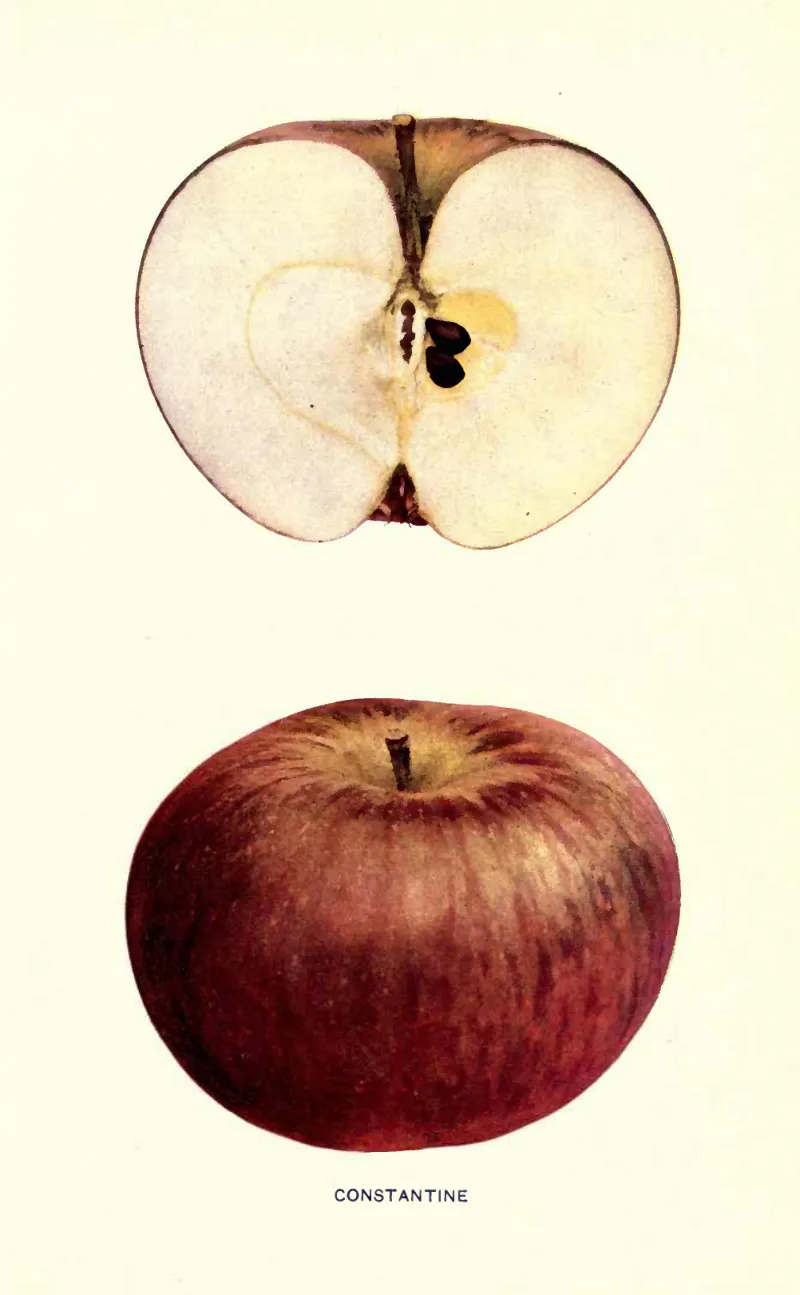
Constantine
Origin/History
Constantine is of the Aport type and very closely resembles Alexander. Its origin is uncertain. It was first described in Europe in 1873 (Leroy) and in America in 1880 in the Iowa Horticultural Society Report (Budd). It has been known under the names Grand Duc Constantin and Grand Duke Constantine, as well as Berry Apple, Riabinouka, and No. 457.
Compared to Alexander, Constantine ripens about a week later, keeps longer, hangs later on the tree, cracks less about the calyx and stem, and is considered by some to be a little better in flavor. The percentage of marketable fruit is greater than that of Alexander, as there are fewer drops and the skin is less often discolored by chafing against the branches. It is not certain that it is as good a variety for commercial planting as Alexander, but it appears worthy of testing where a variety of the Alexander type is desired.
Tree
Tree small to below medium size (Hedrick simply "small"), at first moderately vigorous but with age becomes a slow grower. Form spreading, open, with short, stout, curved branches. Twigs moderately long, curved, slender; internodes long. Bark brown with some olive-green, lightly streaked with scarf-skin; pubescent near tips. Lenticels scattering, medium to small, oblong, not raised. Buds medium size, plump, obtuse, free, slightly pubescent. [Twig, bark, lenticels, and bud details from Beach only; not given by Hedrick.]
The trees are not so large as those of Alexander and may be planted more closely. Constantine is a reliable cropper, yielding good crops biennially or nearly annually. [Cropping details from Beach only.]
Fruit
Size: Large or very large (Beach); very large (Hedrick).
Form: Roundish conic, flat at the base, varying to oblate conic (Beach); round-conic to oblate-conic (Hedrick). Regular or somewhat ribbed, symmetrical.
Stem: Below medium to long, rather slender to moderately thick (Beach); medium to long, slender to thick (Hedrick).
Cavity: Large, acuminate or acute (Beach: "acuminate or acute"; Hedrick: "acuminate"), very deep, broad, symmetrical, russeted and with outspreading rays of greenish-russet.
Calyx: Medium to rather large, usually somewhat open (Beach); open (Hedrick). Lobes medium in width and length, acute.
Basin: Narrow to medium in width (Beach); narrow (Hedrick). Moderately deep to deep (Beach; Hedrick omits depth). Abrupt, smooth or slightly wrinkled.
Skin: Thick, tough, smooth, waxy. Color clear greenish-yellow or whitish (Beach), greenish-yellow (Hedrick), mottled, marbled and blushed with bright red over nearly the whole surface, with wide broken stripes of carmine radiating from the cavity, overspread with thin bloom. Dots whitish or pale russet. Prevailing effect bright red.
Calyx tube: Long, wide, funnel-shape or conical (Beach); funnel-shape (Hedrick).
Stamens: Median or below (Beach); median (Hedrick).
Core: Medium size, somewhat abaxile (Beach); abaxile (Hedrick). Cells open or partly closed (Beach); open or closed (Hedrick). Core lines somewhat clasping (Beach); clasping (Hedrick). Carpels broadly ovate or approaching cordate, emarginate.
Seeds: Medium or below in size (Beach); medium in size (Hedrick). Moderately wide, short, thick, plump, obtuse, dark brown.
Flesh: Whitish (Beach); white (Hedrick). Moderately firm (Beach); firm (Hedrick). Coarse, tender, juicy, sprightly subacid. Quality fair to good. Some hold that it is rather better in flavor than Alexander.
Season
Late September to November. Ripens about a week later than Alexander and continues longer in season.
Uses
Suitable for culinary use and market.
Other
Beach notes that as grown at the Geneva Station, the fruit shows fewer cracks about the calyx and stem than Alexander, and the skin is less often discolored by chafing against the branches, resulting in a higher proportion of marketable fruit.
Book Sources
Described in 2 period pomological works
Nursery Catalog Sources
Found in 2 catalogs (1886–1913) from Alabama, Illinois
- Huntsville Wholesale Nurseries (Jessie S. Moss , Proprietor; W.F. Heikes, Manager), Huntsville , Alabama — 1886 — listed as Riabinouka
- Benjamin Buckman (personal inventory) , Farmingdale , Illinois — 1913 — listed as Riabinouka
View original book sources (2)
— S.A. Beach, The Apples of New York, Vol. 2 (1905)CONSTANTINE.
REFERENCES. 1. Leroy, 1873:335. fig. 2. Budd, Ia. Hort. Soc. Rpt., 1880:524. 3. Gibb, Montreal Hort. Soc. Rpt., 1881:155. 4. Hogg, 1884:95. 5. Gibb, Montreal Hort. Soc. Rpt., 1886-87:14. 6. Ib., 14:86. 1888. 7. Hoskins, Rural N. Y., 51:682. 1892. fig.
SYNONYMS. Berry Apple (7). CONSTANTINE (2, 3). GRAND DUC CONSTANTIN (1). GRAND DUKE CONSTANTINE (4, 5, 6, 7). Grand Duke Constantine (2, 3). No. 457 (7). Riabinouka (7).
This fruit is of the Aport type and very closely resembles Alexander. The flesh is rather coarse, subacid and fair to good in quality. Some hold that it is rather better in flavor than Alexander. As grown at this Station, the fruit, as compared with that of Alexander, begins to ripen about a week later and continues longer in season. The trees are not so large and may be planted more closely together than those of Alexander. It is a reliable cropper, yielding good crops biennially or nearly annually. The percentage of marketable fruit is greater than that of Alexander because there are fewer drops, the apples are less apt to show cracks about the calyx and stem and the skin is less often discolored by chafing against the branches. We are not sure that it is as good a variety for commercial planting as Alexander, but it appears to be worthy of testing where a variety of the Alexander type is desired.
TREE. Tree small to below medium size, at first moderately vigorous but with age it becomes a slow grower with short, stout, curved branches. Form spreading, open. Twigs moderately long, curved, slender; internodes long. Bark brown with some olive-green, lightly streaked with scarf-skin; pubescent near tips. Lenticels scattering, medium to small, oblong, not raised. Buds medium size, plump, obtuse, free, slightly pubescent.
FRUIT. Fruit large or very large. Form roundish conic flat at the base, varying to oblate conic, regular or somewhat ribbed, symmetrical. Stem below medium to long, rather slender to moderately thick. Cavity large, acuminate or acute, very deep, broad, symmetrical, russeted and with outspreading rays of greenish-russet. Calyx medium to rather large, usually somewhat open; lobes medium in width and length, acute. Basin narrow to medium in width, moderately deep to deep, abrupt, smooth or slightly wrinkled. Skin thick, tough, smooth, waxy, clear greenish-yellow or whitish, mottled, marbled and blushed with bright red over nearly the whole surface with wide broken stripes of carmine radiating from the cavity, overspread with thin bloom. Dots whitish or pale russet. Prevailing effect bright red. Calyx tube long, wide, funnel-shape or conical. Stamens median or below. Core medium size, somewhat abaxile; cells open or partly closed; core lines somewhat clasping. Carpels broadly ovate or approaching cordate, emarginate. Seeds medium or below, moderately wide, short, thick, plump, obtuse, dark brown. Flesh whitish, moderately firm, coarse, tender, juicy, sprightly subacid, fair to good; suitable for culinary use and market. Season late September to November.
— U.P. Hedrick, Cyclopedia of Hardy Fruits (1922)CONSTANTINE. Fig. 15. Grand Duke Constantine. Constantine is very similar to the better-known Alexander, from which it differs in that the fruit ripens a week later, keeps longer, hangs later, cracks less, and is a little better in quality. The trees are not so large as those of Alexander and may be planted more closely. The origin of Constantine is uncertain. It was first described in Europe in 1873, in America in 1880 in the Iowa Horticultural Society Report.
- Constantine. (X¾)
Tree small, at first vigorous but becoming a slow grower, spreading, open, with short, stout, curved branches. Fruit very large, round-conic to oblate-conic, regular or ribbed, symmetrical; stem medium to long, slender to thick; cavity large, acuminate, very deep, broad, symmetrical, russeted and with outspreading rays of greenish-russet; calyx open; lobes medium in width and length, acute; basin narrow, abrupt, smooth or wrinkled; skin thick, tough, smooth, waxy, greenish-yellow, mottled, marbled and blushed with bright red over nearly the whole surface, with wide broken stripes of carmine radiating from the cavity, overspread with thin bloom; dots white or pale russet; prevailing effect bright red; calyx-tube long, wide, funnel-shape; stamens median; core of medium size, abaxile; cells open or closed; core-lines clasping; carpels broadly ovate or cordate, emarginate; seeds medium in size, wide, short, thick, plump, obtuse, dark brown; flesh white, firm, coarse, tender, juicy, sprightly subacid; fair to good; late September to November.