Easter Bergamot
Pear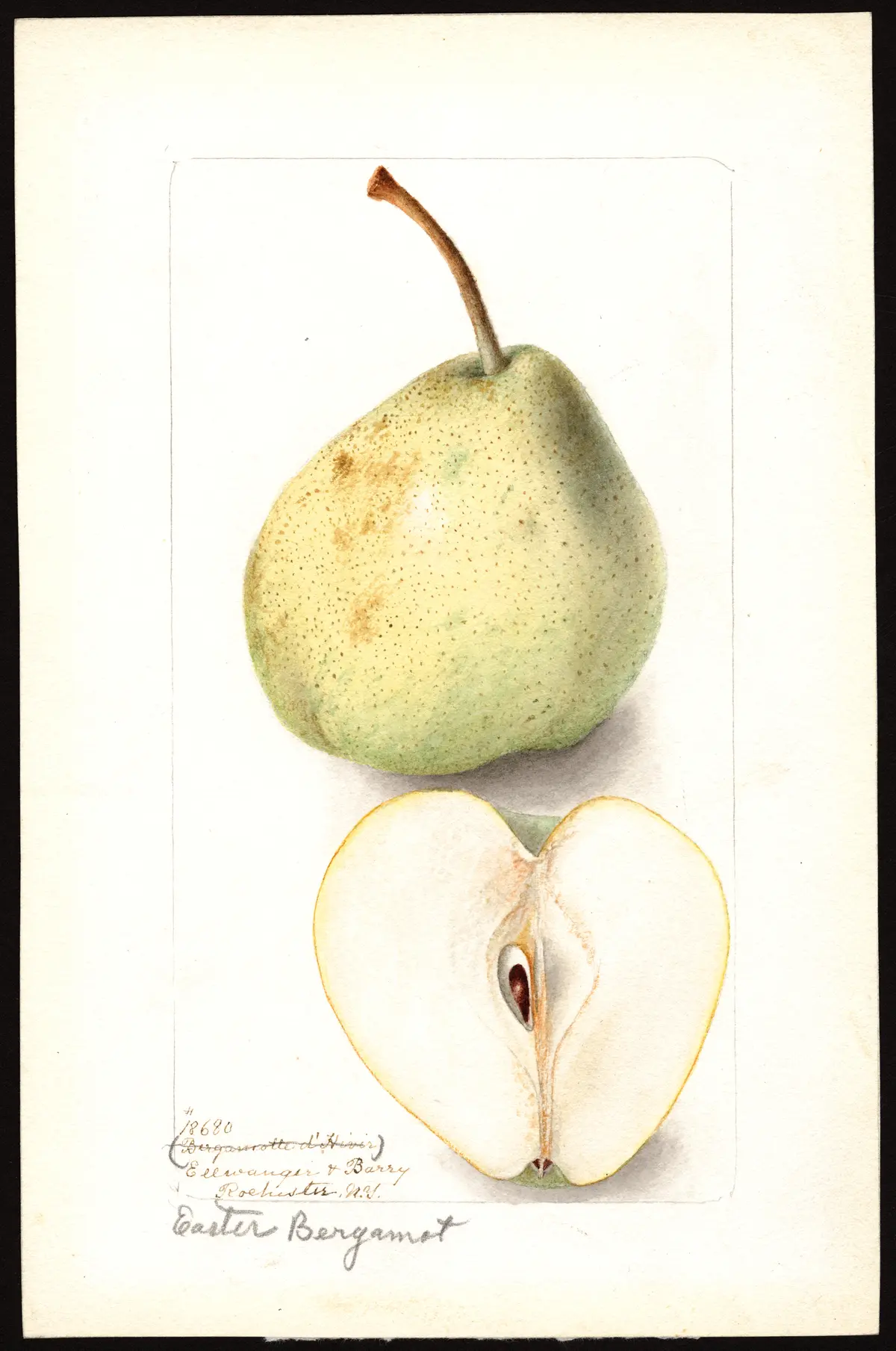
USDA Pomological Watercolor Collection
Easter Bergamot
Origin / History
An old French pear. Merlet wrote of it in 1675, calling it Bergamote de Pasques or the La Grilliere (Hedrick). According to Switzer it was early known in England: he saw trees of it at Hampton Court growing against a wall said to have been erected by Queen Elizabeth, which had every appearance of having stood there since that time. Coxe described it in 1817 under the heading "Paddington, or Easter Bergamot." Elliott classes it as foreign. Hedrick cites accounts by Downing (Fruit Trees of America, 1869) and Hogg (Fruit Manual, 1884). He also cites Leroy (Dictionnaire de Pomologie, 1867, with figure), who treats it as Bergamote de Paques.
Tree
Not described in source.
Fruit
Size: Medium to large. Elliott gives medium or above, and Coxe calls it a large fruit.
Form: Roundish obovate to globular-turbinate; round and full, diminishing or narrowing toward the stalk.
Stem: Short and thick (Coxe).
Cavity: Not described in source.
Calyx: Not described in source.
Basin: Not described in source.
Skin: Green, pale green, or grayish green and dull, inclining to yellow and changing to pale yellow as it ripens; greenish yellow (Elliott).
Dots: Small and gray (Coxe); thickly dotted with brown (Hedrick).
Flesh and flavor: Flesh white, juicy, semi-fine, gritty. It is crisp and breaking (Thomas, Hedrick), or half buttery (Coxe). Flavor sprightly, somewhat acid, pleasant; juice sweet and acid. Hedrick finds it "with not much perfume or flavor" and rates it "second only, on account of its extreme lateness."
Core and seeds: Not described in source.
Season
The recorded season runs from January to May. Most authors place it in late winter and spring, February or March to May. Coxe gives January to March. Thomas gives late winter in one entry and late October in another.
Uses
Not described in source.
Subtypes / Variants
Not described in source.
Other
Not described in source.
Book Sources
Described in 4 period pomological works
- Thomas, The American Fruit Culturist (1903) — listed as Bergamot, Easter
- Coxe, A View of the Cultivation of Fruit Trees (1817) — listed as 43. Paddington, Or Easter Bergamot
- Elliott, The Western Fruit Book (1865)
- Hedrick, The Pears of New York (1921)
Nursery Catalog Sources
Found in 3 catalogs (1845–1864) from Massachusetts
- Winship's Nursery (Brighton Nurseries , operated by the Winship family), Brighton (Boston) , Massachusetts — 1845 — listed as Bergamot Easter
- Hovey & Co. , Cambridge , Massachusetts — 1849
- St. Helena Nursery , Howell Prairie, Marion County, OR (Marion Co., Ogn.) — 1864
View original book sources (4)
— William Coxe, A View of the Cultivation of Fruit Trees (1817)
- PADDINGTON, OR EASTER BERGAMOT.
This is a large fruit; of a round full shape, diminishing towards the stem, which is short and thick—the skin is green, with small grey dots, inclining to yellow as it ripens; the flesh is white, half buttery, sprightly, and somewhat acid: it is in season from January to March.
— F.R. Elliott, The Western Fruit Book (1865)Bergamot, Easter. Bergamot de Paques, Bergamot d'Hiver, Bergamot de Bugi, Bergamot de Toulouse, Winter Bergamot, Paddington, Royal Tairling, Terling, Robert's Keeping Foreign. Medium or above, roundish obovate, greenish yellow. February, May.
— John J. Thomas, The American Fruit Culturist (1903)Bergamot, Easter. Medium, roundish-obovate, pale green; crisp, juicy, pleasant. Late October.
[Additional entry in this volume: "Easter Bergamot", pp. 784–784]
Bergamot, Easter. Medium, roundish-obovate, pale green; crisp, juicy, pleasant. Late winter.
— U.P. Hedrick, The Pears of New York (1921)Easter Bergamot.
i. Downing Fr. Trees Am. 751. 1869. 2. Hogg Fruit Man. 572. 1884. Bergamote de Paques. 3. Leroy Dict. Pom. 1:250, fig. 1867.
An old French pear of which Merlet wrote in 1675, calling it Bergamote de Pasques or the La Grilliere. This variety was early known in England according to Switzer who saw trees of it at Hampton Court growing against a wall said to have been erected by Queen Elizabeth and which had every appearance of having stood there since that time. Fruit medium, globular-turbinate, narrowing toward the stalk, grayish-green, dull, changing to pale yellow, thickly dotted with brown; flesh white, semi-fine, gritty, breaking; juice sweet, acid, with not much perfume or flavor; second only, on account of its extreme lateness; Mar. to May.