Harrisons Large Fall Pear
Pear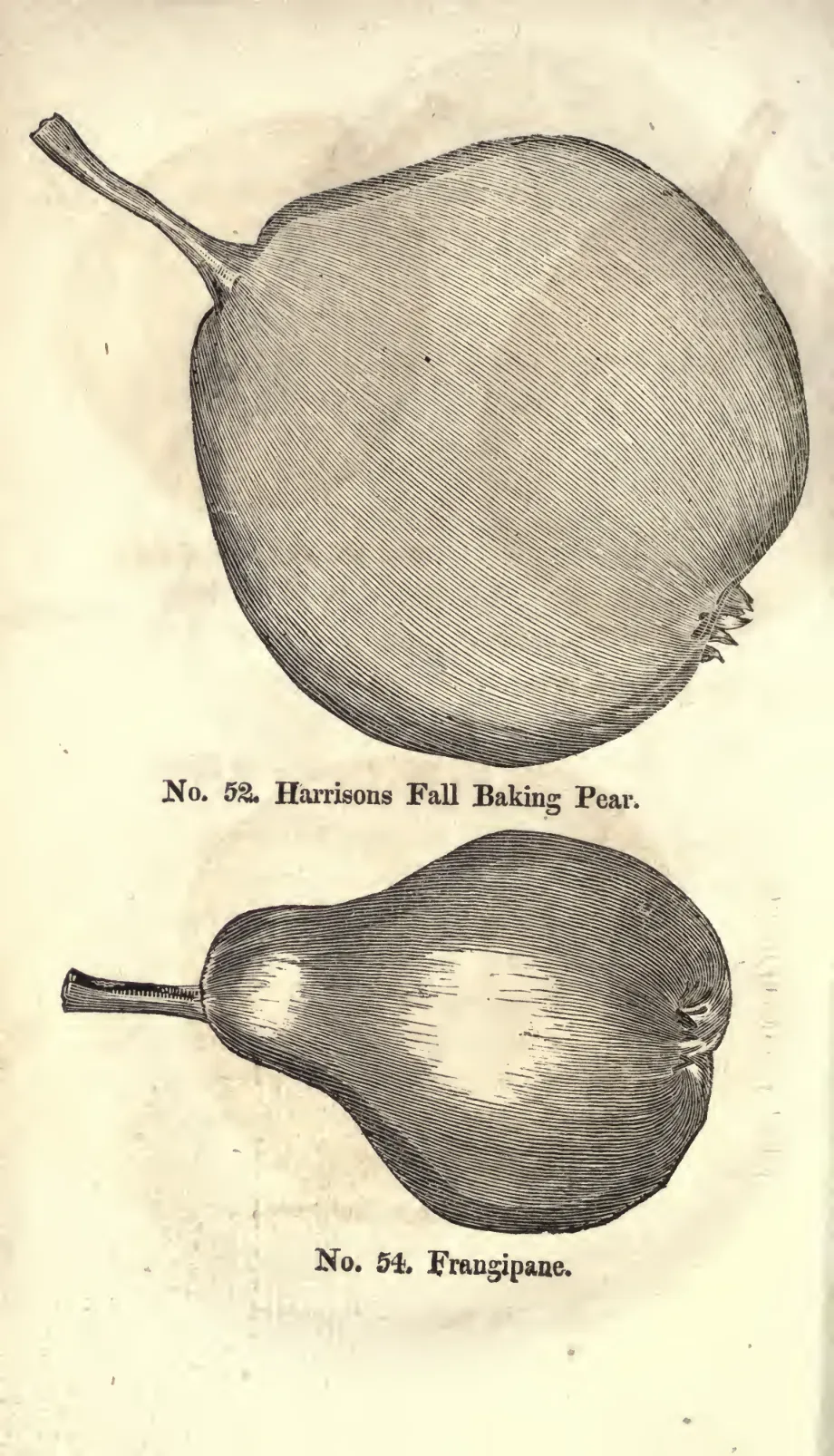
Harrisons Large Fall Pear
Origin / History
An American variety (Downing). Hedrick calls it "a fine old baking pear of American origin." Coxe described it in 1817 as No. 52, with additional entries in the same volume under the heading "Harrisons Fall Baking Pear." He records that Mr. Prince called it the Swans Egg, "but is a much inferior fruit." Hedrick cites Downing's Fruits and Fruit Trees of America of 1857 (p. 575) and Leroy's Dict. Pom. of 1869 (2:608, with figure).
Tree
Very large, strong, and vigorous, of rapid growth. Comes early into bearing; a great, uniform, and abundant bearer.
Fruit
Size: Large; very large (Coxe).
Form: Irregular, inclined, obovate obtuse pyriform (Downing). Coxe describes it as flat at the blossom end, otherwise very round, and but little diminished toward the stem.
Stem: Large and long (Coxe).
Cavity: Not described in source.
Calyx: Not described in source.
Basin: Not described in source.
Skin: Pale yellow, with a red cheek.
Dots: Not described in source.
Flesh and flavor: Flesh coarse, "without much juice or flavour" (Coxe).
Core and seeds: Not described in source.
Season
Ripens from August into October. Most authors place it in August and September, and Coxe gives September. Hedrick extends the season to October. Coxe says it "continues without rotting a long time."
Uses
A baking and cooking pear. Coxe calls it "excellent for baking, requiring when ripe no sugar." Thomas says it is "valued only for baking."
Subtypes / Variants
Not described in source.
Other
Not described in source.
Book Sources
Described in 4 period pomological works
- Coxe, A View of the Cultivation of Fruit Trees (1817)
- Downing, Fruits and Fruit Trees of America (1900) — listed as Harrison's Large Fall
- Thomas, The American Fruit Culturist (1903) — listed as Harrison's Large Fall
- Hedrick, The Pears of New York (1921) — listed as Harrison Large Fall
Nursery Catalog Sources
Found in 1 catalog (1845) from Massachusetts
- Winship's Nursery (Brighton Nurseries , operated by the Winship family), Brighton (Boston) , Massachusetts — 1845 — listed as Rushmore's Bon Chretien
View original book sources (4)
— William Coxe, A View of the Cultivation of Fruit Trees (1817)
- HARRISONS LARGE FALL PEAR.
This is by Mr. Prince called the Swans Egg ; but is a much inferior fruit—it is however excellent for baking, requiring when ripe no sugar ; it is of very large size, flat at the blossom end, otherwise very round, but little diminished towards the stem, which is large and long : the flesh is coarse, without much juice or flavour ; the tree is very large and vigorous, a great and uniform bearer—it ripens in September, and continues without rotting a long time.
[Additional entry in this volume: "Harrisons Fall Baking Pear", pp. 325–325]
- HARRISONS LARGE FALL PEAR.
This is by Mr. Prince called the Swans Egg ; but is a much inferior fruit—it is however excellent for baking, requiring when ripe no sugar ; it is of very large size, flat at the blossom end, otherwise very round, but little diminished towards the stem, which is large and long : the flesh is coarse, without much juice or flavour ; the tree is very large and vigorous, a great and uniform bearer—it ripens in September, and continues without rotting a long time.
[Additional entry in this volume: "No. 52. Harrisons Fall Baking Pear.", pp. 329–329]
No. 52. Harrisons Fall Baking Pear.
— A.J. Downing, The Fruits and Fruit Trees of America (1900)Harrison's Large Fall.
Rushmore's Bon Chretien. Richmond. Englebert Lott. Large Swan's Egg. Lott's Pear.
An American variety, a strong, rapidly-growing tree, comes early into bearing, and produces abundantly.
Fruit large, irregular, inclined, obovate obtuse pyriform, pale yellow, with a red cheek. Valued as a cooking fruit. August, September.
— John J. Thomas, The American Fruit Culturist (1903)Harrison's Large Fall. Large, yellow—valued only for baking.
— U.P. Hedrick, The Pears of New York (1921)Harrison Large Fall.
- Downing Fr. Trees Am. 575. 1857. Rushmore.
- Leroy Diet. Pom. 2:608, fig. 1869.
A fine old baking pear of American origin. Fruit large, irregular, inclined, obovate-obtuse-pyriform, pale yellow with a red cheek; Aug. to Oct.