Hibernal
Apple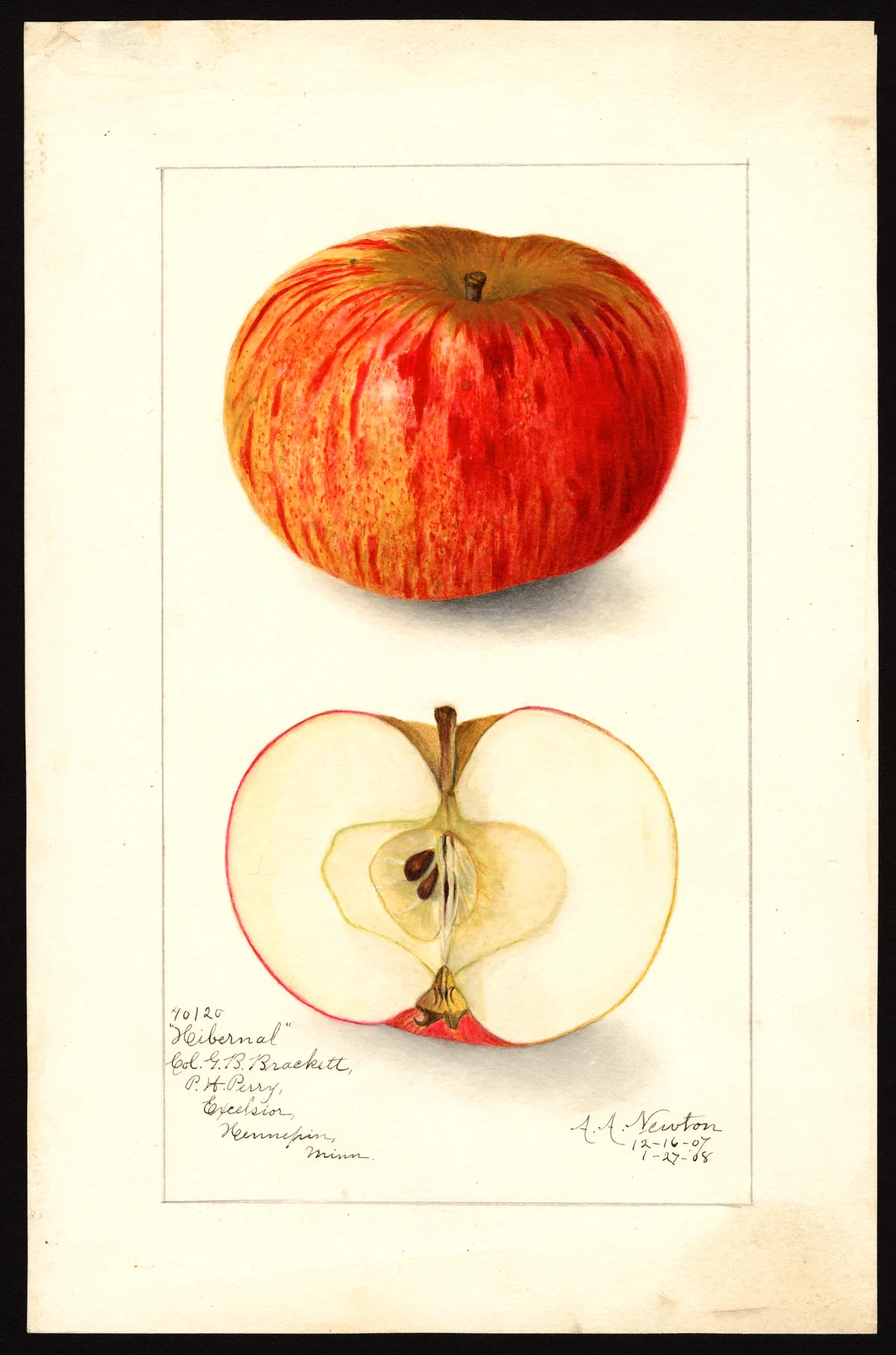
USDA Pomological Watercolor Collection
Hibernal
Origin / History
Hibernal is a Russian variety, imported from Russia between 1870 and 1880 (Hedrick). It is also known by the designation No. 378. The variety has proven valuable in portions of the Upper Mississippi valley, the Middle Northwest, and parts of Canada because of its ability to withstand the rigorous climatic conditions of those regions. Hansen notes that it "represents what is probably the hardiest type of the Russian race of apples; there are several sorts closely resembling, or identical with, Hibernal." Hedrick ranks Hibernal "among the best of the Russian apples—one of the most valuable in rigorous climates in the United States and Canada," noting that the fruit is "but mediocre for dessert or cooking, but the tree commends the variety most highly."
C. G. Patten (quoted by Hansen) remarked: "I find that Pendent Ear is not one-tenth the value of Hibernal with me, because it does not bear, and yet the fruit is the same." Hansen also lists a related Hibernal Group including Lieby or Recumbent (No. 240), Yellow Arcadian (No. 327), Silken Leaf (75 M.), Recumbent (41 M.), Pendent Ear, and several entries he flags as spurious (Juicy Burr No. 544, Romenskoe No. 599, Zusoff, Omensk, Romna, and Ostrakoff of the U.S. Department).
Tree
Tree vigorous, very spreading, productive, healthy, and one of the hardiest of its type (Hansen, Budd-Hansen, Hedrick, Macoun). The strong spreading growth makes it especially desirable as a stock for top-grafting — Hansen calls it "probably the best we have at the present time" for that purpose, and Hedrick describes it as making "an excellent orchard plant either to produce its own fruit or upon which to graft less hardy or less vigorous varieties." Hedrick further describes the tree as "spreading, drooping; branches short, stout, curved, crooked and drooping." The Central Experimental Farm catalog records it as "a strong grower" (planted spring 1896) and "a vigorous grower" (planted spring 1895).
Fruit
Size and Form
Fruit large, irregular, with sides often unequal (Hansen, Budd-Hansen, Hedrick). Form is variously described as oblate to roundish oblate, conical (Hansen, Lowther); roundish, often oblate, conical (Budd-Hansen); usually oblate-conic (Hedrick); oblate (Hansen's tabular description); "broadly conical" (Central Experimental Farm, 1896 planting); and "oblong, conical" (Central Experimental Farm, 1895 planting). Hansen gives size as "5" in his tabular description.
Stem and Cavity
Stem medium, often short (Hansen, Budd-Hansen, Lowther); Hedrick describes the stem as "short and stout, pubescent." Hansen's tabular description simply lists "medium." Cavity regular, medium deep, with a large patch of russet radiating out irregularly over nearly the entire base — Hansen, Budd-Hansen, and Lowther all note that "this is a marked characteristic." Hansen's tabular form gives the cavity as "medium narrow, deep, russeted extending over base." Hedrick describes the cavity as "large, acute, deep, wide, furrowed, occasionally lipped, russeted."
Calyx and Basin
Calyx half open or open (Hansen, Budd-Hansen, Lowther). Hedrick describes the calyx as "large, open or partly closed; lobes often separated at the base, broad, acute." Basin narrow, rather shallow, wrinkled (Hansen, Budd-Hansen, Lowther); Hansen's tabular description gives the basin as "broad, medium deep, corrugated." Hedrick describes the basin as "large, often oblique, narrow, abrupt, furrowed and wrinkled."
Skin and Surface
Skin thick (Hansen, Budd-Hansen); Hedrick adds "tough, smooth or roughened with flecks of russet." Surface greenish yellow, with a dull bronze mixed red on the sunny side, with a few dull crimson splashes (Hansen, Budd-Hansen, Lowther). Hansen's tabular description gives the color as "yellowish green, stripes and splashes of pale red, many white dots." Hedrick describes the color as "pale yellow, with thin bloom, blushed and striped with bright carmine." The Central Experimental Farm catalog records skin as "greenish yellow with a pale red cheek" (1896 planting) and "greenish, with a faint blush on the sunny side" (1895 planting).
Dots
Dots white, minute, obscure, often some large russet dots (Hansen, Budd-Hansen, Lowther). Hedrick describes the dots as "small, numerous, pale yellow or gray, conspicuous."
Flesh and Flavor
Flesh acid, with some astringency, juicy, good for cooking (Hansen, Budd-Hansen, Lowther). Hansen's tabular description gives the flesh as "yellowish green, medium fine" with flavor "sour." Macoun reports: "Flesh yellowish, crisp, tender, juicy, acid; core small; quality above medium... Although not a good dessert fruit this is a fine cooking apple and on account of its great hardiness and productiveness is one of the best of the Russian apples." Hedrick describes the flesh as "yellow, firm, coarse, juicy, brisk subacid; astringent; fair to good." The Central Experimental Farm catalog records flesh as "white, brisk, pleasantly acid, quality good" (1896 planting) and "white, moderately juicy, a little coarse, sub-acid, quality poor" (1895 planting).
Core and Seeds
Core closed, meeting (Hansen, Budd-Hansen, Lowther); Macoun notes the core as "small." Tube funnel-shaped (Hansen, Budd-Hansen); Lowther also gives "tube funnel shaped." Hedrick describes the calyx-tube as "long, wide, funnel-shape." Stamens median (Hansen, Budd-Hansen, Lowther, Hedrick). Seeds few (Hansen, Budd-Hansen, Lowther); Hedrick describes the seeds as "small, short, plump, obtuse, dark brown." Hedrick further notes: "core small, axile; cells closed; core-lines meeting; carpels round-ovate, emarginate, tufted."
Season
Early winter (Hansen, Lowther); late fall and early winter (Budd-Hansen); September to November (Macoun); September to January (Hedrick); October (Central Experimental Farm, 1896 planting); late autumn (Central Experimental Farm, 1895 planting).
Hansen also gives the related Recumbent (Lejanka, 41 M) as "late fall, early winter."
Uses
Good for cooking; not a good dessert fruit (Hansen, Budd-Hansen, Lowther, Macoun, Hedrick). Macoun: "Although not a good dessert fruit this is a fine cooking apple." Hedrick: "but mediocre for dessert or cooking." The variety is especially valued as a stock for top-grafting because of its strong spreading growth and hardiness (Hansen, Budd-Hansen, Lowther, Hedrick).
Subtypes / Variants
Hansen lists a Hibernal Group of closely resembling or identical sorts: Hibernal (No. 378), Lieby or Recumbent (No. 240), Yellow Arcadian (No. 327), Silken Leaf (75 M.), Recumbent (41 M.), and Pendent Ear. He marks the following as spurious within the group: Juicy Burr (No. 544), Romenskoe (No. 599), Zusoff, Omensk, Romna, and Ostrakoff (United States Department).
Hansen provides a separate entry for Recumbent (Lejanka, 41 M), noting it is "nearly or quite identical with Hibernal and equally valuable." Fruit large, roundish oblate, somewhat angular; surface greenish yellow, partially and sparsely covered with broken stripes and splashes of dull red, the color not solid but somewhat bronzed and mixed; dots russet, rough, scattered, a few white dots; cavity regular, medium, with much russet, the russet in most specimens radiating out all over the base; stem medium, stout, curved; basin wide, shallow, corrugated around the eye; calyx closed, segments erect convergent. Core open; tube long and very broad; stamens median; flesh juicy, acid, good for culinary. Late fall, early winter.
Thomas describes Recumbent (Lieby) as: "Large, irregular, oblate; yellow splashed red and crimson; cavity deep, regular, basin wide; skin astringent, good for cooking. Russian." (Fig. 431.)
Other
Not described in source.
Book Sources
Described in 6 period pomological works
- Beach, The Apples of New York Vol. 2 (1905)
- Budd & Hansen, Systematic Pomology (1914)
- Hansen, A Study of Northwestern Apples (1902)
- Lowther (ed.), Encyclopedia of Practical Horticulture (1914)
- Hedrick, Cyclopedia of Hardy Fruits (1922)
- Thomas, The American Fruit Culturist (1903) — listed as Recumbent
Nursery Catalog Sources
Found in 9 catalogs (1900–1913) from Illinois, Missouri
- Central Experimental Farm , Dominion Department of Agriculture, Agassiz, British Columbia (under test; Bulletin No. 3, Second Series) — 1900
- Central Experimental Farm , Dominion Department of Agriculture, Agassiz, British Columbia (under test; Bulletin No. 3, Second Series) — 1900 — listed as Silken Leaf
- Benjamin Buckman (personal inventory) , Farmingdale , Illinois — 1901
- Phoenix Nursery Company (W. E. Rossney , President; Sidney Tuttle, Vice-President), Bloomington , Illinois — 1904
- Stark Bros. Nurseries & Orchards Co. , Louisiana , Missouri — 1906
- Stark Bros. Nurseries & Orchards Co. , Louisiana , Missouri — 1910
- Stark Bros. Nurseries & Orchards Co. , Louisiana , Missouri — 1911
- Stark Bros. Nurseries & Orchards Co. , Louisiana , Missouri — 1912
- Benjamin Buckman (personal inventory) , Farmingdale , Illinois — 1913
View original book sources (7)
— N.E. Hansen, A Study of Northwestern Apples (1902)Hibernal—Origin, Russia; this variety represents what is probably the hardiest type of the Russian race of apples; there are several sorts closely resembling, or identical with, Hibernal. Tree vigorous, very spreading, productive. The strong spreading growth makes it especially desirable as a stock for top-grafting, probably the best we have at the present time—Fruit large, irregular, oblate to roundish oblate, conical; skin thick; surface greenish yellow, with a dull bronze mixed red on sunny side, with a few dull crimson splashes; dots white, minute, obscure, often some large russet dots; cavity regular, medium deep, with a large patch of russet radiating out irregularly over nearly the entire base, this is a marked characteristic; stem medium, often short; basin narrow, rather shallow, wrinkled; calyx half open or open. Core closed, meeting; tube funnel-shaped; stamens median; seeds few; flesh acid, with some astringency, juicy, good for cooking. Early winter.
HIBERNAL GROUP.
Hibernal, No. 378; Lieby or Recumbent, 240; Yellow Arcadian, 327; Juicy Burr, 544 (spurious); Romenskoe, 599 (spurious); Silken Leaf, 75 M.; Recumbent, 41 M.; Zusoff, (spurious); Pendent Ear; Omensk, (spurious); Romna, (spurious); Ostrakoff, United States Department, (spurious).
DESCRIPTION:
Hibernal—siez, 5; form, oblate; color, yellowish green, stripes and splashes of pale red, many white dots; cavity, medium narrow, deep, russeted extending over base; stem, medium; basin, broad, medium deep, corrugated; calyx, half open; flesh, yellowish green, medium fine; flavor, sour; season early winter; origin, Russia.
C. G. Patten: "I find that Pendent Ear is not one-tenth the value of Hibernal with me, because it does not bear, and yet the fruit is the same." (Rus. Nom. Com.)
[Additional entry in this volume: "Recumbent", pp. 90–90]
Recumbent (Lejanka, 41 M)—Origin, Russia; nearly or quite identical with Hibernal and equally valuable, see Hibernal group—Fruit large, roundish oblate, somewhat angular; surface greenish yellow, partially and sparsely covered with broken stripes and splashes of dull red, the color is not solid but somewhat bronzed and mixed; dots russet, rough, scattered, a few white dots; cavity regular, medium, with much russet; the russet in most specimens radiating out all over the base; stem medium, stout, curved; basin wide, shallow, corrugated around the eye; calyx closed, segments erect convergent. Core open; tube long and very broad; stamens median; flesh juicy, acid, good for culinary. Late fall, early winter.
— John J. Thomas, The American Fruit Culturist (1903)Recumbent. (Lieby.) Large, irregular, oblate; yellow splashed red and crimson; cavity deep, regular, basin wide; skin astringent, good for cooking. Fig. 431. Russian.
— S.A. Beach, The Apples of New York, Vol. 2 (1905)HIBERNAL.
REFERENCES. 1. Budd, Ia. Hort. Soc. Rpt., 1880:525. 2. Gibb, Montreal Hort. Soc. Rpt., 1881:156. 3. Tuttle, Ib., 8:136. 1881-82. 4. Ib., 1883:98. 5. Gibb, Ia. Hort. Soc. Rpt., 1883:440. 6. Budd, Ia. Agr. Coll. Bul., 1885:15. 7. Gibb, Montreal Hort. Soc. Rpt., 1886-87:15. 8. Schroeder, Ib., 1886-87:71. 9. Craig, Ib., 1886-87:103. 10. Budd, Ia. Agr. Coll. Bul., 1890:20. 11. Can. Hort., 13:216. 1890. 12. Budd, Ia. Sta. Bul., 19:537. 1892. 13. Bailey, An. Hort., 1892:241. 14. Taylor, Me. Pom. Soc. Rpt., 1892:57, 58. 15. Freeborn, Nat. Nurseryman, 1894:132. 16. Can. Hort., 17:7. 1894. 17. Gard. and For., 8:340. 1895. 18. Munson, Me. Sta. Rpt., 1896:74. 19. Waugh, Vt. Sta. Bul., 61:30. 1897. 20. Am. Pom. Soc. Cat., 1897:13. 21. Troop, Ind. Sta. An. Rpt., 12:80. 1899. 22. Waugh, Vt. Sta. An. Rpt., 14:296. 1901. 23. Macoun, Can. Dept. Agr. Bul., 37:39. 1901. 24. Hansen, S. D. Sta. Bul., 76:57. 1902. fig. 25. Munson, Me. Sta. An. Rpt., 1902:83, 87. 26. Budd-Hansen, 1903:98. fig.
SYNONYMS. HIBERNAL (1, 2, 3, 4, 5, 6, 7, 9, 10, 11, 12, 13, 14, 15, 16, 17, 18, 19, 20, 21, 22, 23, 24, 25, 26). Hibernal (8). No. 378 (1, 2, 4, 5, 6, 10, 12, 15, 18, 25, 26). Orsimus (4, 5, 6). Osimof (8). Romna (23).
A Russian variety which is proving valuable in portions of the Upper Mississippi valley and the Northwest because of its ability to withstand the rigorous climatic conditions of those regions. Hansen says of it: "This variety represents what is probably the hardiest type of the Russian race of apples; there are several sorts closely resembling, or identical with, Hibernal. Tree vigorous, very spreading, productive. The strong spreading growth makes it especially desirable as a stock for top-grafting, probably the best we have at the present time. Fruit large, irregular, oblate to roundish oblate conical; skin thick; surface greenish-yellow, with a dull bronze mixed red on sunny side, with a few dull crimson splashes; dots white, minute, obscure, often some large russet dots; cavity regular, medium deep, with a large patch of russet radiating out irregularly over nearly the entire base, this is a marked characteristic; stem medium, often short; basin narrow, rather shallow, wrinkled; calyx half open or open. Core closed, meeting; tube funnel-shaped; stamens median; seeds few; flesh acid, with some astringency, juicy, good for cooking. Early winter" (24, 26).
Macoun reports "Flesh yellowish, crisp, tender, juicy, acid; core small; quality above medium; season September to November. Tree very hardy, a strong, spreading grower, and very productive. Although not a good dessert fruit this is a fine cooking apple and on account of its great hardiness and productiveness is one of the best of the Russian apples" (23).
— J.L. Budd & N.E. Hansen, American Horticultural Manual, Part II: Systematic Pomology (1914)Hibernal (No. 378). — Origin, Russia. This variety represents what is probably the hardiest type of the Russian race of apples; there are several sorts closely resembling, or identical with, Hibernal; tree vigorous, very spreading, productive. The strong spreading growth makes it desirable as a stock for top-grafting. Fruit large, irregular, roundish, often oblate, conical, skin thick; surface greenish yellow, with a dull bronze mixed red on sunny side with a few dull crimson splashes; dots white, minute, obscure, often some large russet dots; cavity regular, medium deep, with a large patch of russet radiating out irregularly over nearly the entire base, this is a marked characteristic; stem medium, often short; basin narrow, rather shallow, wrinkled; calyx half open or open. Core closed, meeting; tube funnel-shaped; stamens median; seeds few; flesh acid with some astringency, juicy, good for cooking. Late fall and early winter. Hibernal.
— Granville Lowther (ed.), Encyclopedia of Practical Horticulture (1914)Hibernal
The Hibernal is a Russian variety that is proving valuable in the Upper Mississippi valley and the Middle Northwest, because of its ability to withstand the rigorous climatic conditions of those regions. Hansen says of it: "This variety represents what is probably the hardiest type of the Russian race of apples. There are several sorts closely resembling or almost identical with the Hibernal. Tree vigorous, very spreading, productive. The strong spreading growth makes it especially desirable as a stock for top-grafting probably the best we have at the present time. Fruit large, irregular, oblate to roundish oblate conical; surface greenish yellow, with a dull bronze mixed red on the sunny side, with a few dull crimson splashes; dots white, minute, obscure, often some large russet dots; cavity large, regular, medium, deep, with a large patch of russet radiating out irregularly nearly over the entire base; this is a marked characteristic. Stem medium, often short, basin narrow, rather shallow, wrinkled; calyx half open or open. Core closed, meeting; tube funnel shaped, stamens median. Seeds few; flesh acid with some astringency, juicy, good for cooking. Early winter."
Macoun reports: "Flesh yellowish, crisp, tender, juicy, acid; core small, quality above medium; season September to November. Tree very hardy, a strong spreading grower, and very productive. Although not a good dessert apple, it is fine for cooking; on account of its great hardiness and productiveness it is one of the best of the Russian apples."
— U.P. Hedrick, Cyclopedia of Hardy Fruits (1922)HIBERNAL. Romna.
Hibernal ranks among the best of the Russian apples—one of the most valuable in rigorous climates in the United States and Canada. The fruit is but mediocre for dessert or cooking, but the tree commends the variety most highly. The tree is not only one of the hardiest of its type, but also one of the most vigorous, healthy, and productive, making an excellent orchard plant either to produce its own fruit or upon which to graft less hardy or less vigorous varieties. The variety was imported from Russia between 1870 and 1880.
Tree vigorous, spreading, drooping; branches short, stout, curved, crooked and drooping. Fruit large, not uniform in shape or size, usually oblate-conic, often with sides unequal; stem short and stout, pubescent; cavity large, acute, deep, wide, furrowed, occasionally lipped, russeted; calyx large, open or partly closed; lobes often separated at the base, broad, acute; basin large, often oblique, narrow, abrupt, furrowed and wrinkled; skin thick, tough, smooth or roughened with flecks of russet; color pale yellow, with thin bloom, blushed and striped with bright carmine; dots small, numerous, pale yellow or gray, conspicuous; calyx-tube long, wide, funnel-shape; stamens median; core small, axile; cells closed; core-lines meeting; carpels round-ovate, emarginate, tufted; seeds small, short, plump, obtuse, dark brown; flesh yellow, firm, coarse, juicy, brisk subacid; astringent; fair to good; September to January.
— Central Experimental Farm, Central Experimental Farm, Agassiz BC — Catalogue of Fruit Trees under Test (Bulletin No. 3, 1900) (1900)Planted Spring 1896. Tree a strong grower. Fruit large, broadly conical. Skin greenish yellow with a pale red cheek. Flesh white, brisk, pleasantly acid, quality good. Season October.
Planted Spring 1895. Tree a vigorous grower. Fruit large, oblong, conical. Skin greenish, with a faint blush on the sunny side. Flesh white, moderately juicy, a little coarse, sub-acid, quality poor. Season late Autumn.