Hyslop
Crab Apple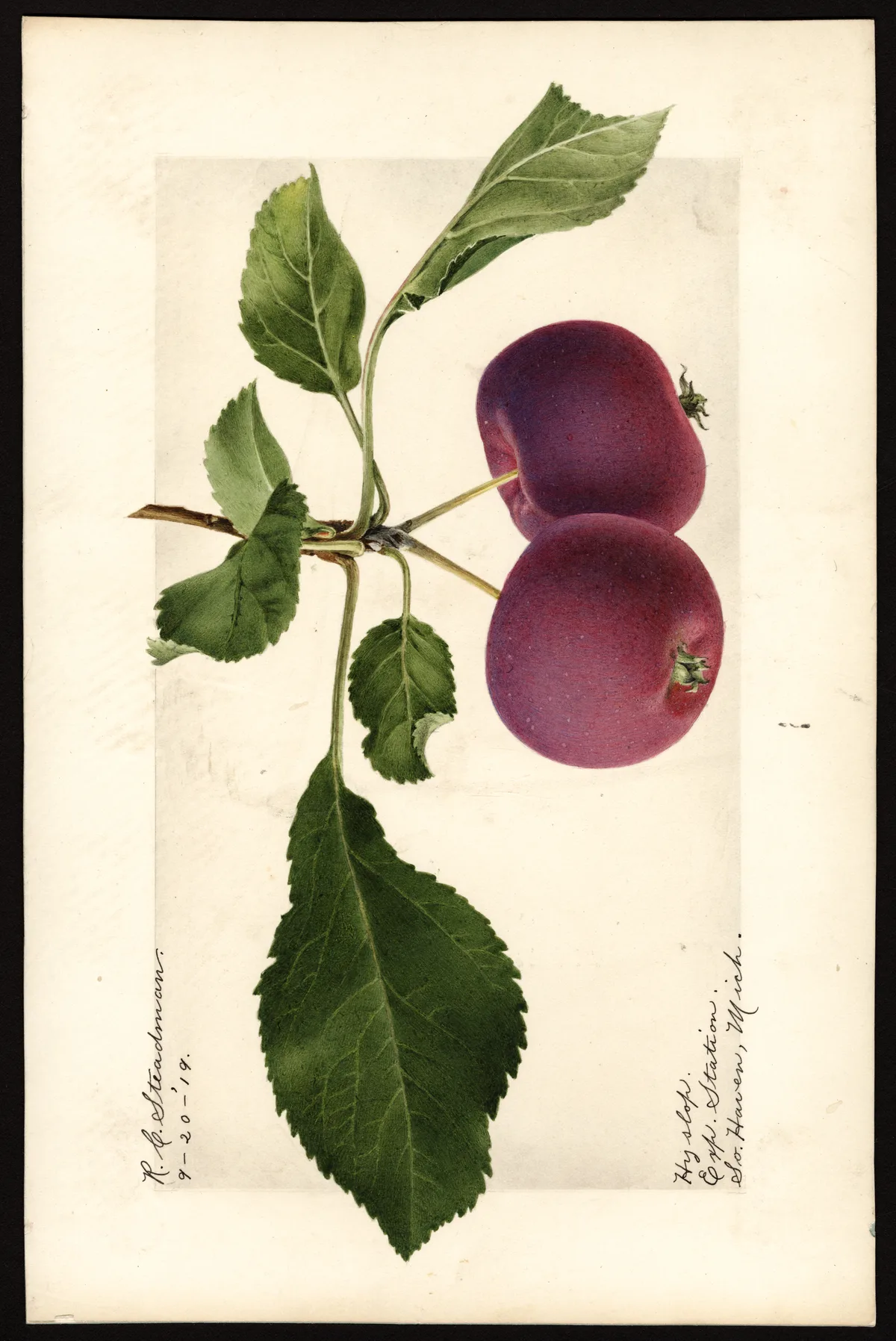
USDA Pomological Watercolor Collection
Hyslop
Origin/History
The origin of Hyslop is unknown. It is an old and widely known variety that has long been one of the standard American crab-apples, widely distributed and extensively cultivated. Warder first set forth its good qualities in 1869. In 1869 Downing remarked that "This variety has been long and pretty extensively cultivated." It is commonly listed by nurserymen throughout the country and is one of the best known and most widely cultivated of the crabapples. Thomas (1903) called it "the most popular variety." At the Central Experimental Farm, Agassiz BC, trees were planted in spring 1890.
Tree
The tree is hardy — Thomas describes it as "very hardy and vigorous," and Beach notes it is "very hardy." Growth is strong (Downing, Budd-Hansen) or vigorous to moderately vigorous (Beach), and rather spreading (Downing, Budd-Hansen); Beach and Hedrick describe the form as upright-spreading, rather open. It is a reliable cropper yielding good crops biennially or in some cases annually (Beach), and productive (Central Experimental Farm).
Wood light-colored, a little downy (Downing, Budd-Hansen).
Twigs long, curved, slender; internodes long. Bark olive-green, tinged with reddish-brown, lightly streaked with scarf-skin; slightly pubescent near tips. Lenticels numerous, very conspicuous, greenish-yellow, medium to large, oblong. Buds exceptionally large and prominent, very long, narrow, plump, acute, free, slightly pubescent.
Fruit
Size
Large (Downing, Thomas, Budd-Hansen, Central Experimental Farm); above medium to large, very uniform in size and shape (Beach); medium to large, uniform in size and shape (Hedrick). Borne in clusters (Downing, Thomas, Budd-Hansen, Beach), thickly borne in large clusters (Hedrick).
Form
Roundish ovate (Downing, Central Experimental Farm); round (Thomas); roundish ovate or obovate, sometimes a little inclined to oblong, regular or obscurely ribbed, symmetrical (Beach); round-ovate or obovate, sometimes oblong, regular or obscurely ribbed, symmetrical (Hedrick); roundish, tapering, regular, sometimes obscurely angular; surface smooth (Budd-Hansen).
Stem
Long, slender (Downing, Budd-Hansen); rather short to very long, slender (Beach); short to very long, slender (Hedrick).
Cavity
Acuminate, rather small, shallow, narrow to medium in width, sometimes furrowed, often slightly russeted (Beach); acuminate, small, shallow, narrow, sometimes furrowed, often russeted (Hedrick); obtuse, regular (Budd-Hansen).
Calyx
Closed (Downing, Beach, Hedrick, Budd-Hansen). Beach describes it as medium to large, closed, with lobes medium to long, narrow, acuminate, reflexed; Hedrick describes lobes as long, narrow, acuminate, reflexed. Budd-Hansen describes the calyx as small, closed, with segments divergent.
Basin
Shallow, medium to wide, distinctly furrowed and wrinkled (Beach); shallow, wide, distinctly furrowed and wrinkled (Hedrick); flat, corrugated (Budd-Hansen).
Skin
Dark rich red, covered with a thick blue bloom (Downing, Central Experimental Farm); bright, deep crimson, blue bloom (Thomas); very brilliantly colored, dark red or purplish overspread with thick blue bloom (Beach); clear pale yellow almost completely overspread with lively dark red shading to deep carmine or purplish carmine and covered with thick, blue bloom (Beach, detailed); pale yellow overspread with dark red shading to deep carmine and covered with thick bloom (Hedrick); nearly or entirely covered with very dark solid red, with heavy blue bloom, a beautiful fruit (Budd-Hansen). Brilliant, dark red with heavy blue bloom (Hedrick summary).
Dots
Small, numerous, pale or gray (Beach); small, numerous, pale (Hedrick); minute, yellow, obscure, many (Budd-Hansen).
Flesh and Flavor
Yellowish, subacid, good for culinary uses and for cider (Downing). Sub-acid, only fair quality, handsome (Thomas). Yellow, sometimes with tinge of red next the skin, very firm, moderately fine, at first juicy but eventually becoming dry and mealy, subacid, astringent, good for culinary purposes (Beach). Yellow with a tinge of red next the skin, firm, fine-grained, juicy, but eventually becoming dry and mealy; very good; subacid, astringent (Hedrick). Yellow, acid; good for culinary use and for cider (Budd-Hansen).
Core and Seeds
Core medium size, axile; cells symmetrical, closed; core lines meeting. Carpels elongated ovate, emarginate. Seeds small, narrow, short, plump, obtuse to acute, medium brown (Beach); seeds small, narrow, short, plump, obtuse, brown (Hedrick). Core closed; tube conical; stamens median (Budd-Hansen). Calyx tube short, narrow, cone-shape to urn-shape; stamens median (Beach, Hedrick).
Season
Late September and October (Beach, Hedrick); October (Thomas); September to November (Budd-Hansen); September (Central Experimental Farm). Its late season and showy appearance make it valuable for market (Budd-Hansen).
Uses
Good for culinary purposes (Beach, Hedrick); good for culinary uses and for cider (Downing, Budd-Hansen). Desirable both for home use and for market (Beach). Valuable for market on account of its late season and showy appearance (Budd-Hansen).
Subtypes/Variants
Not described in source.
Other
Not described in source.
Book Sources
Described in 5 period pomological works
Nursery Catalog Sources
Found in 71 catalogs (1881–1925) from Alabama, California, England, Illinois, Kansas, Maryland, Massachusetts, Missouri, Nebraska, New Jersey, Oregon, Pennsylvania, Virginia, Washington
- Hutchison Nursery , James Hutchison, Oakland , California — 1881
- Felix Gillet , Barren Hill Nursery, Nevada City , California — 1884
- Huntsville Wholesale Nurseries (Jessie S. Moss , Proprietor; W.F. Heikes, Manager), Huntsville , Alabama — 1886
- W.R. Strong & Co. , Capital and Orange Hill Nurseries (Robert Williamson, prop.), Sacramento , California — 1886
- Fancher Creek Nursery , Fresno , California — 1886
- Felix Gillet , Barren Hill Nursery, Nevada City , California — 1888
- California Nursery Co. , Niles , California — 1889
- Felix Gillet , Barren Hill Nursery, Nevada City , California — 1889
- Felix Gillet , Barren Hill Nursery, Nevada City , California — 1890
- William H. Moon Co. , Morrisville, Bucks County , Pennsylvania — 1890
- Felix Gillet , Barren Hill Nursery, Nevada City , California — 1891
- Missouri Nursery Co. , Louisiana , Missouri — 1891
- Puyallup & Yakima Nurseries , Puyallup, Washington (Lock Box 191) and North Yakima , Washington — 1892
- Milwaukie-Canby Nurseries , Canby, OR (and Milwaukie, OR) — 1893
- Oregon Wholesale Nurseries , Salem , Oregon — 1893
- Rogers Nursery Co. , Moorestown , New Jersey — 1893
- Sherwood Hall Nursery Co. , Timothy Hopkins (Menlo Park Nurseries), San Francisco / Menlo Park , California — 1893
- Multnomah Nurseries , Russellville , Oregon — 1894
- The Vineland Nurseries (Kelsey & Co. , Proprietors), St. Joseph, Missouri (Office: 13th and Atchison Sts., 2 Blocks East of the Citizens St. Car Line) — 1894
- Woodburn Nurseries , Woodburn, Marion Co. , Oregon — 1894
- Felix Gillet , Barren Hill Nursery, Nevada City , California — 1895
- The Lovett Company , Little Silver , New Jersey — 1896
- Felix Gillet , Barren Hill Nursery, Nevada City , California — 1897
- The Salem Nursery (John A. Francis , Proprietor), Salem , Virginia — 1897
- J.V. Cotta (Cotta Nursery) , Carroll County , Illinois — 1898
- Reading Nursery , Jacob W. Manning, Proprietor, Reading , Massachusetts — 1898
- Brown Brothers Co. , Continental Nurseries, Rochester, NY (also operated from Toronto, Canada) — 1899
- Alabama Nursery Co. , Huntsville , Alabama — 1900
- Central Experimental Farm , Dominion Department of Agriculture, Agassiz, British Columbia (under test; Bulletin No. 3, Second Series) — 1900
- The Dalles Nurseries , The Dalles , Oregon — 1901
- Washington Nursery Co. , Toppenish , Washington — 1901
- Benjamin Buckman (personal inventory) , Farmingdale , Illinois — 1901
- Brown Brothers Co. , Continental Nurseries, Rochester, NY (also operated from Toronto, Canada) — 1901
- Mountain Grove Nurseries (Tippin & Moore , Proprietors; Geo. T. Tippin, J. W. Tippin, J. C. Moore), Mountain Grove , Missouri — 1901
- S.L. Watkins , Grizzly Flats, El Dorado County , California — 1901
- Forestville Nurseries , T.J. True, Forestville , California — 1902
- Pacific Nursery Company (W. O. Hudson & A. D. Hudson) , Tangent , Oregon — 1903
- Russellville Nursery Co. , Russellville, OR (three miles east of Portland, one mile from Montavilla car line) — 1903
- Phoenix Nursery Company (W. E. Rossney , President; Sidney Tuttle, Vice-President), Bloomington , Illinois — 1904
- Stark Bros. Nurseries & Orchards Co. , Louisiana , Missouri — 1906
- Russellville Nursery Co. , Montavilla Station, Portland, OR (three miles east of Portland, one mile from Montavilla car line) — 1907
- Carlton Nursery Co. , Carlton , Oregon — 1909
- Milton Nursery Co. (A. Miller & Sons , Proprietors), Milton , Oregon — 1909
- Wm. J. Corse (successor to Robert Sinclair / Sinclair Nurseries) , Baltimore , Maryland — 1909
- Washington Nursery Company , Toppenish , Washington — 1909
- C.F. Lansing , Salem , Oregon — 1910
- Stark Bros. Nurseries & Orchards Co. , Louisiana , Missouri — 1910
- Galbraith Nursery Co. (DeWitt Hansen , Pres.-Mgr.), Fairbury , Nebraska — 1911
- Island Nurseries & Fruit Farm , Vashon (Vashon Island) , Washington — 1911
- Stark Bros. Nurseries & Orchards Co. , Louisiana , Missouri — 1911
- James Veitch & Sons , Ltd., Royal Exotic Nursery, Chelsea, London (also Coombe Wood, Langley, and Feltham) , England — 1911
- Ballygreen Nurseries , Hanford , Washington — 1912
- Pacific Nursery Company , Portland , Oregon — 1912
- Stark Bros. Nurseries & Orchards Co. , Louisiana , Missouri — 1912
- Vineland Nurseries Company , Clarkston , Washington — 1912
- Washington Nursery Company , Toppenish , Washington — 1912
- J. B. Pilkington , Nurseryman, Portland, OR (nurseries near Newberg, forty miles from Portland) — 1913
- Island Nurseries & Fruit Farm , Vashon (Vashon Island) , Washington — 1914
- Island Nurseries & Fruit Farm , Vashon (Vashon Island) , Washington — 1915
- Union Nurseries , J.B. Weaver & Sons, Union , Oregon — 1915
- J.B. Pilkington , Portland , Oregon — 1916
- Holsinger Bros. Nurseries (Holsinger Brothers Nursery) , Rosedale , Kansas — 1916
- Island Nurseries & Fruit Farm , Vashon (Vashon Island) , Washington — 1916
- Manalapan Nurseries , Englishtown , New Jersey — 1916
- Island Nurseries & Fruit Farm , Vashon (Vashon Island) , Washington — 1917
- Fancher Creek Nurseries , George C. Roeding, Fresno , California — 1918
- Christopher Nurseries / John Stewart & Sons , Christopher , Washington — 1920
- Oregon Nursery Co. , Orenco , Oregon — 1920
- Benedict Nursery Co. , Portland , Oregon — 1921
- Columbia & Okanogan Nursery Co. , Wenatchee , Washington — 1925
- North-Western Nurseries , Walla Walla , Washington
View original book sources (6)
— A.J. Downing, The Fruits and Fruit Trees of America (1900)Hyslop.
This variety has been long and pretty extensively cultivated. The trees are hardy, the growth strong, rather spreading. Wood light colored, a little downy.
Fruit large, produced in clusters, roundish ovate, dark rich red, covered with a thick blue bloom. Stalk long, slender. Calyx closed. Flesh yellowish, subacid, good for culinary uses and for cider.
— John J. Thomas, The American Fruit Culturist (1903)Hyslop.* Large, round; in clusters; bright, deep crimson, blue bloom; sub-acid, only fair quality, handsome. Tree very hardy and vigorous. October. The most popular variety.
— S.A. Beach, The Apples of New York, Vol. 2 (1905)HYSLOP.
REFERENCES. 1. Warder, Tilt. Jour. Hort., 1869:206. figs. 2. Downing, 1869:424. 3. Fitz, 1872:147. 4. Gibb, Montreal Hort. Soc. Rpt., 1876:21. 5. Minn. Hort. Soc. Rpt., 1876:110. 6. Barry, 1883:359. 7. Gibb, Montreal Hort. Soc. Rpt., 1884:398. 8. Thomas, 1885:513. 9. Wickson, 1889:249. 10. Bailey, An. Hort., 1892:241. 11. Munson, Me. Sta. Rpt., 1893:134. 12. La. Sta. Bul., 27:926. 1894. 13. Can. Hort., 26:489. 1903. figs. 14. Budd-Hansen, 1903:220. fig.
SYNONYMS. HISLOP (1). HYSLOP (2, 3, 4, 5, 6, 7, 9, 10, 11, 12, 13, 14). HYSLOP'S CRAB (8).
Fruit large, very brilliantly colored, dark red or purplish overspread with thick blue bloom; borne in clusters. The tree is a good grower, very hardy, and a reliable cropper yielding good crops biennially or in some cases annually. It is desirable both for home use and for market.
Historical. Origin unknown. In 1869 Downing remarked: "This variety has been long and pretty extensively cultivated" (2). It is commonly listed by nurserymen throughout the country (10). It is one of the best known and most widely cultivated of the crabapples.
TREE.
Tree vigorous or moderately vigorous. Form upright spreading, rather open. Twigs long, curved, slender; internodes long. Bark olive-green, tinged with reddish-brown, lightly streaked with scarf-skin; slightly pubescent near tips. Lenticels numerous, very conspicuous, greenish-yellow, medium to large, oblong. Buds exceptionally large and prominent, very long, narrow, plump, acute, free, slightly pubescent.
FRUIT.
Fruit above medium to large, very uniform in size and shape. Form roundish ovate or obovate, sometimes a little inclined to oblong, regular or obscurely ribbed, symmetrical. Stem rather short to very long, slender. Cavity acuminate, rather small, shallow, narrow to medium in width, sometimes furrowed, often slightly russeted. Calyx medium to large, closed; lobes medium to long, narrow, acuminate, reflexed. Basin shallow, medium to wide, distinctly furrowed and wrinkled.
Skin clear pale yellow almost completely overspread with lively dark red shading to deep carmine or purplish carmine and covered with thick, blue bloom. Dots small, numerous, pale or gray.
Calyx tube short, narrow, cone-shape to urn-shape. Stamens median.
Core medium size, axile; cells symmetrical, closed; core lines meeting. Carpels elongated ovate, emarginate. Seeds small, narrow, short, plump, obtuse to acute, medium brown.
Flesh yellow, sometimes with tinge of red next the skin, very firm, moderately fine, at first juicy but eventually becoming dry and mealy, subacid, astringent, good for culinary purposes.
Season late September and October.
— J.L. Budd & N.E. Hansen, American Horticultural Manual, Part II: Systematic Pomology (1914)Hyslop. — An old and widely known variety. Tree of strong growth, rather spreading. Wood light-colored, a little downy. Its late season and showy appearance makes it valuable for market.
Fruit large, produced in clusters, roundish, tapering, regular, sometimes obscurely angular; surface smooth, nearly or entirely covered with very dark solid red, with heavy blue bloom, a beautiful fruit; dots minute, yellow, obscure, many; cavity obtuse, regular; stem long, slender; basin flat, corrugated; calyx small, closed; segments divergent. Core closed; tube conical; stamens median; flesh yellow, acid; good for culinary use and for cider. September to November.
Hyslop Crab.
— U.P. Hedrick, Cyclopedia of Hardy Fruits (1922)HYSLOP. Hyslop has long been one of the standard American crab-apples, and is widely distributed and extensively cultivated. The apples are a brilliant, dark red with heavy blue bloom, and are thickly borne in large clusters. The flesh is yellow with a tinge of red next the skin, firm, fine-grained, juicy, but eventually becoming dry and mealy. The trees are vigorous, hardy, and fruitful. The origin of the variety is unknown; Warder first set forth its good qualities in 1869.
Tree vigorous, upright-spreading, open. Fruit medium to large, uniform in size and shape, round-ovate or obovate, sometimes oblong, regular or obscurely ribbed, symmetrical; stem short to very long, slender; cavity acuminate, small, shallow, narrow, sometimes furrowed, often russeted; calyx closed; lobes long, narrow, acuminate, reflexed; basin shallow, wide, distinctly furrowed and wrinkled; skin pale yellow overspread with dark red shading to deep carmine and covered with thick bloom; dots small, numerous, pale; calyx-tube short, narrow, cone-shape to urn-shape; stamens median; core medium size, axile; cells symmetrical, closed; core-lines meeting; carpels elongated-ovate, emarginate; seeds small, narrow, short, plump, obtuse, brown; flesh yellow, sometimes with tinge of red next the skin, very firm, fine, at first juicy but becoming dry and mealy, subacid, astringent; very good; late September and October.
— Central Experimental Farm, Central Experimental Farm, Agassiz BC — Catalogue of Fruit Trees under Test (Bulletin No. 3, 1900) (1900)Planted Spring 1890. Tree a strong grower and productive. Fruit large, roundish, ovate. Skin dark rich red, with a blue bloom. Season September.