Jones
Pear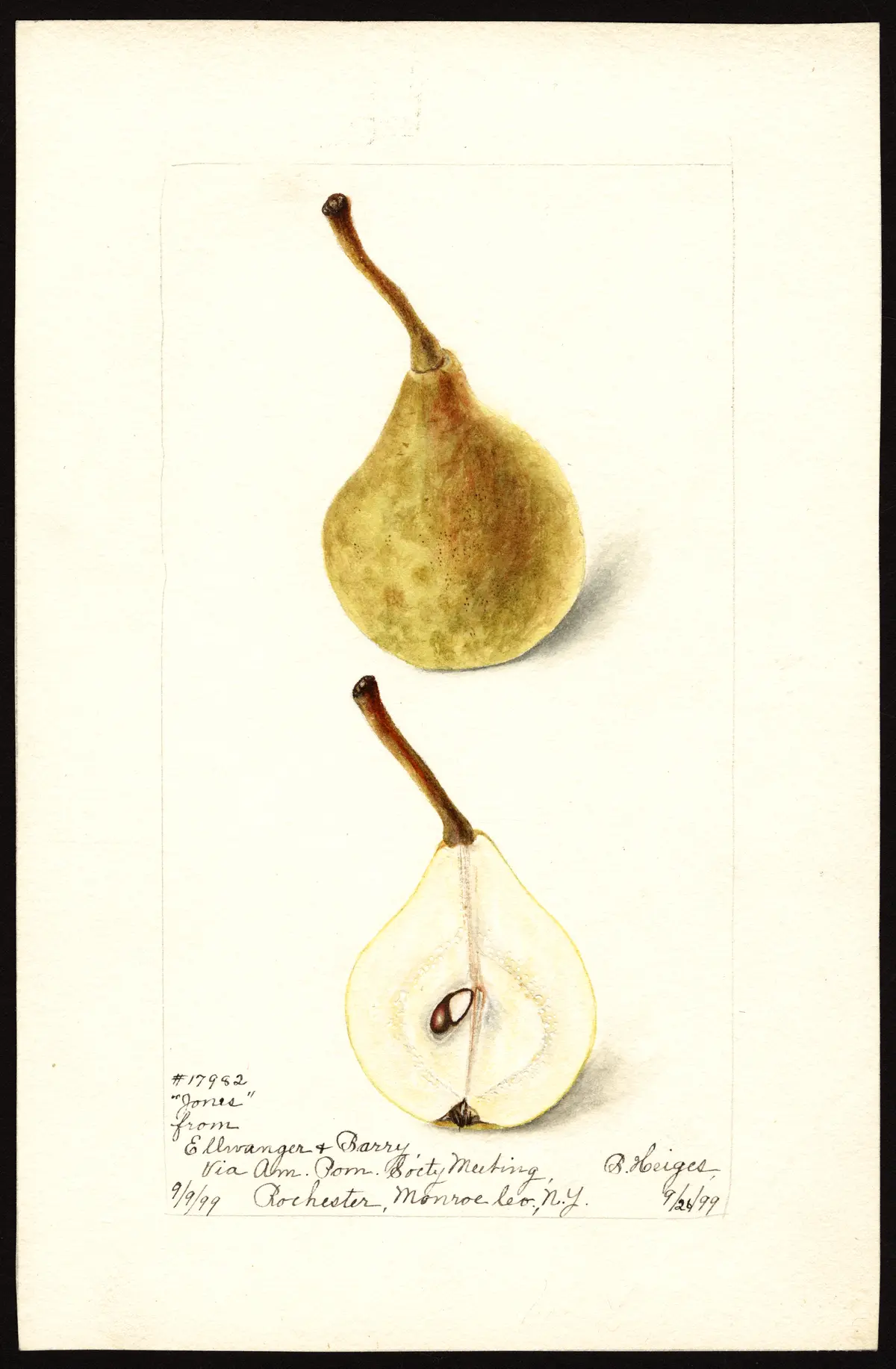
USDA Pomological Watercolor Collection
Jones
Origin / History
Jones originated at Kingsessing, near Philadelphia, Pennsylvania. Hedrick cites its description in Downing's Fruits and Fruit Trees of America, page 515 of the 1857 edition, and page 793 with a figure in the 1869 edition. Downing called it "one of the good Pears, and, were it a little larger, would be one of the most valuable." Thomas called it "productive and valuable."
Tree
Vigorous and productive. Upright in growth (Downing), with shoots diverging and ascending (Thomas). Young shoots of a dull olive brown. Hardy (Budd and Hansen).
Fruit
Size: Medium or below to small.
Form: Pyriform, broad at the calyx, tapering to the stem. Elliott calls it acute pyriform. Thomas gives Bloodgood-shaped, or obovate, remotely pyriform. Budd and Hansen give obovate, pyriform.
Stem: An inch to an inch and a fourth long, variable in thickness, fleshy at insertion, meeting the fruit by a fleshy junction. Inclined (Budd and Hansen).
Cavity: None; the stem is not sunk, the flesh meeting it without cavity.
Calyx: Open (Downing).
Basin: Broad, shallow, uneven.
Skin: Yellow, shaded with russet; surface cinnamon russet or rich yellow russet. Bright cinnamon on the sunny side, reddish in the sun. Budd and Hansen give bright crimson in the sun.
Dots: Not described in source.
Flesh and flavor: Coarse to quite coarse, granular, buttery, juicy, sugary, sweet, brisk and vinous. Thomas calls it melting and of fine flavor. Flesh yellowish according to Thomas, white according to Budd and Hansen. Elliott and Downing call it "very good." Budd and Hansen give "fair to good."
Core and seeds: Not described in source.
Season
Autumn, October or November. Thomas extends it into early winter, ripening late autumn and early winter.
Uses
Not described in source.
Subtypes / Variants
Not described in source.
Other
Figured in Thomas's American Fruit Culturist as Fig. 733.
Book Sources
Described in 5 period pomological works
Nursery Catalog Sources
Found in 4 catalogs (1891–1901) from Alabama, Illinois, Missouri
- Missouri Nursery Co. , Louisiana , Missouri — 1891 — listed as Jones Seedling
- J.V. Cotta (Cotta Nursery) , Carroll County , Illinois — 1898 — listed as Jones Seedling
- Alabama Nursery Co. , Huntsville , Alabama — 1900 — listed as Jones Seedling
- Benjamin Buckman (personal inventory) , Farmingdale , Illinois — 1901 — listed as Jones Seedling
View original book sources (5)
— F.R. Elliott, The Western Fruit Book (1865)Jones.
Small, acute pyriform, cinnamon russet, reddish in sun, juicy, buttery, sweet; "very good." November.
— A.J. Downing, The Fruits and Fruit Trees of America (1900)Jones.
Jones's Seedling.
Origin, Kingsessing, near Philadelphia. This is one of the good Pears, and, were it a little larger, would be one of the most valuable. The tree is vigorous and upright in growth, and productive. Young shoots of a dull olive brown.
Fruit medium or below, pyriform, broad at calyx, tapering to the stem, which meets it by a fleshy junction. Skin yellow, shaded with russet, bright cinnamon on the sunny side. Calyx open, in a broad, shallow, uneven basin. Flesh coarse, granular, buttery, sugary, brisk and vinous. Very good. October.
— John J. Thomas, The American Fruit Culturist (1903)Jones. (Jones' Seedling.) Size medium or small, Bloodgood-shaped, or obovate, remotely pyriform; surface rich yellow russet; stalk an inch or an inch and a fourth in length, variable in thickness, fleshy at insertion, not sunk; basin shallow; flesh yellowish, melting, of fine flavor. Ripens late autumn and early winter. Shoots diverging and ascending. Origin, Kingsessing, near Philadelphia. Productive and valuable. Fig. 733.
— J.L. Budd & N.E. Hansen, American Horticultural Manual, Part II: Systematic Pomology (1914)Jones (Jones Seedling). — Medium, obovate, pyriform; color yellow shaded with russet and bright crimson in the sun; stem one and one-quarter inches long, inclined, and fleshy at insertion with the flesh without cavity; basin broad, shallow, uneven. Flesh white, quite coarse, granular, buttery, sugary, with vinous flavor; quality fair to good. Season, autumn. A vigorous hardy tree. Pennsylvania.
— U.P. Hedrick, The Pears of New York (1921)Jones.
- Downing Fr. Trees Am. 515. 1857. 2. Ibid. 793, fig. 1869.
Originated at Kingsessing, near Philadelphia. Fruit medium or below, pyriform, broad at calyx, tapering to the stem which meets it by a fleshy junction; yellow shaded with russet, bright cinnamon on the sunny side; flesh coarse, granular, buttery, sugary, brisk and vinous; very good; were it a little larger would be one of the most valuable; Oct.