Lodi
Apple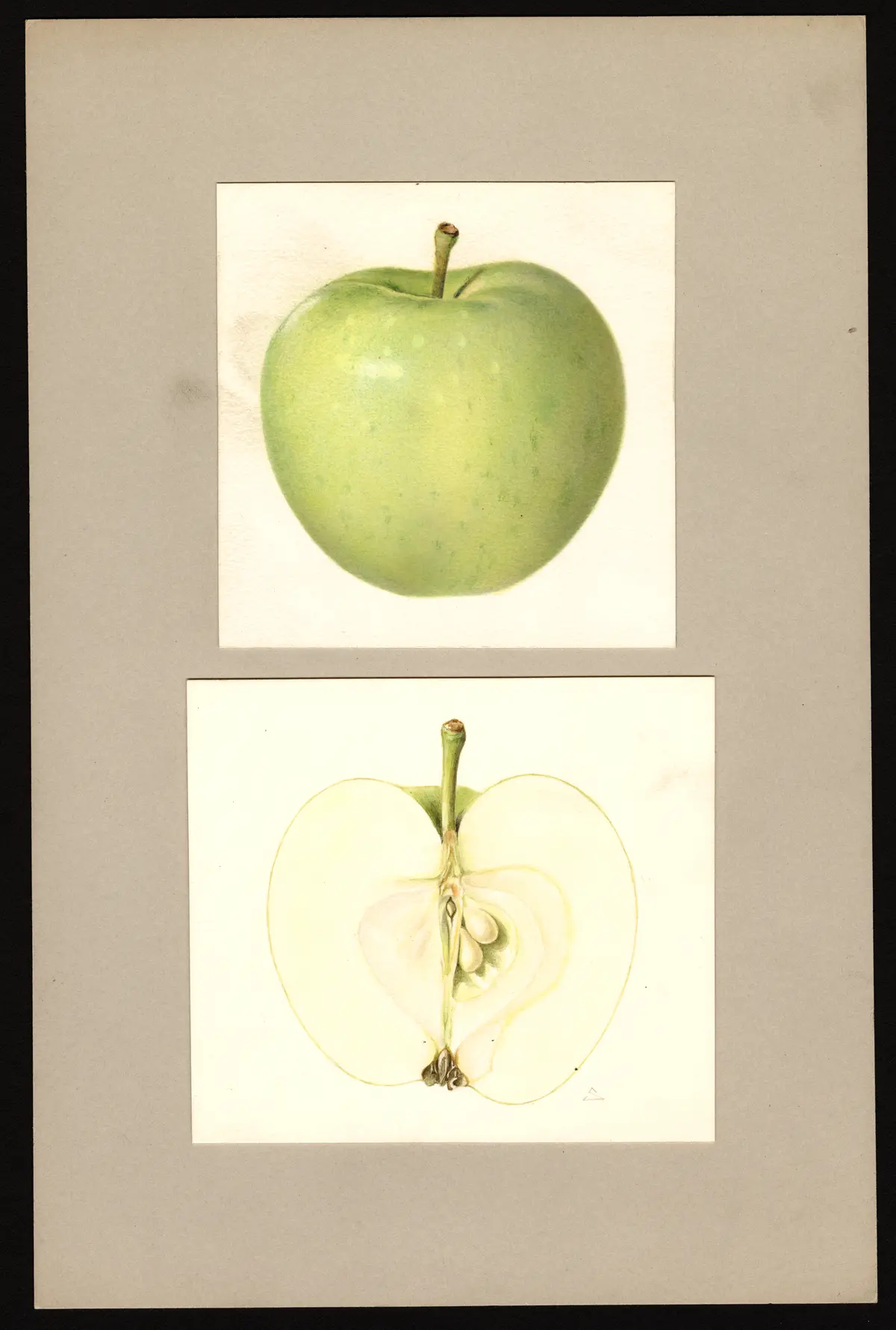
USDA Pomological Watercolor Collection
Lodi
Origin and History
Lodi originated at the Agricultural Experiment Station in Geneva, New York, and was introduced in 1924. It is a cross of Montgomery × Yellow Transparent. The variety was distributed widely throughout the United States via multiple experiment stations and commercial nurseries, establishing a presence across the country from the 1960s onward.
Tree
The tree is of the Yellow Transparent type but notably larger in growth habit. It is reported to be early fruiting and winter hardy.
Fruit
Size and Form: Medium to large, round, slightly conical.
Skin: Pale green or white.
Flesh: White, acid, juicy, slightly soft.
Flavor and Quality: Good culinary quality.
Stem, Cavity, Calyx, and Basin: Not described in source.
Core and Seeds: Not described in source.
Season
Ripens early August.
Uses
Good culinary quality.
Other
As of 1963, Lodi was held at the following institutions: Agricultural Experiment Station, Department of Pomology, Geneva, New York (station number 2581); Agricultural Experiment Station, University of Maine, Orono, Maine; Agricultural Research Service, Irrigation Experiment Station, Prosser, Washington; Moxee Quarantine Station, Moxee, Washington; Agricultural Experiment Station, University of Illinois, Urbana, Illinois; Ashland Spooner Peninsular Station, Sturgeon Bay, Wisconsin; Agricultural Experiment Station, University of Wisconsin, Madison, Wisconsin; Graham Horticultural Experiment Station, Grand Rapids, Michigan; Agricultural Experiment Station, University of Missouri, Columbia, Missouri; Agricultural Experiment Station of Rutgers, New Brunswick, New Jersey; Ohio Agricultural Experiment Station, Wooster, Ohio; Agricultural Experiment Station, University of Vermont, Burlington, Vermont (station number 135, received 1960); Agricultural Experiment Station, Pennsylvania State University, University Park, Pennsylvania; Agricultural Experiment Station, Iowa State University, Ames, Iowa; Agricultural Experiment Station, Oregon State University, Corvallis, Oregon; U.S. Horticultural Field Station, Cheyenne, Wyoming (station number A34307); Agricultural Experiment Station, Kansas State University, Manhattan, Kansas; Agricultural Experiment Station, Oklahoma State University, Stillwater, Oklahoma; Agricultural Experiment Station, University of Connecticut, Storrs, Connecticut; and Agricultural Experiment Station, Purdue University, Lafayette, Indiana.
Book Sources
Described in 1 period pomological work
View original book sources (1)
— H.H. Fisher (USDA ARS), A Survey of Apple Clones in the United States (1963)Lodi originated at the Agricultural Experiment Station, Geneva, New York, and was introduced in 1924. It is a cross of Montgomery × Yellow Transparent. The fruit is medium to large, round, slightly conical; skin pale green or white. Flesh is white, acid, juicy, slightly soft. Good culinary quality. Ripens early August. Tree is of the Yellow Transparent type but large. Reported by the Agricultural Experiment Station, Department of Pomology, Geneva, New York (station number 2581), which received material from the originating station. The Agricultural Experiment Station, University of Maine, Orono, Maine; Agricultural Research Service, Irrigation Experiment Station, Prosser, Washington; Moxee Quarantine Station, Moxee, Washington; Agricultural Experiment Station, University of Illinois, Urbana, Illinois; Ashland Spooner Peninsular Station, Sturgeon Bay, Wisconsin; Agricultural Experiment Station, University of Wisconsin, Madison 6, Wisconsin; and Graham Horticultural Experiment Station, Grand Rapids, Michigan all received the variety from the Agricultural Experiment Station, Geneva, New York (station numbers AP-H-88 and M-754), noting it as early fruiting and winter hardy. The Agricultural Experiment Station, University of Missouri, Columbia, Missouri; Agricultural Experiment Station of Rutgers, New Brunswick, New Jersey; and Ohio Agricultural Experiment Station, Wooster, Ohio received material from Bountiful Ridge Nursery, Princess Anne, Maryland. The Agricultural Experiment Station, University of Vermont, Burlington, Vermont (station number 135) received it from Brookdale-Kingsway, Ltd., Bowmanville, Ontario, Canada in 1960. The Agricultural Experiment Station, Pennsylvania State University, University Park, Pennsylvania received it from Kelly Brothers, Dansville, New York. The Agricultural Experiment Station, Iowa State University, Ames, Iowa received it from Inter-State Nursery, Hamburg, Iowa. The Agricultural Experiment Station, Oregon State University, Corvallis, Oregon received it from Branch Experiment Station, Hood River, Oregon. The U.S. Horticultural Field Station, Cheyenne, Wyoming (station number A34307) received it from Greening Nursery Company, Monroe, Michigan. The Agricultural Experiment Station, Kansas State University, Manhattan, Kansas received material from a commercial nursery. The Agricultural Experiment Station, Oklahoma State University, Stillwater, Oklahoma; Agricultural Experiment Station, University of Connecticut, Storrs, Connecticut; and Agricultural Experiment Station, Purdue University, Lafayette, Indiana also hold this variety.