Malinda
Apple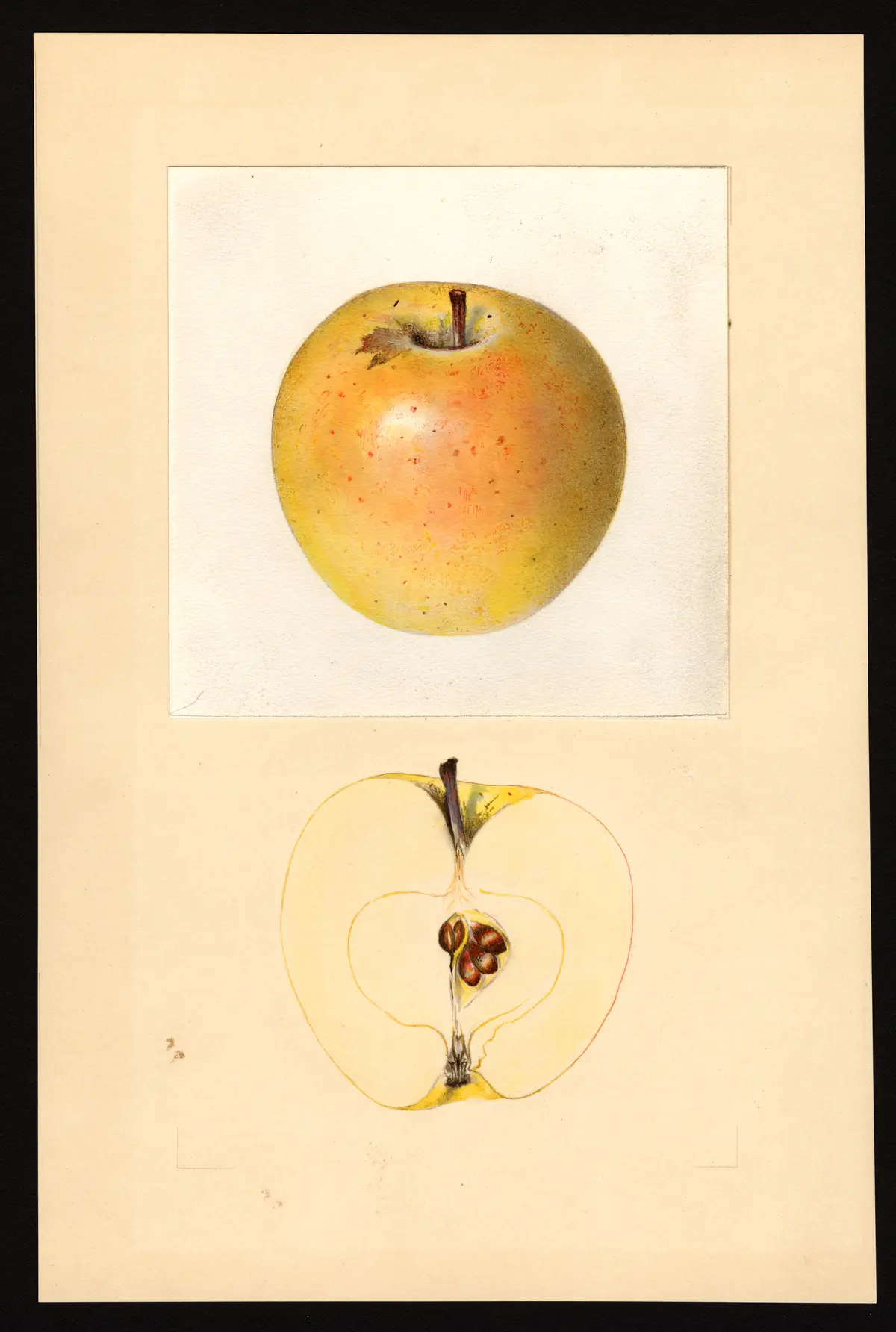
USDA Pomological Watercolor Collection
Malinda
Origin/History
Malinda originated in Orange County, Vermont, raised by Mr. Rollins and named for one of his daughters. It was introduced into Minnesota by his son, J. W. Rollins (given as I. W. Rollins in Budd-Hansen), of Elgin, Minnesota, about 1858 or 1860 (Beach gives the introduction date as "about 1860"). The variety has been recommended among the "ironclad" varieties of the northern states of the Great Plains for its hardiness (Hedrick). It has done well in northern Iowa and southern Minnesota, particularly when top-grafted on Hibernal apple or Virginia crab stock. At the South Dakota Station orchard at Brookings, young trees of Malinda top-grafted on Whitney crab killed back very severely in the winter of 1898–99 (Hansen). At the time of Beach's 1905 account it was as yet untested in New York, and he judged it not worthy of testing there except possibly in regions where hardiness is a prime requisite. Malinda is noted as the maternal parent of Minnesota varieties (Fisher). A separate accession received by Fisher from Jewell Nursery Co., Long Lake, Minn. (station number A33563), and reported by the U.S. Horticultural Field Station at Cheyenne, Wyoming, is recorded as a seedling of Antonovka.
Tree
Tree very hardy (Hedrick); a slender, straggling grower in the nursery, and a tardy bearer — it does not come into bearing young. The tree lacks vigor on its own roots in the orchard and is a rather poor grower on its own roots (Hedrick); for this reason it is commonly top-worked on the very hardy Hibernal apple or on the Virginia crab stock, on which it bears early. Fisher records the tree as medium vigorous.
Twigs medium, rather slender, comparatively blunt at the tips, nearly straight; internodes short to medium. Bark dull brownish-red, uniformly overlaid with thin scarf-skin, slightly pubescent. Lenticels rather inconspicuous, rather few, medium or below in size, elongated or roundish, not raised. Buds rather small, hardly moderately projecting, somewhat pubescent, free from bark or slightly adhering.
Fruit
Size
Above medium to large (Beach, Hansen, Budd-Hansen); medium to large (Hedrick); medium-large (Fisher).
Form
Sharply conical, somewhat angular and ribbed. The separate Jewell Nursery accession reported by Fisher is described as round-conical.
Stem
Short, stout. (Hedrick gives stem as short, without specifying stoutness.)
Cavity
Acute, medium, regular, with a stellate russet patch. Hedrick describes it as "acute, regular, with stellate russet dots."
Calyx
Closed. Calyx-tube conical. Stamens median.
Basin
Abrupt, narrow, deep, wavy, wrinkled (Beach); narrow, abrupt, wavy, corrugated, deep (Hansen, Budd-Hansen); abrupt, narrow, deep, wrinkled (Hedrick).
Skin
Smooth, rich yellow with dull red blush (Hedrick gives "dull blush"; the separate Jewell Nursery accession reported by Fisher is described as having red stripe). Dots minute, distinct, numerous, white.
Flesh/Flavor
Yellowish-white, firm, juicy (Hedrick: "very juicy"), very mild subacid with a sweet after-taste; quality fair. Fisher's separate Jewell Nursery accession is described as mellow, with quality "Good."
Core/Seeds
Core closed; core lines meeting.
Season
Late winter. (The separate Jewell Nursery accession reported by Fisher is given as late September.)
Uses
Fruit ranks only fair in quality (Beach); "very fair" in quality (Hedrick); of local value (Fisher). The variety's principal utility lies in its extreme hardiness for the northern Great Plains, particularly when top-worked on Hibernal or Virginia crab.
Subtypes/Variants
A separate accession received by Fisher from Jewell Nursery Co., Long Lake, Minn. (station number A33563), reported by the U.S. Horticultural Field Station at Cheyenne, Wyoming, is recorded as a seedling of Antonovka, with fruit medium-large, round-conical, red stripe, mellow, good in quality, ripening late September, and slightly susceptible (susceptibility not further specified).
Other
Fisher notes Malinda as the maternal parent of Minnesota varieties. The Jewell Nursery accession is noted as "Slight susceptible" (specific susceptibility not stated in source).
Book Sources
Described in 5 period pomological works
Nursery Catalog Sources
Found in 3 catalogs (1901–1914) from Illinois, Missouri
- Benjamin Buckman (personal inventory) , Farmingdale , Illinois — 1901 — listed as Melinda
- Benjamin Buckman (personal inventory) , Farmingdale , Illinois — 1913 — listed as Melinda
- Stark Bros. Nurseries & Orchards Co. , Louisiana , Missouri — 1914
View original book sources (5)
— S.A. Beach, The Apples of New York, Vol. 1 (1905)MALINDA.
REFERENCES. 1. Am. Pom. Soc. Rpt., 1877:46. 2. Van Deman, U. S. Pom. Rpt., 1891:390. 3. Craig, Can. Dept. Agr. Rpt., 1896:132. 4. Macoun, Can. Hort., 22:396. 1899. 5. Hansen, S. D. Sta. Bul., 76:73. 1902. fig. 6. Munson, Me. Sta. An. Rpt., 18:84. 1902. 7. Budd-Hansen, 1903:122. fig. 8. Ragan, U. S. B. P. I. Bul., 56:190. 1905.
SYNONYM. Melinda (8).
This variety is as yet untested in New York. It originated in Orange county, Vt., and was introduced into Minnesota about 1860. The tree does not come into bearing young. It has done well in Iowa and Minnesota when top-worked on the very hardy Hibernal apple or on the Virginia crab stock (5). The fruit ranks only fair in quality. The variety does not appear worthy of testing for New York except possibly in those regions of the state where hardiness is a prime requisite.
TREE (5).
Tree a slender, straggling grower in the nursery. Twigs medium, rather slender, comparatively blunt at the tips, nearly straight; internodes short to medium. Bark dull brownish-red, uniformly overlaid with thin scarf-skin, slightly pubescent. Lenticels rather inconspicuous, rather few, medium or below, elongated or roundish, not raised. Buds rather small, hardly moderately projecting, somewhat pubescent, free from bark or slightly adhering.
FRUIT (5).
Fruit above medium to large. Form sharply conical, somewhat angular and ribbed. Stem short, stout. Cavity acute, medium, regular, with stellate russet. Calyx closed. Basin abrupt, narrow, deep, wavy, wrinkled. Skin smooth, rich yellow with dull red blush. Dots minute, distinct, numerous, white. Calyx tube conical. Stamens median. Core closed; core lines meeting. Flesh yellowish-white, firm, juicy, very mild subacid with sweet after-taste, fair. Season late winter.
— N.E. Hansen, A Study of Northwestern Apples (1902)Malinda—Originated by Mr. Rollins, of Orange County, Vermont; named for one of his daughters, introduced into Minnesota by his son, J. W. Rollins, of Elgin, Minnesota, about 1858 or 1860. Tree a slender straggling grower in nursery, and tardy bearer; tree has done well in northern Iowa and southern Minnesota and bears early when top-grafted on Hibernal apple or Virginia crab. In the Station orchard at Brookings, young trees of Malinda top-grafted on Whitney crab killed back very severely in winter of 1898-99—Fruit above medium to large, sharply conical, somewhat angular, and ribbed; surface smooth, rich yellow, with dull red blush; dots minute, white, distinct, numerous; cavity acute, medium, regular, with stellate russet patch; stem short, stout; basin narrow, abrupt, wavy, corrugated, deep; calyx closed. Core closed, meeting; tube conical; stamens median; flesh yellowish white, firm, juicy, very mild subacid, with sweet after taste, fair. Late winter.
— J.L. Budd & N.E. Hansen, American Horticultural Manual, Part II: Systematic Pomology (1914)Malinda. — Originated by Mr. Rollins of Orange Co., Vermont, named for one of his daughters, introduced into Minnesota by his son, I. W. Rollins, of Elgin, Minn.; about 1858 or 1860. Tree a slender, straggling grower in nursery, and tardy bearer; tree has done well in northern Iowa and southern Minnesota, and bears early when top-grafted on Hibernal apple or Virginia crab.
Fruit above medium to large, sharply conical, somewhat angular and ribbed; surface smooth, rich yellow with dull red blush; dots minute, white, distinct, numerous; cavity acute, medium, regular, with stellate russet patch; stem short, stout; basin narrow, abrupt, wavy, corrugated, deep; calyx closed. Core closed, meeting; tube conical; stamens median; flesh yellowish white, firm, juicy, very mild subacid, with sweet after-taste, fair. Late winter.
— U.P. Hedrick, Cyclopedia of Hardy Fruits (1922)MALINDA. This is one of the ironclad varieties recommended in the northern states of the Great Plains for its hardiness. When an especially hardy tree is wanted, Malinda is top-worked on Hibernal, the tree on its own roots being a rather poor grower. The fruit ranks very fair in quality. The variety originated in Orange County, Vermont, and was taken to Minnesota as early as 1860. Tree very hardy, a slender, straggling grower in the nursery and lacking vigor on its own roots in the orchard. Fruit medium to large, sharply conical, angular and ribbed; stem short; cavity acute, regular, with stellate russet dots; calyx closed; basin abrupt, narrow, deep, wrinkled; skin smooth, rich yellow with dull blush; dots numerous, minute, distinct, white; calyx-tube conical; stamens median; core closed with core-lines meeting; flesh yellowish-white, very juicy, mild subacid with a sweet after-taste; quality fair; late winter.
— H.H. Fisher (USDA ARS), A Survey of Apple Clones in the United States (1963)Malinda is the maternal parent of Minnesota varieties. Received from Horticultural Field Station, Cheyenne, Wyoming; reported by the Agricultural Experiment Station, University of Minnesota, St. Paul Campus, St. Paul, Minnesota and the Agricultural Experiment Station, Department of Pomology, Geneva, New York: fruit medium-large, sharply conical. Skin smooth, yellow with dull red blush. Flesh yellow-white, firm, mildly subacid, juicy, fair. Local value. Late winter. Tree medium vigorous. Also received from Jewell Nur. Co., Long Lake, Minn., station number A33563, reported by the U.S. Horticultural Field Station, P.O. Box 1250, Cheyenne, Wyoming: seedling of Antonovka. Fruit medium-large, round-conical, red stripe, mellow. Good. Late Sept. Slight susceptible.