McMAHON
Apple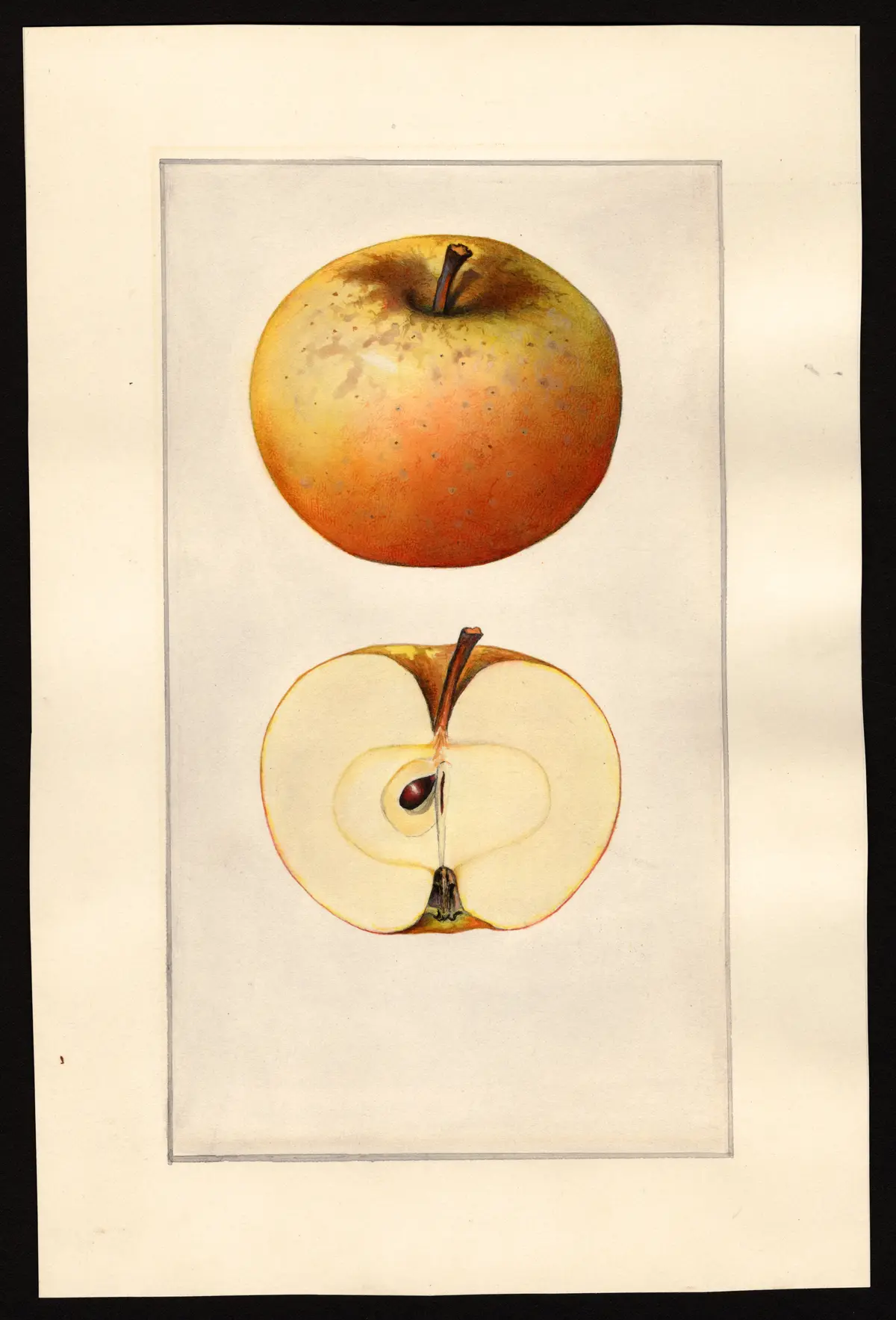
USDA Pomological Watercolor Collection
McMAHON
Origin / History
Originated about 1860 in Richland County, Wisconsin, from seed planted about 1860, claimed to be from seed of Alexander (Hansen 1902; Budd-Hansen 1914; Hedrick 1922). Hedrick notes that McMAHON in quality is similar to Alexander, of which it is possibly a seedling, but does not equal it in any characters which contribute to making a commercial variety, and that its culture is confined to its native and nearby states. Beach places it within the Aport group. It is doing well in Wisconsin and parts of southern South Dakota and Minnesota, but is not a first-class shipper, as the skin is tender and shows bruises readily (Hansen 1902; Budd-Hansen 1914). As grown at the New York Station it ripens unevenly and does not appear well adapted for storage (Beach 1905). Hedrick judges the apple not good enough in quality for home-growing.
Tree
A very strong grower and a good bearer (Hansen 1902; Budd-Hansen 1914). Hedrick describes the tree as medium in size, vigorous, and spreading. The Central Experimental Farm at Agassiz, BC (planted Spring 1890) records the tree as a strong and spreading grower and productive. Bearing records from Lowther's Encyclopedia of Practical Horticulture (1914), for trees planted 1888, give yields in gallons per tree for 1898–1905:
- Tree 1: 1898, 62.0; 1899, blank; 1900, 83.0; 1901, 2.0; 1902, 147.0; 1903, 1.5; 1904, 141.0; 1905, 40.0; total 1899–1905, 476.5.
- Tree 2: 1898, 42.0; 1899, 1.0; 1900, 6.0; 1901, 12.5; 1902, 98.0; 1903, 23.0; 1904, 116.0; 1905, 30.0; total 328.5.
- Tree 3: 1898, 32.0; 1899, 29.0; 1900, 49.0; 1901, 18.0; 1902, 55.0; 1903, 63.5; 1904, 56.0; 1905, 108.0; total 410.5.
- Tree 4: 1898, 85.0; 1899, blank; 1900, 34.5; 1901, 4.0; 1902, 63.0; 1903, 34.0; 1904, 67.0; 1905, 69.0; total 306.5.
- Tree 5: 1898, blank; 1899, 37.5; 1900, 55.0; 1901, 49.0; 1902, blank; 1903, 61.0; 1904, blank; 1905, 98.0; total 300.5.
- Tree 6: 1898, 29.0; 1899, 4.5; 1900, 46.0; 1901, 0.5; 1902, 69.5; 1903, 43.0; 1904, 72.0; 1905, 96.0; total 360.5.
- Tree 7: 1898, 0.5; 1899, 9.5; 1900, 19.5; 1901, 4.0; 1902, 19.0; 1903, 39.5; 1904, 14.0; 1905, 87.0; total 143.0.
- Tree 8: 1898, 7.0; 1899, 9.0; 1900, 27.0; 1901, 9.0; 1902, 53.0; 1903, 15.5; 1904, 54.0; 1905, 35.5; total 210.0.
The bearing pattern across these records shows pronounced biennialism, with very heavy crops alternating with near-blank years on most trees.
Fruit
Size and Form
Large to very large (Hansen 1902; Budd-Hansen 1914; Hedrick 1922; Central Experimental Farm 1900). Roundish, somewhat conical, obscurely angular and irregular (Hansen 1902; Budd-Hansen 1914). Hedrick describes the form as round-conic, faintly ribbed. The Central Experimental Farm at Agassiz describes the fruit as oblate, conical.
Stem and Cavity
Stem short to medium, stout (Hansen 1902; Budd-Hansen 1914); Hedrick gives stem medium in length and thick. Cavity deep, acute, russeted (Hansen 1902; Budd-Hansen 1914). Hedrick describes the cavity as remarkably acuminate, very deep, broad, compressed, russeted and with outspreading rays.
Calyx and Basin
Calyx open, segments divergent (Hansen 1902; Budd-Hansen 1914). Hedrick gives calyx small, open, with lobes separated at base, short. Basin medium deep, wavy, narrow (Hansen 1902; Budd-Hansen 1914); Hedrick describes the basin as deep, narrow, abrupt, compressed, furrowed and wrinkled.
Skin
Surface light yellow, becoming almost clear white when fully ripe, often with delicate blush; dots white, large, suffused (Hansen 1902; Budd-Hansen 1914). Beach (1905) describes it as pale yellow or almost white, often with a delicate pink blush. Hedrick gives skin pale yellow or nearly white with irregular stripes and patches of white scarf-skin extending from the cavity over the base, often having the cheek overspread with a thin blush, faintly splashed and striped with carmine; dots few, inconspicuous, green or russet. The Central Experimental Farm describes the skin as white, with a handsome blush and a few whitish dots. The skin is tender and shows bruises readily (Hansen 1902; Budd-Hansen 1914).
Flesh and Flavor
White, coarse-grained, crisp, juicy, sprightly subacid; good for table, very good for cooking (Hansen 1902; Budd-Hansen 1914). Beach (1905) describes the flesh as juicy, brisk subacid, fair to good in quality, excellent for culinary use. Hedrick gives flesh white, fine, tender, juicy, sprightly subacid; quality fair to good. (Hansen and Budd-Hansen describe the flesh as coarse-grained, while Hedrick describes it as fine and tender — a notable conflict between sources.) The Central Experimental Farm describes the flesh as white, very tender, juicy, mildly acid, and rates it a first-class cooking apple.
Core and Seeds
Core closed, irregular, sessile; tube obtusely conical; stamens basal (Hansen 1902; Budd-Hansen 1914). Hedrick gives core small, abaxile to axile; cells symmetrical, closed or open; core-lines meeting; carpels round or elliptical, emarginate; calyx-tube long, wide, broadly conical or cylindrical; stamens median; seeds dark brown, plump, obtuse. (The position of the stamens differs between sources: Hansen and Budd-Hansen give basal, Hedrick gives median.)
Season
October to December (Hansen 1902; Budd-Hansen 1914). Beach gives the season as October to January or February. Hedrick gives October to February. The Central Experimental Farm at Agassiz, BC, gives the season as October and November.
Uses
Good for table and very good for cooking (Hansen 1902; Budd-Hansen 1914); excellent for culinary use (Beach 1905); a first-class cooking apple (Central Experimental Farm 1900). Hedrick considers the apple not good enough in quality for home-growing. Not a first-class shipper because of the tender skin (Hansen 1902; Budd-Hansen 1914); as grown at the New York Station it ripens unevenly and is not well adapted for storage (Beach 1905).
Subtypes / Variants
Not described in source.
Other
Beach places McMAHON within the Aport group of apples.
Book Sources
Described in 5 period pomological works
USDA Nomenclature (1905)
From W.H. Ragan, Nomenclature of the Apple, USDA Bulletin No. 56
Origin, Richland Co., Wis., in about 1860.
Nursery Catalog Sources
Found in 9 catalogs (1891–1912) from Illinois, Missouri, Washington
- Missouri Nursery Co. , Louisiana , Missouri — 1891 — listed as McMahon White
- J.V. Cotta (Cotta Nursery) , Carroll County , Illinois — 1898 — listed as McMahon White
- Central Experimental Farm , Dominion Department of Agriculture, Agassiz, British Columbia (under test; Bulletin No. 3, Second Series) — 1900 — listed as McMahan White
- Benjamin Buckman (personal inventory) , Farmingdale , Illinois — 1901 — listed as McMahon White
- Stark Bros. Nurseries & Orchards Co. , Louisiana , Missouri — 1906 — listed as McMahon White
- Stark Bros. Nurseries & Orchards Co. , Louisiana , Missouri — 1910 — listed as McMahon White
- Stark Bros. Nurseries & Orchards Co. , Louisiana , Missouri — 1911 — listed as McMahon White
- Ballygreen Nurseries , Hanford , Washington — 1912 — listed as McMahon White
- Stark Bros. Nurseries & Orchards Co. , Louisiana , Missouri — 1912 — listed as McMahon White
View original book sources (6)
— N.E. Hansen, A Study of Northwestern Apples (1902)McMahon (McMahon White)—Origin, Richland County, Wisconsin, about 1860, it is claimed from seed of Alexander; it is doing well in Wisconsin and parts of southern South Dakota and Minnesota, but is not a first-class shipper, as the skin is tender, and shows bruises readily; tree a very strong grower and a good bearer—Fruit large to very large, roundish, somewhat conical, obscurely angular and irregular; surface light yellow, becoming almost clear white when fully ripe, often with delicate blush; dots white, large, suffused; cavity deep, acute, russeted; stem short to medium, stout; basin medium deep, wavy, narrow; calyx open, segments divergent. Core closed, irregular, sessile; tube obtusely conical; stamens basal; flesh white, coarse grained, crisp, juicy, sprightly subacid, good for table, very good for cooking. October to December.
— S.A. Beach, The Apples of New York, Vol. 2 (1905)McMAHON.
REFERENCES. 1. Am. Pom. Soc. Rpt., 1885:27. 2. Mich. Hort. Soc. Rpt., 1886:221. 3. Am. Pom. Soc. Rpt., 1887:93. 4. Rural N. Y., 46:751. 1887. 5. Can. Hort., 11:220. 1888. fig. 6. Am. Pom. Soc. Cat., 1889:10. 7. Am. Gard., 11:243. 1890. 8. Can. Hort., 13:174, 216. 1890. 9. Van Deman, U. S. Pom. Rpt., 1890:413. 10. Can. Hort., 14:339. 1891. 11. Taylor, Me. Pom. Soc. Rpt., 1892:57, 59. 12. Bailey, An. Hort., 1892:244. 13. Can. Hort., 15:393. 1892. 14. Ib., 16:77, 134. 1893. col. pl. 15. Craig, Ib., 16:137. 1893. fig. 16. Ib., Ont. Fr. Gr. Assn. An. Rpt., 26:16. 1894. 17. Ib., Can. Dept. Agr. Rpt., 1894:125. 18. Ib., 1895:93. fig. 19. Beach, N. Y. Sta. An. Rpt., 15:273. 1896. figs. 20. Thomas, 1897:675. 21. Waugh, Vt. Sta. An. Rpt., 14:300. 1901. 22. Hansen, S. D. Sta. Bul., 76:72. 1902. fig. 23. Powell and Fulton, U. S. B. P. I. Bul., 48:48. 1903. 24. Farrand, Mich. Sta. Bul., 205:42. 1903. 25. Budd-Hansen, 1903:121. fig. 26. Beach and Clark, N. Y. Sta. Bul., 248:130. 1904. 27. Ragan, U. S. B. P. I. Bul., 56:188. 1905.
SYNONYMS. MCMAHAN (14, 20). McMahan (27). MCMAHAN WHITE (6, 7, 15, 16, 17, 18). MCMAHON (11, 19, 21, 22, 23, 25, 26, 27). MCMAHON WHITE (1, 2, 3, 4, 5, 8, 9, 10, 12, 13, 24). McMahon White (19, 21, 22, 23, 25, 26, 27).
A large apple of the Aport group, pale yellow or almost white, often with a delicate pink blush. The flesh is juicy, brisk subacid, fair to good in quality, excellent for culinary use. As grown at this Station it ripens unevenly and does not appear well adapted for storage (26). Season October to January or February. The
— J.L. Budd & N.E. Hansen, American Horticultural Manual, Part II: Systematic Pomology (1914)McMahon (McMahon White).—Origin, Wisconsin, from seed planted about 1860, it is claimed, from seed of Alexander; it is doing well in Wisconsin and parts of southern South Dakota and Minnesota, but is not a first-class shipper as the skin is tender, and shows bruises readily; tree a very strong grower and a good bearer.
Fruit large to very large, roundish, somewhat conical, obscurely angular and irregular; surface light yellow, becoming almost clear white when fully ripe, often with delicate blush; dots white, large, suffused; cavity deep, acute, russeted; stem short to medium, stout; basin medium deep, wavy, narrow; calyx open; segments divergent. Core closed, irregular, sessile; tube obtusely conical; stamens basal; flesh white, coarse-grained, crisp, juicy, sprightly subacid, good, very good for cooking. October to December.
— Granville Lowther (ed.), Encyclopedia of Practical Horticulture (1914)McMahan apple, planted 1888; yield recorded in gallons per tree, 1898–1905. Tree 1: 1898, 62.0; 1899, blank; 1900, 83.0; 1901, 2.0; 1902, 147.0; 1903, 1.5; 1904, 141.0; 1905, 40.0; total yield 1899–1905, 476.5. Tree 2: 1898, 42.0; 1899, 1.0; 1900, 6.0; 1901, 12.5; 1902, 98.0; 1903, 23.0; 1904, 116.0; 1905, 30.0; total, 328.5. Tree 3: 1898, 32.0; 1899, 29.0; 1900, 49.0; 1901, 18.0; 1902, 55.0; 1903, 63.5; 1904, 56.0; 1905, 108.0; total, 410.5. Tree 4: 1898, 85.0; 1899, blank; 1900, 34.5; 1901, 4.0; 1902, 63.0; 1903, 34.0; 1904, 67.0; 1905, 69.0; total, 306.5. Tree 5: 1898, blank; 1899, 37.5; 1900, 55.0; 1901, 49.0; 1902, blank; 1903, 61.0; 1904, blank; 1905, 98.0; total, 300.5. Tree 6: 1898, 29.0; 1899, 4.5; 1900, 46.0; 1901, 0.5; 1902, 69.5; 1903, 43.0; 1904, 72.0; 1905, 96.0; total, 360.5. Tree 7: 1898, 0.5; 1899, 9.5; 1900, 19.5; 1901, 4.0; 1902, 19.0; 1903, 39.5; 1904, 14.0; 1905, 87.0; total, 143.0. Tree 8: 1898, 7.0; 1899, 9.0; 1900, 27.0; 1901, 9.0; 1902, 53.0; 1903, 15.5; 1904, 54.0; 1905, 35.5; total, 210.0.
— U.P. Hedrick, Cyclopedia of Hardy Fruits (1922)McMAHON. McMahon White. McMahon in quality is similar to Alexander, of which it is possibly a seedling, but does not equal it in any characters which contribute to making a commercial variety. The apple is not good enough in quality for home-growing. The variety originated about 1860 in Richland County, Wisconsin, and its culture is confined to its native and nearby states. Tree medium in size, vigorous, spreading. Fruit large or very large, round-conic, faintly ribbed; stem medium in length, thick; cavity remarkably acuminate, very deep, broad, compressed, russeted and with outspreading rays; calyx small, open; lobes separated at base, short; basin deep, narrow, abrupt, compressed, furrowed and wrinkled; skin pale yellow or nearly white with irregular stripes and patches of white scarf-skin extending from the cavity over the base, often having the cheek overspread with a thin blush, faintly splashed and striped with carmine; dots few, inconspicuous, green or russet; calyx-tube long, wide, broadly conical or cylindrical; stamens median; core small, abaxile to axile; cells symmetrical, closed or open; core-lines meeting; carpels round or elliptical, emarginate; seeds dark brown, plump, obtuse; flesh white, fine, tender, juicy, sprightly subacid; fair to good; October to February.
— Central Experimental Farm, Central Experimental Farm, Agassiz BC — Catalogue of Fruit Trees under Test (Bulletin No. 3, 1900) (1900)Planted Spring 1890. Tree a strong and spreading grower and productive. Fruit large, oblate, conical, skin white, with a handsome blush and a few whitish dots. Flesh white, very tender, juicy, mildly acid. A first-class cooking apple. Season October and November.