Osband's Summer
Pear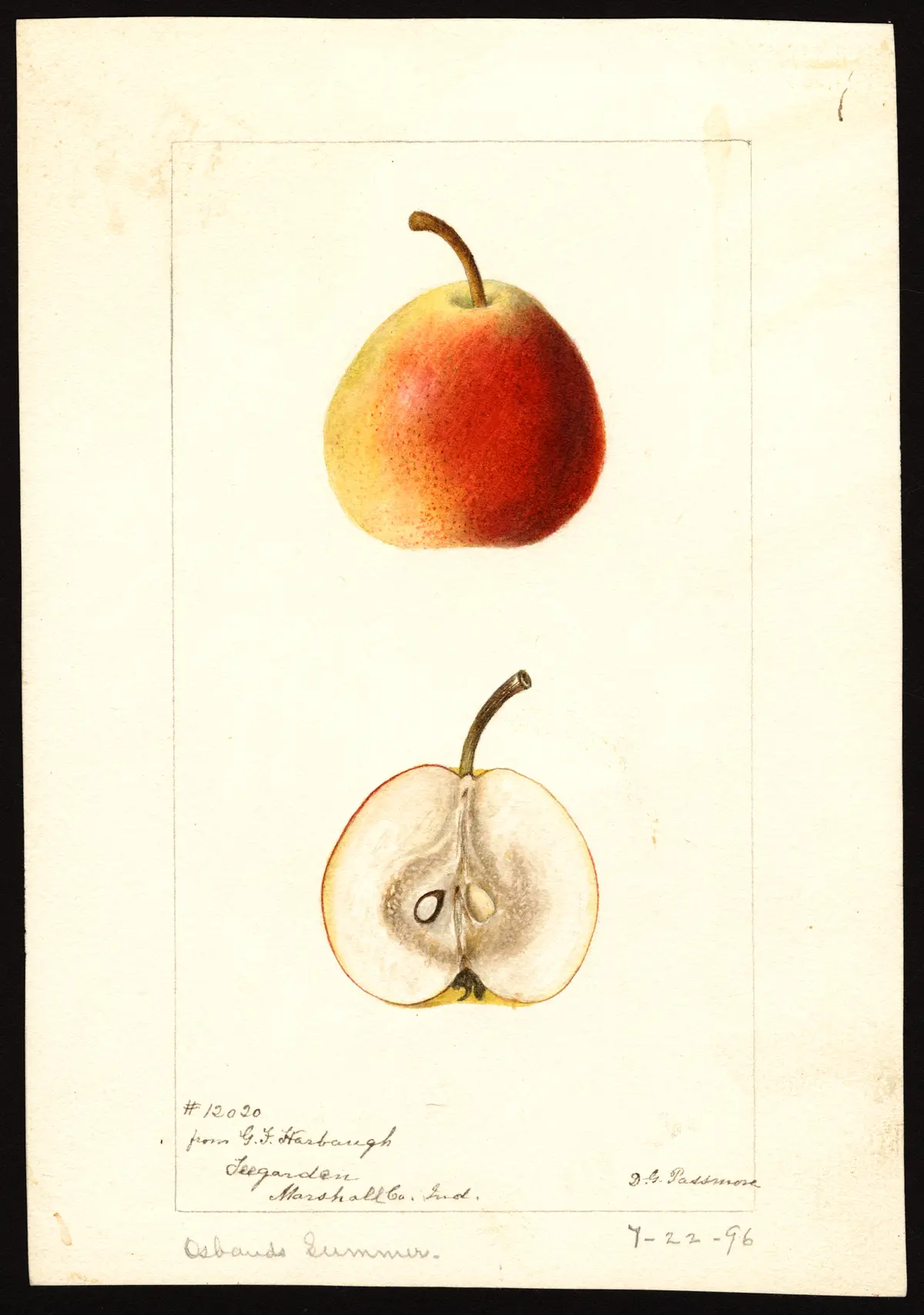
USDA Pomological Watercolor Collection
Osband's Summer
Origin / History
American, a native of Wayne County, New York. It originated in the vicinity of Palmyra about 1840 (Hedrick). It was at first known as Summer Virgalieu and was published under that name in the Genesee Farmer in 1845 or 1846. Hedrick gives as references the Horticulturist (1:211, fig. 59, 1846) and Leroy's Dictionnaire de Pomologie (2:492, fig., 1869). Elliott, in 1865, said it "promises 'valuable.'" Budd and Hansen call it "widely grown across the continent." The Central Experimental Farm at Agassiz, British Columbia, planted it under test in the spring of 1890.
Tree
Moderately vigorous, upright, an early and prolific bearer; young wood rich yellow brown (Downing). At Agassiz the tree was a strong grower but a shy bearer.
Fruit
Size: Small; below medium (Elliott).
Form: Roundish ovate obovate pyriform.
Stem: Of medium length, rather strong (Downing). Three-quarters to one inch long (Budd and Hansen).
Cavity: Abrupt (Downing, Budd and Hansen); Elliott calls it shallow and uneven. Russeted (Budd and Hansen).
Calyx: Open, with long, straggling segments (Elliott).
Basin: Broad, shallow; russeted (Budd and Hansen).
Skin: Rather thick (Elliott). Clear yellow, with a warm or rosy cheek on the side next the sun. Elliott has only "rarely a slight red cheek in sun." Some traces of russet, particularly around the stalk and calyx.
Dots: Small, numerous, thickly set, greenish and brown. Elliott calls them green; the Agassiz catalog calls them brownish.
Flesh and flavor: Flesh white, juicy, melting, with a rich sugary or rich sweet flavor and a pleasant musky perfume. Elliott alone gives the flesh as yellowish white and rather coarse grained. Quality "very good" (Downing, Budd and Hansen). Hedrick rates it "first in quality and appearance."
Core and seeds: Not described in source.
Season
Early August. Elliott gives early September.
Uses
Not described in source.
Subtypes / Variants
Not described in source.
Other
Not described in source.
Book Sources
Described in 4 period pomological works
- Downing, Fruits and Fruit Trees of America (1900)
- Elliott, The Western Fruit Book (1865)
- Budd & Hansen, Systematic Pomology (1914) — listed as Osband Summer
- Hedrick, The Pears of New York (1921) — listed as Osband Summer
Nursery Catalog Sources
Found in 9 catalogs (1849–1904) from Alabama, Florida, Illinois, Massachusetts, Virginia
- Hovey & Co. , Cambridge , Massachusetts — 1849
- Huntsville Wholesale Nurseries (Jessie S. Moss , Proprietor; W.F. Heikes, Manager), Huntsville , Alabama — 1886
- Glen St. Mary Nurseries (G.L. Taber , Proprietor), Glen St. Mary , Florida — 1893
- The Vineland Nurseries (Kelsey & Co. , Proprietors), St. Joseph, Missouri (Office: 13th and Atchison Sts., 2 Blocks East of the Citizens St. Car Line) — 1894
- The Salem Nursery (John A. Francis , Proprietor), Salem , Virginia — 1897
- Alabama Nursery Co. , Huntsville , Alabama — 1900
- Central Experimental Farm , Dominion Department of Agriculture, Agassiz, British Columbia (under test; Bulletin No. 3, Second Series) — 1900
- Benjamin Buckman (personal inventory) , Farmingdale , Illinois — 1901
- Phoenix Nursery Company (W. E. Rossney , President; Sidney Tuttle, Vice-President), Bloomington , Illinois — 1904
View original book sources (5)
— F.R. Elliott, The Western Fruit Book (1865)Osband's Summer.
Osband's Favorite, | Summer Vergalieu, of some.
American. Native of Wayne Co., N. Y. Fruit, below medium, ovate obovate pyriform, clear yellow, small green dots, and rarely a slight red cheek in sun ; skin, rather thick ; stem, medium, inserted in a shallow, uneven cavity ; calyx, with open, long, straggling segments ; flesh, yellowish white, rather coarse grained, juicy ; promises " valuable." Early September.
— A.J. Downing, The Fruits and Fruit Trees of America (1900)Osband's Summer.
Osband's Favorite. Summer Virgalieu.
Origin, Wayne County, N. Y. Tree moderately vigorous, upright, an early and prolific bearer. Young wood rich yellow brown.
Fruit small, roundish ovate obovate pyriform, clear yellow, thickly dotted with small greenish and brown dots, with a warm cheek on the side of the sun, and some traces of russet, particularly around stalk and calyx. Stalk of medium length, rather strong, inserted in an abrupt cavity. Calyx open, set in a broad, shallow basin. Flesh white, juicy, melting, with a rich sugary flavor and pleasant musky perfume. Very good. Ripens early in August.
— J.L. Budd & N.E. Hansen, American Horticultural Manual, Part II: Systematic Pomology (1914)Osband Summer.—Small, roundish, obovate pyriform; color yellow with numerous greenish and brown dots; rosy cheek in the sun, and russet in basin and cavity; stalk three-quarters to one inch long, inserted in abrupt cavity; basin broad, shallow. Flesh white, juicy, melting, with rich sweet flavor very good. Widely grown across the continent. New York.
— U.P. Hedrick, The Pears of New York (1921)Osband Summer,
- Horticulturist 1:211, fig. 59. 1846.
- Leroy Dict. Pom. 2:492, fig. 1869.
Originated in the vicinity of Palmyra in Wayne County, N. Y., about 1840 and was at first known as Summer Virgalieu and so published in the Genesee Farmer in 1845 or 1846. Fruit small, obovate-pyriform, clear yellow, thickly dotted with small greenish and brown dots, with a warm cheek on the side next the sun and with some traces of russet especially around the stem and calyx; flesh white, juicy, melting, with a rich sugary flavor and agreeable perfume of musk; first in quality and appearance; early in Aug.
— Central Experimental Farm, Central Experimental Farm, Agassiz BC — Catalogue of Fruit Trees under Test (Bulletin No. 3, 1900) (1900)Planted Spring 1890. Tree a strong grower but a shy bearer. Fruit small, roundish, ovate, pyriform. Skin yellow, with many small brownish dots. Flesh white, juicy, melting, with a rich sweet flavour. Season early August.