Pomona
Apple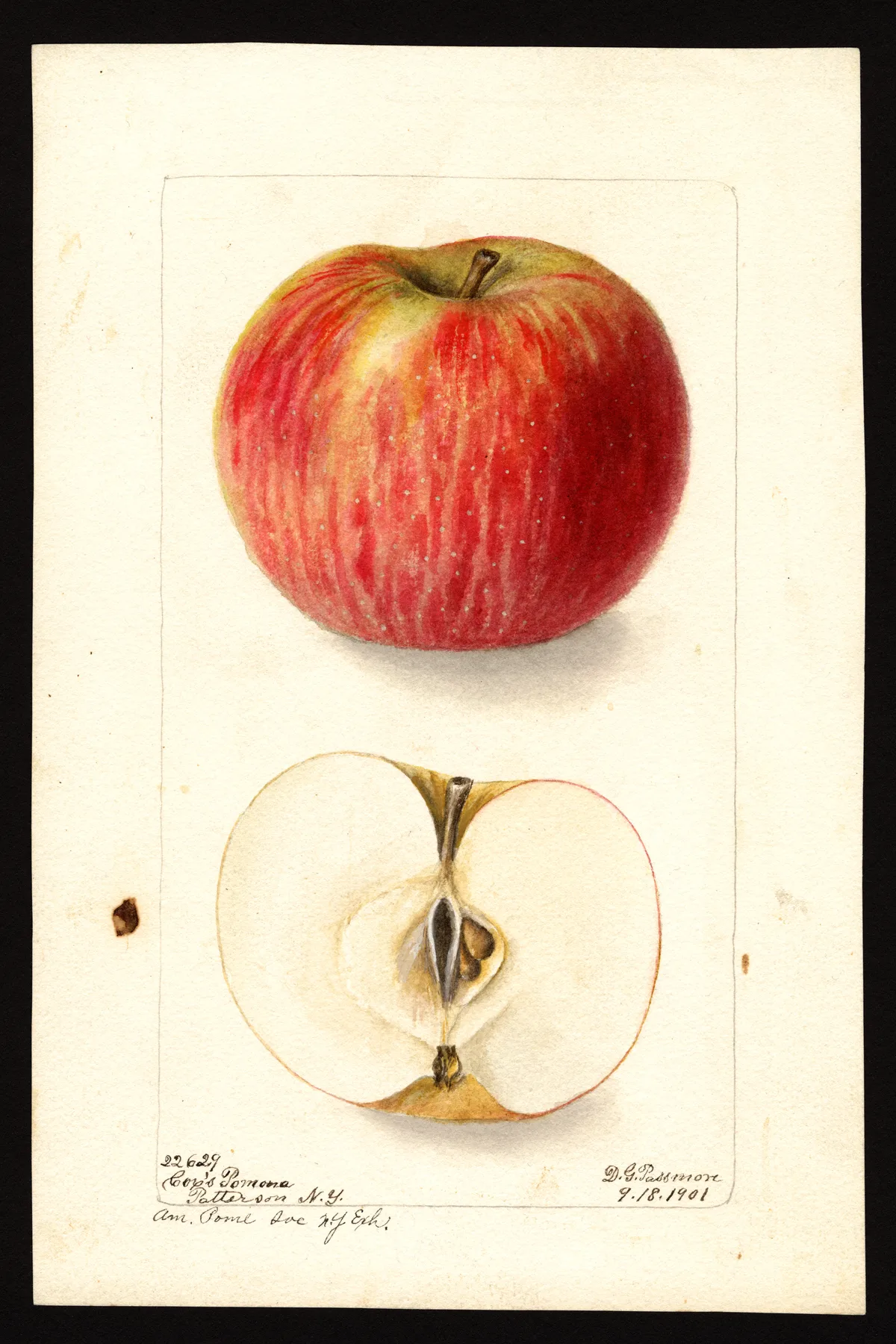
USDA Pomological Watercolor Collection
Pomona
Origin/History
Pomona was raised by Mr. Cox of Colnbrook Lawn, near Slough, Buckinghamshire, England, about 1825 (Herefordshire Pomona; Beach; Bunyard). Mr. Cox also originated Cox Orange (Beach, citing Hogg). It was sent out by Mr. Smale of Colnbrook nursery (Bunyard). Downing notes it as a variety from England.
Tree
Tree medium size, moderately vigorous, a good grower, with branches moderately stout, spreading and often drooping (Beach). Form roundish (Beach). Twigs straight, stocky, long; internodes medium (Beach). Bark rather bright reddish-brown mingled with olive-green, thinly overlaid with narrow streaks of gray scarf-skin (Beach). Lenticels rather numerous, conspicuous, medium to sometimes large, roundish or sometimes elongated (Beach). Buds medium to large, broad, obtuse, appressed, somewhat pubescent (Beach). Leaves rather large, broad, dark green; base of petioles red (Beach). Bunyard describes the leaf as medium, roundish, light green, nearly flat, with broad shallow serrate margin. Growth moderate (Bunyard); fertile (Bunyard). Comes into bearing young and is an annual cropper, or nearly so, but only moderately productive (Beach). Central Experimental Farm (planted Spring 1896, Agassiz BC) reports the tree a vigorous grower.
Fruit
Size
Frequently large; fruit is not very uniform in size, often unsymmetrical (Beach). Beach gives "medium to very large, fairly uniform in size but not in shape." Herefordshire Pomona: above medium size, sometimes large. Downing: medium. Bunyard: medium, 3 by 2 inches. Central Experimental Farm: above medium size. Veitch: large and fine. George Bunyard catalog: medium-sized.
Form
Sources give related but varying forms. Herefordshire Pomona: ovate and somewhat flattened and angular. Downing: oblate, somewhat conic. Beach: oblate conic, very irregular, ribbed; sides usually unequal. Bunyard: round, flattened, conical, irregular. Central Experimental Farm: oblate conical.
Stem
Stalk an inch long, deeply inserted (Herefordshire Pomona). Stem usually short, moderately thick (Beach). Stem rather short, set in a very deep cavity (Bunyard).
Cavity
Cavity large, acuminate to acute, deep, broad, rather symmetrical or sometimes compressed, irregularly russeted (Beach). Bunyard notes the cavity as very deep.
Calyx / Eye
Eye slightly open, set in a deep and angular basin (Herefordshire Pomona). Calyx medium size, open or nearly closed; lobes separated at base, short, rather broad, obtuse to acute, reflexed (Beach). Bunyard: eye open in a deep basin which has five prominent knobs.
Basin
Deep and angular (Herefordshire Pomona). Deep, medium in width to rather wide, abrupt, smooth or ridged, slightly wrinkled (Beach). Deep, with five prominent knobs (Bunyard).
Skin
Skin thin, rather tender, waxy, smooth (Beach). Color descriptions agree on a yellow ground variably overlaid with crimson: yellow and very much streaked with bright crimson (Herefordshire Pomona); greenish yellow with a shade of crimson in the sun (Downing); when highly colored, mottled and striped with crimson over a clear pale yellow ground; greenish-yellow or pale yellow partly blushed with crimson, and mottled and narrowly striped with carmine (Beach); yellow flushed and striped with crimson (Bunyard). Central Experimental Farm reports the skin as russet green with a faint shade of red. George Bunyard catalog calls the appearance dull. Dots scattering, small, inconspicuous, usually whitish and submerged, sometimes gray or russet (Beach).
Flesh / Flavor
Sources agree on white, tender, juicy flesh with a sub-acid character. Herefordshire Pomona: flesh white, tender, delicate and pleasantly acid. Downing: flesh white, crisp, juicy, brisk subacid; good. Beach: flesh whitish, not very firm, rather fine, crisp, tender, juicy, subacid, sprightly, good to very good for culinary use. Bunyard: flesh tender, white, sub-acid. Central Experimental Farm: flesh white, crisp, juicy, brisk sub-acid, quality good. George Bunyard catalog: distinctly acid.
Core / Seeds
Core small (Downing); core medium to small, somewhat abaxile; cells open or closed, symmetrical; core lines clasping (Beach). Calyx tube wide, conical, sometimes extending to the core; stamens median to nearly marginal (Beach). Carpels ovate to broadly roundish or elliptical, emarginate (Beach). Seeds medium to small, wide, short, very plump, flat, obtuse, dark brown (Beach).
Season
October (Herefordshire Pomona; Downing; Central Experimental Farm). September and October (Beach). October to December (Bunyard). October to April (George Bunyard catalog). Veitch notes January and May. Beach observes the fruit is tender, easily bruised, and not a very good keeper — in ordinary storage its commercial limit is October. Veitch nonetheless calls it "an excellent keeper."
Uses
A first-rate and very handsome culinary apple (Herefordshire Pomona). Valuable as a culinary apple (Downing). Good to very good for culinary use (Beach). Dessert or culinary (Bunyard). Veitch: valuable for the kitchen. George Bunyard catalog: culinary, excellent for cooking. Beach states it is not recommended for commercial planting in New York.
Subtypes/Variants
Not described in source.
Other
A very attractive fruit (Bunyard); rather attractive when highly colored (Beach).
Book Sources
Described in 4 period pomological works
- Beach, The Apples of New York Vol. 2 (1905)
- Bunyard, A Handbook of Hardy Fruits (1920) — listed as COX'S POMONA
- Downing, Fruits and Fruit Trees of America (1900) — listed as Cox's Pomona
- The Herefordshire Pomona (1876–1885) — listed as Cox's Pomona
Nursery Catalog Sources
Found in 7 catalogs (1900–1917) from England, Illinois
- George Bunyard & Co. , Royal Nurseries, Maidstone, Kent , England — 1900 — listed as Cox's Pomona
- Central Experimental Farm , Dominion Department of Agriculture, Agassiz, British Columbia (under test; Bulletin No. 3, Second Series) — 1900 — listed as Cox's Pomona
- Benjamin Buckman (personal inventory) , Farmingdale , Illinois — 1901 — listed as Cox's Pomona
- James Veitch & Sons , Ltd., Royal Exotic Nursery, Chelsea, London (also Coombe Wood, Langley, and Feltham) , England — 1911 — listed as Cox's Pomona
- Benjamin Buckman (personal inventory) , Farmingdale , Illinois — 1913 — listed as Cox's Pomona
- George Bunyard & Co. , Royal Nurseries, Maidstone, Kent , England — 1914 — listed as Cox's Pomona
- George Bunyard & Co. , Royal Nurseries, Maidstone, Kent , England — 1917 — listed as Cox's Pomona
View original book sources (7)
— Woolhope Naturalists Field Club, The Herefordshire Pomona (1885)
- COX'S POMONA.
This beautiful apple was raised by Mr. Cox, of Colnbrook Lawn, about 1825.
Description.—Fruit, above medium size, sometimes large ; ovate and somewhat flattened and angular. Skin, yellow and very much streaked with bright crimson. Eye, slightly open, set in a deep and angular basin. Stalk, an inch long, and deeply inserted. Flesh, white, tender, delicate and pleasantly acid.
A first-rate and very handsome culinary apple. Season, October.
— A.J. Downing, The Fruits and Fruit Trees of America (1900)Cox's Pomona. A variety from England, valuable as a culinary apple. Fruit medium, oblate, somewhat conic, greenish yellow, shade of crimson in the sun. Flesh white, crisp, juicy, brisk subacid. Good. Core small. October.
— S.A. Beach, The Apples of New York, Vol. 2 (1905)POMONA.
REFERENCES. 1. Downing, 1869:135. 2. Leroy, 1873:248. fig. 3. Hogg, 1884:55. 4. Bailey, An. Hort., 1892:237. 5. Beach, N. Y. Sta. An. Rpt., 13:579. 1894. 6. Ib., Gard. and For., 8:428. 1895. 7. Ib., Can. Hort., 20:183. 1897. 8. Bunyard, Jour. Roy. Hort. Soc., 1898:356. 9. Beach and Clark, N. Y. Sta. Bul., 248:139. 1904.
SYNONYMS. Cox's POMONA (1, 2, 3, 4, 5, 6, 7, 8). Cox's Pomona (9). Dean's Codlin (2). POMONA (9).
Fruit frequently large and when highly colored rather attractive, being mottled and striped with crimson over a clear pale yellow ground color. The fruit is not very uniform in size, often unsymmetrical, tender, easily bruised and not a very good keeper. In ordinary storage its commercial limit is October (9). The tree is a good grower, comes into bearing young and is an annual cropper, or nearly so, but only moderately productive. It is not recommended for commercial planting in New York.
Historical. Originated by Mr. Cox, Colnbrook Lawn near Slough, Bucks, England, who also originated Cox Orange (3).
TREE. Tree medium size, moderately vigorous with branches moderately stout, spreading and often drooping. Form roundish. Twigs straight, stocky, long; internodes medium. Bark rather bright reddish-brown mingled with olive-green, thinly overlaid with narrow streaks of gray scarf-skin. Lenticels rather numerous, conspicuous, medium to sometimes large, roundish or sometimes elongated. Buds medium to large, broad, obtuse, appressed, somewhat pubescent. Leaves rather large, broad, dark green; base of petioles red.
FRUIT. Fruit medium to very large, fairly uniform in size but not in shape. Form oblate conic, very irregular, ribbed; sides usually unequal. Stem usually short, moderately thick. Cavity large, acuminate to acute, deep, broad, rather symmetrical or sometimes compressed, irregularly russeted. Calyx medium size, open or nearly closed; lobes separated at base, short, rather broad, obtuse to acute, reflexed. Basin deep, medium in width to rather wide, abrupt, smooth or ridged, slightly wrinkled. Skin thin, rather tender, waxy, smooth, greenish-yellow or pale yellow partly blushed with crimson, and mottled and narrowly striped with carmine. Dots scattering, small, inconspicuous, usually whitish and submerged, sometimes gray or russet. Calyx tube wide, conical, sometimes extending to the core. Stamens median to nearly marginal. Core medium to small, somewhat abaxile; cells open or closed, symmetrical; core lines clasping. Carpels ovate to broadly roundish or elliptical, emarginate. Seeds medium to small, wide, short, very plump, flat, obtuse, dark brown. Flesh whitish, not very firm, rather fine, crisp, tender, juicy, subacid, sprightly, good to very good for culinary use. Season September and October.
— E.A. Bunyard, A Handbook of Hardy Fruits (1920)COX'S POMONA. Her. Pom., 12. F., Pomona de Cox. (Royal Portugee, Hill's Seedling.) Dessert or culinary, October to December, medium, 3 by 2, round, flattened, conical, irregular. Colour, yellow flushed and striped with crimson. Flesh, tender, white, sub-acid. Eye, open in a deep basin which has five prominent knobs. Stem, rather short in a very deep cavity. Growth, moderate; fertile. Leaf, medium, roundish, light green, nearly flat, broad shallow serrate. Origin, raised by Mr. Cox, in 1825, near Slough, Bucks., and sent out by Mr. Smale, Coinbrook nursery. A very attractive fruit.
— Central Experimental Farm, Central Experimental Farm, Agassiz BC — Catalogue of Fruit Trees under Test (Bulletin No. 3, 1900) (1900)Planted Spring 1896. Tree a vigorous grower. Fruit above medium size, oblate conical. Skin russet green, with a faint shade of red. Flesh white, crisp, juicy, brisk sub-acid, quality good. Season October.
— James Veitch & Sons, Veitch's Fruit Trees (1911) (1911)COX'S POMONA. (Large and fine; an excellent keeper; valuable for the kitchen). Jan. & May
— George Bunyard & Co., George Bunyard Catalog of Fruit Trees (1914) (1914)Culinary; Oct.-April. Dull; Medium-sized, distinctly acid. Excellent for cooking. (H, B.T., P.)