Repka Malenka
Apple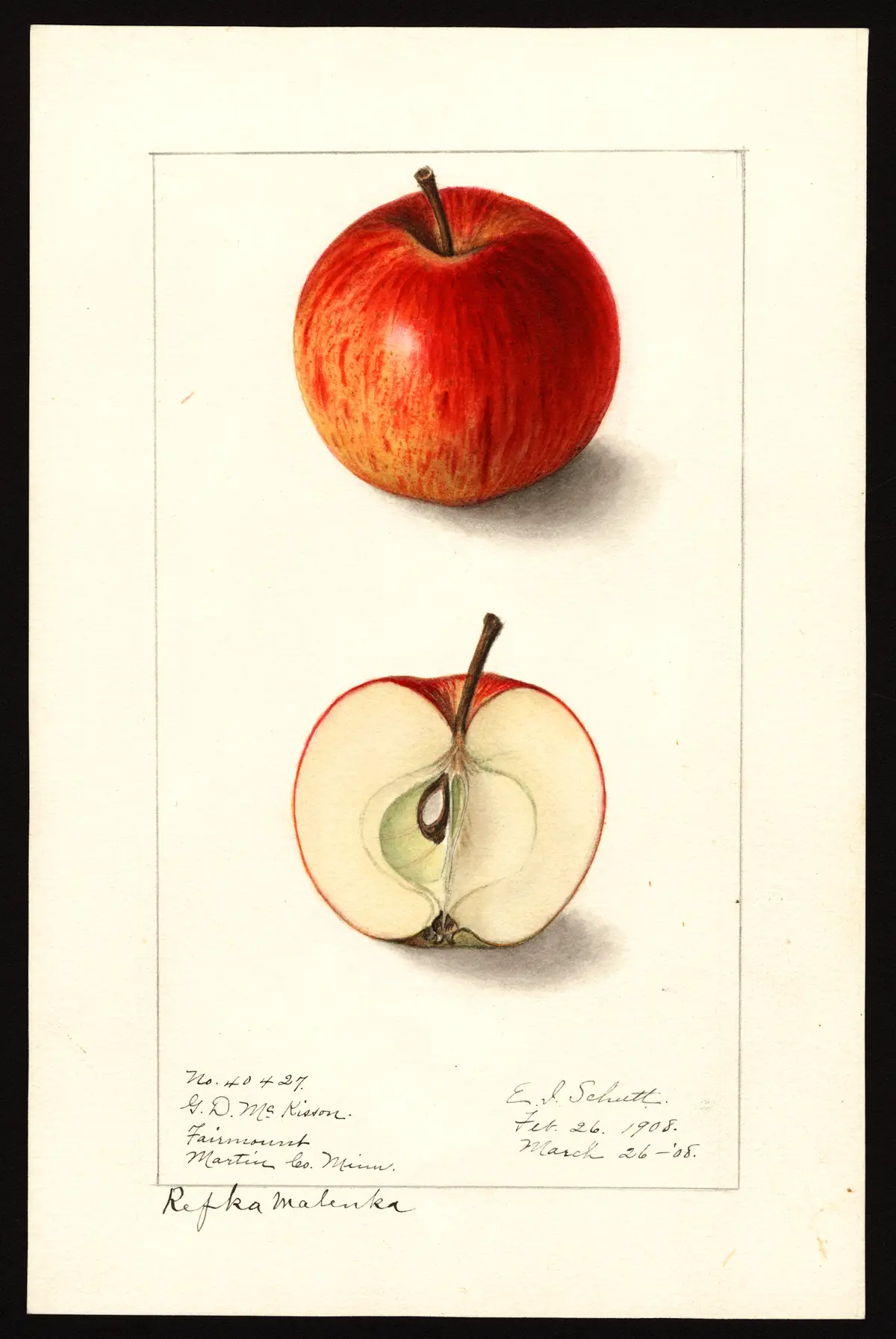
USDA Pomological Watercolor Collection
Repka Malenka
Origin/History
Repka Malenka originates from Russia. The name "Malenka" means small. It is considered probably the best keeper among the Russian varieties. A. G. Tuttle of Baraboo, Wisconsin, reported that the fruit keeps easily until June — as good a keeper as Little Romanite and a much better apple in quality. It was introduced to American pomological attention through J.L. Budd's reporting beginning in 1880, and was listed in the American Pomological Society Catalog by 1899.
Tree
Upright, symmetrical, and of rather slow growth.
Fruit
Size
Below medium.
Form
Conical to roundish conical, obscurely angular, somewhat irregular and unequal.
Stem
Medium to long.
Cavity
Regular, obtuse, with considerable radiating russet.
Calyx
Open or closed; segments erect convergent, very long.
Basin
Abrupt, narrow, shallow, slightly corrugated and wrinkled.
Skin
Surface yellow, striped, splashed, mixed and dotted dull red on the sunny side. Dots obscure, few, very minute, white.
Flesh/Flavor
Flesh white (Hansen's group description notes it as greenish white), firm. Flavor mild subacid, good.
Core/Seeds
Core closed, clasping. Cells round. Tube funnel-shaped, sometimes linear (long and very narrow). Stamens marginal or median. Seeds about ten, large, plump, packed tightly in the small cells.
Season
Late winter and spring. Hansen's group description gives January to April. With exceptional storage, fruit has been kept until June (Tuttle).
Uses
Valued primarily as a keeper among the Russian varieties, though Beach notes the fruit is too small to be of commercial value.
Subtypes/Variants
Not described in source.
Other
Hansen notes that the fruit is too small to be valuable commercially, a judgment echoed by Beach. Despite this, Tuttle's testimony highlights its exceptional storage qualities and above-average eating quality relative to other Russian keepers.
Book Sources
Described in 3 period pomological works
USDA Nomenclature (1905)
From W.H. Ragan, Nomenclature of the Apple, USDA Bulletin No. 56
This is probably Little Rep-ka. Bul. 8 is in error.
Nursery Catalog Sources
Found in 2 catalogs (1901–1913) from Illinois
- Benjamin Buckman (personal inventory) , Farmingdale , Illinois — 1901
- Benjamin Buckman (personal inventory) , Farmingdale , Illinois — 1913
View original book sources (3)
— S.A. Beach, The Apples of New York, Vol. 1 (1905)REPKA MALENKA.
REFERENCES. 1. Budd, Ia. Hort. Soc. Rpt., 1880:525. 2. Am. Pom. Soc. Rpt., 1881:118. 3. Webster, Am. Pom. Soc. Rpt., 1883:113. 4. Budd, Ia. Agr. Coll. Bul., 1885:16. 5. Ib., 1890:24. 6. Bailey, An. Hort., 1892:248. 7. Taylor, Me. Pom. Soc. Rpt., 1892:57. 8. Harris, U. S. Pom. Rpt., 1892:274. 9. Budd, Ia. Sta. Bul., 19:541. 1892. 10. Am. Pom. Soc. Cat., 1899:20. 11. Ragan, Am. Pom. Soc. Rpt., 1901:49. 12. Hansen, S. D. Sta. Bul., 76:92. 1902. fig. 13. Budd-Hansen, 1903:163. fig. 14. Ragan, U. S. B. P. I. Bul., 56:181. 1905. 15. Ragan, U. S. B. P. I. Bul., 56:260. 1905.
SYNONYMS. Dept. No. 418 (4). Green Sweet (12). LITTLE REPKA (14). LITTLE SEEDLING (2). Little Seedling (3, 12, 14, 15). No. 410 (1, 5, 9, 12, 13). Reipka Melenkaya (14). Repka Malenka (14).
Repka Malenka is said to be one of the best keepers among the Russian varieties but the fruit is too small to be valuable (7). Hansen (12) gives the following description of this variety: "Fruit below medium, conical to roundish conical, obscurely angular, somewhat irregular and unequal; surface yellow, striped, splashed, mixed and dotted dull red on sunny side; dots obscure, few, very minute, white; cavity regular, obtuse, with considerable radiating russet; stem medium to long; basin abrupt, narrow, shallow, slightly corrugated and wrinkled; calyx open or closed, segments erect convergent, very long. Core closed, clasping; cells round; tube funnel-shaped, sometimes linear (long and very narrow); stamens marginal or median; seeds about ten, large, plump, packed tightly in the small cells; flesh white, firm, mild subacid, good. Late winter and spring."
— N.E. Hansen, A Study of Northwestern Apples (1902)Repka Malenka—Origin, Russia. Malenka means small. This is probably the best keeper of the Russians. A. G. Tuttle of Baraboo, Wisconsin, finds the fruit keeps easily until June—Fruit below medium, conical to roundish conical, obscurely angular, somewhat irregular and unequal; surface yellow, striped, splashed, mixed and dotted dull red on sunny side; dots obscure, few, very minute, white; cavity regular, obtuse, with considerable radiating russet; stem medium to long; basin abrupt, narrow, shallow, slightly corrugated and wrinkled; calyx open or closed, segments erect convergent, very long. Core closed, clasping; cells round; tube funnel-shaped, sometimes linear (long and very narrow); stamens marginal or median; seeds about ten, large, plump, packed tightly in the small cells; flesh white, firm, mild subacid, good. Late winter and spring.
REPKA MALENKA GROUP.
Repka Malenka, 4rn; Little Seedling; Green Sweet; 169, (spurious).
DESCRIPTION: Repka Malenka—Size 4; form, round, conical, angular; color, light green, striped with dull red; cavity, deep, russeted at the bottom; basin, narrow, abrupt, wrinkled; calyx, closed; flesh, greenish white, firm; flavor, mild, subacid; season, January to April; origin, Russia; tree, upright, symmetrical and of rather slow growth.
A. G. Tuttle: "Repka Malenka with me bears early and keeps until apples come again. I find it is fully as good a keeper as Little Romanite and a much better apple in quality." (Rus. Nom. Com.)
— J.L. Budd & N.E. Hansen, American Horticultural Manual, Part II: Systematic Pomology (1914)Repka Malenka. — Origin, Russia. Malenka means small. This is probably the best keeper of the Russians. A. G. Tuttle, of Baraboo, Wis., finds that the fruit keep easily till June.
Fruit below medium, conical to roundish conical, obscurely angular, somewhat irregular and unequal; surface yellow, striped, splashed, mixed and dotted dull red on sunny side; dots obscure, few, very minute, white; cavity regular, obtuse, with considerable radiating russet; stem medium to long; basin abrupt, narrow, shallow, slightly corrugated and wrinkled; calyx open or closed; segments erect convergent, very long. Core closed, clasping; cells round; tube funnel-shaped, sometimes linear (long and very narrow); stamens marginal or median; seeds about ten, large, plump, packed tight in the small cells; flesh white, firm, mild subacid, good. Late winter and spring.