Rock Pippin
Apple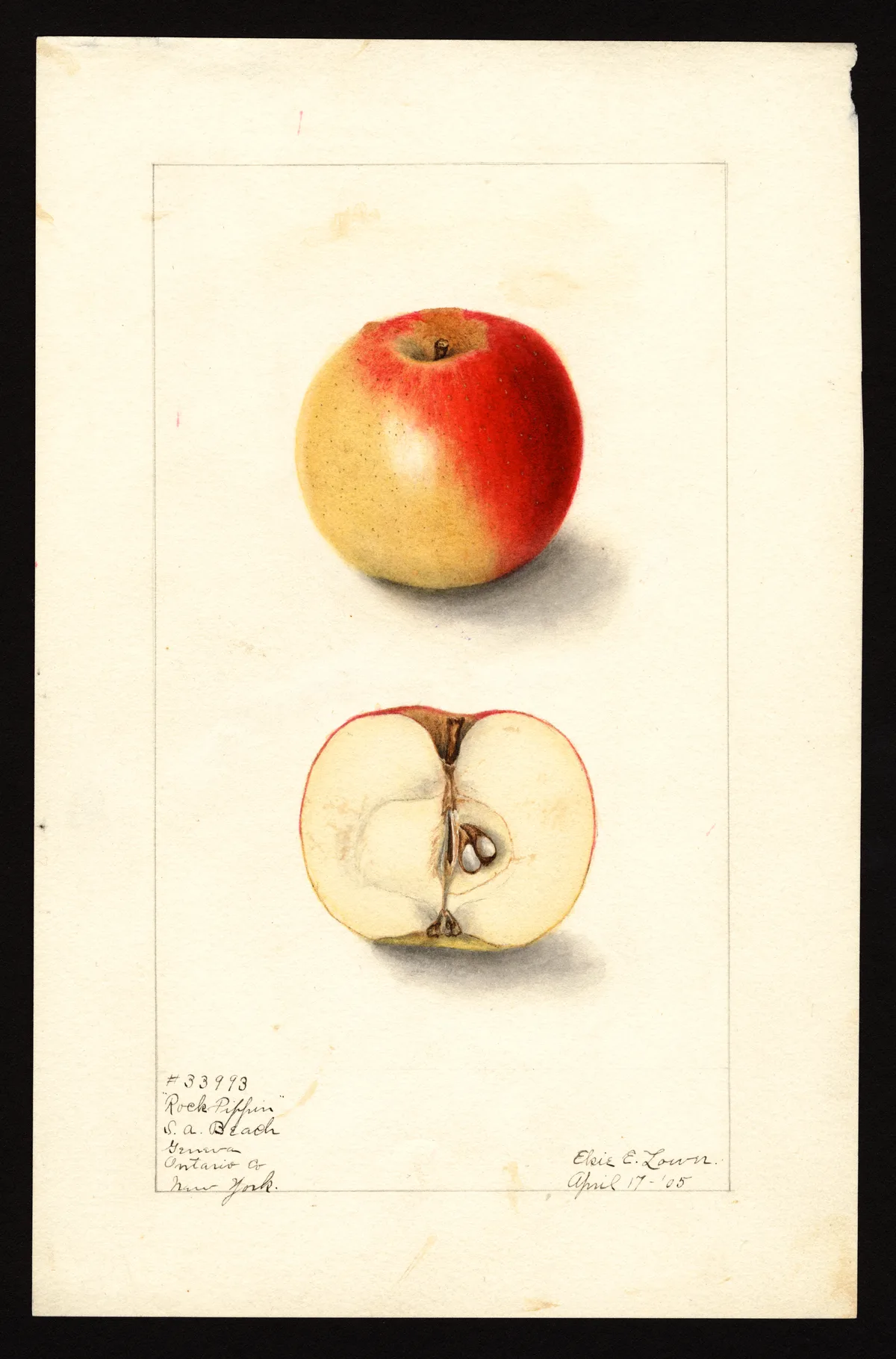
USDA Pomological Watercolor Collection
Rock Pippin
Origin/History
From Ohio, according to Downing. Also known historically as Ridge Pippin, Lemon, Walnut Stem, and Pippin.
Tree
Very thrifty, large, and productive (Warder). Branches open and spreading. Shoots stout and dark. Foliage large, scattered.
Fruit
Size
Full medium (Warder; confirmed by Downing and Lowther).
Form
Warder describes the fruit as oblong, ovate, angular, often ribbed, truncate at the apex, and sometimes unequal. Downing describes it as oblong conical. Lowther, however, describes the form as oblate-round — a significant departure from the oblong form reported by both Warder and Downing.
Stem
Medium length (Warder). Downing notes the synonym "Walnut Stem," suggesting a characteristic stem. Cavity acute, often lipped (Warder).
Cavity
Acute, often lipped (Warder).
Calyx
Eye small, short, closed (Warder).
Basin
Shallow, plaited or folded (Warder).
Skin
Surface very smooth (Warder). Color very rich yellow, blushed bright carmine when ripe (Warder). Downing describes it as yellow, bronzed in the sun — suggesting the carmine blush may appear as a bronze tone under sun exposure rather than a vivid flush. Lowther describes the color as yellow-red, consistent with a blushed yellow fruit.
Dots few, small, dark (Warder).
Flesh and Flavor
Flesh yellow, breaking, rather dry (Warder). Warder and Downing conflict slightly on texture: Warder calls the flesh "breaking, rather dry," while Downing calls it "firm." Flavor acid to sub-acid, rich (Warder). Quality rated "only good" by Warder; Lowther rates it simply "good."
Core and Seeds
Core medium, pyriform, open, somewhat clasping (Warder). Seeds numerous, long, brown (Warder).
Season
December through May, with the fruit of most value when sold in the latter part of the season — i.e., spring (Warder). Downing likewise identifies it as a profitable spring market fruit. Lowther lists the season as winter.
Uses
Market and kitchen (Warder). Cooks well all winter (Warder). A profitable market fruit in spring on account of its soundness and beauty at that late date (Warder, Downing). Lowther describes it as suited to family use.
Subtypes/Variants
Not described in source.
Other
Rock Pippin is described by Warder as an admirable long-keeper with particular claims on the commercial orchardist's attention for its soundness and beauty in the spring — a variety whose chief value lies in its ability to carry through winter in good condition to the late-season market.
Book Sources
Described in 3 period pomological works
USDA Nomenclature (1905)
From W.H. Ragan, Nomenclature of the Apple, USDA Bulletin No. 56
Somewhat confused with Ridge
Nursery Catalog Sources
Found in 3 catalogs (1901–1913) from Illinois
- Benjamin Buckman (personal inventory) , Farmingdale , Illinois — 1901
- Phoenix Nursery Company (W. E. Rossney , President; Sidney Tuttle, Vice-President), Bloomington , Illinois — 1904
- Benjamin Buckman (personal inventory) , Farmingdale , Illinois — 1913
View original book sources (3)
— John A. Warder, American Pomology: Apples (1867)Rock Pippin.
RIDGE PIPPIN, LEMON, &C.
This admirable long-keeper has claims upon the attention of the commercial orchardist, on account of its soundness and beauty in the spring. Tree very thrifty, large, productive; Branches open, spreading; Shoots stout, dark; Foliage large, scattered.
Fruit full medium, oblong, ovate, angular, often ribbed, truncate at the apex, sometimes unequal; Surface very smooth, very rich yellow, blushed bright carmine when ripe; Dots few, small, dark.
Basin shallow, plaited or folded; Eye small, short, closed. Cavity acute, often lipped; Stem medium.
Core medium, pyriform, open, somewhat clasping; Seeds numerous, long, brown; Flesh yellow, breaking, rather dry; Flavor acid to sub-acid, rich; Quality only good; Use, market and kitchen; Season, December to May; of most value to sell at the latter period.
Cooks well all winter.
— A.J. Downing, The Fruits and Fruit Trees of America (1900)Rock Pippin. Lemon. Walnut Stem. From Ohio. Fruit medium, oblong conical, yellow, bronzed in sun. Flesh firm, and a good keeper, and in spring profitable market fruit. (O. P. S.)
— Granville Lowther (ed.), Encyclopedia of Practical Horticulture (1914)Rock Pippin (also known as Pippin) (20): medium size; oblate-round form; yellow-red color; good quality; family use; winter season.