Russian Baldwin
Apple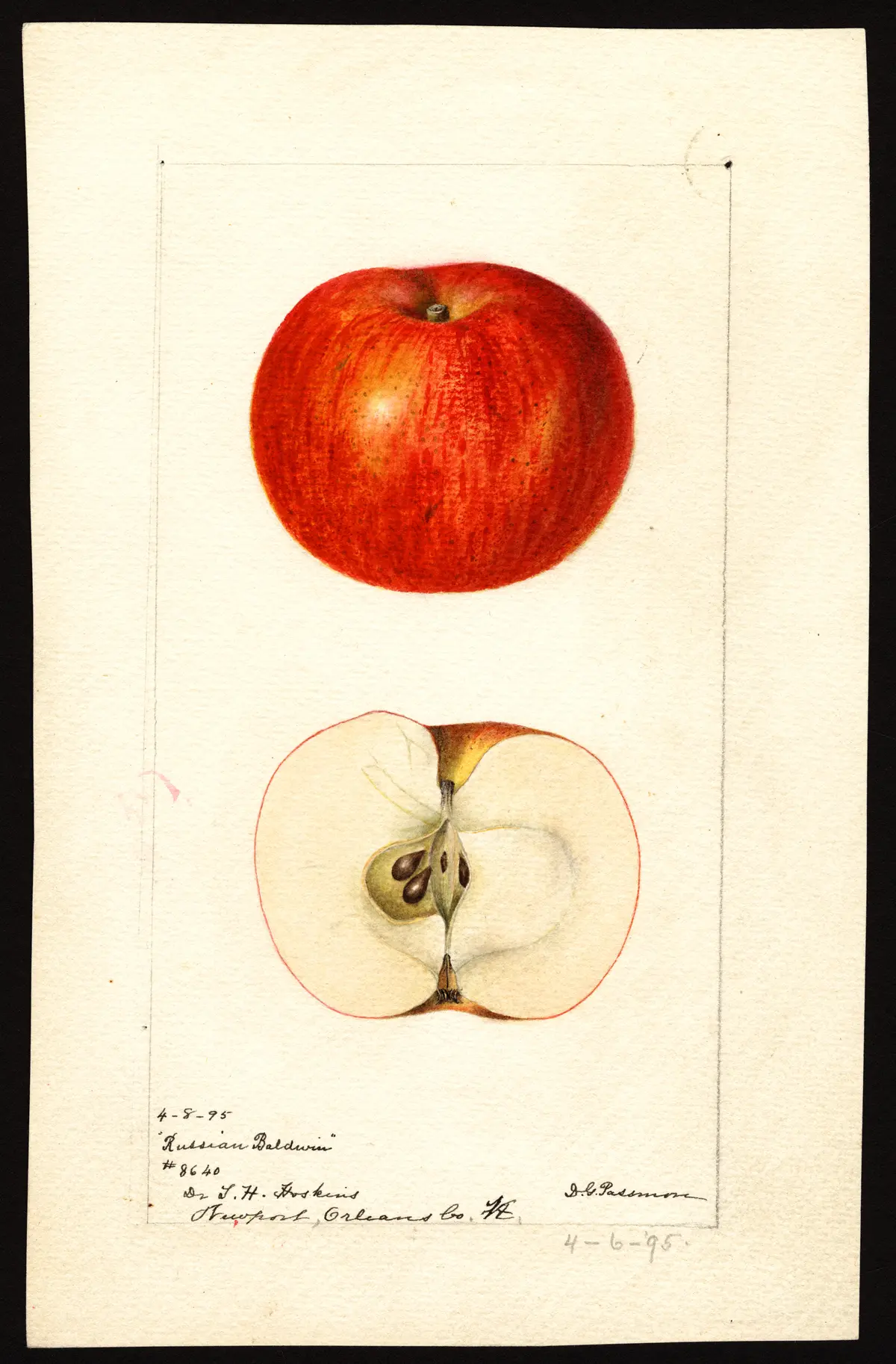
USDA Pomological Watercolor Collection
Russian Baldwin
Origin / History
A Russian apple, an all-winter sort of commercial value, received from the late Charles Gibb and named by Dr. T. H. Hoskins (Budd and Hansen). Dr. T. H. Hoskins, Newport, Vermont, who was instrumental in introducing Yellow Transparent and Scott, commended it very highly and believed it worth more than both of the others (Beach). In a letter of 1897 he wrote: "The Russian Baldwin has all the merits with none of the defects of the old Baldwin—being as large and handsome, as good a bearer, better quality, and a much better keeper."
Tree
Hoskins rates it as good a bearer as the old Baldwin.
Fruit
Size: Medium or above medium. Hoskins calls it as large and handsome as the old Baldwin.
Form: Roundish oblate, faintly ribbed.
Stem: Short, moderately thick.
Cavity: Medium to deep, narrow to moderately wide, irregular, with gradual slope, russeted, somewhat furrowed, sometimes lipped or slightly lipped.
Calyx: Small to above medium; usually partly open (Beach), or closed or nearly so (Budd and Hansen). Lobes short, wide; segments converging (Budd and Hansen).
Basin: Small, shallow, narrow, regular, somewhat furrowed.
Skin: Thin, smooth. Ground clear yellow, almost entirely mottled and splashed with bright red, washed with mixed red, splashed and striped with crimson, becoming deep red on the exposed cheek, with some indistinct streaks of purplish-carmine.
Dots: Small, pale or russet; erupted (Budd and Hansen).
Flesh and flavor: Whitish tinged with yellow, or yellowish white; moderately fine, crisp, moderately juicy. Mild subacid. Quality "good"; Hoskins calls the quality better than that of the old Baldwin.
Core and seeds: Core above medium to large, wide; cells partly open; core lines clasping. Seeds numerous, small, plump, dark brown.
Season
All-winter; late winter (Budd and Hansen). Hoskins calls it "a much better keeper" than the old Baldwin.
Uses
Of commercial value (Budd and Hansen).
Subtypes / Variants
Not described in source.
Other
Not described in source.
Book Sources
Described in 2 period pomological works
View original book sources (2)
— S.A. Beach, The Apples of New York, Vol. 1 (1905)RUSSIAN BALDWIN.
REFERENCES. 1. Hoskins, Rural N. Y., 53:573. 1894. 2. Can. Hort., 18:222, 266. 1895. 3. Heiges, U. S. Pom. Rpt., 1895:32. 4. Can. Hort., 20:242. 1897. 5. Budd-Hansen, 1903:170.
A Russian apple commended very highly by Dr. T. H. Hoskins, Newport, Vermont, who was instrumental in introducing Yellow Transparent and Scott. He believed this to be worth more than both of the others and said of it,¹ "The Russian Baldwin has all the merits with none of the defects of the old Baldwin—being as large and handsome, as good a bearer, better quality, and a much better keeper."
FRUIT.
Fruit medium or above medium. Form roundish oblate, faintly ribbed. Stem short, moderately thick. Cavity deep, narrow to moderately wide, russeted, somewhat furrowed, sometimes lipped. Calyx above medium to small, usually partly open; lobes short, wide. Basin small, shallow, narrow, somewhat furrowed. Skin thin, smooth, almost entirely mottled and splashed with bright red over a clear yellow background, becoming deep red on the exposed cheek with some indistinct streaks of purplish-carmine. Dots small, pale or russet. Core above medium to large, wide; cells partly open; core lines clasping. Seeds numerous, small, plump, dark brown. Flesh whitish tinged with yellow, moderately fine, crisp, moderately juicy, mild subacid, good.
¹Letter, 1897.
— J.L. Budd & N.E. Hansen, American Horticultural Manual, Part II: Systematic Pomology (1914)Russian Baldwin. — An all-winter Russian apple of commercial value; received from the late Charles Gibb and named by Dr. T. H. Hoskins.
Fruit above medium, roundish oblate; skin thin; surface smooth, yellow, washed with mixed red, splashed and striped with crimson; dots erupted, russet; cavity medium, irregular, with gradual slope, slightly lipped and somewhat russeted; stem of medium size, short; basin small, regular, shallow, furrowed; calyx small, closed or nearly so; segments short, wide, converging. Core large, wide, partially open, clasping; seeds numerous, small, plump, dark brown; flesh yellowish white, moderately fine, moderately juicy; flavor subacid; quality good. Season late winter. (U. S. Pomologist Report, 1895.)