Titus Pippin
Apple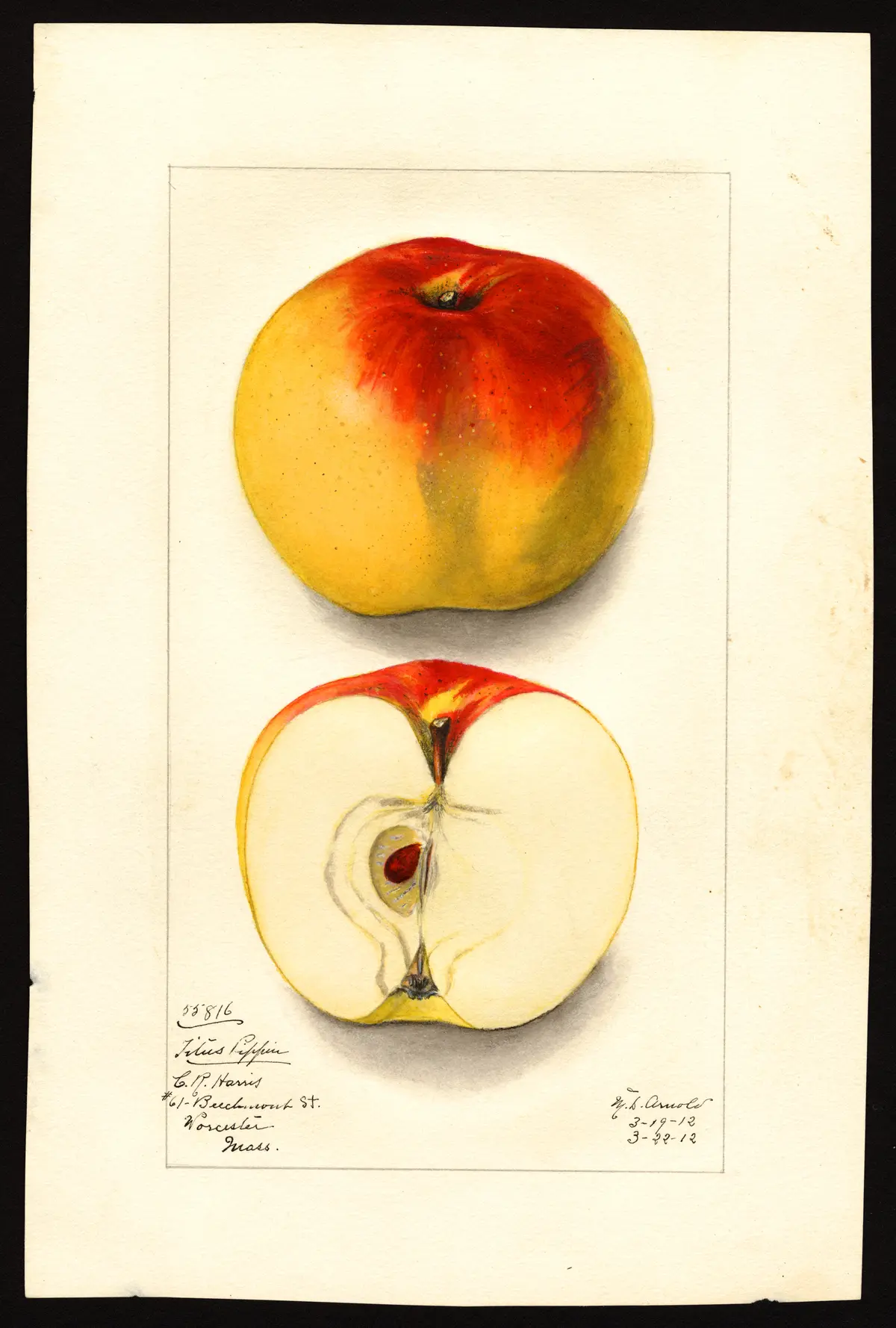
USDA Pomological Watercolor Collection
Origin/History
Originated near Hempstead, Long Island, New York. The time of origin is unrecorded, but Manning described the fruit as early as 1841, stating he received the variety from Flushing, N.Y. (Beach). It is quite commonly cultivated on Long Island but little known elsewhere in the state (Beach, Hedrick). Despite its good qualities, after a long period of probation it has not superseded the better-known Yellow Bellflower, to which it is closely related and by which it is surpassed in both tree and fruit (Hedrick). The variety evidently belongs in the Yellow Bellflower group (Beach).
Beach notes that the name "Titus" has been used for a fall apple of Russian origin, so "Titus Pippin" is the preferred designation to avoid confusion.
Tree
Large, rather vigorous, upright-spreading (Downing calls it simply "upright"), rather dense in form. Hardy, healthy, long-lived, productive, and profitable for market. Comes into bearing rather young and is a reliable cropper, yielding good to heavy crops biennially or almost annually. The fruit hangs well to the tree.
Twigs: Below medium to short, straight, moderately stout, with large terminal buds; internodes short to rather long.
Bark: Olive-green tinged with reddish-brown, lightly mottled with scarf-skin; slightly pubescent.
Lenticels: Brownish, very scattering, small to medium, roundish, slightly raised.
Buds: Rather prominent, about medium size, plump, acute, free, slightly pubescent.
Fruit
Size: Large (Downing, Elliott, Hedrick); above medium to large (Beach). Usually a rather high percentage of the crop is of marketable size, though it does not ripen evenly.
Form: Oblong conic (Downing, Elliott), or oblong-conic varying to roundish/round-conic (Beach, Hedrick), often irregularly elliptical or obtusely ribbed; somewhat ribbed (Downing); sides somewhat unequal; axis often somewhat oblique.
Stem: Medium in length and thickness (Beach, Hedrick); rather slender (Downing).
Cavity: Small to medium (small per Hedrick), acuminate or acute, moderately deep to deep (deep per Hedrick), narrow to rather broad, somewhat furrowed, often partly russeted and with narrow, outspreading russet rays.
Calyx: Usually large and open or partly so (Beach, Hedrick); open (Downing). Lobes leafy, long, acute.
Calyx tube: Large, wide above, deep, cone-shape with fleshy pistil point projecting into the base. Stamens median or below (Beach); median (Hedrick).
Basin: Small, often distinctly oblique, shallow to moderately deep (shallow to deep per Hedrick), narrow to medium in width, abrupt, often prominently ribbed, sometimes with mammiform protuberances.
Skin: Rather tender, smooth, waxy, yellow (pale yellow per Downing; light yellow per Elliott), often clouded with green, sometimes with an orange blush (Downing: "rarely with a blush"), rarely with distinct red lines or dots. Dots numerous, small, russet or submerged. Prevailing effect attractive clear yellow. Fair and attractive.
Flesh/Flavor: Flesh white tinged with yellow (Beach) / whitish yellow (Downing) / yellow (Hedrick), firm, a little coarse, breaking (Downing), rather crisp, moderately tender (Beach) / crisp and tender (Hedrick) / tender (Elliott, Downing), juicy, subacid with pleasant aroma; brisk subacid (Downing); not high flavored (Elliott). Good to very good (Beach, Hedrick); Good (Downing). Agreeably / pleasantly flavored, good either for dessert or culinary uses.
Core/Seeds: Core large (Downing, Beach, Hedrick) and open (Downing), abaxile; cells usually symmetrical, wide open, sometimes partly closed; core lines partly clasping or meeting. Carpels elongated ovate, emarginate, tufted. Seeds irregular, often imperfectly developed, medium to rather large (Beach) / large (Hedrick), long, moderately acute (Beach) / acute (Hedrick).
Season
December to February (Downing); November, December (Elliott); October to February (Hedrick); fall and early winter as grown on Long Island (Beach). Some of the fruit becomes very ripe before winter sets in, but as grown at the New York Station (Geneva) the bulk of the crop keeps well into the winter in ordinary storage. A considerable portion may be held in pretty good condition till April in cold storage and has been held till May firm and with no decay or scald (Beach, citing Powell and Fulton).
Uses
Good either for dessert or culinary uses.
Subtypes/Variants
Not described in source.
Other
Not described in source.
Book Sources
Described in 4 period pomological works
Nursery Catalog Sources
Found in 1 catalog (1913) from Illinois
- Benjamin Buckman (personal inventory) , Farmingdale , Illinois — 1913
View original book sources (4)
— A.J. Downing, The Fruits and Fruit Trees of America (1900)Titus Pippin.
Well Apple. Hang-On. Timothy. Timothy Titus Sort.
Origin, near Hempstead, Long Island. Tree an upright, thrifty grower, productive, and profitable for market.
Fruit large, roundish oblong conic, somewhat ribbed, pale yellow, rarely with a blush. Stalk rather slender. Calyx open. Flesh whitish yellow, a little coarse, breaking, juicy, tender, brisk subacid. Good. Core large and open. December to February.
— S.A. Beach, The Apples of New York, Vol. 1 (1905)TITUS PIPPIN.
References. 1. Manning, Mag. Hort., 7:50. 1841. 2. Downing, 1857:224. 3. Hooper, 1857:93. 4. Warder, 1867:734. 5. Downing, 1869:383. 6. Thomas, 1875:514. 7. Powell and Fulton, U. S. B. P. I. Bul., 48:58. 1903. 8. Ragan, U. S. B. P. I. Bul., 56:311. 1905.
Synonyms. Hang-On (5). Timothy (5). Timothy Titus Sort (5). Titus (7, 8). Titus Pippin (7, 8). Well Apple (5).
This variety evidently belongs in the Yellow Bellflower group. The fruit is large, predominantly yellow, smooth, fair, attractive, agreeably flavored, good either for dessert or culinary uses. The tree is a good grower, hardy, healthy, long-lived, comes into bearing rather young and is a reliable cropper, yielding good to heavy crops biennially or almost annually. The fruit hangs well to the tree. Usually a rather high percentage of the crop is of marketable size, but it does not ripen evenly. Some of the fruit becomes very ripe before winter sets in, but as grown at this Station the bulk of the crop keeps well into the winter in ordinary storage. A considerable portion of it may be held in pretty good condition till April in cold storage and it has been held till May firm and with no decay or scald (7). As grown on Long Island it is in season in fall and early winter.
The accompanying plate should bear the legend Titus Pippin instead of Titus, since the name Titus has been used for a fall apple of Russian origin.
Historical. Originated near Hempstead, Long Island (5). We find no record of the time of its origin but as long ago as 1841 Manning gave a description of this fruit and stated that he received the variety from Flushing, N. Y. (1). It is quite commonly cultivated on Long Island but is little known in other portions of the state.
Tree.
Tree large, rather vigorous. Form upright spreading, rather dense. Twigs below medium to short, straight, moderately stout, with large terminal buds; internodes short to rather long. Bark olive-green tinged with reddish-brown, lightly mottled with scarf-skin; slightly pubescent. Lenticels brownish, very scattering, small to medium, roundish, slightly raised. Buds rather prominent, about medium size, plump, acute, free, slightly pubescent.
Fruit.
Fruit above medium to large. Form oblong conic varying to roundish conic, often irregularly elliptical or obtusely ribbed; sides somewhat unequal; axis often somewhat oblique. Stem medium in length and thickness. Cavity small to medium, acuminate or acute, moderately deep to deep, narrow to rather broad, somewhat furrowed, often partly russeted and with narrow, outspreading russet rays. Calyx usually large and open or partly so; lobes leafy, long, acute. Basin small, often distinctly oblique, shallow to moderately deep, narrow to medium in width, abrupt, often prominently ribbed, sometimes with mammiform protuberances.
Skin rather tender, smooth, waxy, yellow, often clouded with green, sometimes with orange blush, rarely with distinct red lines or dots. Dots numerous, small, russet or submerged. Prevailing effect attractive clear yellow.
Calyx tube large, wide above, deep, cone-shape with fleshy pistil point projecting into the base. Stamens median or below.
Core large, abaxile; cells usually symmetrical, wide open, sometimes partly closed; core lines partly clasping or meeting. Carpels elongated ovate, emarginate, tufted. Seeds irregular, often imperfectly developed, medium to rather large, long, moderately acute.
Flesh white tinged with yellow, firm, a little coarse, rather crisp, moderately tender, juicy, subacid with pleasant aroma, good to very good.
— F.R. Elliott, The Western Fruit Book (1865)Titus Pippin.
Tree, vigorous and productive. Fruit, large, oblong conic ; skin, light yellow ; flesh, tender, juicy, not high flavored. November, December.
— U.P. Hedrick, Cyclopedia of Hardy Fruits (1922)TITUS PIPPIN. Hang-on. Timothy. Well Apple. Every character of Titus Pippin bespeaks its relationship to Yellow Bellflower, by which it is surpassed in both tree and fruit. The fruits are large, smooth, attractive, pleasantly flavored, and adapted to either dessert or culinary uses. The trees are vigorous, hardy, healthy, productive, long-lived, bear young, and hold their load well. Despite these good qualities, the variety, after a long period of probation, is not superseding the better-known Yellow Bellflower. Titus Pippin originated near Hempstead, Long Island, and was first described in 1841. It is still a general favorite on Long Island, but is little known elsewhere.
Tree large, vigorous, upright-spreading, dense. Fruit large, oblong-conic or round-conic, often irregularly elliptical or obtusely ribbed, sides unequal, axis oblique; stem medium in length and thickness; cavity small, acuminate, deep, narrow to broad, furrowed, often russeted and with narrow, outspreading russet rays; calyx large, open; lobes leafy, long, acute; basin small, often oblique, shallow to deep, narrow, abrupt, often prominently ribbed, sometimes with mammiform protuberances; skin tender, smooth, waxy, yellow, clouded with green, sometimes with an orange blush, rarely with distinct red lines or dots; dots numerous, small, russet or submerged; prevailing effect yellow; calyx-tube large, wide, deep, cone-shape with fleshy pistil point projecting into the base; stamens median; core large, abaxile; cells symmetrical, wide open, sometimes partly closed; core-lines clasping or meeting; carpels elongated-ovate, emarginate, tufted; seeds irregular, often imperfectly developed, large, long, acute; flesh yellow, firm, coarse, crisp, tender, juicy, subacid, with pleasant aroma; good to very good; October to February.