Aurate
Pear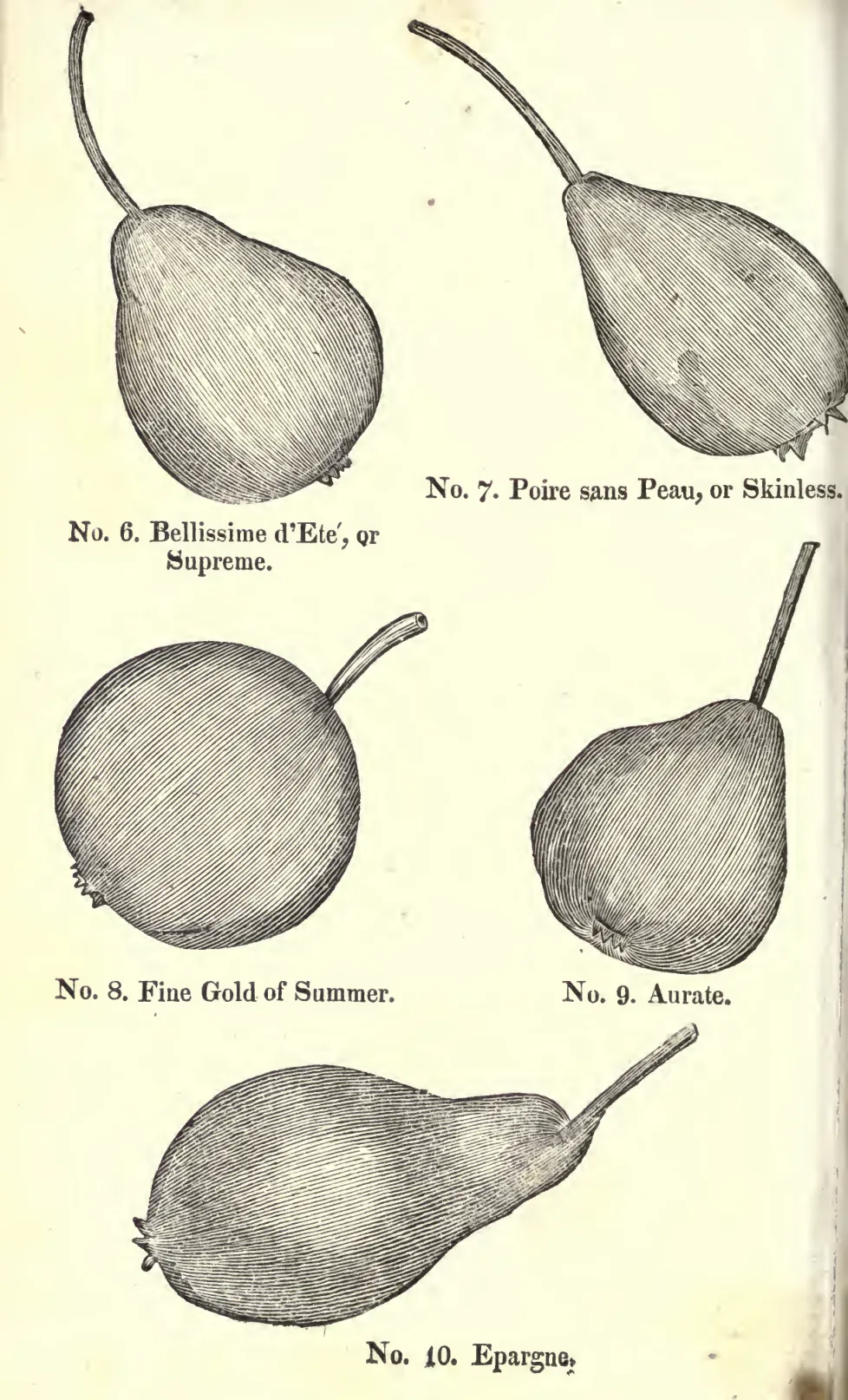
Aurate Pear
Origin/History
An ancient French pear, described by Hedrick as having appeared under the name Muscat de Nancy in Le Lectier's Catalogue de son verger et plant in 1628, and sold in Nancy over 300 years ago. It is extensively grown in Germany in the valleys of the Rhine and in the plains of Coblenz and Mayence under the names Petit-Muscat rouge, Muscat d'ete, Goldbirne, and others. Downing notes it simply as "an old variety."
Tree
A great bearer (Coxe). Further tree characteristics not described in source.
Fruit
Size: Small.
Form: Regular in contour (Coxe, Hedrick). Coxe describes the fruit as diminishing towards the stem; Downing and Hedrick give the form as pyriform and turbinate, ventriculous, and obtuse respectively. Hedrick adds that fruit grows in clusters.
Stem: Very long (Coxe). Further stem dimensions not described in source.
Cavity: Streaked with brownish-red (Hedrick). Further cavity dimensions not described in source.
Calyx: Not described in source.
Basin: Not described in source.
Skin: Coxe describes the skin as rough, pale yellowish green. Hedrick describes the fruit as dark green at first, dotted with fawn, streaked with brownish-red in the cavity, and washed with rose where exposed to the sun. Downing concurs with pale yellowish green.
Flesh/Flavor: Coxe: highly flavoured, rich, and luscious. Downing: juicy, rich; quality rated Very Good. Hedrick: yellowish-white, semi-fine and semi-melting, juicy, generally gritty, saccharine, vinous, and delicately musky; rated first quality.
Core/Seeds: Not described in source.
Season
Coxe and Downing place ripening at the end/last of July. Hedrick gives late August. These accounts conflict; the discrepancy may reflect different climates, selections, or synonymous varieties.
Uses
Not described in source.
Subtypes/Variants
Not described in source.
Other
Hedrick cites Duhamel, Trait. Arb. Fr. 2:122, Pl. III (1768) and Dochnahl, Fuhr. Obstkunde 2:26 (1856) as references.
Book Sources
Described in 3 period pomological works
Nursery Catalog Sources
Found in 1 catalog (1900)
- Central Experimental Farm , Dominion Department of Agriculture, Agassiz, British Columbia (under test; Bulletin No. 3, Second Series) — 1900
View original book sources (3)
— William Coxe, A View of the Cultivation of Fruit Trees (1817)
- AURATE.
This is a small pear of a regular form, diminishing towards the stem which is very long ; the skin is rough, of a pale yellowish green ; the flesh is highly flavoured, rich and luscious: it is a great bearer ; ripens about the end of July.
— A.J. Downing, The Fruits and Fruit Trees of America (1900)Aurate.
An old variety.
Fruit small, pyriform, pale yellowish green. Flesh juicy, rich Very good. Last of July.
— U.P. Hedrick, The Pears of New York (1921)Aurate.
- Duhamel Trait. Arb. Fr. 2:122, Pl. III. 1768. 2. Dochnahl Fuhr. Obstkunde 2:26. 1856.
This ancient French pear appeared under the name Muscat de Nancy in Le Lectier's Catalogue de son verger et plant in 1628, and was sold in Nancy over 300 years ago. It is extensively grown in Germany in the valleys of the Rhine and in the plains of Coblenz and Mayence under the name of Petit-Muscat rouge, Muscat d'ete, Goldbirne, etc. Fruit small, growing in clusters, turbinate, ventriculous, obtuse, regular in contour, dark green at first, dotted with fawn, streaked with brownish-red in the cavity and washed with rose where exposed to the sun; flesh yellowish-white, semi-fine and semi-melting, juicy, generally gritty, saccharine, vinous, delicately musky; first; late Aug.