Winter Rousselet
Pear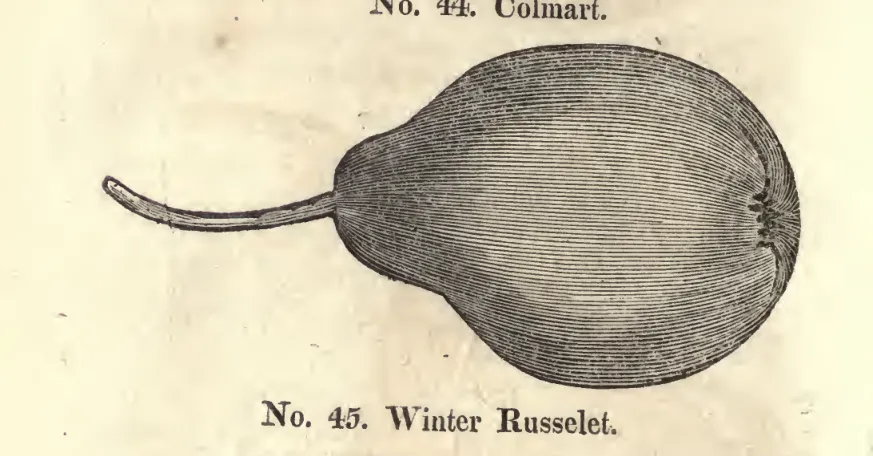
Winter Rousselet
Origin/History
Winter Rousselet is an ancient French pear of unknown origin. It was described by Claude Saintfitienne in 1670 and by Duhamel in the eighteenth century, and is referenced in Mawe and Abercrombie's Universal Gardener and Botanist (1778) and in Leroy's Dictionnaire de Pomologie (2:593, with figure, 1869). William Coxe included it among his enumerated pears in 1817.
Tree
Not described in source, beyond bearing habit. Coxe notes it is an abundant bearer.
Fruit
Size
Small (both Coxe and Hedrick).
Form
Coxe describes a regular shape, gradually diminishing towards the stem. Hedrick gives a fuller characterization: turbinate, more or less obtuse, usually somewhat contracted toward the top, and often depressed on one side and mammillate on the other.
Stem
Not described in source.
Cavity
Not described in source.
Calyx
Not described in source.
Basin
Not described in source.
Skin
Coxe describes the skin as a lively russet like a Golden Pippin. Hedrick describes the ground color as yellow-green, dotted with gray russet and blushed with reddish-brown on the face exposed to the sun.
Flesh and Flavor
The two sources conflict on flesh color: Coxe gives it as yellow; Hedrick as white. Coxe describes the flesh as rich and sprightly, and rather too firm for a table fruit. Hedrick describes it as semi-breaking, watery, and rather granular, with juice abundant and saccharine; he adds that it rarely has much aroma and is sometimes acid. Hedrick rates it second quality.
Core and Seeds
Not described in source.
Season
February and March (Hedrick). Coxe notes it is a fine keeping pear.
Uses
Coxe considers it rather too firm for use as a table fruit but excellent for baking and stewing.
Subtypes/Variants
Not described in source.
Other
Not described in source.
Book Sources
Described in 2 period pomological works
- Coxe, A View of the Cultivation of Fruit Trees (1817) — listed as 45. WINTER RUSSELET
- Hedrick, The Pears of New York (1921)
View original book sources (2)
— William Coxe, A View of the Cultivation of Fruit Trees (1817)
- WINTER RUSSELET.
Is a small pear, of regular shape, gradually diminishing towards the stem: the skin is a lively russet like a Golden Pippin the flesh is yellow, rich, and sprightly, rather too firm for a table fruit, but excellent for baking and stewing; it is a fine keeping pear, and an abundant bearer.
[Additional entry in this volume: "Winter Russelet", pp. 313–313]
- WINTER RUSSELET.
Is a small pear, of regular shape, gradually diminishing towards the stem : the skin is a lively russet like a Golden Pippin—the flesh is yellow, rich, and sprightly, rather too firm for a table fruit, but excellent for baking and stewing ; it is a fine keeping pear, and an abundant bearer.
— U.P. Hedrick, The Pears of New York (1921)Winter Rousselet. i. Mawe-Abercrombie Univ. Card. Bot. 1778. Rousselet d'Hiver. 3. Leroy Dict. Pom. 2:593, fig. 1869. An ancient French pear of unknown origin, though it was described by Claude Saintfitienne in 1670 and by Duhamel in the eighteenth century. Fruit small, turbinate, more or less obtuse, usually somewhat contracted toward the top, and often depressed on one side and mammillate on the other, yellow-green dotted with gray russet and blushed with reddish-brown on the face exposed to the sun; flesh white, semi-breaking, watery, rather granular, juice abundant, saccharine, rarely having much aroma and sometimes acid; second; Feb. and Mar.