Bailey Sweet
Apple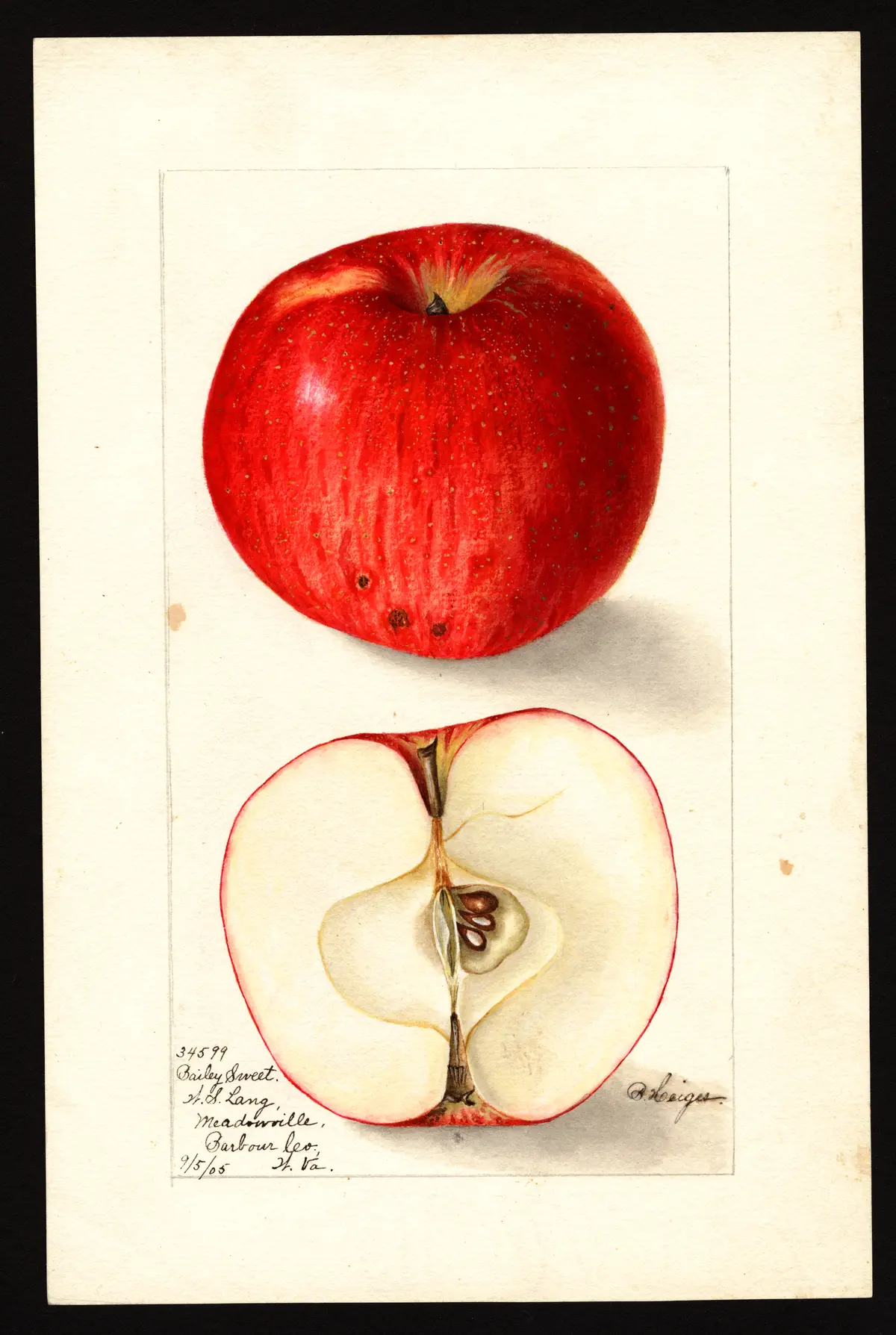
USDA Pomological Watercolor Collection
Bailey Sweet
Origin / History
The origin of Bailey Sweet is unknown. It was introduced under this name from Perry, Wyoming County, New York, more than 60 years before 1905 (Beach), by J. Edgerly of Perry (Downing). Whether it originated there or was an old variety brought in from the East is uncertain. The first description was published by Thomas in 1849 (Hedrick). Hansen records it as "first introduced in New York," characterizing it as "an old, choice variety." Budd-Hansen gives the origin simply as New York. Although it has long been known and widely disseminated, there is no section of New York State where it is grown in large quantities (Beach). Despite many faults, it is largely grown in many parts of America because of its rich, sweet fruits agreeable to all who like sweet apples (Hedrick).
Tree
Tree vigorous and productive (Warder, Budd-Hansen); hardy, vigorous, upright, spreading, productive (Downing). Beach describes the tree as upright, somewhat spreading, rather open, not dense; branches moderately stout or slender. Hedrick gives it as upright-spreading, open, with slender branches. Twigs rather slender, nearly straight; internodes medium to short. Bark rather dark brownish-red marked with thin gray scarf-skin; sparingly pubescent. Lenticels numerous, medium to below medium in size, usually oblong, conspicuous, somewhat raised. Buds medium to large, broad, acute to somewhat obtuse, appressed, somewhat pubescent. Leaves often rather broad and large (Beach), large (Hedrick); foliage not dense.
In the nursery the development of the root system is rather light or weak. In the orchard the tree makes a rather slow or moderately vigorous growth and does not become large. It is a reliable cropper with a tendency to annual bearing. The fruit hangs well to the tree (Beach).
Hansen notes that it is not generally hardy at the north, but specimens have been shown from the southern part of South Dakota at the state fair. Hedrick notes the trees lack vigor, health, and hardiness, defects offset somewhat by productiveness and regularity in bearing. The Central Experimental Farm at Agassiz, BC (planted Spring 1890) reports the tree to be a moderate grower. The Bunyard catalog (1914) describes the tree as vigorous, with a spreading habit, growing readily.
Fruit
Size
Large (Warder, Downing, Thomas, Hansen, Budd-Hansen, Beach, Hedrick); medium to large (Elliott); sometimes as large as Baldwin or larger, and averages above medium (Beach); medium-sized (Bunyard, Central Experimental Farm). Hedrick notes the fruits are often malformed and not uniform in size, though Beach finds them pretty uniform in size and shape.
Form
Round, ovate flattened, sometimes ribbed (Elliott); round, sometimes flattened, sometimes angular or ribbed (Warder); roundish conical, often approaching oblong, obscurely ribbed (Downing); roundish oblong, somewhat conic, irregular (Hansen); large regular ovate, often slightly and sometimes considerably ribbed (Thomas); roundish to roundish conic, or somewhat oblate, ribbed obscurely if at all, rather symmetrical, sides somewhat elliptical (Beach); roundish tapering, obscurely ribbed, irregular (Budd-Hansen); round-conic or oblate, ribbed obscurely, symmetrical, sides elliptical (Hedrick); oblate conical (Central Experimental Farm); round (Bunyard).
A secondary description quoted by Warder gives the form as "above medium, roundish, approaching conic, sometimes elongated, angular."
Stem
Slender (Elliott); long (Warder); short and rather small (Downing); short (Hansen, Budd-Hansen, Beach, Hedrick); slender, one inch long (Thomas); short to medium, rather slender to thick (Beach). The secondary description quoted by Warder gives it as short.
Cavity
Narrow, deep (Elliott); regular, acute, green (Warder); narrow (Downing); deep, narrow, regular, with a patch of russet (Hansen); small, narrow, slightly ribbed (Thomas); acute, usually rather deep, somewhat furrowed, sometimes with sides compressed or lipped, often partly covered with a thin golden-brown russet (Beach); regular, acuminate, slightly russeted, deep, narrow (Budd-Hansen); acute, deep, furrowed, sometimes with sides compressed or lipped, often with thin golden-brown russet (Hedrick). The secondary description quoted by Warder calls it broad and shallow.
Calyx
Closed (Elliott, Downing); small, closed (Warder, Downing, Hedrick); open, segments divergent (Hansen); half open, segments entire, divergent (Budd-Hansen); closed or sometimes partly open, small to medium, with short obtuse to acute lobes (Beach); closed, small, with short obtuse lobes (Hedrick).
Basin
Medium, abrupt, often plaited (Elliott); narrow, abrupt, regular or folded (Warder); narrow, irregular (Downing); shallow, slightly corrugated, some fine wrinkles (Hansen); small, plaited (Thomas); somewhat shallow to very shallow, medium to narrow, obtuse to rather abrupt, often slightly furrowed or slightly corrugated, with a tendency to develop mammiform protuberances (Beach); shallow, narrow, abrupt, slightly corrugated, wrinkled (Budd-Hansen); shallow, narrow, obtuse, furrowed or corrugated, often with mammiform protuberances (Hedrick).
Skin
Clear yellowish red, with an occasional russet patch (Elliott); surface smooth, mottled, mixed and striped deep red (Warder); yellowish, mostly shaded and obscurely striped with red, and thickly sprinkled with minute dots (Downing); surface roughened by russet dots, greenish yellow, mostly covered with dark, rather dull red stripes, solid on sunny side; dots distinct, numerous, russet (Hansen); the whole surface frequently a full bright red in small, broken, indistinct stripes and dots on light ground (Thomas); rather tender, nearly smooth, clear bright yellow largely covered with deep red, mottled or obscurely striped with darker red — often irregularly netted markings and dots of whitish or russet-gray contrast conspicuously with the red surface; whitish scarf-skin sometimes radiates from the cavity; prevailing effect attractive bright red (Beach); surface roughened by scattered russet dots, yellow, mostly covered with dark rich red, obscurely striped, solid on sunny side; dots many, minute, russet, distinct (Budd-Hansen); tender, smooth, clear bright yellow covered with deep red, mottled or striped with darker red, often with irregularly netted markings and dots (Hedrick); greenish yellow, nearly covered with dull red, and many small dots (Central Experimental Farm); greenish-yellow (Bunyard).
Warder also describes dots as "numerous, large, gray" — distinct from the later sources' "minute" or "russet" characterization. The secondary description quoted by Warder gives the skin as "greenish yellow, shaded and splashed with crimson, sprinkled with gray dots."
Downing notes the skin is perhaps a little too tender for shipping long distances. Hedrick adds that the fruits are susceptible to the scab fungus, and Beach notes that in some localities the fruit is apt to be rather scabby and knotty, with a high percentage of unmarketable fruit unless well sprayed.
Flesh / Flavor
Yellow, rather dry, sweet; "very good" (Elliott); yellow, tender, fine-grained, juicy; flavor very sweet, rich; quality good to very good (Warder); white, tender, not very juicy, almost melting, with a honeyed sweet flavor; very good (Downing); yellow, moderately juicy, firm, sweet, very good (Hansen); very tender, not juicy; flavor mild, rich, sweet; fine (Thomas); tinged with yellow, firm, moderately coarse, moderately crisp, rather tender, moderately juicy to juicy, decidedly sweet, agreeable in flavor, very good in quality (Beach); yellow, moderately juicy, firm, fine-grained, very sweet, very good (Budd-Hansen); yellow, firm, coarse, crisp, tender, juicy, sweet, agreeable in flavor, very good in quality (Hedrick); white, tender, not juicy, very sweet, quality good (Central Experimental Farm); good flavour (Bunyard).
Sources thus disagree on flesh color (yellow per Elliott, Warder, Hansen, Budd-Hansen, Beach, Hedrick; white per Downing and Central Experimental Farm), on juiciness (rather dry / not juicy / not very juicy per Elliott, Thomas, Downing, Central Experimental Farm; moderately juicy per Hansen and Budd-Hansen; juicy per Warder and Hedrick; moderately juicy to juicy per Beach), and on texture coarseness (fine-grained per Warder and Budd-Hansen; moderately coarse per Beach; coarse per Hedrick).
Beach summarizes it as "a very beautiful red apple, distinctly sweet and of very good quality."
Core / Seeds
Core medium; seeds ovate pyriform (Elliott). Core rather large, turbinate, open, clasping; seeds numerous, angular, dark (Warder). Core rather large (Downing). Core open; cells ovate; tube funnel-shaped; stamens median; seeds large, long, pointed, plump (Hansen). Core closed; tube funnel-shaped; stamens median; seeds large, long-pointed, plump (Budd-Hansen). Calyx tube funnel-shape, medium length with a rather wide limb; stamens median; core axile, medium in size, closed; core lines clasping; carpels elliptic to roundish cordate, emarginate; seeds medium to rather large, long, acute (Beach). Calyx-tube funnel-shape, wide limb; stamens median; core axile, closed; core-lines clasping; carpels elliptic, emarginate; seeds large, long, acute (Hedrick).
Sources disagree on whether the core is open (Warder, Hansen) or closed (Budd-Hansen, Beach, Hedrick).
Season
October (Warder); November to December (Elliott); November to March (Downing); late fall, early winter (Hansen); early winter (Thomas, Budd-Hansen); October to January or sometimes later (Beach, Hedrick); early Autumn (Central Experimental Farm); October (Bunyard). Beach notes it is not a very good keeper, and Hedrick concurs that the fruits do not keep well.
Uses
Kitchen, table (Warder). Warder additionally calls it "a very valuable variety also for stock." Downing regards it as profitable for all purposes, though perhaps a little too tender of skin for shipping long distances. Beach states it is not recommended for cultivation, citing scab susceptibility, lack of tree vigor/health/hardiness, and keeping limitations. Bunyard lists it as a dessert apple, "Valuable only (H, B.T., P.)."
Subtypes / Variants
Not described in source.
Other
Warder classifies it as Class III (Round Apples), Order II (Irregular), Section 1 (Sweet), Sub-section 2 (Striped). Thomas references "Fig. 404" for an illustration. Warder includes a secondary quoted description (origin unknown; good grower and very productive) that is partially truncated in the source — only the beginning of the flesh description ("Flesh yel—") survives.
Book Sources
Described in 8 period pomological works
- Beach, The Apples of New York Vol. 1 (1905)
- Warder, American Pomology: Apples (1867)
- Budd & Hansen, Systematic Pomology (1914)
- Elliott, The Western Fruit Book (1865)
- Hansen, A Study of Northwestern Apples (1902)
- Hedrick, Cyclopedia of Hardy Fruits (1922)
- Thomas, The American Fruit Culturist (1903)
- Downing, Fruits and Fruit Trees of America (1900) — listed as Bailey's Sweet
Nursery Catalog Sources
Found in 24 catalogs (1889–1947) from Illinois, Kansas, Maryland, Massachusetts, Missouri, New Jersey, Oregon, Pennsylvania, Washington
- Palouse Nursery and Pleasant Dale Fruit Farm , Colfax, Washington Territory (situated two miles northeast of Colfax) - undated (single-page broadside flyer; "Washington Territory" suggests pre — 1889 — listed as Bailey's Sweet
- William H. Moon Co. , Morrisville, Bucks County , Pennsylvania — 1890 — listed as Bailey's Sweet
- Puyallup & Yakima Nurseries , Puyallup, Washington (Lock Box 191) and North Yakima , Washington — 1892 — listed as Bailey's Sweet
- Rogers Nursery Co. , Moorestown , New Jersey — 1893 — listed as Bailey's Sweet
- The Vineland Nurseries (Kelsey & Co. , Proprietors), St. Joseph, Missouri (Office: 13th and Atchison Sts., 2 Blocks East of the Citizens St. Car Line) — 1894 — listed as Bailey's Sweet
- Reading Nursery , Jacob W. Manning, Proprietor, Reading , Massachusetts — 1898 — listed as Bailey's Sweet
- Brown Brothers Co. , Continental Nurseries, Rochester, NY (also operated from Toronto, Canada) — 1899 — listed as Bailey's Sweet
- Central Experimental Farm , Dominion Department of Agriculture, Agassiz, British Columbia (under test; Bulletin No. 3, Second Series) — 1900 — listed as Bailey's Sweet
- The Dalles Nurseries , The Dalles , Oregon — 1901 — listed as Bailey's Sweet
- Brown Brothers Co. , Continental Nurseries, Rochester, NY (also operated from Toronto, Canada) — 1901 — listed as Bailey's Sweet
- Mountain Grove Nurseries (Tippin & Moore , Proprietors; Geo. T. Tippin, J. W. Tippin, J. C. Moore), Mountain Grove , Missouri — 1901 — listed as Bailey's Sweet
- Benjamin Buckman (personal inventory) , Farmingdale , Illinois — 1901 — listed as Bailey's Sweet
- Pacific Nursery Company (W. O. Hudson & A. D. Hudson) , Tangent , Oregon — 1903 — listed as Bailey's Sweet
- Russellville Nursery Co. , Russellville, OR (three miles east of Portland, one mile from Montavilla car line) — 1903 — listed as Bailey's Sweet
- Phoenix Nursery Company (W. E. Rossney , President; Sidney Tuttle, Vice-President), Bloomington , Illinois — 1904 — listed as Bailey's Sweet
- Carlton Nursery Co. , Carlton , Oregon — 1909 — listed as Bailey's Sweet
- Milton Nursery Co. (A. Miller & Sons , Proprietors), Milton , Oregon — 1909 — listed as Bailey's Sweet
- Wm. J. Corse (successor to Robert Sinclair / Sinclair Nurseries) , Baltimore , Maryland — 1909 — listed as Bailey's Sweet
- Benjamin Buckman (personal inventory) , Farmingdale , Illinois — 1913 — listed as Bailey's Sweet
- Union Nurseries , J.B. Weaver & Sons, Union , Oregon — 1915 — listed as Bailey's Sweet
- Holsinger Bros. Nurseries (Holsinger Brothers Nursery) , Rosedale , Kansas — 1916 — listed as Bailey's Sweet
- Benedict Nursery Co. , Portland , Oregon — 1921 — listed as Bailey's Sweet
- Hudson's Wholesale Nurseries , Tangent , Oregon — 1936 — listed as Bailey's Sweet
- Milton Nursery Co. , Milton-Freewater , Oregon — 1947 — listed as Bailey's Sweet
View original book sources (10)
— F.R. Elliott, The Western Fruit Book (1865)Bailey Sweet. Patterson Sweet, | Edgerly Sweet, Howard's Sweet. From Perry, N. Y. Fruit, medium to large, round, ovate flattened, sometimes ribbed, clear yellowish red, with an occasional russet patch ; stem, slender ; cavity, narrow, deep ; calyx, closed ; basin, medium, abrupt, often plaited; flesh, yellow, rather dry, sweet; "very good;" core, medium ; seeds, ovate pyriform. November to December.
— John A. Warder, American Pomology: Apples (1867)CLASS III.— ROUND APPLES. ORDER II.— IRREGULAR. SECTION 1.— SWEET. SUB-SECTION 2.— STRIPED.
From Wyoming County, New York. Tree vigorous, productive.
Fruit large, round, sometimes flattened, sometimes angular or ribbed; Surface smooth, mottled, mixed and striped deep red; Dots numerous, large, gray.
Basin narrow, abrupt, regular or folded; Eye small, closed.
Cavity regular, acute green; Stem long.
Core rather large, turbinate, open, clasping; Seeds numerous, angular, dark; Flesh yellow, tender, fine-grained, juicy; Flavor very sweet, rich; Quality good to very good; Use, kitchen, table; Season, October.
A very valuable variety also for stock.
"Origin unknown; good grower, and very productive.
"Fruit above medium, roundish, approaching conic, sometimes elongated, angular; Skin greenish yellow, shaded and splashed with crimson, sprinkled with gray dots; Stem short, inserted in a broad, shallow cavity; Calyx closed, set in a small corrugated basin; Flesh yel-
— A.J. Downing, The Fruits and Fruit Trees of America (1900)Bailey's Sweet. Edgerly's Sweet. Howard's Sweet. Paterson's Sweet. Origin unknown, introduced by J. Edgerly of Perry, Wyoming Co., N. Y. Tree hardy, vigorous, upright, spreading, productive. This variety is regarded as profitable for all purposes, although perhaps a little too tender skin for shipping long distances. Fruit large, form roundish conical, often approaching oblong, obscurely ribbed, color yellowish, mostly shaded and obscurely striped with red, and thickly sprinkled with minute dots. Stalk short and rather small, inserted in a narrow cavity. Calyx small, closed, set in a narrow irregular basin. Flesh white, tender, not very juicy, almost melting, with a honeyed sweet flavor. Core rather large. Very good. November to March.
— N.E. Hansen, A Study of Northwestern Apples (1902)Bailey Sweet—Origin unknown, first introduced in New York. An old, choice variety, not generally hardy at the north, but specimens have been shown from the southern part of South Dakota at the state fair. The following description is from specimens grown at Freeburg, Minnesota—Fruit large, roundish oblong, somewhat conic, irregular; surface roughened by russet dots, greenish yellow, mostly covered with dark, rather dull red stripes, solid on sunny side; dots distinct, numerous, russet; cavity deep, narrow, regular, with a patch of russet; stem short; basin shallow, slightly corrugated, some fine wrinkles; calyx open, segments divergent. Core open; cells ovate; tube funnel-shaped; stamens median; seeds large, long, pointed, plump; flesh yellow, moderately juicy, firm, sweet, very good. Late fall, early winter.
— John J. Thomas, The American Fruit Culturist (1903)Bailey Sweet.* (Patterson Sweet, Edgerly Sweet.) Large, regular ovate, often slightly and sometimes considerably ribbed; the whole surface frequently a full bright red, in small, broken, indistinct stripes and dots, on light ground; stalk slender, one inch long; cavity small, narrow, slightly ribbed; basin small, plaited; flesh very tender, not juicy; flavor mild, rich, sweet; fine. Early winter. Fig. 404. Origin, Perry, Wyoming Co., N. Y.
— S.A. Beach, The Apples of New York, Vol. 1 (1905)BAILEY SWEET.
REFERENCES. 1. Thomas, 1849:159. 2. Emmons, Nat. Hist. N. Y., 3:59. 1851. 3. Downing, 1857:116. 4. Elliott, 1858:121. 5. Warder, 1867:633. fig. 6. Downing, 1872:84. 7. Barry, 1883:342. 8. Lyon, Mich. Hort. Soc. Rpt., 1890:288. 9. Bailey, An. Hort., 1892:234. 10. Vt. Sta. An. Rpt., 1901:287. 11. Fulton, Mich. Sta. Bul., 187:85. 1901. 12. Hansen, S. D. Sta. Bul., 76:27. 1902. 13. Thomas, 1903:319. 14. Budd-Hansen, 1903:42. fig. 15. Beach and Clark, N. Y. Sta. Bul., 248:111. 1904. 16. Cole, 123. 17. Hooper, 12.
SYNONYMS. BAILEY'S GOLDEN SWEET (16). BAILEY SWEET (1, 4, 5, 12, 13, 17). Bailey Sweet (8, 10). BAILEY'S SWEET (2, 3, 7, 16). Bailey's Sweet (9). Edgerly Sweet (1, 4, 13). Edgerly's Sweet (3, 6). Harvard's Sweet (3, 6). Paterson's Sweet (3, 6). Patterson Sweet (13). Patterson's Sweet (1, 2).
This is a very beautiful red apple, distinctly sweet and of very good quality. It is in season from October to January or sometimes later. It is not a very good keeper. In some localities the fruit is apt to be rather scabby and knotty, and unless it is well sprayed the percentage of unmarketable and low-grade fruit runs rather high. The tree is reliably productive but it does not excel either in vigor, health or hardiness. It is not recommended for cultivation.
Historical. Bailey Sweet was introduced under this name from Perry, Wyoming county, New York, more than 60 years ago (1). Whether it originated there or was an old variety brought in from the East is uncertain (3). Although it has long been known and widely disseminated, there is no section of the state where it is grown in large quantities.
TREE.
Tree upright, somewhat spreading, rather open, not dense; branches moderately stout or slender. Twigs rather slender, nearly straight; internodes medium to short. Bark rather dark brownish-red marked with thin gray scarf-skin; sparingly pubescent. Lenticels numerous, medium to below, usually oblong, conspicuous, somewhat raised. Buds medium to large, broad, acute to somewhat obtuse, appressed; somewhat pubescent. Leaves often rather broad and large; foliage not dense.
In the nursery the development of the root system is rather light or weak. In the orchard the tree makes a rather slow or moderately vigorous growth and does not become large. It is a reliable cropper with a tendency to annual bearing. The fruit hangs well to the tree.
FRUIT.
Fruit sometimes as large as Baldwin or larger and averages above medium. Form roundish to roundish conic, or somewhat oblate, ribbed obscurely if at all, rather symmetrical, sides somewhat elliptical; pretty uniform in size and shape. Stem short to medium, rather slender to thick. Cavity acute, usually rather deep, somewhat furrowed, sometimes with sides compressed or lipped, often partly covered with a thin golden-brown russet. Calyx closed or sometimes partly open, small to medium with short obtuse to acute lobes. Basin somewhat shallow to very shallow, medium to narrow, obtuse to rather abrupt, often slightly furrowed or slightly corrugated, with a tendency to develop mammiform protuberances.
Skin rather tender, nearly smooth, clear bright yellow largely covered with deep red, mottled or obscurely striped with darker red. Often irregularly netted markings and dots of whitish or russet-gray contrast conspicuously with the red surface. Whitish scarf-skin sometimes radiates from the cavity. Prevailing effect attractive bright red.
Calyx tube funnel-shape, medium length with a rather wide limb. Stamens median.
Core axile, medium in size, closed; core lines clasping. Carpels elliptic to roundish cordate, emarginate. Seeds medium to rather large, long, acute.
Flesh tinged with yellow, firm, moderately coarse, moderately crisp, rather tender, moderately juicy to juicy, decidedly sweet, agreeable in flavor, very good in quality.
Season October to January or later.
— J.L. Budd & N.E. Hansen, American Horticultural Manual, Part II: Systematic Pomology (1914)Bailey Sweet.—Origin, New York; tree vigorous, productive.
Fruit large, roundish tapering, obscurely ribbed, irregular; surface roughened by scattered russet dots, yellow, mostly covered with dark rich red, obscurely striped, solid on sunny side; dots many, minute, russet, distinct; cavity regular, acuminate, slightly russeted, deep, narrow; stem short; basin shallow, narrow, abrupt, slightly corrugated, wrinkled; calyx half open; segments entire, divergent. Core closed; tube funnel-shaped; stamens median; seeds large, long-pointed, plump; flesh yellow, moderately juicy, firm, fine-grained, very sweet, very good. Early winter.
— U.P. Hedrick, Cyclopedia of Hardy Fruits (1922)BAILEY SWEET. Howard's Sweet. Despite many faults, Bailey Sweet is largely grown in many parts of America because of its rich, sweet fruits agreeable to all who like sweet apples. The trees lack vigor, health, and hardiness, defects offset somewhat by productiveness and regularity in bearing. The fruits are susceptible to the scab fungus, do not keep well, are often malformed, and are not uniform in size. The origin of the variety is not known, further than that it was disseminated from Perry, New York. The first description was published by Thomas in 1849.
Tree upright-spreading, open; branches slender. Leaves large. Fruit large, round-conic, or oblate, ribbed obscurely, symmetrical, sides elliptical, uniform in size and shape; stem short; cavity acute, deep, furrowed, sometimes with sides compressed or lipped, often with thin golden-brown russet; calyx closed, small with short obtuse lobes; basin shallow, narrow, obtuse, furrowed or corrugated, often with mammiform protuberances; skin tender, smooth, clear bright yellow covered with deep red, mottled or striped with darker red, often with irregularly netted markings and dots; calyx-tube funnelshape, wide limb; stamens median; core axile, closed; core-lines clasping; carpels elliptic, emarginate; seeds large, long, acute; flesh yellow, firm, coarse, crisp, tender, juicy, sweet, agreeable in flavor; very good in quality; October to January or later.
— Central Experimental Farm, Central Experimental Farm, Agassiz BC — Catalogue of Fruit Trees under Test (Bulletin No. 3, 1900) (1900)Planted Spring 1890. Tree a moderate grower. Fruit of medium size, oblate conical. Skin greenish yellow, nearly covered with dull red, and many small dots. Flesh white, tender, not juicy, very sweet, quality good. Season, early Autumn.
— George Bunyard & Co., George Bunyard Catalog of Fruit Trees (1914) (1914)Dessert; Oct. Tree vigorous. Fruit medium-sized, round, greenish-yellow, good flavour, and spreading habit; growing readily for high value. Valuable only (H, B.T., P.)