← All varieties

Crimson Beauty

Apple
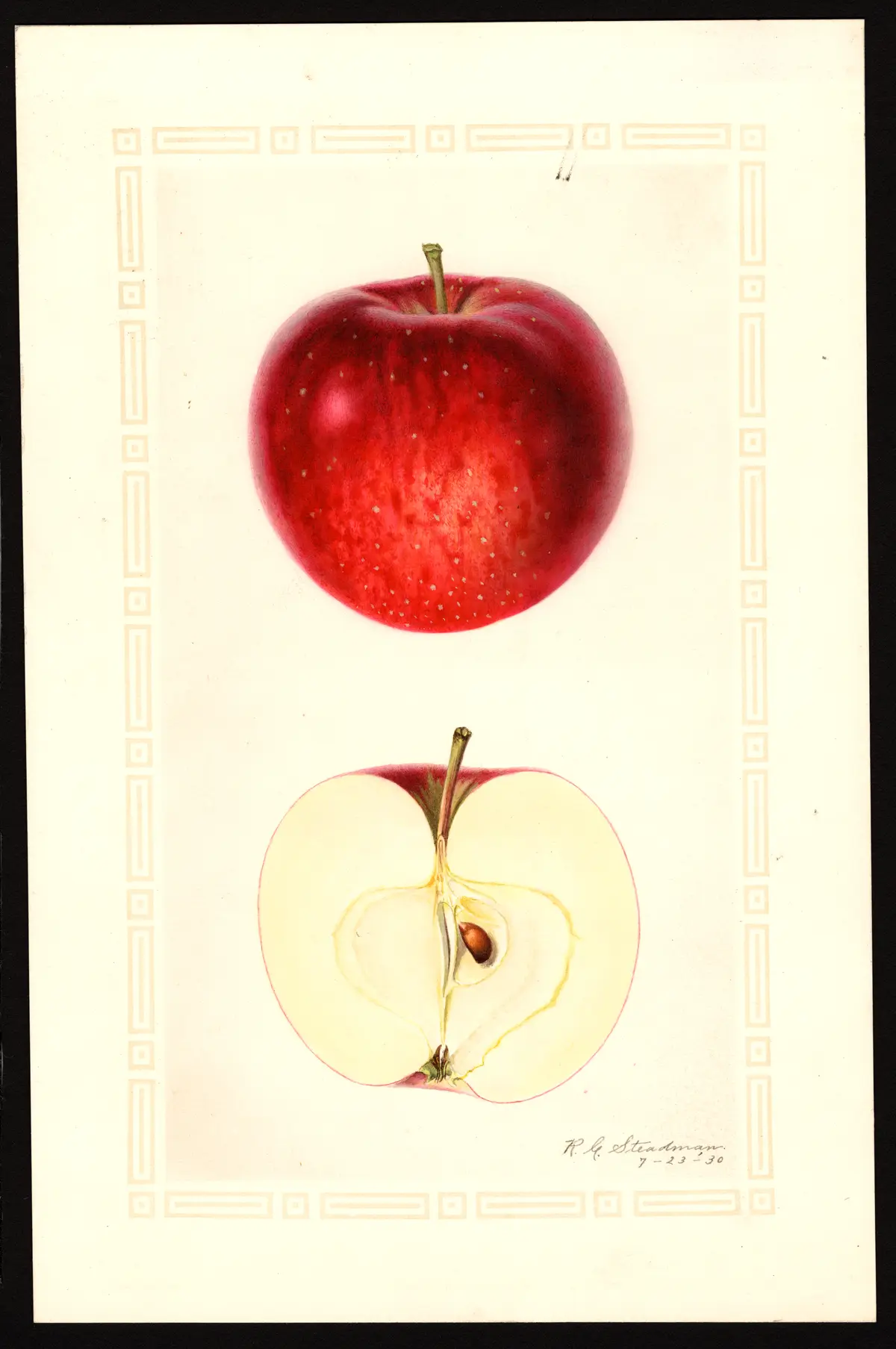
Crimson Beauty

Origin/History

Crimson Beauty originated with F. P. Sharp of Woodstock, New Brunswick, as a cross of New Brunswick with Fameuse pollen. It is described as a good early variety of remarkable beauty. Records of the variety appear in Nova Scotia (P. J. Shaw, 1912) and Canada more broadly (PI 143173, 1941). It was distributed by nurseries including Stark Bros. Nursery of Louisiana, Missouri; Bountiful Ridge Nursery of Princess Anne, Maryland; and Van Well Nursery of Wenatchee, Washington.

Tree

Not described in source.

Fruit

Size: Budd & Hansen describe the fruit as large. Fisher's USDA survey records it as medium.

Form: Roundish, flattened at the ends, slightly oblique and angular. Fisher's survey describes the form as round-oblate, consistent with the flattened ends noted by Budd & Hansen.

Stem: Long and quite stout.

Cavity: Deep and abrupt.

Calyx: Not described in source.

Basin: Abrupt, quite deep, ridged, and often corrugated.

Skin: Surface yellowish white, overspread with crimson red, with irregular and often indistinct stripes.

Flesh/Flavor: Budd & Hansen describe the flesh as yellowish white (Fisher gives white), fine-grained, juicy, and subacid, rated very good. Fisher's survey adds that the flesh is firm and crisp, with a tart-subacid flavor, and notes the variety is suitable for both dessert and culinary use.

Core/Seeds: Core open, not meeting.

Season

Very early — approximately one week earlier than Yellow Transparent. Fisher's survey confirms the early season and notes it is a poor keeper.

Uses

Dessert and culinary (Fisher). Valued as an early-season variety.

Subtypes/Variants

Not described in source.

Other

Fisher's USDA survey notes light susceptibility to fire blight. The variety was held at multiple experiment stations, including the Agricultural Experiment Station at Geneva, New York; the North Dakota station (NdM); the South Dakota station (SdC); the Wyoming station (WyC); the Maryland station (MdG); the Ohio station (OhW); and the Washington station (WaP, accession AP-H-298), as well as the Dominion Experimental Station at Morden, Manitoba, with station accession numbers A33157 and N-13.

Book Sources

Described in 2 period pomological works

View original book sources (2)

Crimson Beauty. — Originated by F. P. Sharp, Woodstock, New Brunswick, by crossing New Brunswick with Fameuse pollen. A good early variety of remarkable beauty.

Fruit large, roundish, flattened at ends, slightly oblique and angular; surface yellowish white, overspread with crimson red, with irregular and often indistinct stripes; cavity deep, abrupt; stem long, quite stout; basin abrupt, quite deep, ridged and often corrugated. Core open, not meeting; flesh yellowish white, fine-grained, juicy, subacid, very good. Very early, about one week earlier than Yellow Transparent.

— J.L. Budd & N.E. Hansen, American Horticultural Manual, Part II: Systematic Pomology (1914)

CRIMSON BEAUTY

Received from Stark Bros. Nurs., Louisiana, Mo. Fr. med., rnd.-oblate, red stripe. Flesh wh., firm, crisp, tart-sa., dess. culin., early, poor keeper. Lt. blight. Station No. A33157. WyC

PI 143173. Canada 1941. MdG

Bountiful Ridge Nur., Princess Anne, Md. OhW

Van Well Nur., Wenatchee, Wash. AP-H-298. WaP

N-13. SdC

AES, Geneva, N. Y. MyG

P. J. Shaw, Nova Scotia, Canada 1912. NdM

Dominion Exp. Sta., Morden, Manitoba.

— H.H. Fisher (USDA ARS), A Survey of Apple Clones in the United States (1963)
Scarlet Pippin