Echasserie
Pear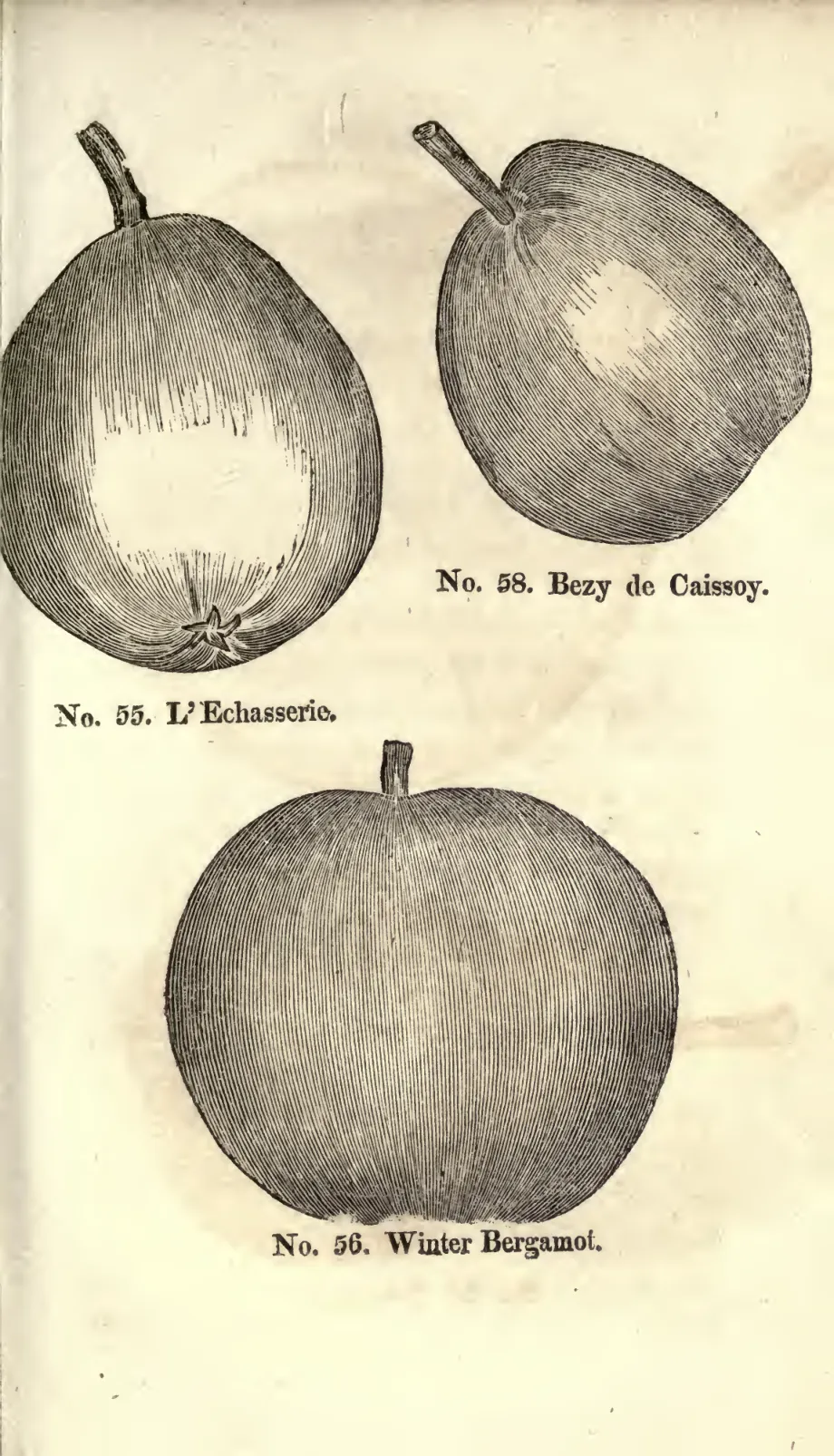
Echasserie
Origin / History
A French pear, listed by Elliott as foreign. According to Hedrick, the wilding from which Echasserie was derived was probably noticed about 1660. La Quintinye, writing before 1690, spoke of it as having been in French gardens for twenty years. It appears to have been a native of Anjou, where three places bear the name given to it. Hedrick thinks it had probably been cultivated locally under other names for a long time before its official recognition. Coxe described it in 1817 under the name "L'Echasserie."
Tree
Fruitful and productive, and an early bearer. Coxe calls the tree very handsome. Elliott calls it a poor grower.
Fruit
Size: Medium; medium to small by Hedrick's account.
Form: Roundish oval. Coxe gives oval, diminished toward the stalk, with the blossom end very round. Hedrick gives globular-oval but variable, always obtuse and bossed.
Stem: Large (Coxe).
Cavity: Not described in source.
Calyx: Open (Elliott); the eye not sunk (Coxe).
Basin: Not described in source.
Skin: Pale green, yellowish at maturity, or greenish yellow. Coxe gives light yellow inclining to white, and Hedrick lemon-yellow with some patches of grayish-brown russet. Smooth (Downing) or rough to the touch (Hedrick).
Dots: Gray, showing when ripe, slight in Downing's account; fawn (Hedrick).
Flesh and flavor: Flesh melting and buttery. Coxe calls it fine. Hedrick gives white and fine, with very small grits around the core. Flavor sweet. Coxe calls the juice musky and very pleasant, and Downing calls the flavor perfumed. Hedrick finds the juice extremely abundant, acidulous, saccharine, "with an aftertaste of musk, very agreeable." Coxe calls it "an excellent pear" and Hedrick rates it "first," while Elliott gives "good" and Downing calls it "a French Pear of second quality."
Core and seeds: Not described in source.
Season
Winter, November into April. Most authors give November to December, January, or February; Downing alone gives January to April.
Uses
Not described in source.
Subtypes / Variants
Not described in source.
Other
Hedrick's references for Echasserie are Duhamel, Trait. Arb. Fr. 2:187, Pl. XXXII, 1768; Downing, Fr. Trees Am. 753, 1869; Am. Pom. Soc. Rpt. 90, 1856; and Leroy, Dict. Pom. 1:269, with figure, 1867.
Book Sources
Described in 5 period pomological works
- Coxe, A View of the Cultivation of Fruit Trees (1817) — listed as L'Echasserie
- Downing, Fruits and Fruit Trees of America (1900)
- Hedrick, The Pears of New York (1921)
- Elliott, The Western Fruit Book (1865) — listed as Echassery
- Thomas, The American Fruit Culturist (1903) — listed as Echassery
Nursery Catalog Sources
Found in 2 catalogs (1845–1849) from Massachusetts
- Winship's Nursery (Brighton Nurseries , operated by the Winship family), Brighton (Boston) , Massachusetts — 1845
- Hovey & Co. , Cambridge , Massachusetts — 1849
View original book sources (5)
— William Coxe, A View of the Cultivation of Fruit Trees (1817)
- L'ECHASSERIE.
This pear is of the medium size, an oval form, diminished towards the stalk, the blossom end very round, the eye not sunk, the stalk is large : the flesh is melting, buttery and fine, the juice sweet, musky and very pleasant—the skin is of a light yellow, inclining to white ; its maturity is from November, to February, and it is an excellent pear : the tree is very handsome and fruitful, and is an early bearer.
— F.R. Elliott, The Western Fruit Book (1865)ECHASSERY.
Echasserie, Bezi d'Echassie, Bezi de Chasserie, Jagdbirne.
Foreign. Poor grower. Fruit, medium, roundish oval, pale green, yellowish, dotted with gray when ripe; calyx, open; flesh, melting, buttery, sweet; "good." November and December.
— A.J. Downing, The Fruits and Fruit Trees of America (1900)ECHASSERIE.
Bezi d'Echassey. Bezi l'Echasserie. Jagdbirne. Bezi de Chasseray. L'Echasserie. Verte Longue d'Hiver. Besidery. Sandry. Echassery. Winter Long Green. Winter Green Long. Landry. Wilding.
A French Pear of second quality, productive. Fruit of medium size, roundish oval. Skin smooth, pale green, yellowish at maturity, slightly dotted with gray. Flesh melting, buttery, with a sweet perfumed flavor. January to April.
— John J. Thomas, The American Fruit Culturist (1903)Echassery. Medium, roundish-oval, greenish-yellow; melting, buttery, sweet. Winter. French.
— U.P. Hedrick, The Pears of New York (1921)Echasserie.
- Duhamel Trait. Arb. Fr. 2:187, Pl. XXXII. 1768. 2. Downing Fr. Trees Am. 753. 1869. Walnut. 3. Am. Pom. Soc. Rpt. 90. 1856. Besi de l'Echasserie. 4. Leroy Dict. Pom. 1:269, fig. 1867.
The wilding from which this variety was derived was probably noticed about 1660 and La Quintinye before 1690 spoke of it as having been in French gardens for twenty years. It appears to have been a native of Anjou, where there are three places bearing the name given to it. Probably it had been locally cultivated under other names for a long time previous to its official recognition.
Fruit medium to small, globular-oval but variable, always obtuse and bossed; skin rough to the touch, lemon-yellow dotted with fawn and with some patches of grayish-brown russet; flesh white, fine, melting, with very small grits around the core; juice extremely abundant, acidulous, saccharine, with an aftertaste of musk, very agreeable; first; Nov. through Jan.