Oswego
Apple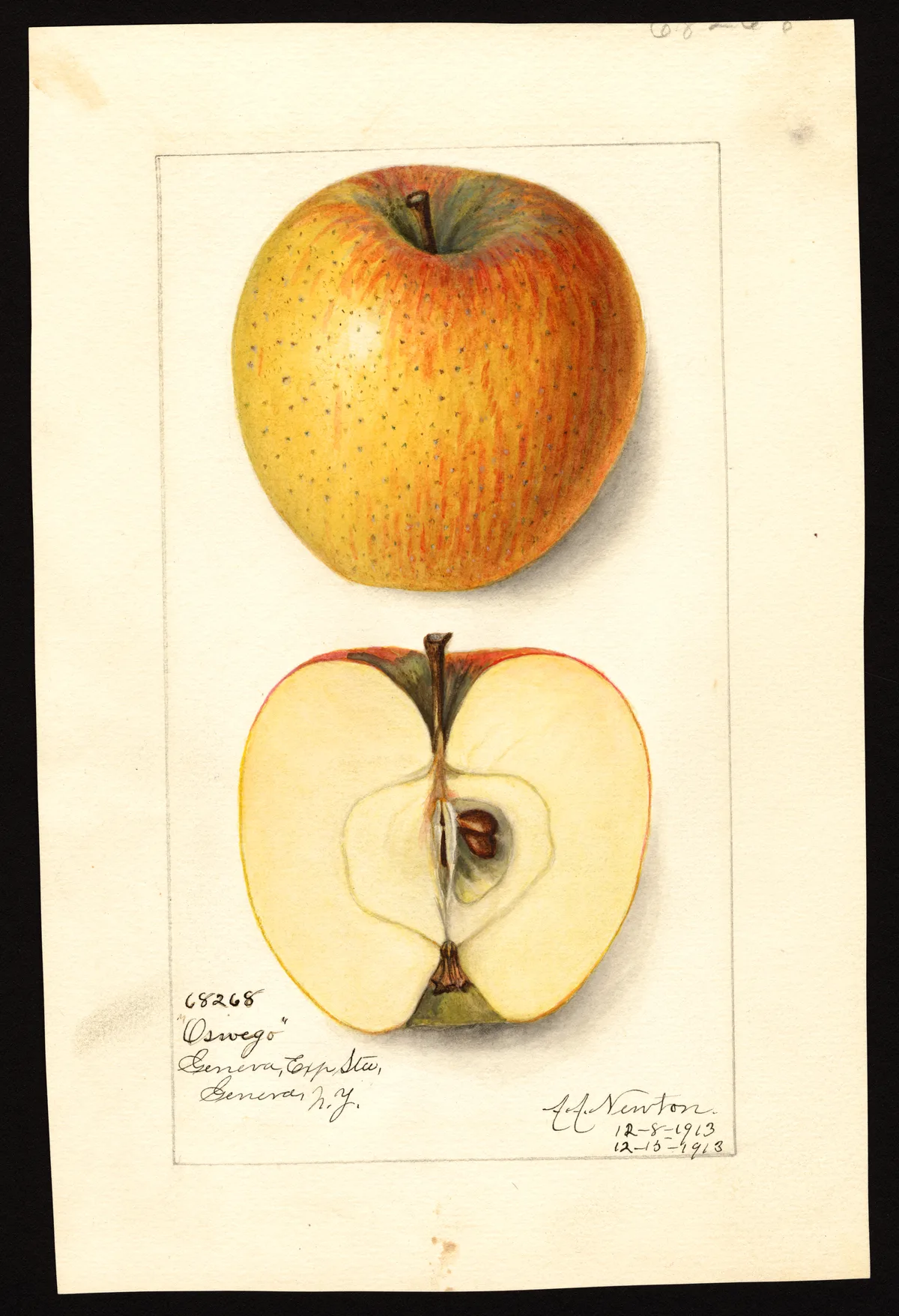
USDA Pomological Watercolor Collection
Oswego
Origin / History
Oswego resulted from a cross between Sutton and Northern Spy made in 1899. It is a sister of Tioga. The breeding record number was 5599, and the seedling number was 57. It was selected in 1911 from a population of seven seedlings and introduced in 1915, along with five other cultivars. It was named for Oswego County, New York. The breeding work which led to its origin was described by Hedrick and Wellington (94). Hedrick described Oswego, and trees of it were distributed to fruit growers in 1915 (88). The variety is not commercially useful. Nursery trees of Oswego were never sold by the New York State Fruit Testing Association or any commercial nursery, and it is not recommended for planting.
Tree
Oswego trees are large, very vigorous, upright, spreading, tall, dense, and round-topped. Trees are not highly productive and are strongly biennial in their bearing habit. The trunk is stocky. The trunk bark is brownish gray and somewhat shaggy. The twigs are thick, long, and somewhat pubescent. Oswego trees bloom late, about a day and a half after Delicious. The variety is diploid, and the pollen is viable.
Fruit
Size: Fruits are large, up to 3½ inches in diameter, though mostly 3 to 3¼ inches.
Form: Round conic, rather symmetrical, but sometimes ribbed.
Stem: Short, thick, sometimes fleshy, and usually much flared at its terminal.
Cavity: Varies from obtuse to acute; symmetrical, medium in depth and width, and much russeted, with small concentric cracks in the russet.
Calyx: Medium sized and open. Calyx lobes medium in length and width, and acute. The calyx tube is short (9 mm), wide (7 mm), and conic. The stamens are basal.
Basin: Medium in depth, somewhat narrow, abrupt, symmetrical, very slightly furrowed, and sometimes with short russet flecks.
Skin: Thin, tough, smooth, slightly dull, and somewhat waxy, with slight scarfskin and covered with a light bloom. The color is 30 percent grayish, light red, striped, somewhat splashed, and usually not attractive. The ground color is light green.
Dots: Light brown russet, fairly numerous, small, and obscure.
Flesh and flavor: Flesh is yellowish cream colored, usually with a greenish tinge. It is firm, medium coarse, crisp, somewhat dry, slightly acid, and sprightly. The juice is rich. The eating quality is fair. Exposed flesh oxidizes rapidly. Fruits are frequently severely affected by stippin.
Core and seeds: Core medium sized (25 mm wide) and closed. Carpels slightly cordate. Seeds numerous, large, wide, plump, and obtuse.
Season
Fruits ripen late. The average ripening date at Geneva is November 1, 3 weeks after Delicious. It is the latest ripening cultivar introduced at Geneva. The average number of days from full bloom to harvest is 166, 21 more than Delicious. Fruits adhere well to the tree after they have ripened. The approximate storage life at 31°F is 200 days. It is an excellent keeper. In very dry storage, the fruits tend to shrivel. The shelf life after storage is very good.
Uses
Oswego is a culinary type and is not suitable for the fresh market. Its eating quality is fair, its juice is rich, and its flesh oxidizes rapidly once exposed. It is not commercially useful.
Subtypes / Variants
Not described in source.
Other
Oswego fruits are illustrated in Figure 24 of the source, captioned "Oswego."
Book Sources
Described in 1 period pomological work
View original book sources (1)
— Roger D. Way, Apple Cultivars Introduced by the New York State Agricultural Experiment Station, 1914–1968 (1971)Oswego
Origin. Oswego resulted from a cross between Sutton and Northern Spy which was made in 1899. It is a sister of Tioga (see Tioga). The breeding record number was 5599, and the seedling number was 57. It was selected in 1911 from a population of seven seedlings. It was introduced in 1915 (Table 2), along with five other cultivars. It was named for Oswego County, New York.
The breeding work which led to the origin of Oswego was described by Hedrick and Wellington (94). Oswego was described by Hedrick, and trees of it were distributed to fruit growers in 1915 (88).
Tree. Tree characteristics are summarized in Table 5. Oswego trees are large, very vigorous, upright, spreading, tall, dense, and round-topped. Trees are not highly productive, and they are strongly biennial in their bearing habit (Table 5). The trunk is stocky. The trunk bark is brownish gray and somewhat shaggy. The twigs are thick, long, and somewhat pubescent.
Pollination. Oswego trees bloom late, about a day and a half after Delicious (Table 6). It is diploid (Table 4), and the pollen is viable.
Fruit. Oswego fruits are illustrated in Figure 24. Their characteristics are summarized in Table 8. The average ripening date at Geneva is November 1, 3 weeks after Delicious (Table 7). It is the latest ripening cultivar introduced at Geneva. The average number of days from full bloom to harvest is 166 days, 21 more than Delicious. The fruits adhere well to the tree after they have ripened.
Figure 24.--Oswego.
Oswego fruits are large, up to 3½ inches in diameter, though mostly 3 to 3¼ inches. They are round conic, rather symmetrical, but sometimes ribbed. The stem is short, thick, sometimes fleshy, and usually much flared at its terminal. The cavity varies from obtuse to acute; it is symmetrical, medium in depth and width, and much russeted, with small concentric cracks in the russet. The calyx is medium sized and open. The calyx lobes are medium in length and width, and they are acute. The basin is medium in depth, somewhat narrow, abrupt, symmetrical, very slightly furrowed, and sometimes with short russet flecks.
The skin is thin, tough, smooth, slightly dull, somewhat waxy, with slight scarfskin, and covered with a light bloom. The color is 30 per cent grayish, light red, striped, somewhat splashed, and usually not attractive. The ground color is light green. The dots are light brown russet, fairly numerous, small, and obscure. The calyx tube is short (9 mm), wide (7 mm), and conic. The stamens are basal. The core is medium sized (25 mm wide) and closed. The carpels are slightly cordate. The seeds are numerous, large, wide, plump, and obtuse.
The flesh is yellowish cream colored, usually with a greenish tinge. The flesh is firm, medium coarse, crisp, somewhat dry, slightly acid, and sprightly. The juice is rich. The eating quality is fair. It is a culinary type and is not suitable for the fresh market. Exposed flesh oxidizes rapidly. Fruits are frequently severely affected by stippin. The approximate storage life at 31°F is 200 days (Table 10). It is an excellent keeper. In a very dry storage, the fruits tend to shrivel. The shelf life after storage is very good.
Commercial Usefulness. Oswego is not commercially useful. Nursery trees of Oswego were never sold by the New York State Fruit Testing Association or any commercial nursery. It is not recommended for planting.