Tioga
Apple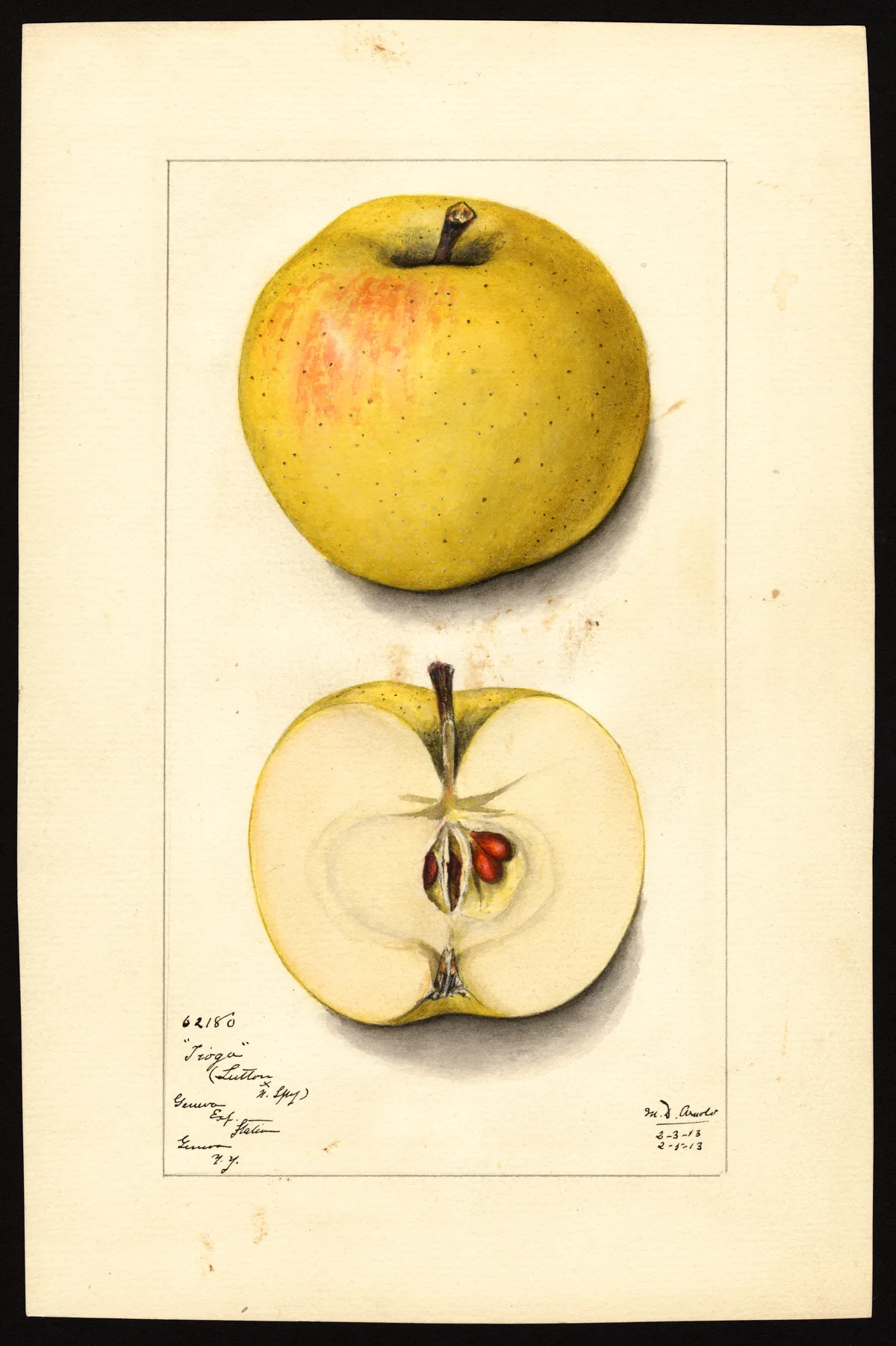
USDA Pomological Watercolor Collection
Tioga
Origin / History
Tioga originated from the cross Sutton x Northern Spy, made in 1899. It is a sister seedling of Oswego. The breeding record number of the cross was 5599, and the seedling number was 5599-4, sometimes designated as Station 54. It was selected in 1911 from a population of seven seedlings. Tioga was named and introduced in 1915 (Table 2), after only four years of observation and without benefit of a second test. It was named for Tioga County, New York. From these six cultivars, only Cortland became commercially important. The breeding work that resulted in the origin of Tioga was described by Hedrick and Wellington (94), and the cultivar was further described by Hedrick (88, 89). It was briefly described in the catalogs of the New York State Fruit Testing Association for 1919 to 1922 and 1924.
Trees of Tioga were first distributed to fruit growers in 1915 (88). The New York State Fruit Testing Association propagated and sold Tioga trees for five years, 1919 to 1922 and 1924 (Table 2). During the 1960-68 period, only one commercial nursery propagated Tioga trees for sale (Table 3). In Michigan, Nitschke (170) examined the fruit. During the 51 years since its introduction, Tioga has never been planted on a commercial scale.
Tree
The tree characteristics of Tioga are summarized in Table 5. The tree is large, vigorous, upright, spreading, tall, dense, and vase form, and it is variable in yield, tending to be somewhat biennial in its bearing habit. The trunk is stocky and smooth. In Massachusetts, Shaw (192) described in minute detail the vegetative characteristics of young nursery trees of Tioga so that they can be distinguished from other cultivars growing in the nursery. Tioga blooms in midseason, just after Delicious (Table 6). It is diploid (Table 4), and its pollen is viable.
Fruit
Size: Fruits are large, mostly 3 inches in diameter. They are larger than Yellow Newtown (170), which they resemble. The fruits hang well on the tree after maturity.
Form: Roundish, ribbed, somewhat irregular, and five-sided.
Stem: Short and thick.
Cavity: Obtuse, medium in depth and width, nearly symmetrical, and russeted, with fine concentric cracks in the russeted area.
Calyx: Usually open, rather large, with calyx lobes medium in length, narrow, and acute. The calyx tube is short (7 mm), narrow (6 mm), and conical. The stamens are basal.
Basin: Medium in depth, somewhat narrow, abrupt, almost symmetrical, generally rather smooth, and with russet rings in it.
Skin: Thick, tough, somewhat rough, and dull. The skin color is greenish at harvest, changing to yellow in storage; sometimes 5 percent of the skin area has a dull grayish orange stripe. In Michigan, Nitschke (170) found that ripe fruits are yellowish green with some slight red blush, very much like a large Yellow Newtown in texture and flavor.
Dots: Numerous, small, dark brown russet, and very conspicuous.
Flesh and flavor: Yellowish cream colored, firm, somewhat coarse, crisp, and only slightly juicy. Flavor is subacid, aromatic, and sprightly. Quality is fair.
Core and seeds: The core is medium sized (22 mm wide) and closed. The carpels are oval to slightly cordate. The seeds are numerous, medium sized, wide, plump, and acute.
Season
Tioga ripens late, on the average October 24 at Geneva, 2 weeks after Delicious (Table 7). The average number of days from full bloom to harvest is 159, 15 more than Delicious. The fruits have very good keeping quality (Table 10), with a storage life of 180 days at 31°F. During extended periods of dry storage, deep rot spots, stippin, soft scald, and severe shrivel sometimes develop. In Michigan, Nitschke (170) found that Tioga does not keep well in cold storage.
Uses
Tioga fruits have good processing qualities for canned and frozen slices (Table 9). Tioga probably has no commercial value because the market will not accept a greenish apple covered with conspicuous russet dots.
Subtypes / Variants
Not described in source.
Other
Tioga fruits contain 15 mg ascorbic acid per 100 g of fruit, which compares with 37 for Calville Blanc and 4 for McIntosh (105).
Book Sources
Described in 1 period pomological work
View original book sources (1)
— Roger D. Way, Apple Cultivars Introduced by the New York State Agricultural Experiment Station, 1914–1968 (1971)Tioga
Origin. Tioga originated from the cross, Sutton x Northern Spy, made in 1899. It is a sister seedling of Oswego (see Oswego). The breeding record number of the cross was 5599, and the seedling number was 5599-4 which was sometimes designated as Station 54. It was selected in 1911 from a population of seven seedlings. Tioga was named and introduced in 1915 (Table 2), after only 4 years of observation and without benefit of a second test. It was named for Tioga County, New York. From these six cultivars, only Cortland became commercially important. The breeding work which resulted in the origin of Tioga was described by Hedrick and Wellington (94), and the cultivar was further described by Hedrick (88, 89). It was briefly described in the catalogs of the New York State Fruit Testing Association for 1919 to 1922 and 1924.
Tree. The tree characteristics of Tioga are summarized in Table 5. The tree is large, vigorous, upright, spreading, tall, dense, vase form, and variable in yield, tending to be somewhat biennial in its bearing habit (Table 5). The trunk is stocky and smooth. In Massachusetts, Shaw (192) described in minute detail the vegetative characteristics of young nursery trees of Tioga so that they can be distinguished from other cultivars growing in the nursery. Tioga blooms in midseason, just after Delicious (Table 6). It is diploid (Table 4), and its pollen is viable.
Fruit. Tioga fruits are illustrated in Figure 34, and the fruit characteristics are summarized in Table 8. The fruits ripen late, on the average October 24 at Geneva, 2 weeks after Delicious (Table 7). The average number of days from full bloom to harvest is 159, 15 more than Delicious. The fruits hang well on the tree after maturity. They are large, mostly 3 inches in diameter. They are larger than Yellow Newtown (170) which they resemble. They are roundish, ribbed, somewhat irregular, and five-sided. The stem is short and thick. The cavity is obtuse, medium in depth and width, nearly symmetrical, and russeted, with fine concentric cracks in the russeted area. The calyx is usually open, rather large, with calyx lobes medium in length, narrow, and acute. The basin is medium in depth, somewhat narrow, abrupt, almost symmetrical, generally rather smooth, and with russet rings in it.
The skin is thick, tough, somewhat rough, and dull. The skin color is greenish at harvest, changing to yellow in storage; sometimes 5 per cent of the skin area has a dull grayish orange stripe. The dots on the skin are numerous, small, dark brown russet, and very conspicuous. The calyx tube is short (7 mm), narrow (6 mm), and conical. The stamens are basal. The core is medium sized (22 mm wide) and closed. The carpels are oval to slightly cordate. The seeds are numerous, medium sized, wide, plump, and acute. The flesh is yellowish cream colored, firm, somewhat coarse, crisp, only slightly juicy, subacid, aromatic, sprightly, and fair in quality. The fruits have very good keeping quality (Table 10), with a storage life of 180 days at 31° F. However, during extended periods of dry storage, deep rot spots, stippin, soft scald, and severe shrivel sometimes develop. Tioga fruits contain 15 mg ascorbic acid per 100 gm of fruit, which compares with 37 for Calville Blanc and 4 for McIntosh (105).
Commercial Usefulness. Trees of Tioga were first distributed to fruit growers in 1915 (88). Tioga trees were propagated and sold by the New York State Fruit Testing Association for 5 years, 1919 to 1922 and 1924 (Table 2). In the 1960-68 period, only one commercial nursery propagated trees of Tioga for sale (Table 3). In Michigan, Nitschke (170) found that ripe Tioga fruits are yellowish green with some slight red blush, very much like a large Yellow Newtown in texture and flavor. He found that it does not keep well in cold storage. Tioga fruits have good processing qualities for canned and frozen slices (Table 9). Tioga probably has no commercial value because the market will not accept a greenish apple covered with conspicuous russet dots. During the 51 years since its introduction, it has never been planted on a commercial scale.