Redwell
Apple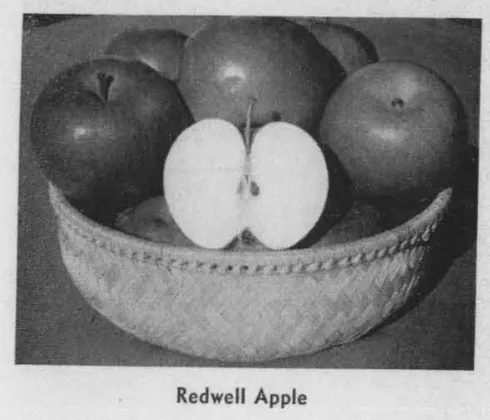
Redwell
Origin / History
Originated at the Minnesota Fruit Breeding Farm of the University of Minnesota as an open-pollinated seedling of Scotts Winter; Minn. No. 638. Introduced commercially in 1946. Many fruit growers tested Redwell before introduction, and a fair volume of fruit moved to market in 1951 and 1952. Alderman, Wilcox and Weir state that consumer acceptance "was very favorable" and believe orchard plantings will be increased. Zielinski, writing for Oregon, doubts that Redwell will ever become a commercial variety there: growers will likely prefer a more highly colored variety with a more sprightly flavor, and one that holds longer in storage without scalding.
Tree
Trees very hardy and vigorous, developing to only a medium size, with roundish head and slightly drooping branches. Apples set singly on terminals of shoots and long spurs, and are so well distributed that no thinning is required. Alderman, Wilcox and Weir name four important characteristics for a commercial variety: annual bearing, attractive red color, uniform distribution of fruits, and strong adherence to the tree at harvest time. Seems to be one of the hardiest of Minnesota introductions, but ripens late, and its northern range may be limited by length of season. Susceptibility to scab medium; to fire blight and cedar rust slightly above medium.
Fruit
Size: Medium to above in size (Alderman, Wilcox and Weir); large, 2½ to 3½ inches (Zielinski).
Form: Roundish to slightly oblate (Alderman, Wilcox and Weir); round to conic, uniform, and symmetrical (Zielinski).
Stem: Long, medium-thick (Alderman, Wilcox and Weir); strong (Zielinski).
Cavity: Medium.
Calyx: Partly open; lobes long, slender; tube short conic.
Basin: Wide, medium-deep.
Skin: Thin, medium-tough, with a smooth satin-like finish (Alderman, Wilcox and Weir); thick, tough, smooth, with a good finish (Zielinski). Usually fully colored with bright medium-red overlaid with a thin bloom (Alderman, Wilcox and Weir); striped and blushed with red, the color and striping reminiscent of Rome Beauty (Zielinski).
Dots: Small, russet.
Flesh and flavor: Flesh yellowish white, tinged with green (Zielinski); medium fine-grained, firm, tender, medium juicy. Flavor pleasant, mild subacid (Alderman, Wilcox and Weir); mild, nonacid, pleasant (Zielinski). Quality good for eating, baking or sauce and fair for pies (Alderman, Wilcox and Weir); excellent for baking, dessert, and sauce according to the originators, as cited by Zielinski.
Core and seeds: Core large.
Season
Season of use mid-October to January. In Oregon, matures for picking November 1 to 5. Keeps in good condition in storage until February, but prone to scald if stored at temperatures below 36° F (Zielinski).
Uses
Eating, baking, and sauce; fair for pies. Excellent for baking, dessert, and sauce according to the originators. A fair volume moved to market in 1951 and 1952 with very favorable consumer acceptance. Doubtful as a commercial variety in Oregon (Zielinski).
Subtypes / Variants
Not described in source.
Other
Not described in source.
Book Sources
Described in 2 period pomological works
View original book sources (2)
— W.H. Alderman, A.N. Wilcox & T.S. Weir, Fruit Varieties Developed at the University of Minnesota Fruit Breeding Farm (1957)Redwell. Minn. No. 638. Scotts Winter open pollinated. Introduced 1946.
Many fruit growers were testing Redwell before it was commercially introduced, with the result that a fair volume of fruit moved to market in 1951 and 1952. Consumer acceptance of this variety was very favorable and it is believed that orchard plantings will be increased.
Redwell has four important characteristics for a commercial variety: annual bearing, attractive red color, uniform distribution of fruits, and strong adherence to the tree at harvest time. It seems to be one of the hardiest of Minnesota introductions, but it ripens late and its northern range may be limited by length of season. Susceptibility to scab is medium, and to fire blight and cedar rust slightly above medium.
The trees are very hardy and vigorous but develop to only a medium size with roundish head and slightly drooping branches. Apples set singly on terminals of shoots and long spurs and are so well distributed that no thinning is required. The fruit is medium to above in size, roundish to slightly oblate, usually fully colored with bright medium-red overlaid with a thin bloom; stem long, medium-thick; cavity medium; basin wide, medium-deep; calyx partly open, lobes long, slender; tube short conic; skin thin, medium-tough and with a smooth satin-like finish; flesh yellowish-white, medium fine-grained, firm, tender, medium juicy; flavor pleasant mild subacid; quality good for eating, baking or sauce and fair for pies; season of use mid-October to January.
— Quentin B. Zielinski, Apple Varieties for Oregon (1964)Redwell†
This new variety originated at the Minnesota Fruit Breeding Farm as an open-pollinated seedling of Scott's Winter. Redwell was introduced commercially in 1946. In Oregon, it matures for picking November 1 to 5. Fruit is large—2½ to 3½ inches—round to conic, uniform, and symmetrical, with a large core and a strong stem. The skin is smooth, thick, tough, has a good finish, and is striped and blushed with red. Color and striping is reminiscent of a Rome Beauty with small, russet dots. The flesh is yellowish white, tinged with green, firm, mild in flavor, nonacid, and pleasant. According to the originators, Redwell is excellent for baking, dessert, and sauce. Redwell keeps in good condition in storage until February, but is prone to scald if stored at temperatures below 36° F. It is doubtful if Redwell ever will become a commercial variety in Oregon. Growers likely will prefer a more highly colored variety with a more sprightly flavor, and one that holds longer in storage without scalding.