Soldat Labourer
Pear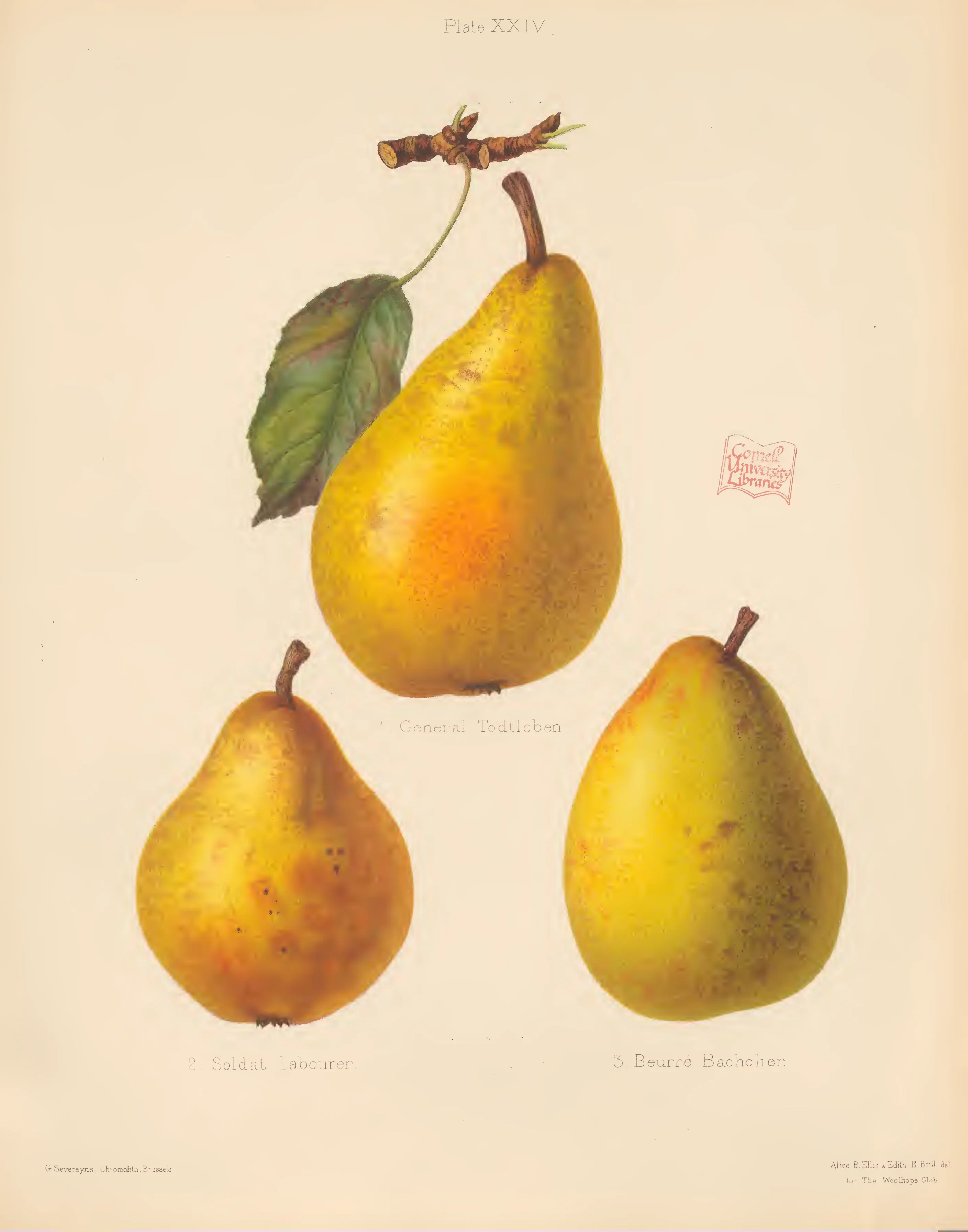
Soldat Labourer
Origin / History
Soldat Labourer was raised by Major Esperen of Malines (Mechlin), Belgium, from a seed bed made about 1820, and first fruited about that year (Herefordshire Pomona). Bunyard calls it the first seedling Esperen raised and says Esperen named it in reference to his career. Thomas gives it as Belgian. Desportes (1856) calls it "a distinct variety" that "must not be confounded with the Soldat Laboureur of the French, or Beurre d'Aremberg." Bunyard (1920) calls it "an excellent fruit much cultivated on the Continent, deserving more attention in this country."
Tree
Vigorous, of strong growth, upright or inclined to be upright, with erect shoots. Desportes calls it "a hardy and beautiful tree." Young wood dull grayish reddish brown (Downing); shoots light greenish-brown (Thomas). Leaf long oval, upfolded, widely serrate (Bunyard). An early and abundant bearer, of excellent fertility. On the quince stock it forms a very good pyramid and bears profusely (Herefordshire Pomona).
Fruit
Size: Medium to large; most authors call it large or rather large. The Herefordshire Pomona gives three and three-quarter inches long by three inches wide. Bunyard calls it medium and gives "3 by 3½."
Form: Pyriform: oblong obovate, roundish obovate pyriform, round pyriform, ovate-pyriform, or turbinate. Narrowing from the bilge both toward the eye and toward the stalk (Herefordshire Pomona). Uneven (Bunyard), bossed (Hedrick). Desportes compares its form to the Beurre Diel, "but a little more depressed at the stem."
Stem: Rather stout, curved, slightly sunk, inserted by the side of a fleshy swelling. Downing calls it long, and the Herefordshire Pomona gives an inch. Bunyard alone calls it short and stout.
Cavity: Small, narrow, and abrupt. Bunyard calls it very slight and uneven.
Calyx: Open, scarcely sunk or on a level (Downing, Bunyard). The Herefordshire Pomona calls the eye large and slightly closed, with long acuminate segments.
Basin: Small to very small, a shallow depression.
Skin: Smooth and rather thick (Hedrick). Bright green, passing to yellow, pale lemon yellow, or golden-yellow when perfectly ripe. Russeting runs from slight, or mere tracings here and there, to patches and netting. Hedrick gives it shaded with fawn, and Bunyard nearly covered with cinnamon russet in patches.
Dots: Minute, russet, fawn, or cinnamon. The Herefordshire Pomona describes the skin as completely covered with them.
Flesh and flavor: Flesh yellowish white to yellowish or pale yellow; semi-fine, slightly granular, or a little gritty. Melting and buttery, though Bunyard calls it only slightly melting. Juicy to very juicy, with juice abundant. Flavor sugary or saccharine, rich, vinous, and perfumed, with "a little perfume" (Desportes) and "somewhat of the flavour of the Autumn Bergamot" (Herefordshire Pomona). The flavor depends on growing conditions: rich and vinous "when well grown" (Thomas), very vinous "on land suiting it" (Hedrick). Most authors rate it highly: "this excellent pear" (Herefordshire Pomona), "an excellent fruit" (Bunyard), "very good, highest quality" (Hedrick). Downing gives "good to very good," and Thomas calls it "variable, often poor."
Core and seeds: Not described in source.
Season
The recorded season runs from October into February. Most authors give late autumn: October and November, through November, or November to December. Desportes alone gives December to February.
Uses
A dessert pear (Bunyard).
Subtypes / Variants
Not described in source.
Other
Figured in the Annales de Pomologie Belge (1855) and in the Herefordshire Pomona, Plate XXIV.
Book Sources
Described in 6 period pomological works
- The Herefordshire Pomona (1876–1885)
- Thomas, The American Fruit Culturist (1903)
- Bunyard, A Handbook of Hardy Fruits (1920) — listed as SOLDAT LABOUREUR
- Downing, Fruits and Fruit Trees of America (1900) — listed as SOLDAT LABOUREUR
- Hedrick, The Pears of New York (1921) — listed as Soldat Laboureur
- The Horticulturist (1855) — listed as Soldat Laboureur
View original book sources (6)
— B. Desportes, The Horticulturist (1856)Soldat Laboureur. — Fruit large, resembling the Beurre Diel in form, but a little more depressed at the stem. Flesh, melting and buttery, with a little perfume. Ripens from December to February. This is a distinct variety, raised by Maj. Esperen, of Malines, a hardy and beautiful tree, and must not be confounded with the Soldat Laboureur of the French, or Beurre d'Aremberg.
— Woolhope Naturalists Field Club, The Herefordshire Pomona (1885)Plate XXIV. 2. SOLDAT LABOURER. [Syn : Soldat Esperen ; Auguste Van Mons Soldat ; Beurré de Blumenbach.] A seedling grown by Major Esperen, and first fruited about the year 1820. Description.—Fruit : large, three inches and three-quarters long and three inches wide ; oblong obovate, narrowing from the bilge both towards the eye and the stalk. Skin : pale lemon yellow, marked here and there with tracings of russet, and completely covered with minute russet dots. Eye : large, slightly closed, with long acuminate segments, and placed in a shallow depression. Stalk : an inch long, inserted by the side of a fleshy swelling in a narrow cavity. Flesh : yellowish white, buttery, melting and very juicy, rich and sugary. This excellent pear has somewhat of the flavour of the Autumn Bergamot. It is in season through November. On the Quince stock it forms a very good pyramid, and bears profusely.
[Additional entry in this volume: "Soldat Laboureur", pp. 388–388]
Plate XXIV. 2. Soldat Laboureur.
— A.J. Downing, The Fruits and Fruit Trees of America (1900)SOLDAT LABOUREUR.
Auguste Van Krans. Blumenbach. Soldat Esperen.
A seedling of Major Esperen's, produced about 1820. Tree vigorous, upright, an early and abundant bearer. Young wood dull grayish reddish brown.
Fruit rather large, roundish obovate pyriform. Skin yellow, patched, netted, and dotted with russet. Stalk rather stout, long and curved, inserted in a small, abrupt cavity. Calyx open, scarcely sunk. Basin very small. Flesh yellowish, slightly granular, melting, juicy, with a sugary, vinous, perfumed flavor. Good to very good. October, November.
— John J. Thomas, The American Fruit Culturist (1903)Brabant. See Soldat Laboreur.
[Additional entry in this volume: "Soldat Laboureur", pp. 548–548]
Soldat Laboureur. Rather large, pyriform; skin becoming yellow when ripe, slightly russeted; stalk rather stout, curved, slightly sunk; cavity small, abrupt; basin small; flesh granular, melting, juicy, and when well grown of a rich, vinous flavor; variable, often poor. Late autumn. Shoots erect, light greenish-brown. Belgian.
— E.A. Bunyard, A Handbook of Hardy Fruits (1920)SOLDAT LABOUREUR. Her. Pom., I., 24. G. Blumenbach's Butterbirne. Dessert, November to December, medium, 3 by 3½, round pyriform, uneven. Colour, pale yellow, nearly covered with cinnamon russet in patches and dots. Flesh, pale yellow slightly melting, very juicy and vinous, a little gritty. Eye, open on a level. Stem, short and stout in a very slight uneven cavity. Growth, strong, inclined to be upright; fertility excellent. Leaf, long oval, upfolded, widely serrate. Origin, the first seedling raised by Major Esperen (about 1820) and named by him in reference to his career. An excellent fruit much cultivated on the Continent, deserving more attention in this country.
— U.P. Hedrick, The Pears of New York (1921)Soldat Laboureur.
- Ann. Pom. Belge 3:31, fig. 1855. 2. Bunyard Handb. Hardy Fr. 198. 1920.
Soldat Laboureur was obtained from a seed bed made about 1820 by Major Esperen, Mechlin, Bel. Fruit medium to large, ovate-pyriform or turbinate, bossed; skin smooth, rather thick, bright green passing to golden-yellow when perfectly ripe, dotted and shaded with fawn; flesh yellowish-white, semi-fine, melting; juice abundant, saccharine, perfumed, and, on land suiting it, very vinous; very good, highest quality; Oct. and Nov.