Esopus Spitzenberg
Apple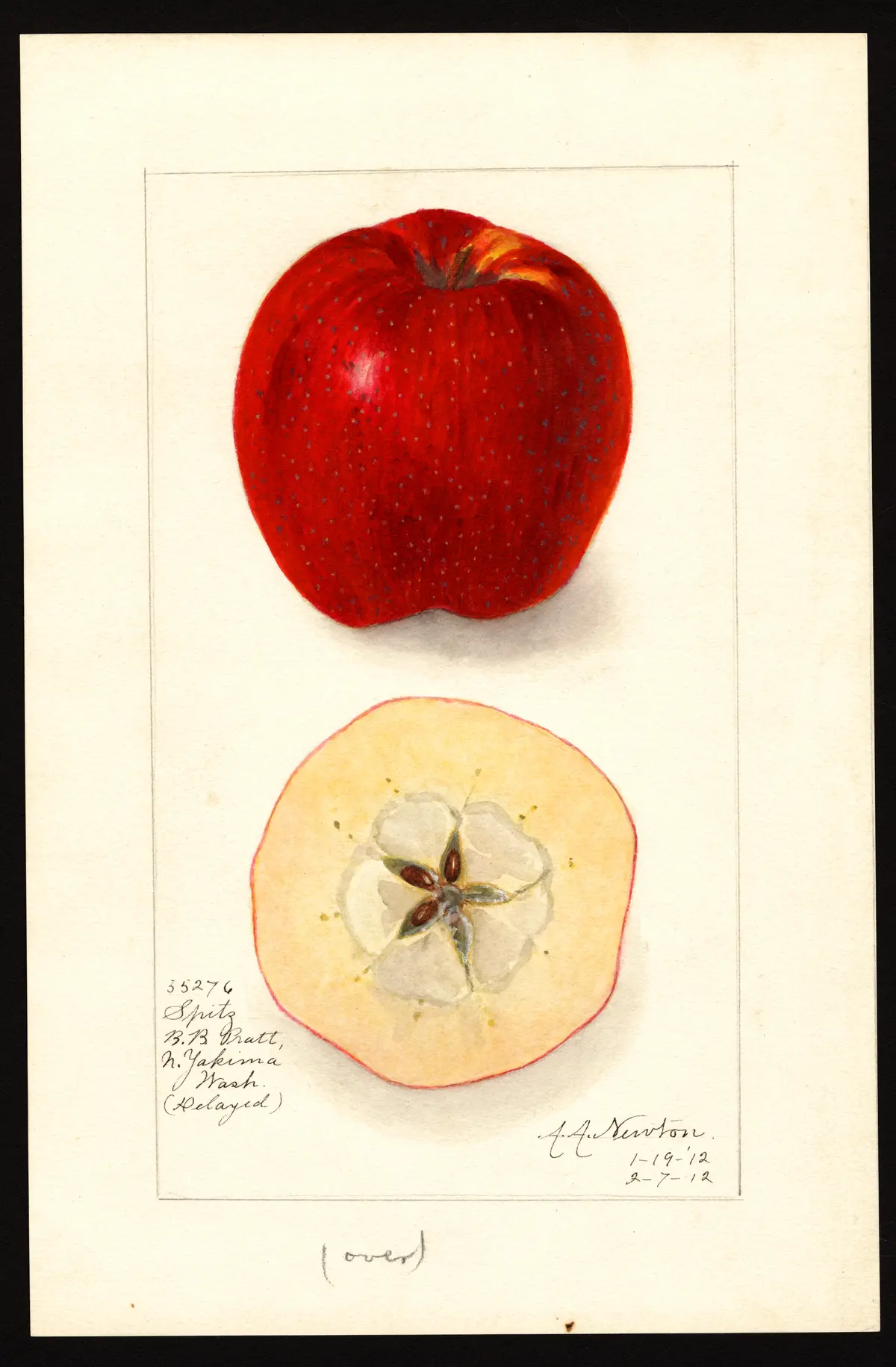
USDA Pomological Watercolor Collection
Esopus Spitzenberg
Origin/History
The name has been variously spelled by different pomologists as Spitzemberg, Spitzenberg, Spitzenbergh, Spitzenburgh, and Spitszenburgh, though Spitzenburg is now the commonly accepted spelling (Beach, 1905). New York fruit growers and fruit dealers commonly use the simple name Spitzenburg, or its colloquial abbreviation Spitz. Pomologists have been publishing the name with Spitzenburg in italics as a first step toward shortening the name to Esopus, though comparatively few New York fruit growers would recognize it by the name Esopus, and it will doubtless continue to be called Spitzenburg as long as it remains in cultivation (Beach, 1905). Several distinct varieties carry the word Spitzenburg either in their accepted name or in a synonym; those described in Beach's volume include Flushing Spitzenburg, Newtown Spitzenburg, and Scribner Spitzenburg (Beach, 1905).
Tree
Not described in source.
Fruit
Size
Medium (Encyclopedia of Practical Horticulture, 1914).
[NOTE: Source text may be incorrect — the Budd & Hansen (1914) entry labeled "Spitzenburg" describes a fruit of the pure Pyrus baccata type measuring only one and one-half inches in diameter with deciduous calyx segments, which is characteristic of a Siberian crab apple, not the Esopus Spitzenberg. This description is almost certainly for a different variety or represents a misattribution. The following physical details from that entry are included for completeness but should be treated with caution.]
Per Budd & Hansen (1914): size round, truncated, one and one-half inches in diameter; surface covered with solid dark crimson, with blue bloom, a handsome fruit; dots obscure, few, russet.
Form
Roundish oblate (Encyclopedia of Practical Horticulture, 1914). Per Budd & Hansen (1914): round, truncated.
Stem
Per Budd & Hansen (1914): long to very long.
Cavity
Per Budd & Hansen (1914): wide, obtuse.
Calyx
Per Budd & Hansen (1914): deciduous calyx segments.
Basin
Per Budd & Hansen (1914): wide, shallow, smooth.
Skin
Yellow-red (Encyclopedia of Practical Horticulture, 1914). Per Budd & Hansen (1914): surface covered with solid dark crimson, with blue bloom.
Flesh/Flavor
Per Budd & Hansen (1914): flesh yellow, juicy, firm, pleasant subacid, good for table or culinary. Quality rated best (Encyclopedia of Practical Horticulture, 1914).
Core/Seeds
Not described in source.
Season
Winter (Encyclopedia of Practical Horticulture, 1914). Per Budd & Hansen (1914): late fall, early winter.
Uses
Both kitchen and market (Encyclopedia of Practical Horticulture, 1914). Per Budd & Hansen (1914): good for table or culinary.
Subtypes/Variants
Not described in source.
Other
The Encyclopedia of Practical Horticulture (1914) reports the variety under survey number 24, with results from 2 stations in the Northern Division, 8 stations in the Central Division, and 1 station in the Southern Division; the asterisk on each division indicates the variety is reported as adapted to more than one division. The Beach (1905) entry for "Spitzenburg" is a cross-reference only, directing the reader to the Esopus Spitzenburg entry elsewhere in that volume; no independent physical description is given under this heading.
Book Sources
Described in 3 period pomological works
- Beach, The Apples of New York Vol. 1 (1905) — listed as Spitzenburg
- Budd & Hansen, Systematic Pomology (1914) — listed as Spitzenburg
- Lowther (ed.), Encyclopedia of Practical Horticulture (1914) — listed as Spitzenburg
View original book sources (3)
— S.A. Beach, The Apples of New York, Vol. 1 (1905)SPITZENBURG.
New York fruit growers and fruit dealers commonly use the simple name Spitzenburg or its colloquial abbreviation Spitz, in referring to the variety known to pomologists as Esopus Spitzenburg. Pomologists are now publishing this name with Spitzenburg in italics as the first step toward shortening the name to Esopus, but comparatively few New York fruit growers would recognize it by the name Esopus and it will doubtless continue to be called Spitzenburg as long as it remains in cultivation. For an account of this variety the reader is referred to Esopus Spitzenburg.
This word has been variously spelled by different pomologists as, Spitzemberg, Spitzenberg, Spitzenbergh, Spitzenburgh and Spitszenburgh, but Spitzenburg is now the commonly accepted spelling.
Many different varieties have the word Spitzenburg appearing either in the accepted name or in a synonym; those which are described in this volume are Esopus Spitzenburg, Flushing Spitzenburg, Newtown Spitzenburg and Scribner Spitzenburg (see Scribner).
— J.L. Budd & N.E. Hansen, American Horticultural Manual, Part II: Systematic Pomology (1914)Spitzenburg. — Fruit of the pure Pyrus baccata type, with deciduous calyx segments; size round, truncated, one and one-half inches in diameter; surface covered with solid dark crimson, with blue bloom, a handsome fruit; dots obscure, few, russet; cavity wide, obtuse; stem long to very long; basin wide, shallow, smooth; flesh yellow, juicy, firm, pleasant subacid, good for table or culinary. Late fall, early winter.
— Granville Lowther (ed.), Encyclopedia of Practical Horticulture (1914)Spitzenburg (24) is medium in size, roundish oblate in form, with yellow-red skin color. Quality: best. Use: both kitchen and market. Season: winter. Reported by 2 stations in the Northern Division, 8 stations in the Central Division, and 1 station in the Southern Division; the asterisk on each division indicates the variety is reported as adapted to more than one division.