Bietigheimer
Apple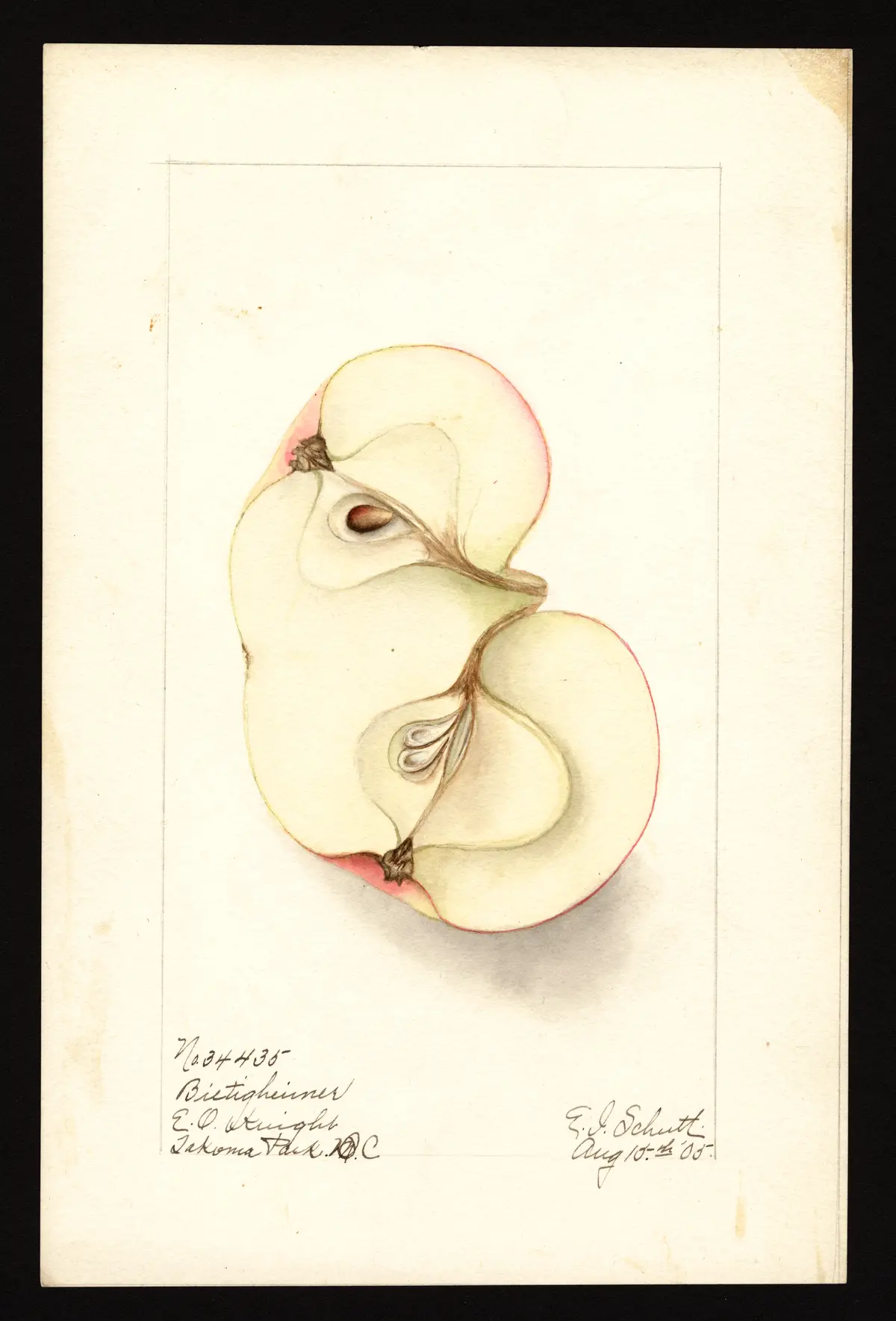
USDA Pomological Watercolor Collection
Bietigheimer
Origin / History
Of German origin. Introduced from Germany about 1870 (Hedrick) and now more or less grown in the colder parts of America. A specimen at the Pan-American Exposition from the State of Washington weighed 28½ ounces (Budd-Hansen). Bunyard notes the synonyms number more than twenty-five and that "the correct name is Rother Stettiner."
References cited by Beach include Downing (1881), Thomas (1885), Hoskins in Rural N.Y. (1888), Wickson (1889), Canadian Horticulturist (1890, 1893, 1894 with colored plate), Bailey's Annual Horticulturist (1892), Gardening and Forestry (1895), American Pomological Society Catalog (1897), Dickens and Greene in Kansas Station Bulletin 106 (1902), Budd-Hansen (1903), and Farrand in Michigan Station Bulletin 205 (1903).
Tree
Tree large, moderately vigorous to vigorous (Beach); a strong grower (Budd-Hansen); a free grower (Downing); a vigorous grower and free bearer, hardy (Thomas); hardy and healthy (Hedrick); growth spreading and vigorous (Bunyard); vigorous and spreading grower (Central Experimental Farm). Form upright-spreading or roundish, dense, with laterals inclined to droop (Beach); upright-spreading, dense, with drooping laterals (Hedrick); spreading habit (Budd-Hansen).
Twigs short, curved, stout, with large terminal buds; internodes long. Bark dull brown tinged with green, lightly streaked with scarf-skin; pubescent. Lenticels quite numerous, conspicuous, medium in size, oval, raised. Buds prominent, large, broad, plump, obtuse, free, pubescent (Beach).
Leaves large and shining (Downing, Budd-Hansen); rather pale, flat, finely and sharply serrate (Bunyard).
Bearing: an abundant bearer on alternate years (Downing); an abundant biennial bearer (Budd-Hansen); comes into bearing rather early and under favorable conditions is an annual cropper but only moderately productive (Beach); comes into bearing early but is among the unmanageables of orchard and nursery, and is seldom fruitful (Hedrick). In the nursery it is a rough grower forming many badly shaped trees, and for this reason it is best to topwork it on some good straight stock (Beach).
Fruit
Size
Large to very large (Downing); very large (Thomas); very large, pretty uniform in size and shape (Beach); very large to enormous (Budd-Hansen); of largest size (Hedrick); large, 3 by 2½ inches (Bunyard); very large (Central Experimental Farm). A specimen from Washington at the Pan-American Exposition weighed 28½ ounces (Budd-Hansen). The fruit being extremely large, drops badly before the crop is ready to pick (Beach); the apples drop badly during the maturing period (Hedrick).
Form
Oblate, slightly conical, regular (Downing); round, oblate (Thomas); roundish oblate or inclined to conic, with broad, flat base, somewhat irregular (Beach); roundish to roundish oblate, somewhat angular (Budd-Hansen); round-oblate, with broad, flat base, somewhat irregular (Hedrick); round flattened, regular (Bunyard); oblate conical (Central Experimental Farm).
Stem
Short, rather stout (Downing); medium to short, thick (Beach); very short (Budd-Hansen); short, thick (Hedrick).
Cavity
Broad, deep, regular, often russeted (Downing); large, acute, or approaching acuminate, wide, moderately shallow to rather deep, sometimes furrowed, occasionally lipped, often much russeted and with outspreading russet rays (Beach); wide, regular, rather shallow, obtuse, green, trace of russet (Budd-Hansen); large, acute, wide, shallow, sometimes furrowed, occasionally lipped, often much russeted and with outspreading russet rays (Hedrick).
Calyx
Closed (Downing, Budd-Hansen); medium to small, closed; lobes rather narrow, acute (Beach); small, closed, with narrow, acute lobes (Hedrick). Segments flat, convergent (Budd-Hansen).
Basin
Large, deep, slightly corrugated (Downing); varies from shallow and obtuse to deep and abrupt, medium in width, somewhat wrinkled, often marked with mammiform protuberances (Beach); narrow, slightly corrugated (Budd-Hansen); shallow and obtuse to deep and abrupt, wrinkled, often marked with mammiform protuberances (Hedrick).
Skin
Smooth, whitish or whitish yellow, shaded with light and dark red (purplish crimson where fully exposed to the sun), sometimes obscure stripes and splashes, a few grayish and many rather indistinct light dots (Downing); dark yellow, covered with purplish crimson (Thomas); thick, tough, smooth, bright pale yellow to greenish or whitish washed with pinkish-red and sparingly and obscurely splashed with deeper red (Beach); smooth, whitish yellow, almost wholly covered with pale red, with a few obscure stripes and splashes (Budd-Hansen); thick, tough, smooth, pale yellow washed with pinkish-red, sparingly and obscurely splashed with deeper red (Hedrick); a rich crimson, with a curious milky tinge in the lighter portions — remarkable for its distinct colouring (Bunyard); whitish yellow, shaded with light and dark red (Central Experimental Farm).
Dots
A few grayish and many rather indistinct light dots (Downing); numerous, small, inconspicuous, yellowish or russet (Beach); obscure, numerous, whitish (Budd-Hansen); numerous, small, inconspicuous, yellow or russet (Hedrick).
Flesh and Flavor
White, half fine, quite firm, juicy, with a brisk subacid flavor (Downing); firm, sub-acid, good (Thomas); almost white, firm, very coarse, crisp, somewhat tough, juicy, subacid, fair to nearly good (Beach); white, quite firm, juicy, brisk subacid, good (Budd-Hansen); white, firm, very coarse, crisp, tough, juicy, subacid; fair to good (Hedrick); firm, greenish-white, sweet but with no aroma (Bunyard); white, firm, brisk sub-acid (Central Experimental Farm).
Beach characterizes the fruit as "coarse, subacid and not desirable for dessert use," and describes it as "a good cooking apple but coarse." Hedrick calls the apples "coarse, poor in quality." Beach concludes that the variety is "a fine fruit for exhibition but is not worthy of cultivation for either home use or market." Bunyard likewise concludes "Not worthy of cultivation."
Core and Seeds
Core medium or rather large (Downing); core medium to large, axile to somewhat abaxile; cells partly open; core lines clasping; carpels cordate or broadly roundish, a little tufted; seeds numerous, large to medium, rather wide, broadly acute, rather light brown (Beach); core open, abaxile; cells ovate, widely slit; tube conical; stamens basal (Budd-Hansen); core medium to large, axile; cells partly open; core-lines clasping; carpels cordate or broadly roundish, tufted; seeds numerous, large, wide, broadly acute, light brown (Hedrick). Calyx tube broadly conical; stamens usually basal or nearly so (Beach).
Season
September (Downing, Budd-Hansen); September and October (Beach, Hedrick); October (Central Experimental Farm); November to February as a culinary apple (Bunyard).
Uses
Valuable for market and culinary purposes (Downing); use market and culinary (Budd-Hansen); a good cooking apple but coarse, subacid and not desirable for dessert use (Beach); culinary (Bunyard); a good cooking apple (Central Experimental Farm). A fine fruit for exhibition (Beach).
Subtypes / Variants
Not described in source.
Other
Central Experimental Farm at Agassiz BC notes the tree was planted Spring 1890 under test.
Book Sources
Described in 6 period pomological works
- Beach, The Apples of New York Vol. 2 (1905)
- Budd & Hansen, Systematic Pomology (1914) — listed as Bietigheimer (Red Bietigheimer)
- Bunyard, A Handbook of Hardy Fruits (1920)
- Hedrick, Cyclopedia of Hardy Fruits (1922)
- Thomas, The American Fruit Culturist (1903)
- Downing, Fruits and Fruit Trees of America (1900) — listed as Red Bietigheimer
Nursery Catalog Sources
Found in 37 catalogs (1886–1921) from Alabama, California, England, Illinois, Maryland, Massachusetts, Missouri, New Jersey, Oregon, Pennsylvania, Washington
- Huntsville Wholesale Nurseries (Jessie S. Moss , Proprietor; W.F. Heikes, Manager), Huntsville , Alabama — 1886 — listed as Red Bietigheimer
- California Nursery Co. , Niles , California — 1889 — listed as Red Bietigheimer
- William H. Moon Co. , Morrisville, Bucks County , Pennsylvania — 1890 — listed as Red Bietigheimer
- Missouri Nursery Co. , Louisiana , Missouri — 1891 — listed as Red Bietigheimer
- Oregon Wholesale Nurseries , Salem , Oregon — 1893 — listed as Red Bietigheimer
- Rogers Nursery Co. , Moorestown , New Jersey — 1893 — listed as Red Bietigheimer
- Sherwood Hall Nursery Co. , Timothy Hopkins (Menlo Park Nurseries), San Francisco / Menlo Park , California — 1893 — listed as Red Bietigheimer
- The Vineland Nurseries (Kelsey & Co. , Proprietors), St. Joseph, Missouri (Office: 13th and Atchison Sts., 2 Blocks East of the Citizens St. Car Line) — 1894 — listed as Red Bietigheimer
- Woodburn Nurseries , Woodburn, Marion Co. , Oregon — 1894 — listed as Red Bietigheimer
- Stark Bros. Nurseries & Orchards Co. , Louisiana , Missouri — 1896 — listed as Red Bietigheimer
- The Lovett Company , Little Silver , New Jersey — 1896 — listed as Red Bietigheimer
- J.V. Cotta (Cotta Nursery) , Carroll County , Illinois — 1898 — listed as Red Bietigheimer
- Reading Nursery , Jacob W. Manning, Proprietor, Reading , Massachusetts — 1898 — listed as Red Bietigheimer
- Brown Brothers Co. , Continental Nurseries, Rochester, NY (also operated from Toronto, Canada) — 1899 — listed as Red Bietigheimer
- George Bunyard & Co. , Royal Nurseries, Maidstone, Kent , England — 1900 — listed as Red Bietigheimer
- Central Experimental Farm , Dominion Department of Agriculture, Agassiz, British Columbia (under test; Bulletin No. 3, Second Series) — 1900 — listed as Red Bietigheimer
- Washington Nursery Co. , Toppenish , Washington — 1901 — listed as Red Bietigheimer
- Benjamin Buckman (personal inventory) , Farmingdale , Illinois — 1901 — listed as Red Bietigheimer
- Brown Brothers Co. , Continental Nurseries, Rochester, NY (also operated from Toronto, Canada) — 1901 — listed as Red Bietigheimer
- Pacific Nursery Company (W. O. Hudson & A. D. Hudson) , Tangent , Oregon — 1903 — listed as Red Bietigheimer
- Russellville Nursery Co. , Russellville, OR (three miles east of Portland, one mile from Montavilla car line) — 1903 — listed as Red Bietigheimer
- Phoenix Nursery Company (W. E. Rossney , President; Sidney Tuttle, Vice-President), Bloomington , Illinois — 1904 — listed as Red Bietigheimer
- The Dalles Nurseries , The Dalles , Oregon — 1906 — listed as Red Bietigheimer
- Russellville Nursery Co. , Montavilla Station, Portland, OR (three miles east of Portland, one mile from Montavilla car line) — 1907 — listed as Red Bietigheimer
- Carlton Nursery Co. , Carlton , Oregon — 1909 — listed as Red Bietigheimer
- Milton Nursery Co. (A. Miller & Sons , Proprietors), Milton , Oregon — 1909 — listed as Red Bietigheimer
- Wm. J. Corse (successor to Robert Sinclair / Sinclair Nurseries) , Baltimore , Maryland — 1909 — listed as Red Bietigheimer
- Washington Nursery Company , Toppenish , Washington — 1909 — listed as Red Bietigheimer
- James Veitch & Sons , Ltd., Royal Exotic Nursery, Chelsea, London (also Coombe Wood, Langley, and Feltham) , England — 1911 — listed as Red Bietigheimer
- Vineland Nurseries Company , Clarkston , Washington — 1912 — listed as Beitigheimer
- Pacific Nursery Company , Portland , Oregon — 1912 — listed as Red Bietigheimer
- Washington Nursery Company , Toppenish , Washington — 1912 — listed as Red Bietigheimer
- Benjamin Buckman (personal inventory) , Farmingdale , Illinois — 1913 — listed as Red Bietigheimer
- Union Nurseries , J.B. Weaver & Sons, Union , Oregon — 1915 — listed as Red Bietigheimer
- Oregon Nursery Co. , Orenco , Oregon — 1920 — listed as Red Bietigheimer
- Benedict Nursery Co. , Portland , Oregon — 1921 — listed as Red Bietigheimer
- North-Western Nurseries , Walla Walla , Washington — listed as Red Bietigheimer
View original book sources (7)
— A.J. Downing, The Fruits and Fruit Trees of America (1900)Red Bietigheimer.
Of German origin, a large and handsome early autumn apple, valuable for market and culinary purposes. Tree a free grower, having large shining leaves, spreading; an abundant bearer on alternate years.
Fruit large to very large, oblate, slightly conical, regular; skin smooth, whitish or whitish yellow, shaded with light and dark red, (purplish crimson where fully exposed to the sun,) sometimes obscure stripes and splashes, a few grayish and many rather indistinct light dots; stalk short, rather stout; cavity broad, deep, regular, often russeted; calyx closed; basin large, deep, slightly corrugated; flesh white, half fine, quite firm, juicy, with a brisk subacid flavor; core medium or rather large. Season September.
— John J. Thomas, The American Fruit Culturist (1903)Bietigheimer. (Red Bietigheimer.) Very large, round, oblate; dark yellow, covered with purplish crimson; flesh firm, sub-acid, good. Tree a vigorous grower and free bearer, hardy. German.
— S.A. Beach, The Apples of New York, Vol. 2 (1905)BIETIGHEIMER.
REFERENCES. 1. Downing, 1881:101 app. 2. Thomas, 1885:521. 3. Hoskins, Rural N. Y., 47:646. 1888. 4. Wickson, 1889:243. 5. Can. Hort., 13:239, 301. 1890. fig. 6. Bailey, An. Hort., 1892:234. 7. Can. Hort., 16:14. 1893. 8. Ib., 17:413. 1894. col. pl. 9. Gard. and For., 8:390, 428. 1895. 10. Am. Pom. Soc. Cat., 1897:12. 11. Dickens and Greene, Kan. Sta. Bul., 106:54. 1902. 12. Budd-Hansen, 1903:48. fig. 13. Farrand, Mich. Sta. Bul., 205:43. 1903.
SYNONYMS. BEITIGHEIMER (6). BIETIGHEIMER (7, 10, 12, 13). RED BEITIGHEIMER (9). Red Beitigheimer (6). RED BIETIGHEIMER (1, 2, 3, 4, 5, 8, 11).
Fruit remarkable only for its great size and beauty. It is a good cooking apple but coarse, subacid and not desirable for dessert use. The fruit being extremely large, drops badly before the crop is ready to pick. In the nursery it is a rough grower forming many badly shaped trees and for this reason it is best to topwork it on some good straight stock. The tree comes into bearing rather early and under favorable conditions is an annual cropper but only moderately productive. It is a fine fruit for exhibition but is not worthy of cultivation for either home use or market.
Historical. Origin, Germany.
TREE.
Tree large, moderately vigorous to vigorous. Form upright spreading or roundish, dense, with laterals inclined to droop. Twigs short, curved, stout, with large terminal buds; internodes long. Bark dull brown tinged with green, lightly streaked with scarf-skin; pubescent. Lenticels quite numerous, conspicuous, medium in size, oval, raised. Buds prominent, large, broad, plump, obtuse, free, pubescent.
FRUIT.
Fruit very large, pretty uniform in size and shape. Form roundish oblate or inclined to conic, with broad, flat base, somewhat irregular. Stem medium to short, thick. Cavity large, acute, or approaching acuminate, wide, moderately shallow to rather deep, sometimes furrowed, occasionally lipped, often much russeted and with outspreading russet rays. Calyx medium to small, closed; lobes rather narrow, acute. Basin varies from shallow and obtuse to deep and abrupt, medium in width, somewhat wrinkled, often marked with mammiform protuberances. Skin thick, tough, smooth, bright pale yellow to greenish or whitish washed with pinkish-red and sparingly and obscurely splashed with deeper red. Dots numerous, small, inconspicuous, yellowish or russet. Calyx tube broadly conical. Stamens usually basal or nearly so. Core medium to large, axile to somewhat abaxile; cells partly open; core lines clasping. Carpels cordate or broadly roundish, a little tufted. Seeds numerous, large to medium, rather wide, broadly acute, rather light brown. Flesh almost white, firm, very coarse, crisp, somewhat tough, juicy, subacid, fair to nearly good.
Season September and October.
— J.L. Budd & N.E. Hansen, American Horticultural Manual, Part II: Systematic Pomology (1914)Bietigheimer (Red Bietigheimer).—Origin, Germany; a large and showy autumn apple, attaining enormous size. A specimen at the Pan-American Exposition from the State of Washington weighed 28½ ounces. Tree a strong grower and of spreading habit; leaves large and shining; an abundant biennial bearer.
Fruit very large to enormous, roundish to roundish oblate, somewhat angular; surface smooth, whitish yellow, almost wholly covered with pale red, with a few obscure stripes and splashes; dots obscure, numerous, whitish; cavity wide, regular, rather shallow, obtuse, green, trace of russet; stem very short; basin narrow, slightly corrugated; calyx closed; segments flat, convergent. Core open, abaxile; cells ovate, widely slit; tube conical; stamens basal; flesh white, quite firm, juicy, brisk subacid, good. Use market and culinary. September.
— E.A. Bunyard, A Handbook of Hardy Fruits (1920)BIETIGHEIMER. F., Rouge de Stettin; G., Rother Stettiner. Synonyms number more than twenty-five. Culinary, November to February, large, 3 by 2½, round flattened, regular. Colour, a rich crimson, with a curious milky tinge in the lighter portions. Flesh, firm, greenish-white, sweet but with no aroma. Growth, spreading; vigorous. Leaf, rather pale, flat, finely and sharply serrate. Remarkable for its distinct colouring. Not worthy of cultivation. The correct name is Rother Stettiner.
— U.P. Hedrick, Cyclopedia of Hardy Fruits (1922)BIETIGHEIMER. Red Bietigheimer. The fruits are of largest size, for which and for their beauty of form and color, the variety is remarkable. On the other hand, the apples are coarse, poor in quality, and drop badly during the maturing period. The trees are hardy and healthy, and come into bearing early, but are among the unmanageables of orchard and nursery, and are seldom fruitful. The variety was introduced from Germany about 1870, and is now more or less grown in the colder parts of America.
Tree large, vigorous, upright-spreading, dense, with drooping laterals. Fruit very large, uniform in size and shape, round-oblate, with broad, flat base, somewhat irregular; stem short, thick; cavity large, acute, wide, shallow, sometimes furrowed, occasionally lipped, often much russeted and with outspreading russet rays; calyx small, closed, with narrow, acute lobes; basin shallow and obtuse to deep and abrupt, wrinkled, often marked with mammiform protuberances; skin thick, tough, smooth, pale yellow washed with pinkish-red, sparingly and obscurely splashed with deeper red; dots numerous, small, inconspicuous, yellow or russet; calyx-tube broadly conical; stamens basal; core medium to large, axile; cells partly open; core-lines clasping; carpels cordate or broadly roundish, tufted; seeds numerous, large, wide, broadly acute, light brown; flesh white, firm, very coarse, crisp, tough, juicy, subacid; fair to good; September and October.
— Central Experimental Farm, Central Experimental Farm, Agassiz BC — Catalogue of Fruit Trees under Test (Bulletin No. 3, 1900) (1900)Planted Spring 1890. Tree a vigorous and spreading grower. Fruit very large, oblate conical. Skin whitish yellow, shaded with light and dark red. Flesh white, firm, brisk sub-acid. A good cooking apple. Season October.