Early Joe
Apple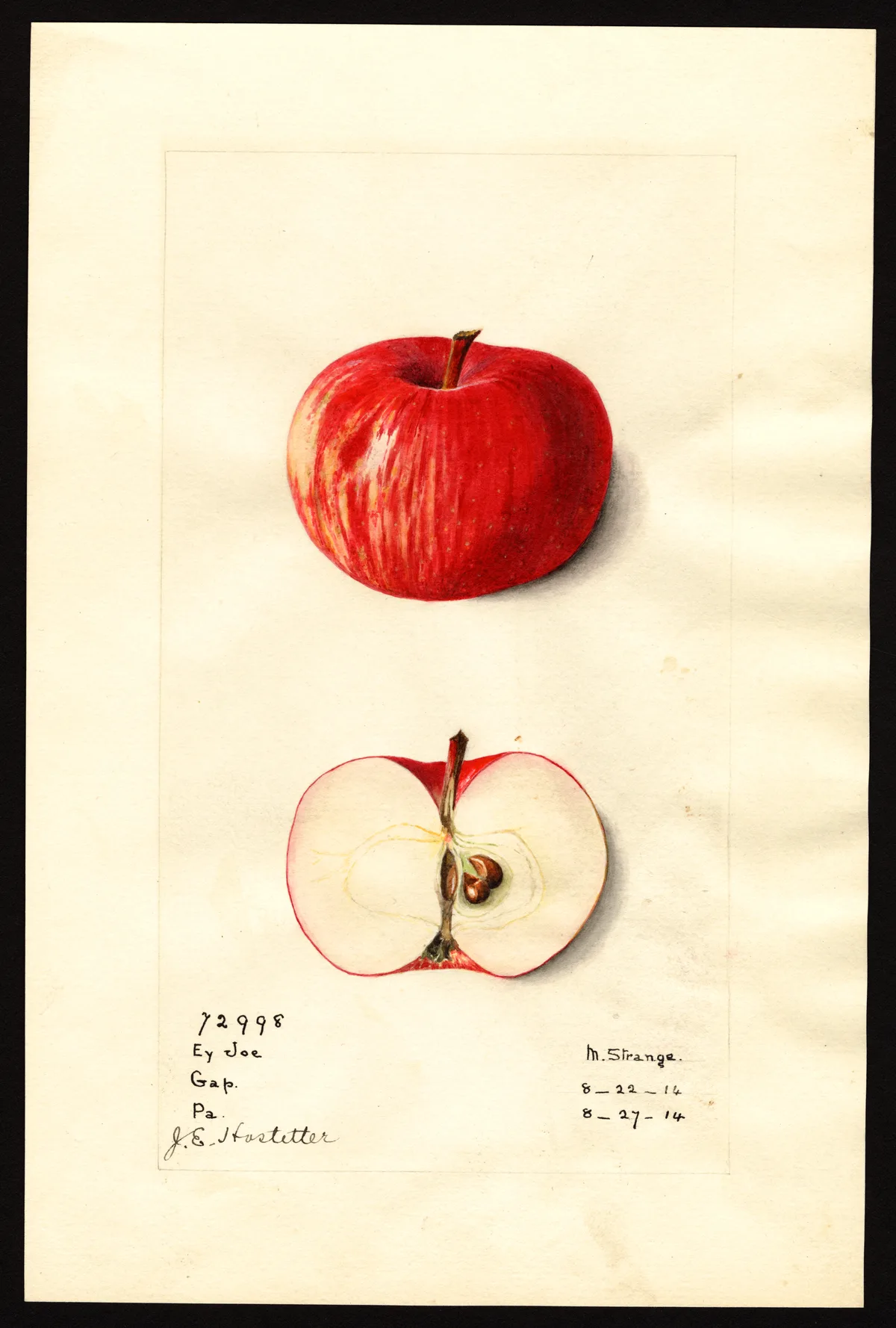
USDA Pomological Watercolor Collection
Early Joe
Origin / History
Early Joe originated in the orchard of Heman Chapin, East Bloomfield, Ontario County, New York. Northern Spy and Melon came from the same orchard. Beach records that the orchard was planted with seedling trees grown from seeds brought from Salisbury, Conn., about the year 1800. Hedrick states that Early Joe grew from a seed planted in 1800 by Heman Chapin. Elliott calls the Ontario County origin a claim only, and says "it is somewhat questionable if it is not an old Connecticut variety."
In October 1843 Jonathan Buel of East Bloomfield exhibited Early Joe at the fair of the New York State Agricultural Society, Rochester, N. Y. Beach's earliest references are the Society's Transactions and the Magazine of Horticulture, both of 1843. Leroy described it in 1873 under the name "Joe Précoce."
Beach says it has been widely disseminated and is still listed by nurserymen, but is not cultivated extensively in any locality. Lowther's station table reports it from 5 stations in the Northern Division and 11 in the Central Division, both entries marked as reported in more than one division. The Southern Division is not recorded.
Warder calls it "this delicious summer apple." Hedrick writes that "the rarest and richest essence of the apple is to be found in the fruits of Early Joe," whose flesh "is universally liked." He adds that "unfortunately the tree is among the 'unmanageables.'" Budd and Hansen find that its poor growth in nursery makes it undesirable for the nurseryman.
Tree
Tree of slow growth, small to medium in size, called moderately vigorous by Warder and Beach. Dwarfish, with short, moderately stout, crooked branches. Form rather flat, spreading. Warder calls it bushy when young. Elliott finds growth slow while young but improving as the trees get older, making a tree of round, irregular, spreading form and medium size. Beach calls it moderately long-lived.
Shoots dark-colored, and Elliott says the foliage is dark as well. Twigs short, straight, stout, with large terminal buds; internodes short. Bark dark brown, lightly streaked with scarf-skin, pubescent. Lenticels scattering, medium size, oblong, slightly raised. Buds medium size, plump, acute, free, slightly pubescent (Beach).
Elliott calls the tree very hardy but says it should have rich, strong soil. Downing and Budd and Hansen say it requires high culture or cultivation, Downing adding "for fair fruit."
Early bearer, coming into bearing rather young. Productive to very productive, and Thomas calls it "a profuse bearer." Beach calls it a reliable biennial cropper; Hedrick calls it "seldom fruitful." The fruit hangs pretty well to the tree until quite ripe. Beach reports that the crop contains a large percentage of undersized or otherwise unmarketable fruit.
Fruit
Size: Small to medium, the sources clustering at medium or rather below. Downing and Budd and Hansen call it below medium, and Lowther lists it as small. Uniform in size and shape (Beach).
Form: Oblate or roundish flattened, very slightly conic or sometimes obscurely approaching conical (Thomas), to oblate conic or conic (Beach). Warder calls it flat-conic. Regular, smooth, rather symmetrical. Beach calls it somewhat ribbed.
Stem: Medium to long, rather slender to thick or stout. Thomas gives the length as three-fourths of an inch.
Cavity: Wide, broad, or large, regular and symmetrical. The russet runs from a little, or thin russet present only sometimes (Beach), to a cavity surrounded by russet (Downing). Budd and Hansen describe the russet as stellate and the cavity as occasionally lipped. Warder calls the cavity wavy and green.
The cavity is acute in Warder, Thomas, and Beach; Budd and Hansen call it obtuse. Depth shallow to deep: shallow to medium (Thomas, Beach), open and deep (Elliott).
Calyx: Small to medium, closed, nearly closed, or slightly open. Warder calls the eye long. Warder describes the segments as reflexed; Budd and Hansen describe them as connivent and leaf-like. Calyx tube conical, described by Beach as medium in length, rather wide, broadly conical. Beach places the stamens median or basal; Budd and Hansen place them marginal.
Basin: Small to medium, moderate, usually shallow, medium in width to narrow. Abrupt or somewhat abrupt, regular and even, smooth or slightly wrinkled.
Skin: Thin, tender, smooth. Ground pale yellowish green or pale greenish yellow to yellow, which Warder gives as "yellow or waxen." Overspread, irregularly, obscurely, and thinly shaded, striped, and splashed with red. Thomas describes the stripes as numerous, short, and broken.
The reds are deep and pale red (Elliott), dark and light red (Budd and Hansen), dull, dark red (Beach), and mixed red splashed with carmine (Warder). Highly colored specimens become deeply blushed on the exposed cheek; Thomas gives a nearly uniform deep red to the sun.
Dots: Numerous to obscure, minute to conspicuous, greenish, white, gray, or russet. The fruit is thickly sprinkled with greenish spots (Downing), with conspicuous white or greenish-white specks (Thomas, Budd and Hansen). Other forms are obscure, minute, gray dots (Budd and Hansen); russet and greenish or nearly white dots (Beach); and minute dots with yellow bases (Warder).
Flesh and flavor: Whitish or yellowish white to tinged with yellow, yellowish, or light yellow. Fine to very fine-grained, tender to very tender, crisp or slightly crisp; Warder calls it breaking. Juicy to very juicy. Elliott calls it "very delicate."
Flavor mild subacid, spicy, aromatic, rich, and vinous. Downing gives "a very agreeable vinous flavor" and Warder calls it "very satisfying." Hedrick describes the flesh as "crisp, tender, juicy, aromatic, richly-flavored." Elliott says it "has the most of delicate-pear flavor of any variety."
Quality "best" by most authors. Beach rates it "very good to best" and "excellent in flavor and quality for dessert use."
Core and seeds: Core medium to rather small, axile; Warder calls it wide. Elliott gives the center as open, while Warder and Budd and Hansen call the core closed. Beach gives the cells as slightly open or closed, and Budd and Hansen describe them as round, slit. Core lines clasping. Carpels broadly obcordate to elliptical, decidedly concave (Beach).
Seeds small to medium, numerous, rather wide, short, plump, obtuse to acute, ovate pyriform or pyriform. Warder gives their color as brown.
Season
The recorded ripening season runs from July through September. Most authors place it from early or middle August into September, ending by the middle of September; Beach gives August and September. Warder alone gives July.
Uses
Dessert apple; Warder says "dessert only," and Lowther lists its use as family. Beach recommends it for the home orchard but not for commercial planting. Elliott says "while it is all unsuited to orcharding, one tree should always be planted."
Subtypes / Variants
Not described in source.
Other
Downing records a Luce's Early Joe, distinct from Early Joe, being larger and not as good in quality. Thomas figures the fruit (Fig. 362).
Beach's references run from the New York Agricultural Society Transactions of 1843 through Budd-Hansen (1903). They include accounts by Hovey, Thomas, Elliott, Downing, Warder, Hogg, Macoun, and Waugh, with published figures in 1846, 1847, 1849, 1854, 1873, and 1903.
Book Sources
Described in 8 period pomological works
- Beach, The Apples of New York Vol. 2 (1905)
- Warder, American Pomology: Apples (1867)
- Downing, Fruits and Fruit Trees of America (1900)
- Budd & Hansen, Systematic Pomology (1914)
- Elliott, The Western Fruit Book (1865)
- Lowther (ed.), Encyclopedia of Practical Horticulture (1914)
- Hedrick, Cyclopedia of Hardy Fruits (1922)
- Thomas, The American Fruit Culturist (1903)
Nursery Catalog Sources
Found in 3 catalogs (1850–1904) from Illinois, Massachusetts
- Azell Bowditch (Nursery / Fruit Catalog) , Boston , Massachusetts — 1850
- Central Experimental Farm , Dominion Department of Agriculture, Agassiz, British Columbia (under test; Bulletin No. 3, Second Series) — 1900
- Phoenix Nursery Company (W. E. Rossney , President; Sidney Tuttle, Vice-President), Bloomington , Illinois — 1904
View original book sources (8)
— F.R. Elliott, The Western Fruit Book (1865)Early Joe.
American : origin, claimed Ontario Co., N. Y. It is somewhat questionable if it is not an old Connecticut variety. This apple has the most of delicate-pear flavor of any variety, and, while it is all unsuited to orcharding, one tree should always be planted. While young, it is of slow growth, but, as the trees get older, it improves, and makes a tree of round irregular spreading form, of medium size. It is very hardy, but should have rich, strong soil. Shoots, dark-colored, and so foliage.
Size, medium, or rather below ; form, roundish flattened ; stem, rather slender ; cavity, open, deep, a little russetted ; color, pale yellowish green, overspread and striped with deep and pale red : calyx, small, nearly closed ; basin, shallow ; flesh, yellowish white, tender, very delicate ; core, medium, centre open ; seeds, short ovate pyriform. Last of August.
— John A. Warder, American Pomology: Apples (1867)Early Joe.
This delicious summer apple originated in Ontario County, New York; Tree moderately vigorous, bushy when young, early bearer, very productive.
Fruit small to medium, flat-conic, regular; Surface yellow or waxen, mixed red, splashed carmine; Dots minute, with yellow bases.
Basin abrupt, regular; Eye medium, long, closed; Segments reflexed.
Cavity wide, acute, wavy, green; Stem medium, thick.
Core wide, closed, clasping; Seeds plump, brown; Flesh light yellow, breaking, very fine grained, juicy; Flavor sub-acid, aromatic, spicy, rich, very satisfying; Quality best; Use, dessert only; Season, July.
— A.J. Downing, The Fruits and Fruit Trees of America (1900)Early Joe.
Origin, orchard of Heman Chapin, Ontario Co., N. Y. Tree of slow growth, productive, requires high culture for fair fruit.
Fruit below medium, oblate, very slightly conic, smooth, yellowish, shaded and striped with red, and thickly sprinkled with greenish spots. Stalk of medium length, inserted in a large cavity surrounded by russet. Calyx closed. Basin moderate. Flesh whitish, tender, juicy, with a very agreeable vinous flavor. Best. Ripe middle of August to middle of September.
There is a Luce's Early Joe which is distinct from this, being larger and not as good quality.
— John J. Thomas, The American Fruit Culturist (1903)Early Joe.* Size medium or rather small; oblate, sometimes obscurely approaching conical; smooth and regular; color, with numerous short, broken, red stripes on yellow ground, a nearly uniform deep red to the sun, with conspicuous white specks; stem three-fourths of an inch long, rather thick; cavity shallow, acute; basin small, even; flesh fine grained, very tender, slightly crisp, juicy, sub-acid, spicy, quality "best." Ripens the last two weeks of summer. Shoots dark, growth slow. A profuse bearer. Fig. 362. Origin, East Bloomfield, N. Y.
— S.A. Beach, The Apples of New York, Vol. 2 (1905)EARLY JOE.
References. 1. N. Y. Agr. Soc. Trans., 1843:152. 2. Mag. Hort., 9:469. 1843. 3. N. Y. Agr. Soc. Trans., 1846:187. fig. 4. Hovey, Mag. Hort., 12:474. 1846. 5. Ib., 13:159. 1847. fig. 6. Smith, Horticulturist, 1:386. 1847. fig. 7. Cultivator, 4:310. 1847. fig. 8. Mag. Hort., 14:539. 1848. 9. Cole, 1849:105. fig. 10. Thomas, 1849:137. fig. 11. Emmons, Nat. Hist. N. Y., 3:19. 1851. 12. Barry, 1851:280. 13. Elliott, 1854:75. fig. 14. Gregg, 1857:36. 15. Downing, 1857:76. 16. Hooper, 1857:32. 17. Am. Pom. Soc. Rpt., 1860:240. 18. Warder, 1867:513. 19. Fitz, 1872:152, 172. 20. Leroy, 1873:404. figs. 21. Ill. Hort. Soc. Rpt., 1877:124. 22. Hogg, 1884:68. 23. Wickson, 1889:243. 24. Lyon, Mich. Hort. Soc. Rpt., 1890:290. 25. Bailey, An. Hort., 1892:238. 26. Macoun, Can. Dept. Agr. Rpt., 1901:96. 27. Waugh, Vt. Sta. An. Rpt., 14:292. 1901. 28. Budd-Hansen, 1903:74. fig.
Synonyms. Early Joe (1, 2, 3, 4, 5, 6, 7, 8, 9, 10, 11, 12, 13, 14, 15, 16, 17, 18, 19, 21, 22, 23, 24, 25, 26, 27, 28). Joe Précoce (20).
Fruit medium to small, red striped, excellent in flavor and quality for dessert use; season, August and early September. The tree is small to medium in size, slow growing, moderately longlived, comes into bearing rather young and is a reliable biennial cropper. The fruit hangs pretty well to the tree until it is quite ripe. The crop contains a large percentage of undersized or otherwise unmarketable fruit. Recommended for the home orchard, but not for commercial planting.
Historical. Originated with Northern Spy and Melon in the orchard of Heman Chapin, East Bloomfield, Ontario Co., N. Y. This orchard was planted with seedling trees grown from seeds brought from Salisbury, Conn. about the year 1800. In October, 1843, Early Joe was exhibited at the fair of the New York State Agricultural Society, Rochester, N. Y., by Jonathan Buel of East Bloomfield (1). It has been widely disseminated and is still listed by nurserymen (25) but it is not cultivated extensively in any locality.
Tree.
Tree moderately vigorous, dwarfish with short, moderately stout, crooked branches. Form rather flat, spreading. Twigs short, straight, stout, with large terminal buds; internodes short. Bark dark brown, lightly streaked with scarf-skin; pubescent. Lenticels scattering, medium size, oblong, slightly raised. Buds medium size, plump, acute, free, slightly pubescent.
Fruit.
Fruit small to medium, uniform in size and shape. Form oblate conic to conic, somewhat ribbed, rather symmetrical. Stem medium to long, rather slender to moderately thick. Cavity acute, shallow to medium in depth, rather broad, symmetrical, sometimes thinly russeted. Calyx medium size, closed or slightly open. Basin small to medium, usually shallow, medium in width or rather narrow, somewhat abrupt, smooth or slightly wrinkled. Skin thin, tender, smooth, pale greenish-yellow, irregularly and obscurely striped and splashed with dull, dark red, in highly colored specimens becoming deeply blushed on the exposed cheek. Dots russet and greenish or nearly white. Calyx tube medium in length, rather wide, broadly conical. Stamens median or basal. Core medium to rather small, axile; cells slightly open or closed; core lines clasping. Carpels broadly obcordate to elliptical, decidedly concave. Seeds small to medium, rather wide, short, obtuse to acute. Flesh tinged with yellow, fine, crisp, very tender, very juicy, mild subacid, very good to best. Season August and September.
— J.L. Budd & N.E. Hansen, American Horticultural Manual, Part II: Systematic Pomology (1914)Early Joe.—Origin, Ontario Co., New York; tree of slow growth, productive, requires high cultivation. The poor growth of this variety in nursery makes it undesirable for the nurseryman.
Fruit below medium, regular, oblate; surface smooth, greenish yellow, thinly shaded, stripes and splashes of dark and light red; dots obscure, minute, gray, and some conspicuous greenish white specks; cavity large, wide, regular obtuse, with stellate russet, occasionally lipped; stem medium to long, stout; basin narrow, abrupt, smooth; calyx closed; segments connivent, leaf-like. Core closed; cells round, slit; tube conical; stamens marginal; seeds numerous, short, plump, pyriform; flesh yellowish, very tender, juicy, fine-grained, spicy subacid, vinous, best. Early August to middle of September.
— Granville Lowther (ed.), Encyclopedia of Practical Horticulture (1914)Early Joe is small in size, flat in form, and yellow in color. Its quality is rated best, and its primary use is family. No season of ripening is recorded. It is reported by 5 stations in the Northern Division (with the asterisk indicating the variety is reported in more than one division) and 11 stations in the Central Division (likewise cross-division reported); the Southern Division is not recorded.
— U.P. Hedrick, Cyclopedia of Hardy Fruits (1922)EARLY JOE. The rarest and richest essence of the apple is to be found in the fruits of Early Joe; their crisp, tender, juicy, aromatic, richly-flavored flesh is universally liked. Unfortunately the tree is among the "unmanageables," being slow of growth, attaining only medium size, seldom fruitful, and producing many undersized and otherwise unmarketable apples. Early Joe grew from a seed planted in 1800 by Heman Chapin, East Bloomfield, New York. Tree vigorous, flat, spreading, dwarfish with short, stout, crooked branches. Fruit small, uniform in size and shape, oblate-conic to conic, ribbed, symmetrical; stem long, slender; cavity acute, shallow, broad, symmetrical, sometimes thinly russeted; calyx closed or slightly open; basin small, shallow, medium in width, abrupt, smooth or wrinkled; skin thin, tender, smooth, pale yellow, irregularly and obscurely striped and splashed with dull, dark red, in highly colored specimens deeply blushed on the exposed cheek; dots russet, white; calyx-tube wide, broadly conical; stamens median; core small, axile; cells open or closed; core-lines clasping; carpels broadly obcordate, concave; seeds small, wide, short, obtuse; flesh yellow, fine, crisp, very tender, very juicy, mild subacid; very good to best; August to September.