Mother
Apple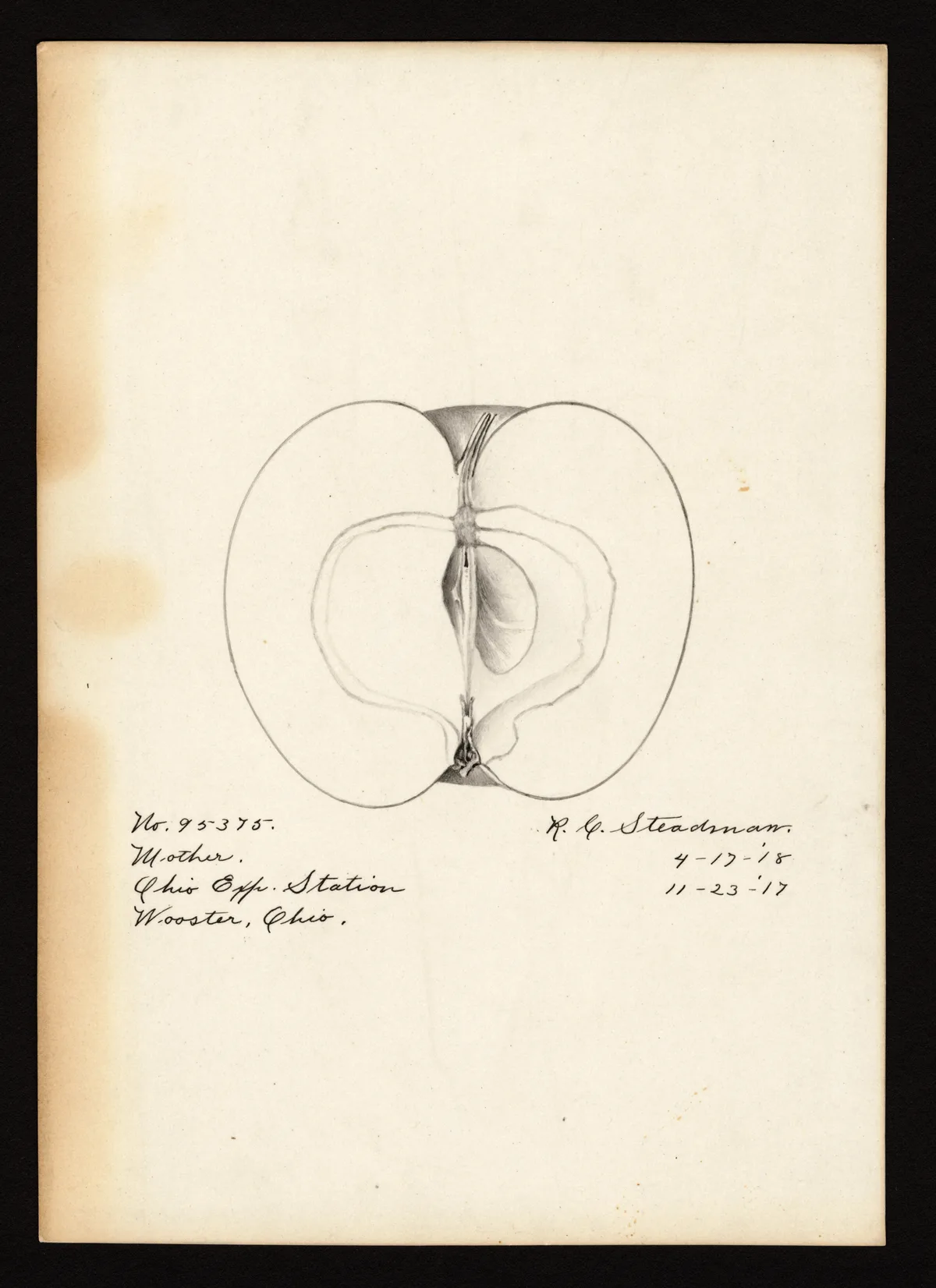
USDA Pomological Watercolor Collection
Mother
Origin / History
Mother originated in Bolton, Worcester County, Massachusetts (Warder; Downing; Thomas; Beach; Budd-Hansen). Thomas described it in 1848 as "a new, handsome late autumn and early winter apple, of the highest quality" (Beach). Beach notes the variety was first published in 1844 in the Magazine of Horticulture. Bunyard records its origin as "rather uncertain, but recorded in America before 1848," and notes that because so many apples have borne the name "Mother," Hogg distinguished this one by prefixing the country of its origin as "American Mother." It is still listed by some nurserymen but is nowhere being extensively planted, and is but seldom found in cultivation in New York (Beach). Hedrick describes it as "one of the prized apples of old orchards, valued alike for its handsome appearance and its tender, rich, well-flavored flesh," and notes it is very generally grown in all apple regions. Both Thomas and Hedrick observe that Mother somewhat resembles the Esopus Spitzenburg in external appearance and in its rich yellow flesh and spiciness, though Hedrick judges it "not quite so good an apple either for dessert or for cookery, falling short in flavor and keeping qualities." Beach adds that it ripens earlier than Esopus Spitzenburg and is not so good a keeper.
Tree
Tree below medium size, hardy (Elliott), of moderate vigor or a rather slow grower (Elliott, Warder, Downing, Budd-Hansen, Beach, Hedrick); slender (Warder; Budd-Hansen), upright (Downing) or upright-spreading to roundish, rather open (Beach; Hedrick). Productive (Warder; Downing; Budd-Hansen), an annual bearer per Elliott, though Beach reports it "does not come into bearing very young and commonly is a biennial cropper yielding moderate to good crops." In many localities it is rather tender and liable to scald or canker on the trunk and larger branches; on this account it is desirable to topwork it upon Northern Spy or some other hardy, vigorous stock (Beach; Hedrick).
Young shoots grayish brown, downy (Downing). Twigs long, curved, moderately stout; internodes long. Bark brown, mingled with olive-green, lightly mottled with scarf-skin; slightly pubescent near tips. Lenticels numerous, rather conspicuous, medium size, oval, raised. Buds rather prominent, medium size, broad, plump, obtuse, free, pubescent (Beach).
Leaf rather large, pale, nearly flat, down-hanging, sharply serrate (Bunyard). Growth moderate, fertility rather irregular (Bunyard).
Fruit
Size
Sources vary: Elliott calls the fruit large; Warder, medium to full medium; Downing and Budd-Hansen, medium or above; Lowther, medium; Bunyard, medium, 2½ by 2¼ inches; Thomas, rather large; Beach, "below medium to above, sometimes large, pretty uniform in size and shape"; Hedrick, large, uniform in size and shape; Central Experimental Farm catalog, above medium size. Veitch's catalog: "Middle sized, medium size."
Form
Roundish ovate (Elliott); oblong, regular (Warder); roundish, slightly conical (Downing); oblong-ovate, approaching conical, slightly and obtusely ribbed (Thomas); roundish oblong, slightly conical, obscurely ribbed (Budd-Hansen); round (Lowther); oval conical, slightly ribbed (Bunyard); roundish or roundish conic to oblong ovate, obscurely and broadly ribbed (Beach); round, round-conic or oblong-ovate, obscurely and broadly ribbed (Hedrick); oblong and tapering to eye (Central Experimental Farm).
Stem / Stalk
Stem slender (Elliott); long, slender (Warder; Hedrick); short, small (Downing); three-fourths of an inch long (Thomas); slender, medium to long (Budd-Hansen); rather short, slender (Bunyard); long to medium, moderately slender to rather thick (Beach).
Cavity
Acute, regular or wavy (Warder); acute, often a little russeted (Downing); moderate (Thomas); acute, deep, often a little russeted (Budd-Hansen); moderate cavity, compressed on one side (Bunyard); acute or approaching acuminate, rather shallow to moderately deep, rather narrow to moderately broad, often russeted, sometimes furrowed or compressed or lipped (Beach); acute, shallow, broad, often russeted, sometimes furrowed, compressed or lipped (Hedrick).
Calyx / Eye
Calyx small, nearly closed (Elliott); eye long, small, closed (Warder); calyx closed (Downing; Budd-Hansen); calyx small, closed or nearly so, lobes medium, narrow, acute (Beach); calyx small, closed or nearly so, lobes narrow, acute (Hedrick); eye very small, closed (Bunyard).
Basin
Plaited (Elliott; Thomas); medium, regular or plaited (Warder); small, corrugated (Downing); narrow, small, corrugated (Budd-Hansen); shallow, narrow, a little abrupt, somewhat furrowed and wrinkled (Beach); shallow, narrow, abrupt, furrowed and wrinkled (Hedrick); small fairly deep basin (Bunyard).
Skin / Surface / Color
Yellow, mostly overspread, marbled and striped with shades of dark red, few russet dots (Elliott). Surface smooth, shaded red on yellow, with close, fine stripes of red; dots minute (Warder). Yellow, almost entirely overspread with light, clear, rich red, splashed and marbled with many deeper shades, many minute light dots (Downing). A high warm rich red on yellow ground; deep red to the sun—in obscure broken stripes and spots (Thomas). Surface golden yellow, almost wholly covered with clear, warm, rich red, splashed, marbled, striped with several shades of dark red and crimson; dots minute, light russet, numerous (Budd-Hansen). Color yellow-red (Lowther). Skin thin, smooth, golden yellow nearly covered with bright deep red, marbled and striped with carmine; dots rather small, inconspicuous, yellowish or pale and submerged (Beach). Skin thin, smooth, golden yellow covered with bright deep red, marbled and striped with carmine; dots inconspicuous, yellow, submerged (Hedrick). Colour, golden-yellow with dull brownish-red flush and faint stripes (Bunyard). Skin greenish yellow, nearly covered with clear red, with a few small dots (Central Experimental Farm).
Flesh / Flavor
Flesh yellowish, tender, spicy, sub-acid, "best" (Elliott). Flesh yellow, crisp, very fine-grained, juicy; flavor sweet, very rich, vinous, aromatic; quality best; use, dessert (Warder). Flesh yellow, tender, juicy, rich, aromatic subacid; best (Downing). Flesh yellow, more so toward the outside, moderately juicy, rich, very spicy, very mild sub-acid, with an admixture of sweet (Thomas). Flesh yellow especially toward the surface, juicy, very rich, spicy aromatic subacid, best (Budd-Hansen). Flesh fine, tender, juicy, very mild subacid, aromatic, very good to best in flavor and quality (Beach). Flesh yellow, fine, tender, juicy, mild subacid, aromatic; very good to best (Hedrick). Flesh, soft and juicy, very sweet, yellow or slightly green of distinct flavour, resembling Peardrops (Bunyard). Flesh yellow, tender, rich, juicy, aromatic, quality very good (Central Experimental Farm). Rich fine flavour, juicy (Veitch).
Beach summarizes: "A beautiful red apple of good size, with tender, rich, aromatic flesh of best dessert quality. It is less desirable for culinary uses, being somewhat lacking in acidity."
Core / Seeds
Core medium, turbinate, regular, closed, clasping; seeds numerous; (Warder). Core medium, closed, clasping; cells elliptical, abaxile; calyx-tube conical, inclining to funnel-shaped; stamens median; seeds numerous (Budd-Hansen). Calyx tube rather long, funnel-form with wide limb and narrow cylinder; stamens marginal; core medium to rather small, abaxile; cells nearly symmetrical, open or partly open; core lines clasping; carpels broadly ovate to roundish, emarginate, mucronate; seeds rather dark, medium or below, plump, acute to acuminate (Beach). Calyx-tube long, funnelform with wide limb and narrow cylinder; stamens marginal; core small, abaxile; cells symmetrical, open or partly so; core-lines clasping; carpels broad-ovate to round, emarginate, mucronate; seeds dark, plump, acute (Hedrick).
Season
October to January (Elliott; Warder); November to February (Downing; Budd-Hansen); late autumn and early winter (Thomas); winter (Lowther); October to November, often keeps good till mid January (Bunyard); late September to January, in its prime in November (Beach); September to January (Hedrick); November and December (Central Experimental Farm); October to December (Veitch). Beach notes that in ordinary storage it does not keep well and November is its safe commercial limit, but in cold storage it may be held till March or later.
Uses
Dessert (Warder; Bunyard — "a very choice dessert fruit"); one of the best of Apples for the dessert, rather too tender for shipment (Downing); both kitchen and market (Lowther). Beach: best dessert quality, less desirable for culinary uses, being somewhat lacking in acidity; cannot be recommended for general commercial planting but it is desirable for the home orchard. Hedrick: not quite so good as Esopus Spitzenburg either for dessert or for cookery.
Subtypes / Variants
Not described in source.
Other
Thomas references Fig. 426; Hedrick references Fig. 36. Bunyard cross-references Florist and Pomologist, 1883, p. 121, and gives the German name as "Mutter Apfel."
Book Sources
Described in 9 period pomological works
- Beach, The Apples of New York Vol. 2 (1905)
- Warder, American Pomology: Apples (1867)
- Budd & Hansen, Systematic Pomology (1914)
- Elliott, The Western Fruit Book (1865)
- Bunyard, A Handbook of Hardy Fruits (1920)
- Downing, Fruits and Fruit Trees of America (1900)
- Lowther (ed.), Encyclopedia of Practical Horticulture (1914)
- Hedrick, Cyclopedia of Hardy Fruits (1922)
- Thomas, The American Fruit Culturist (1903)
Nursery Catalog Sources
Found in 23 catalogs (1845–1932) from England, Illinois, Massachusetts, Missouri, Oregon, Washington
- Winship's Nursery (Brighton Nurseries , operated by the Winship family), Brighton (Boston) , Massachusetts — 1845
- Hovey & Co. , Cambridge , Massachusetts — 1849
- Azell Bowditch (Nursery / Fruit Catalog) , Boston , Massachusetts — 1850
- St. Helena Nursery , Howell's Prairie, Marion County , Oregon — 1864
- Palouse Nursery and Pleasant Dale Fruit Farm , Colfax, Washington Territory (situated two miles northeast of Colfax) - undated (single-page broadside flyer; "Washington Territory" suggests pre — 1889
- Milwaukie-Canby Nurseries , Canby, OR (and Milwaukie, OR) — 1893
- The Vineland Nurseries (Kelsey & Co. , Proprietors), St. Joseph, Missouri (Office: 13th and Atchison Sts., 2 Blocks East of the Citizens St. Car Line) — 1894
- Kelway & Son , Langport, Somerset , England — 1897
- Central Experimental Farm , Dominion Department of Agriculture, Agassiz, British Columbia (under test; Bulletin No. 3, Second Series) — 1900 — listed as American Mother
- George Bunyard & Co. , Royal Nurseries, Maidstone, Kent , England — 1900
- Benjamin Buckman (personal inventory) , Farmingdale , Illinois — 1901 — listed as American Mother
- Stark Bros. Nurseries & Orchards Co. , Louisiana , Missouri — 1906
- Stark Bros. Nurseries & Orchards Co. , Louisiana , Missouri — 1910
- James Veitch & Sons , Ltd., Royal Exotic Nursery, Chelsea, London (also Coombe Wood, Langley, and Feltham) , England — 1911 — listed as American Mother
- Stark Bros. Nurseries & Orchards Co. , Louisiana , Missouri — 1911
- Ballygreen Nurseries , Hanford , Washington — 1912
- Stark Bros. Nurseries & Orchards Co. , Louisiana , Missouri — 1912
- Vineland Nurseries Company , Clarkston , Washington — 1912
- Benjamin Buckman (personal inventory) , Farmingdale , Illinois — 1913 — listed as American Mother
- George Bunyard & Co. , Royal Nurseries, Maidstone, Kent , England — 1914
- George Bunyard & Co. , Royal Nurseries, Maidstone, Kent , England — 1917
- Stark Bros. Nurseries & Orchards Co. , Louisiana , Missouri — 1918
- Stark Bro's Nurseries , Louisiana , Missouri — 1932
View original book sources (11)
— F.R. Elliott, The Western Fruit Book (1865)Mother.
Queen Anne, of some, incorrectly.
From Massachusetts. Tree, hardy, moderate growth, annual bearer. Fruit, large, roundish ovate ; yellow, mostly overspread, marbled and striped with shades of dark red, few russet dots ; stem, slender ; calyx, small, nearly closed ; basin, plaited ; flesh, yellowish, tender, spicy, sub-acid, "best." October to January.
— John A. Warder, American Pomology: Apples (1867)Mother.
Origin Bolton, Massachusetts. Tree rather slender, but productive.
Fruit medium to full medium, oblong, regular; Surface smooth, shaded red on yellow, with close, fine stripes of red; Dots minute.
Basin medium, regular or plaited; Eye long, small, closed.
Cavity acute, regular or wavy; Stem long, slender.
Core medium, turbinate, regular, closed, clasping; Seeds numerous; Flesh yellow, crisp, very fine-grained, juicy; Flavor sweet, very rich, vinous, aromatic; Quality best; Use, dessert; Season, October to January.
— A.J. Downing, The Fruits and Fruit Trees of America (1900)Mother.
Queen Anne. Gardener's Apple.
Origin, Bolton, Mass. Tree moderately vigorous, upright, and productive. Young shoots grayish brown, downy. One of the best of Apples for the dessert, rather too tender for shipment.
Mother.
Fruit medium. Form roundish, slightly conical. Color yellow, almost entirely overspread with light, clear, rich red, splashed and marbled with many deeper shades, many minute light dots. Stalk short, small. Cavity acute, often a little russeted. Calyx closed. Basin small, corrugated. Flesh yellow, tender, juicy, rich, aromatic subacid. Best. November, February.
— John J. Thomas, The American Fruit Culturist (1903)Mother.* Rather large, oblong-ovate, approaching conical; slightly and obtusely ribbed; color a high warm rich red on yellow ground; deep red to the sun—in obscure broken stripes and spots; stalk three-fourths of an inch long, cavity moderate; basin small, plaited; flesh yellow, more so toward the outside, moderately juicy, rich, very spicy, very mild sub-acid, with an admixture of sweet. Somewhat resembles the Esopus Spitzenburgh in external appearance, and in its rich yellow flesh and spiciness. Growth slow. Fig. 426. Late autumn and early winter. Worcester County, Mass.
— S.A. Beach, The Apples of New York, Vol. 2 (1905)MOTHER.
REFERENCES. 1. Mag. Hort., 10:210. 1844. 2. Thomas, Cultivator, 5:306. 1848. fig. 3. Horticulturist, 3:581. 1848. 4. Cole, 1849:115. fig. 5. Hovey, Mag. Hort., 15:65. 1849. fig. 6. Thomas, 1849:169. fig. 7. Waring, 1851:27. 8. Emmons, Nat. Hist. N. Y., 3:58. 1851. 9. Am. Pom. Soc. Cat., 1852. 10. Mag. Hort., 20:241. 1854. 11. Elliott, 1854:147. 12. Downing, 1857:87. 13. Hooper, 1857:62. 14. Gregg, 1857:55. 15. Mag. Hort., 28:281. 1862. 16. Lothrop, Mag. Hort., 32:363. 1866. 17. Warder, 1867:663. fig. 18. Fitz, 1872:141. 19. Barry, 1883:350. 20. Hogg, 1884:7. 21. Lyon, Mich. Hort. Soc. Rpt., 1890:294. 22. Bailey, An. Hort., 1892:245. 23. Bunyard, Jour. Roy. Hort. Soc., 1898:356. 24. Alwood, Va. Sta. Bul., 130:124. 1901. 25. Dickens and Greene, Kan. Sta. Bul., 106:54. 1902. 26. Rural N. Y., 61:829. 1902. figs. 27. Budd-Hansen, 1903:132. figs. 28. Rural N. Y., 62:7, 380. 1903. 29. Bruner, N. C. Sta. Bul., 182:21. 1903. 30. Powell and Fulton, U. S. B. P. I. Bul., 48:50. 1903. 31. Beach and Clark, N. Y. Sta. Bul., 248:133. 1904.
SYNONYMS. AMERICAN MOTHER (20). Gardener's Apple (20). Mother Apple (20). MOTHER (1, 2, 3, 4, 5, 6, 7, 8, 9, 10, 11, 12, 13, 14, 15, 16, 17, 18, 19, 21, 22, 24, 25, 26, 27, 28, 29, 30, 31). MOTHER OF AMERICA (23). Queene Anne (12, 20).
A beautiful red apple of good size, with tender, rich, aromatic flesh of best dessert quality. It is less desirable for culinary uses, being somewhat lacking in acidity. It resembles Esopus Spitzenburg to a marked degree but ripens earlier and is not so good a keeper. In ordinary storage it does not keep well and November is its safe commercial limit, but in cold storage it may be held till March or later (31). The tree is below medium size and but a moderate grower. In many localities it is rather tender and liable to scald or canker on the trunk and larger branches. On this account it is desirable to topwork it upon Northern Spy or some other hardy, vigorous stock. It does not come into bearing very young and commonly is a biennial cropper yielding moderate to good crops. It cannot be recommended for general commercial planting but it is desirable for the home orchard.
Historical. Thomas described it in 1848 as "a new, handsome late autumn and early winter apple, of the highest quality," and stated that it originated at Bolton, Worcester county, Mass. (2). It is still listed by some nurserymen (22) but it is nowhere being extensively planted. It is but seldom found in cultivation in New York.
TREE. Tree below medium size, moderately vigorous or a rather slow grower. Form upright spreading to roundish, rather open. Twigs long, curved, moderately stout; internodes long. Bark brown, mingled with olive-green, lightly mottled with scarf-skin; slightly pubescent near tips. Lenticels numerous, rather conspicuous, medium size, oval, raised. Buds rather prominent, medium size, broad, plump, obtuse, free, pubescent.
FRUIT. Fruit below medium to above, sometimes large, pretty uniform in size and shape. Form roundish or roundish conic to oblong ovate, obscurely and broadly ribbed. Stem long to medium, moderately slender to rather thick. Cavity acute or approaching acuminate, rather shallow to moderately deep, rather narrow to moderately broad, often russeted, sometimes furrowed or compressed or lipped. Calyx small, closed or nearly so; lobes medium, narrow, acute. Basin shallow, narrow, a little abrupt, somewhat furrowed and wrinkled. Skin thin, smooth, golden yellow nearly covered with bright deep red, marbled and striped with carmine. Dots rather small, inconspicuous, yellowish or pale and submerged. Calyx tube rather long, funnel-form with wide limb and narrow cylinder. Stamens marginal. Core medium to rather small, abaxile; cells nearly symmetrical, open or partly open; core lines clasping. Carpels broadly ovate to roundish, emarginate, mucronate. Seeds rather dark, medium or below, plump, acute to acuminate. Flesh fine, tender, juicy, very mild subacid, aromatic, very good to best in flavor and quality. Season late September to January; it is in its prime in November.
— J.L. Budd & N.E. Hansen, American Horticultural Manual, Part II: Systematic Pomology (1914)Mother. — Origin, Bolton, Massachusetts; tree of moderate vigor, rather slender, productive. Fruit medium or above; form roundish oblong, slightly conical, obscurely ribbed; surface golden yellow, almost wholly covered with clear, warm, rich red, splashed, marbled, striped with several shades of dark red and crimson; dots minute, light russet, numerous; cavity acute, deep, often a little russeted; stem slender, medium to long; basin narrow, small, corrugated; calyx closed. Core medium, closed, clasping; cells elliptical, abaxile; calyx-tube conical, inclining to funnel-shaped; stamens median; seeds numerous; flesh yellow especially toward the surface, juicy, very rich, spicy aromatic subacid, best. November to February.
— Granville Lowther (ed.), Encyclopedia of Practical Horticulture (1914)Mother. Size: medium. Form: round. Color: yellow-red. Quality: very good. Use: both kitchen and market. Season: winter.
— E.A. Bunyard, A Handbook of Hardy Fruits (1920)MOTHER. Fl. and Pom., 1883, 121. G., Mutter Apfel. (So many apples have the name "Mother" that Hogg distinguished this one by prefixing the country of its origin :—American Mother.) Dessert. October to November, medium, 2½ by 2¼, oval conical, slightly ribbed. Colour, golden-yellow with dull brownish-red flush and faint stripes. Flesh, soft and, juicy, very sweet, yellow or slightly green of distinct flavour, resembling Peardrops. Eye, very small, closed, in a small fairly deep basin. Stem, rather short, slender in a moderate cavity which is compressed on one side. Growth, moderate; fertility rather irregular. Leaf, rather large, pale, nearly flat, down-hanging, sharply serrate. Origin, rather uncertain, but recorded in America before 1848. A very choice dessert fruit, which often keeps good till mid January.
— U.P. Hedrick, Cyclopedia of Hardy Fruits (1922)MOTHER. Fig. 36.
Mother is one of the prized apples of old orchards, valued alike for its handsome appearance and its tender, rich, well-flavored flesh. It calls to mind the better known Esopus Spitzenburg, but it is not quite so good an apple either for dessert or for cookery, falling short in flavor and keeping qualities. The trees are seldom satisfactory and should be top-worked on a more vigorous stock to obtain vigor and thrift. Mother was described first in 1848 from Worcester County, Massachusetts. It is very generally grown in all apple regions.
Tree small, slow grower, upright-spreading, open. Fruit large, uniform in size and shape, round, round-conic or oblong-ovate, obscurely and broadly ribbed; stem long, slender; cavity acute, shallow, broad, often russeted, sometimes furrowed, compressed or lipped; calyx small, closed or nearly so; lobes narrow, acute; basin shallow, narrow, abrupt, furrowed and wrinkled; skin thin, smooth, golden yellow covered with bright deep red, marbled and striped with carmine; dots inconspicuous, yellow, submerged; calyx-tube long, funnelform with wide limb and narrow cylinder; stamens marginal; core small, abaxile; cells symmetrical, open or partly so; core-lines clasping; carpels broad-ovate to round, emarginate, mucronate; seeds dark, plump, acute; flesh yellow, fine, tender, juicy, mild subacid, aromatic; very good to best; September to January.
— Central Experimental Farm, Central Experimental Farm, Agassiz BC — Catalogue of Fruit Trees under Test (Bulletin No. 3, 1900) (1900)Planted Spring 1894. Tree a moderate grower. Fruit above medium size, oblong and tapering to eye. Skin greenish yellow, nearly covered with clear red, there are also a few small dots. Flesh yellow, tender, rich, juicy, aromatic, quality very good. Season November and December.
— James Veitch & Sons, Veitch's Fruit Trees (1911) (1911)Middle sized, medium size, rich fine flavour, juicy Oct. to Dec.