Alexander
Apple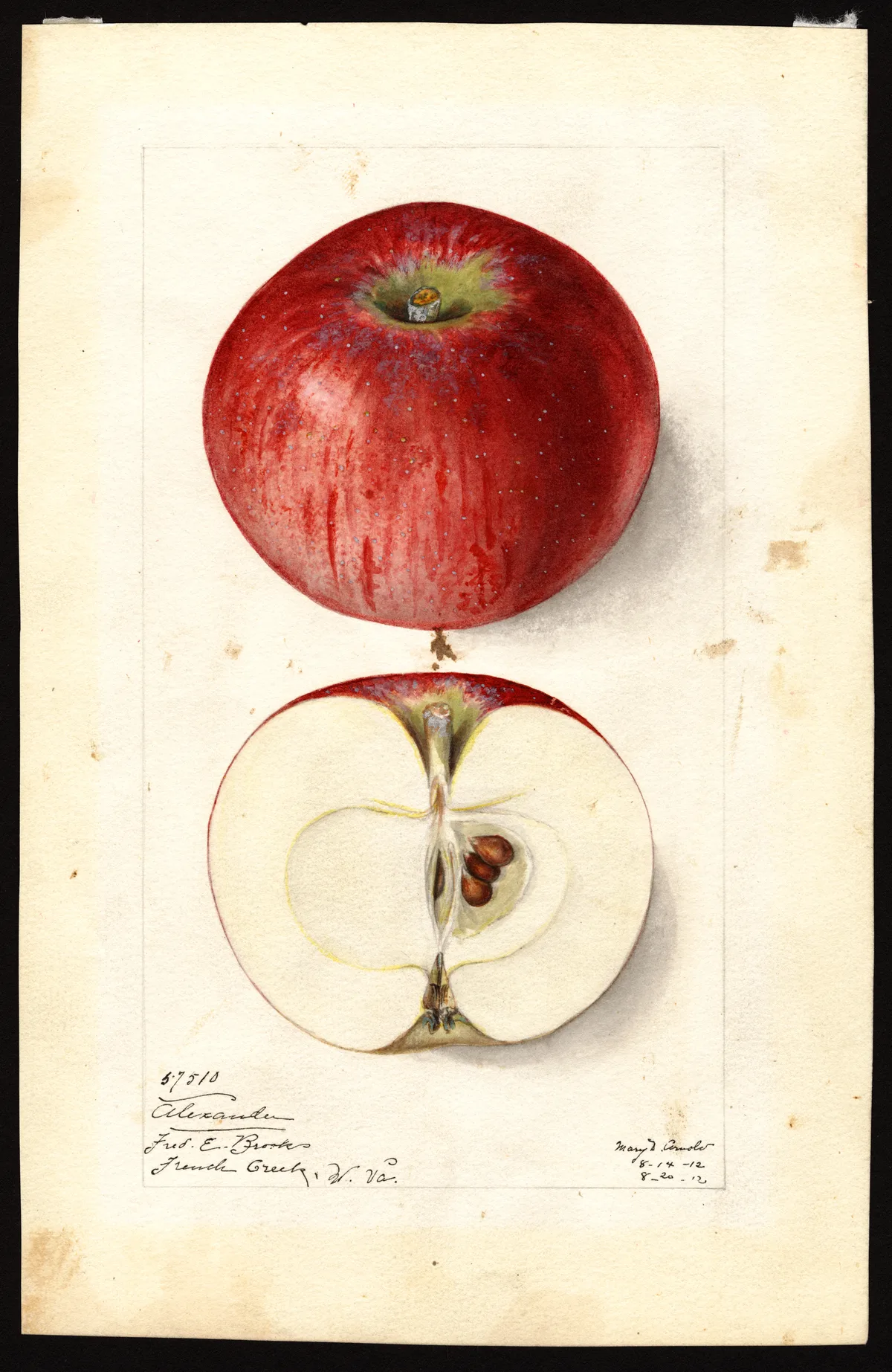
USDA Pomological Watercolor Collection
Alexander
Origin / History
Alexander is of Russian origin, a native of the Southern Provinces of Russia, whence it was transported to Riga (Herefordshire Pomona). It is called Alexander in compliment to the Emperor Alexander the First (Herefordshire Pomona). It was introduced into England by Mr. Lee, nurseryman, of Hammersmith, about the year 1805 according to the Herefordshire Pomona, though most other sources (Beach, Lowther, Hedrick, Bunyard) date the English introduction to 1817. On January 7, 1817, Mr. Lee exhibited some very fine specimens at the Horticultural Society, one of which measured five inches in diameter, four inches in depth, and sixteen inches in circumference, and weighed nineteen ounces; a plate of this apple was given in the Transactions (vol. II. p. 406), though not quite typical in shape owing to its size, and a better figure is given in Ronalds' Pyrus Malus Brentfordiensis, plate xxxv., figure 2 (Herefordshire Pomona).
The exact date of introduction into America is not known (Beach, Lowther). The Massachusetts Horticultural Society made several importations of European varieties which were distributed among the members; Mr. Manning exhibited what was supposed to be Alexander before that society at its meeting on September 18, 1830, with the shipment evidently made prior to that date (Beach). The variety has been widely disseminated and is now well known in apple-growing districts from the Atlantic to the Pacific (Beach). Alexander is a typical representative of the class of Russian apples commonly known as the Aport group (Beach). In the west it is now largely supplanted by its Wisconsin seedling, the Wolf River (Hansen, Budd-Hansen, Beach). Bunyard notes it has "suffered often at the hands of re-christeners."
Tree
Tree large to medium, vigorous to moderately vigorous (Beach), with long, stout branches (Beach, Hedrick, Lowther). Form upright spreading to roundish, open, and somewhat inclined to droop after bearing heavy crops (Beach, Hedrick). Growth strong and spreading (Central Experimental Farm). Warder describes the tree as medium size, spreading, moderately productive, early bearer. Productivity is variously described as moderately productive (Beach, Warder, Lowther), productive (Downing, Hansen, Budd-Hansen, Central Experimental Farm), a good bearer (Herefordshire Pomona), with Hedrick adding earliness and regularity of bearing as merits — but Elliott calls it a "poor bearer" and Thomas a "moderate or poor bearer," while Bunyard rates fertility "moderate." It is perfectly hardy (Herefordshire Pomona, Beach, Hedrick), and the size of its fruit renders protection from the wind desirable (Herefordshire Pomona). The leaves of the tree change in autumn to a fine red hue (Herefordshire Pomona). Bunyard describes the leaf as large, roundish, pale grey-green, down hanging, nearly flat, very coarsely crenate.
Twigs short, curved, stout, with large terminal buds; internodes medium (Beach; Lowther echoes "twigs stout with large terminal buds"). Bark brown mingled with olive-green, lightly streaked with scarf-skin; slightly pubescent near tips (Beach, Lowther). Lenticels scattering, medium in size, oval, raised (Beach). Buds medium in size, plump, obtuse, free, slightly pubescent (Beach).
In some localities the tree is subject to blight (Beach), and Hedrick names susceptibility to blight as the tree's chief fault; Lowther notes it "is more subject to blight than some other varieties." The variety is much used as a filler in some apple regions, and as a permanent tree where hardiness is a determinant (Hedrick).
Fruit
Size
Very large to large; uniform in size and shape (Beach, Hedrick, Lowther, Hansen, Budd-Hansen). Bunyard gives dimensions of 4 by 3 inches. The exceptional Lee specimen of 1817 measured five inches in diameter, four inches in depth, sixteen inches in circumference, and weighed nineteen ounces (Herefordshire Pomona).
Form
Sources differ somewhat on form. Roundish conic to slightly oblate conic, regular or approaching broadly angular, symmetrical (Beach); round-conic to oblate-conic, regular or approaching broadly angular, symmetrical (Hedrick); roundish, slightly conical, symmetrical (Lowther); very large, regularly formed, conical (Downing, Central Experimental Farm); regular, conical (Hansen, Budd-Hansen); conical, flattened at base (Elliott); heart-shaped (Herefordshire Pomona); oblate, inclined to conic, regular (Thomas); conical, truncated, sometimes obscurely angular (Warder); round, conical, flattened on five sides (Bunyard).
Stem / Stalk
Stem medium to rather short, moderately thick (Beach); short, thick (Hedrick); short, knobbed at base (Hansen, Budd-Hansen); medium to short, stout (Warder); small (Elliott, Thomas); rather slender, three-fourths of an inch long (Downing); an inch or more in length (Herefordshire Pomona); rather long (Bunyard).
Cavity
Acute to acuminate, deep, broad, symmetrical, occasionally lipped, russeted, often with broad, conspicuous, outspreading russet rays (Beach); acute, deep, broad, symmetrical, occasionally lipped, russeted, often with broad, conspicuous outspreading russet rays (Hedrick); regular, deep, with trace of russet (Hansen, Budd-Hansen); rather deep, narrow, regular, brown (Warder); deep (Elliott, Thomas); deep, round, and even, lined with russet (Herefordshire Pomona); deep (Downing); deep and wide, russet-lined (Bunyard).
Calyx / Eye
Large (Elliott, Thomas, Downing); medium to large, usually open; lobes medium to short, rather narrow, acute (Beach); large, open; lobes short, narrow, acute (Hedrick); open (Hansen, Budd-Hansen); small, long, closed (Warder); large and half open, with broad, erect, and acuminate segments (Herefordshire Pomona); closed (Bunyard).
Basin
Rather small, deep, narrow to nearly medium in width, abrupt, nearly smooth, symmetrical (Beach); small, deep, narrow, abrupt, smooth, symmetrical (Hedrick); narrow, abrupt, slightly corrugated (Hansen, Budd-Hansen); deep (Elliott, Downing); deep, even (Thomas); medium, regular (Warder); deep, even, and slightly ribbed (Herefordshire Pomona); rather deep and plaited, topped by five angular ribs (Bunyard).
Skin
Moderately thick, tough, smooth, glossy, somewhat waxy (Beach); thick, tough, smooth, glossy, waxen (Hedrick); moderately thick, tough, smooth, glossy, somewhat waxy (Lowther); smooth (Herefordshire Pomona). Ground color greenish or pale yellow deepening to orange-yellow in the sun (Beach, Hedrick), often entirely overspread with lively red or handsomely striped and splashed with bright carmine (Beach, Hedrick). Greenish yellow, faintly streaked with red on the shaded side, but orange on the sunny side, almost wholly covered with bright crimson stripes and splashes — a showy fruit (Hansen, Budd-Hansen, Downing). Greenish yellow with a few streaks of red on the shaded side, and orange, streaked with bright red next the sun; the whole strewed with numerous russety dots (Herefordshire Pomona). Pale yellow, striped and splashed distinctly bright red, sometimes shaded mixed red (Warder). Red streaked on greenish yellow (Elliott). Streaked with bright red on greenish-yellow (Thomas). Golden-yellow, with broad red stripes and flush (Bunyard). Greenish yellow with bright red over nearly the whole surface (Central Experimental Farm). Large red striped (Stark Bros.). In the arid regions of bright sunshine, often of a deep red color (Lowther). Prevailing effect red or striped (Beach, Hedrick).
Dots
Dots inconspicuous, small, scattering (Beach); inconspicuous, scattering (Hedrick); obscure, few, minute, gray (Hansen, Budd-Hansen); minute (Warder); numerous russety dots (Herefordshire Pomona).
Flesh / Flavor
Nearly white with faint yellow tinge, firm, coarse, moderately crisp, tender, juicy, mild subacid, fair to good (Beach). Faint yellow, firm, coarse, crisp, tender, juicy, mild subacid; fair to good (Hedrick). Yellowish white, crisp, tender, and juicy, with a rather pleasant flavor, good (Hansen, Budd-Hansen, Downing). Yellowish white, tender, crisp, juicy, and sugary, with a pleasant and slightly aromatic flavour (Herefordshire Pomona). Whitish, breaking, not fine grained, juicy; flavor acid, not rich; quality scarcely good, except for cooking (Warder). Coarse, crisp (Elliott). Rather crisp, sub-acid, good; a coarse sort, only for cooking (Thomas). Pale yellow, tender, sweet (Bunyard). White, crisp, tender and juicy, mildly acid, and of pleasant flavour (Central Experimental Farm). Rich juicy with a pleasant acidity, flesh firm and crisp (Veitch). Solid, poor quality (Stark Bros.). Coarse in texture, medium to good in quality, suitable for culinary rather than for dessert use (Beach); rather good in quality, better for culinary purposes than for dessert (Lowther); coarse in texture and so poor in quality as to be suitable only for culinary purposes (Hedrick).
Calyx tube / Stamens / Core / Cells / Carpels / Seeds
Calyx tube variable, long to short, wide to medium, conical to funnel-shape (Beach); calyx-tube variable, long, wide, conical (Hedrick); tube conical (Hansen, Budd-Hansen). Stamens median to basal (Beach); stamens median (Hedrick); stamens basal (Hansen, Budd-Hansen). Core small, usually axile; cells often not uniformly developed, closed or very slightly open; core lines slightly clasping (Beach); core small, usually axile; cells closed or slightly open; core-lines clasping (Hedrick); core open; cells ovate, slit (Hansen, Budd-Hansen); core wide, regular, nearly closed, clasping; axis short (Warder). Carpels elliptical to slightly ovate, emarginate (Beach); carpels elliptical, emarginate (Hedrick). Seeds medium in size, wide, short, rather plump, obtuse to acute (Beach); seeds wide, short, plump, obtuse (Hedrick); seeds short, plump (Hansen, Budd-Hansen); seeds large (Warder); short round seeds, by which it may be distinguished from Bismarck (Bunyard).
Season
September and October (Warder, Central Experimental Farm). September and October or early November (Beach). October (Elliott). October to December (Downing, Hansen, Budd-Hansen). Late autumn (Thomas). September to November (Herefordshire Pomona, Hedrick, Veitch, Bunyard). September to first of November in market demand (Lowther). Beach notes the season "begins in September and extends through October or into November" and that the fruit may be held in cold storage till November; it ripens continuously during a period of from four to six weeks and should have more than one picking. Thomas Rivers (1914 catalogue) gives "S Sept.–Jan." The fruit is apt to crack and decay about the stem and calyx, often becomes discolored where chafed by constantly rubbing against twig or branch, and suffers considerable loss from premature dropping (Beach, Lowther, Hedrick). It does not stand heat well before going into storage and should be shipped the day it is picked and under ice (Beach). Hedrick notes it does not keep well in either common or cold storage; Warder notes "fruit falls badly from the tree"; Stark Bros. calls it "a great favorite for keeping." Veitch (1911) and Thomas Rivers (1914) note it keeps well.
Uses
More adapted for culinary than dessert use, but when well coloured it presents a very noble appearance on the table (Herefordshire Pomona). Quality scarcely good, except for cooking (Warder). Only for cooking (Thomas). Very valuable for cooking (Stark Bros.). Good for cooking purposes (Veitch). A good cooking apple (Thomas Rivers). Suitable for culinary rather than for dessert use; the fruit is very large, attractive red or striped, coarse in texture, medium to good in quality (Beach). Valued chiefly on the exhibition table (Bunyard). Bunyard classes it as "Culinary or dessert." Many fruit growers now regard Alexander favorably as a commercial variety as in some markets there is a strong demand for the fruit at good prices; it is being used to some extent for export trade (Beach). It can be recommended for planting in commercial orchards to a limited extent (Beach). "Very showy, its chief recommendation" (Thomas).
Subtypes / Variants
Not described in source. (The Wisconsin seedling Wolf River, frequently named alongside Alexander as having largely supplanted it in the West, is treated by the sources as a distinct variety rather than a subtype.)
Other
Bunyard notes Alexander may be distinguished from Bismarck by the short round seeds. Beach lists "Wolf River incorrectly" among synonyms used in error, and Downing lists "Victoria, incorrectly." The variety has been published under a great many alternate names across the Russian, French, German, and English literature (full synonym apparatus given by Beach via references 1–40).
Book Sources
Described in 11 period pomological works
- Beach, The Apples of New York Vol. 2 (1905)
- Budd & Hansen, Systematic Pomology (1914)
- Warder, American Pomology: Apples (1867)
- Bunyard, A Handbook of Hardy Fruits (1920)
- Downing, Fruits and Fruit Trees of America (1900)
- Elliott, The Western Fruit Book (1865)
- Lowther (ed.), Encyclopedia of Practical Horticulture (1914)
- Hansen, A Study of Northwestern Apples (1902)
- Hedrick, Cyclopedia of Hardy Fruits (1922)
- The Herefordshire Pomona (1876–1885)
- Thomas, The American Fruit Culturist (1903)
Nursery Catalog Sources
Found in 70 catalogs (1845–1921) from California, England, Illinois, Maryland, Massachusetts, Missouri, Nebraska, New Jersey, New York, Oregon, Pennsylvania, Virginia, Washington
- Winship's Nursery (Brighton Nurseries , operated by the Winship family), Brighton (Boston) , Massachusetts — 1845
- Hovey & Co. , Cambridge , Massachusetts — 1849
- Azell Bowditch (Nursery / Fruit Catalog) , Boston , Massachusetts — 1850
- Joseph Breck & Co. , Boston , Massachusetts — 1855
- St. Helena Nursery , Howell's Prairie, Marion County , Oregon — 1864
- Hutchison Nursery , James Hutchison, Oakland , California — 1881
- Felix Gillet , Barren Hill Nursery, Nevada City , California — 1884
- Fancher Creek Nursery , Fresno , California — 1886
- W.R. Strong & Co. , Capital and Orange Hill Nurseries (Robert Williamson, prop.), Sacramento , California — 1886
- California Nursery Co. , Niles , California — 1889
- Felix Gillet , Barren Hill Nursery, Nevada City , California — 1889
- Palouse Nursery and Pleasant Dale Fruit Farm , Colfax, Washington Territory (situated two miles northeast of Colfax) - undated (single-page broadside flyer; "Washington Territory" suggests pre — 1889
- Felix Gillet , Barren Hill Nursery, Nevada City , California — 1890
- William H. Moon Co. , Morrisville, Bucks County , Pennsylvania — 1890
- Felix Gillet , Barren Hill Nursery, Nevada City , California — 1891
- Puyallup & Yakima Nurseries , Puyallup, Washington (Lock Box 191) and North Yakima , Washington — 1892
- Milwaukie-Canby Nurseries , Canby, OR (and Milwaukie, OR) — 1893
- Rogers Nursery Co. , Moorestown , New Jersey — 1893
- Sherwood Hall Nursery Co. , Timothy Hopkins (Menlo Park Nurseries), San Francisco / Menlo Park , California — 1893
- Multnomah Nurseries , Russellville , Oregon — 1894
- The Vineland Nurseries (Kelsey & Co. , Proprietors), St. Joseph, Missouri (Office: 13th and Atchison Sts., 2 Blocks East of the Citizens St. Car Line) — 1894
- Woodburn Nurseries , Woodburn, Marion Co. , Oregon — 1894
- Felix Gillet , Barren Hill Nursery, Nevada City , California — 1895
- Felix Gillet , Barren Hill Nursery, Nevada City , California — 1897
- The Salem Nursery (John A. Francis , Proprietor), Salem , Virginia — 1897
- Reading Nursery , Jacob W. Manning, Proprietor, Reading , Massachusetts — 1898
- Brown Brothers Co. , Continental Nurseries, Rochester, NY (also operated from Toronto, Canada) — 1899
- George Bunyard & Co. , Royal Nurseries, Maidstone, Kent , England — 1900
- Central Experimental Farm , Dominion Department of Agriculture, Agassiz, British Columbia (under test; Bulletin No. 3, Second Series) — 1900
- Brown Brothers Co. , Continental Nurseries, Rochester, NY (also operated from Toronto, Canada) — 1901
- S.L. Watkins , Grizzly Flats, El Dorado County , California — 1901
- Washington Nursery Co. , Toppenish , Washington — 1901
- Benjamin Buckman (personal inventory) , Farmingdale , Illinois — 1901
- Forestville Nurseries , T.J. True, Forestville , California — 1902
- Pacific Nursery Company (W. O. Hudson & A. D. Hudson) , Tangent , Oregon — 1903
- Russellville Nursery Co. , Russellville, OR (three miles east of Portland, one mile from Montavilla car line) — 1903
- Phoenix Nursery Company (W. E. Rossney , President; Sidney Tuttle, Vice-President), Bloomington , Illinois — 1904
- Stark Bros. Nurseries & Orchards Co. , Louisiana , Missouri — 1906
- The Dalles Nurseries , The Dalles , Oregon — 1906
- Russellville Nursery Co. , Montavilla Station, Portland, OR (three miles east of Portland, one mile from Montavilla car line) — 1907
- Carlton Nursery Co. , Carlton , Oregon — 1909
- Milton Nursery Co. (A. Miller & Sons , Proprietors), Milton , Oregon — 1909
- Wm. J. Corse (successor to Robert Sinclair / Sinclair Nurseries) , Baltimore , Maryland — 1909
- Washington Nursery Company , Toppenish , Washington — 1909
- Island Nurseries & Fruit Farm , Vashon (Vashon Island) , Washington — 1910
- Galbraith Nursery Co. (DeWitt Hansen , Pres.-Mgr.), Fairbury , Nebraska — 1911
- Island Nurseries & Fruit Farm , Vashon (Vashon Island) , Washington — 1911
- James Veitch & Sons , Ltd., Royal Exotic Nursery, Chelsea, London (also Coombe Wood, Langley, and Feltham) , England — 1911
- Ballygreen Nurseries , Hanford , Washington — 1912
- Pacific Nursery Company , Portland , Oregon — 1912
- Stark Bros. Nurseries & Orchards Co. , Louisiana , Missouri — 1912
- Washington Nursery Company , Toppenish , Washington — 1912
- Vineland Nurseries Company , Clarkston , Washington — 1912
- Samuel Fraser , Geneseo , New York — 1913
- Van Holderbeke Nursery Co. , Incorporated, Spokane, Washington (nurseries at Otis Orchards WA, Pasadena WA, Kennewick WA) — 1913
- Thomas Rivers & Son , Sawbridgeworth, Hertfordshire , England — 1913
- Benjamin Buckman (personal inventory) , Farmingdale , Illinois — 1913
- George Bunyard & Co. , Royal Nurseries, Maidstone, Kent , England — 1914
- Island Nurseries & Fruit Farm , Vashon (Vashon Island) , Washington — 1914
- Island Nurseries & Fruit Farm , Vashon (Vashon Island) , Washington — 1915
- Union Nurseries , J.B. Weaver & Sons, Union , Oregon — 1915
- Island Nurseries & Fruit Farm , Vashon (Vashon Island) , Washington — 1916
- George Bunyard & Co. , Royal Nurseries, Maidstone, Kent , England — 1917
- Island Nurseries & Fruit Farm , Vashon (Vashon Island) , Washington — 1917
- Fancher Creek Nurseries , George C. Roeding, Fresno , California — 1918
- Christopher Nurseries / John Stewart & Sons , Christopher , Washington — 1920
- Oregon Nursery Co. , Orenco , Oregon — 1920
- Benedict Nursery Co. , Portland , Oregon — 1921
- Island Nurseries & Fruit Farm , Vashon , Washington — 1921
- North-Western Nurseries , Walla Walla , Washington
View original book sources (16)
— F.R. Elliott, The Western Fruit Book (1865)Alexander. Emperor Alexander. Foreign. Fruit, large, conical, flattened at base, red streaked on greenish yellow; stem, small; cavity, deep; calyx, large; basin deep; flesh, coarse, crisp; showy; poor bearer. October.
— John A. Warder, American Pomology: Apples (1867)Alexander.
This Russian apple, so much admired for its size and beauty, is not a favorite in the orchard, though some persons have found it profitable in the markets.
Tree medium size, spreading, moderately productive, early bearer.
Fruit large to very large, fair and handsome, conical, truncated, sometimes obscurely angular; Surface smooth, pale yellow, striped and splashed distinctly bright red, sometimes shaded mixed red; Dots minute.
Basin medium, regular; Eye small, long, closed.
Cavity rather deep, narrow, regular, brown; Stem medium to short, stout.
Core wide, regular, nearly closed, clasping; Axis short; Seeds large; Flesh whitish, breaking, not fine grained, juicy; Flavor acid, not rich; Quality scarcely good, except for cooking; Season, August and September. Fruit falls badly from the tree.
— Woolhope Naturalists Field Club, The Herefordshire Pomona (1885)
- EMPEROR ALEXANDER. [Syn : Aporta ; Alexander ; Russian Emperor ; Kief's Koy.] This beautiful apple is a native of the Southern Provinces of Russia, whence it was transported to Riga. It is called Alexander, in compliment to the Emperor Alexander the First. It was introduced into England by Mr. Lee, nurseryman, of Hammersmith, about the year 1805. On January 7, 1817, Mr. Lee exhibited some very fine specimens at the Horticultural Society, one of which measured five inches in diameter, four inches in depth, and sixteen inches in circumference. It weighed nineteen ounces. A plate of this apple is given in the Transactions (vol. II. p. 406), but it is not quite typical in shape, owing no doubt to its size. A better figure of it is given in Ronalds' Pyrus Malus Brentfordiensis, plate xxxv., figure 2. Description.—Fruit, very large, heart-shaped. Skin, smooth, greenish yellow, with a few streaks of red on the shaded side, and orange, streaked with bright red next the sun ; the whole strewed with numerous russety dots. Eye, large and half open, with broad, erect, and acuminate segments ; set in a deep, even, and slightly ribbed basin. Stalk, an inch or more in length, inserted in a deep, round, and even cavity, which is lined with russet. Flesh, yellowish white, tender, crisp, juicy, and sugary, with a pleasant and slightly aromatic flavour. This is one of the most beautiful and valuable apples, both as regards its size and quality. It is more adapted for culinary than dessert use, but when well coloured it presents a very noble appearance on the table. It is in season from September to December. The tree grows well and vigorously. It is perfectly hardy, and a good bearer. The size of its fruit renders protection from the wind desirable. The leaves of the tree change in autumn to a fine red hue.
— A.J. Downing, The Fruits and Fruit Trees of America (1900)Alexander.
Emperor Alexander. Russian Emperor. Aporta. Victoria, incorrectly.
A very large, showy Russian variety. Tree vigorous, spreading, productive. Fruit very large, regularly formed, conical. Skin greenish-yellow, faintly streaked with red on the shaded side, but orange, brilliantly streaked, and marked with bright red in the sun. Calyx large, set in a deep basin. Stalk rather slender, three-fourths of an inch long, planted in a deep cavity. Flesh yellowish-white, crisp, tender, and juicy, with a rather pleasant flavor. Good. October to December.
— N.E. Hansen, A Study of Northwestern Apples (1902)Alexander—Of Russian origin; tree vigorous, spreading, productive. In the west it is now largely supplanted by its Wisconsin seedling the Wolf River—Fruit very large, regular, conical; surface greenish yellow, faintly streaked with red on shaded side, but orange on the sunny side almost wholly covered with bright crimson stripes and splashes, a showy fruit; dots obscure, few, minute, gray; cavity regular, deep, with trace of russet; stem short, knobbed at base; basin narrow, abrupt, slightly corrugated; calyx open. Core open; cells ovate, slit; tube conical; stamens basal; seeds short, plump; flesh yellowish white, crisp, tender and juicy with a rather pleasant flavor, good. October to December.
— John J. Thomas, The American Fruit Culturist (1903)Alexander. Very large, oblate, inclined to conic, regular; streaked with bright red on greenish-yellow; stalk small, cavity rather deep; calyx large, basin deep, even; flesh rather crisp, sub-acid, good; a coarse sort, only for cooking. A moderate or poor bearer. Late autumn. Very showy, its chief recommendation. Russian.
— S.A. Beach, The Apples of New York, Vol. 2 (1905)ALEXANDER
REFERENCES. 1. Forsyth, 1824:131. 2. London Hort. Soc. Cat., 1831: No. 10. 3. Kenrick, 1832:65. 4. Floy-Lindley, 1833:11. 5. Mag. Hort., 1:395. 1835. 6. Downing, 1845:79. fig. 7. Thomas, 1849:146. 8. Cole, 1849:118. 9. Emmons, Nat. Hist. N. Y., 3:32. 1851. 10. Barry, 1851:282. 11. Elliott, 1854:120. 12. Gregg, 1857:41. 13. Hooper, 1857:11. 14. Am. Pom. Soc. Cat., 1862. 15. Warder, 1867:510. 16. Fitz, 1872:152. 17. Leroy, 1873:333. fig. 18. Ia. Hort. Soc. Rpt., 1879:538. 19. Downing, 1881:11 index, app. 20. Hogg, 1884:72. 21. Roach, Montreal Hort. Soc. Rpt., 1886-87:27. 22. Wickson, 1889:244. 23. Lyon, Mich. Hort. Soc. Rpt., 1890:288. 24. Bailey, An. Hort., 1892:234. 25. Hoskins, Rural N. Y., 53:278. 1894. 26. Gaudier, 1894: No. 14. col. pl. 27. Dempsey, Ont. Fr. Stas. An. Rpt., 1:24. 1894. 28. Burrill and McCluer, Ill. Sta. Bul., 45:312. 1896. 29. Stinson, Ark. Sta. Bul., 43:102. 1896. 30. Waugh, Vt. Sta. Bul., 61:29. 1897. 31. Can. Hort., 20:283. 1897. 32. Woolverton, Ont. Fr. Stas. An. Rpt., 5:5. 1898. figs. 33. Bunyard, Jour. Roy. Hort. Soc., 1898:354. 34. Craig, Cyclopedia of Amer. Hort., 3:1404. 1901. 35. Hansen, S. D. Sta. Bul., 76:22. 1902. 36. Munson, Me. Sta. Rpt., 1902:83, 85, 86. 37. Budd-Hansen, 1903:36. fig. 38. Powell and Fulton, U. S. B. P. I. Bul., 48:36. 1903. 39. Beach and Clark, N. Y. Sta. Bul., 248:111. 1904. 40. Scriber, Can. Hort., 28:248. 1905.
SYNONYMS. Albertin (17, 26). ALEXANDER (1, 2, 5, 6, 7, 8, 9, 10, 11, 12, 13, 14, 15, 16, 18, 19, 21, 22, 23, 24, 27, 28, 29, 30, 31, 32, 34, 35, 36, 37, 38, 39, 40). Alexandre (34, 26). Alexander the First (31). Alexandre (17, 26). Aporta (3, 4, 6, 9, 13, 17, 20, 26, 31). Aporta Nalivia (26). Aubertin (17, 26). Beauty of Queen (17, 26). Belle d'Orleans (17, 26). Comte Woronzoff (17, 26). Corail (17, 26). English King (19, 26). Empereur Alexandre I (17, 26). Empereur Alexandre de Russie (17, 26). Empereur de Russie (17, 26). EMPEROR ALEXANDER (3, 4, 20, 33). Emperor Alexander (2, 6, 9, 10, 11, 13, 26, 32). Fin d'Automne (17, 26). Grand Alexander (26). GRAND ALEXANDRE (17). Grand Alexandre (26). Gros-Alexandre (17, 26). Jolly Gentleman (26). KAISER ALEXANDER (26). Korallen Apfel (26). Phœnix (26). Phönix (17, 26). Pomona Britannica (17, 26). Président Napoleon (17, 26). Russian Emperor (2, 6, 9, 13, 20, 26). Stoke Tulip (26). Wolf River incorrectly (39). Wunderapfel (26).
Alexander is a typical representative of the class of Russian apples commonly known as the Aport group. Fruit very large, attractive red or striped, coarse in texture, medium to good in quality, suitable for culinary rather than for dessert use. The fruit is apt to crack and decay about the stem and calyx and often becomes discolored where it is chafed by constantly rubbing against some twig or branch; there is also a considerable loss from premature dropping of the fruit. Notwithstanding these faults many fruit growers now regard Alexander favorably as a commercial variety as in some markets there is a strong demand for the fruit at good prices. It is being used to some extent for export trade (40). Its season begins in September and extends through October or into November. It may be held in cold storage till November. It goes down quickly and as it does not stand heat well before going into storage it should be shipped the day it is picked and under ice (39). As it ripens continuously during a period of from four to six weeks it should have more than one picking. The tree is hardy, vigorous and moderately productive. In some localities it is subject to blight. It can be recommended for planting in commercial orchards to a limited extent. In the West it is now largely supplanted by its Wisconsin seedling Wolf River (34, 36).
Historical. Introduced into England from Russia in 1817 (20). The exact date of the introduction of this variety into America is not known. The Massachusetts Horticultural Society made several importations of European varieties which were distributed among the members of the society. Mr. Manning exhibited what was supposed to be Alexander before the Massachusetts Horticultural Society at its meeting on September 18, 1830. Whether this was Alexander or not, the shipment of varieties of which Alexander was one had evidently been made prior to that date.¹ It has been widely disseminated and is now pretty well known in the apple growing districts from the Atlantic to the Pacific. Thus far it has not been grown to any considerable extent in New York state but at the present time its cultivation is on the increase.
TREE. Tree large to medium, vigorous to moderately vigorous with long, stout branches. Form upright spreading to roundish, open and somewhat inclined to droop after bearing heavy crops. Twigs short, curved, stout with large terminal buds; internodes medium. Bark brown mingled with olive-green, lightly streaked with scarf-skin; slightly pubescent near tips. Lenticels scattering, medium in size, oval, raised. Buds medium in size, plump, obtuse, free, slightly pubescent.
FRUIT. Fruit large, uniform in size and shape. Form roundish conic to slightly oblate conic, regular or approaching broadly angular, symmetrical. Stem medium to rather short, moderately thick. Cavity acute to acuminate, deep, broad, symmetrical, occasionally lipped, russeted, often with broad, conspicuous, outspreading russet rays. Calyx medium to large, usually open; lobes medium to short, rather narrow, acute. Basin rather small, deep, narrow to nearly medium in width, abrupt, nearly smooth, symmetrical. Skin moderately thick, tough, smooth, glossy, somewhat waxy, greenish or pale yellow deepening to orange-yellow in the sun, often entirely overspread with lively red or handsomely striped and splashed with bright carmine. Dots inconspicuous, small, scattering. Prevailing effect red or striped. Calyx tube variable, long to short, wide to medium, conical to funnel-shape. Stamens median to basal. Core small, usually axile; cells often not uniformly developed, closed or very slightly open; core lines slightly clasping. Carpels elliptical to slightly ovate, emarginate. Seeds medium in size, wide, short, rather plump, obtuse to acute. Flesh nearly white with faint yellow tinge, firm, coarse, moderately crisp, tender, juicy, mild subacid, fair to good.
Season September and October or early November.
¹N. E. Farmer, Sept. 24, 1830: 78.
— J.L. Budd & N.E. Hansen, American Horticultural Manual, Part II: Systematic Pomology (1914)Alexander.—Of Russian origin; tree vigorous, spreading, productive. In the West it is now largely supplanted by its Wisconsin seedling, the Wolf River. Fruit very large, regular, conical; surface greenish yellow, faintly streaked with red on shaded side, but orange on the sunny side, almost wholly covered with bright crimson stripes and splashes, a showy fruit; dots obscure, few, minute, gray; cavity regular, deep, with trace of russet; stem short knobbed at base; basin narrow, abrupt, slightly corrugated; calyx open. Core open; cells ovate, slit; tube conical; stamens basal; seeds short, plump; flesh yellowish white, crisp, tender and juicy, with a rather pleasant flavor, good. October to December.
— Granville Lowther (ed.), Encyclopedia of Practical Horticulture (1914)Alexander
The Alexander originated in Russia; was introduced into England in 1817; but the exact date of its introduction into the United States we are not able to determine.
The fruit is very large, attractive, red or striped, coarse in texture, rather good in quality, better for culinary purposes than for dessert. It is large, uniform in size and shape, roundish, slightly conical, symmetrical. Skin moderately thick, tough, smooth, glossy, somewhat waxy, greenish or pale yellow deepening to orange in the sun. In the arid regions of bright sunshine, it is often of a deep red color.
The tree is hardy, vigorous, moderately productive, but is more subject to blight than some other varieties. It has long branches, upright, spreading to roundish top, twigs stout with large terminal buds; bark brown mingled with olive green.
For market the fruit is in good demand from September to the first of November, although it inclines to crack at the stem and calyx, and there is considerable loss by premature dropping.
— E.A. Bunyard, A Handbook of Hardy Fruits (1920)EMPEROR ALEXANDER. Ronalds, p. 25. F., Grand Alexandre; G., Kaiser Alexander. (Aporta, English King.) Culinary or dessert, September to November, large, 4 by 3, round, conical, flattened on five sides. Colour, golden-yellow, with broad red stripes and flush. Flesh, pale yellow, tender, sweet. Eye, closed, in a rather deep and plaited basin, which is topped by five angular ribs. Stem, rather long in a deep and wide russet-lined cavity. Growth, vigorous, spreading; fertility moderate. Leaf, large, roundish, pale grey-green, down hanging, nearly flat, very coarsely crenate. Origin, Russian. Imported into England in 1817. It has suffered often at the hands of re-christeners. Valued chiefly on the exhibition table. May be distinguished from Bismarck by the short round seeds.
— U.P. Hedrick, Cyclopedia of Hardy Fruits (1922)
- Alexander. (×½)
ALEXANDER. Fig. 6. Aporta.
Alexander has many merits but some faults. Merits of the trees are vigor, hardiness, productiveness, earliness and regularity of bearing; of the fruits, large size and handsome appearance. The chief fault of the tree is susceptibility to blight. The apples fail in being coarse in texture and so poor in quality as to be suitable only for culinary purposes; in ripening unevenly and so requiring several pickings; in dropping prematurely; and in not keeping well in either common or cold storage. The variety is much used as a filler in some apple regions, and as a permanent tree where hardiness is a determinant. Its cultivation is everywhere common in northern apple regions. Alexander was introduced into England in 1817; when into America is not known.
Tree large, vigorous, with long stout branches, upright-spreading, open, somewhat drooping. Fruit large, uniform in size and shape, round-conic to oblate-conic, regular or approaching broadly angular, symmetrical; stem short, thick; cavity acute, deep, broad, symmetrical, occasionally lipped, russeted, often with broad, conspicuous outspreading russet rays; calyx large, open; lobes short, narrow, acute; basin small, deep, narrow, abrupt, smooth, symmetrical; skin thick, tough, smooth, glossy, waxen, pale yellow deepening to orange-yellow in the sun, overspread with lively red or striped and splashed with carmine; dots inconspicuous, scattering; prevailing effect red or striped; calyx-tube variable, long, wide, conical; stamens median; core small, usually axile; cells closed or slightly open; core-lines clasping; carpels elliptical, emarginate; seeds wide, short, plump, obtuse; flesh faint yellow, firm, coarse, crisp, tender, juicy, mild subacid; fair to good; September to November.
— Central Experimental Farm, Central Experimental Farm, Agassiz BC — Catalogue of Fruit Trees under Test (Bulletin No. 3, 1900) (1900)Planted Spring 1890. Tree a strong and spreading grower; productive. Fruit very large, regularly formed, conical. Skin greenish yellow, with bright red over nearly the whole surface. Flesh white, crisp, tender and juicy, mildly acid, and of pleasant flavour. Season, September and October.
— Stark Bros. Nurseries & Orchards Co., Stark Bros. Year Book (1910) (1910)Large red striped apple, solid, poor quality, very valuable for cooking. Though strong it a great favorite for keeping, hardy. NCS
— James Veitch & Sons, Veitch's Fruit Trees (1911) (1911)large and handsome, rich juicy with a pleasant acidity, good for cooking purposes and keeping well. Flesh firm and crisp. Sept. to Nov.
— George Bunyard & Co., George Bunyard Catalog of Fruit Trees (1914) (1914)Probably the same as the preceding.
— Thomas Rivers & Son, Thomas Rivers Catalogue of Fruits (1914) (1914)very large and handsome; a good cooking apple S Sept.-Jan.