Blenheim Orange
Apple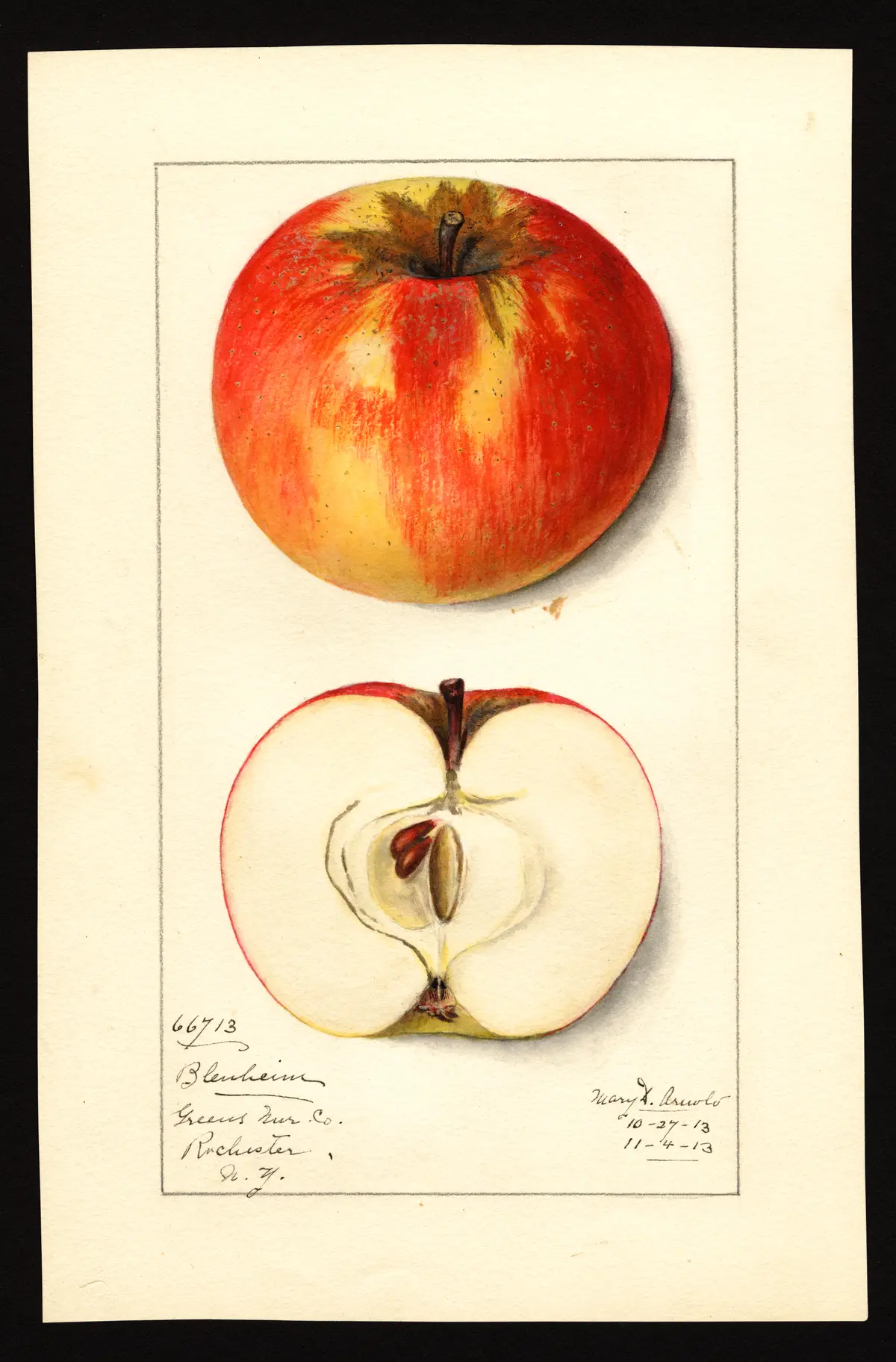
USDA Pomological Watercolor Collection
Blenheim Orange
Origin / History
Blenheim Orange is an old English variety originating at Woodstock, in Oxfordshire, England, in the neighbourhood of Blenheim, the seat of the Duke of Marlborough — from which the variety takes its name (Herefordshire Pomona; Downing; Beach; Budd-Hansen; Bunyard 1920). The exact date of origin is not known. It is not noticed in any of the nursery catalogues of the eighteenth century, and was not cultivated in the London nurseries until about the year 1818 (Herefordshire Pomona; Beach; Bunyard 1920). Hogg (cited in Beach) likewise places its arrival in the London nurseries about 1818.
According to the account given by Bunyard (1920), the apple was raised at Woodstock, near Blenheim, by a Mr. Kempster — hence the provincial name "Kempster's Pippin," still in use as a lasting tribute to him who first planted the kernel from which it sprung. The Herefordshire Pomona preserves a longer narrative, reprinted from the Gardener's Chronicle: the original stump stood in a dilapidated corner of the decaying borough of ancient Woodstock, within ten yards of the wall of Blenheim Park. By the time of the account it was entirely dead and rapidly falling to decay — a mere shell about ten feet high, loose in the ground, with a large hole in the centre. Until within three years of the writing it had occasionally sent up long, thin, wiry twigs, but that last sign of vitality had ceased. Old Grimmett, the basket maker, against whose garden wall the relic was supported, had sat looking on it from his workshop window through more than fifty successive summers; he could remember when, fifty years before, he was a boy and the tree was a fine full-bearing stem, full of bud, blossom and fruit, with thousands thronging from all parts to gaze on its ruddy ripening orange burden, and gardeners coming in springtime to collect the much-coveted scions. Nearly a century had elapsed since Kempster himself "fell like a ripened fruit and was gathered to his fathers"; he had lived in a narrow cottage garden in Old Woodstock, a plain, practical, labouring man among his bees and flowers, said to realize Virgil's dream of the old Corycian ("et regum equabat opes animis").
Although long known in portions of New York, adjacent states, and Canada, it has not assumed great commercial importance in that region (Beach).
A note of conflicting attribution appears in the George Bunyard & Co. 1914 catalogue, which states that the variety was "Raised by W. Messey of Wolverton, and put in commerce in 1839" — a claim that disagrees with the Woodstock/Kempster origin given by all other sources, including Bunyard's own 1920 Handbook.
Bunyard (1920) also enters a separate "Woodstock Pippin," noting that it is "generally considered by pomologists as identical with Blenheim Orange, but is distinct from that in many respects" — and so describes it as a separate variety, with origin "uncertain." This is at variance with the other sources, which all treat Woodstock Pippin as a synonym of Blenheim Orange.
Tree
Tree large, of strong and vigorous growth, an upright-spreading or spreading habit, forming a large and very beautiful standard; makes a large flat-headed tree (Herefordshire Pomona; Downing; Beach; Budd-Hansen; Bunyard 1920). Twigs very stout; bark clear, light reddish-brown, becoming dark (Beach). Leaf large, broad, very dark, flat, sharply serrate; also described as large, round, sharply pointed, curved-serrate, held down and flat (Bunyard 1920).
Bearing habit: a regular and abundant bearer (Downing; Budd-Hansen), bearing its fruit singly and evenly distributed (Beach). The Herefordshire Pomona qualifies this — when full-grown it usually bears regular and abundant crops, but is apt even then to bear well only on alternate years; as a dwarf or espalier it does not bear so regularly or so well, the standard form being the best and most profitable. Bunyard (1920) describes it as "fertile when aged." The Central Experimental Farm (Agassiz BC) 1900 catalogue reports the tree as "a vigorous and spreading grower, and only a moderate bearer." Bunyard's separate Woodstock Pippin entry calls the growth "strong, rather spreading" with "poor" fertility.
Fruit
Size
Large to very large, generally three inches wide and two and a half high (Herefordshire Pomona); Bunyard (1920) gives 3¼ by 2¾, medium to fairly large; his Woodstock Pippin entry gives 3 by 2½, large/fairly large. Beach: usually large or above medium. George Bunyard & Co. (1901): medium size; (1914): medium to large. Veitch's (1911): large and handsome, with a separate listing for a medium-sized form with brownish-red skin.
Form
Globular and somewhat flattened, broader at the base than the apex, regularly and handsomely shaped (Herefordshire Pomona); roundish oblate, conical / slightly conical, very regular (Downing; Budd-Hansen); roundish oblate to roundish inclined to conic, usually pretty regular and symmetrical, sometimes a little furrowed at the apex (Beach); round, flattened, fairly regular (Bunyard 1920, Woodstock Pippin entry); flattened, round, regular (Bunyard 1920, Blenheim Orange entry); roundish, conical (Central Experimental Farm 1900); roundish (George Bunyard 1914).
Stem / Stalk
Short and stout (Downing; Budd-Hansen; Bunyard 1920 Woodstock entry: "short and thick"); rather deeply inserted, scarcely extending beyond the base (Herefordshire Pomona); short to medium (Beach); medium (Bunyard 1920 Blenheim entry).
Cavity
Deep (Downing); regular, obtuse, with a large patch of radiating russet (Budd-Hansen); below medium to rather large, rather narrow to wide, moderately deep to deep, acute to acuminate, usually symmetrical, sometimes compressed or lipped, covered with russet which often extends beyond the cavity (Beach); rather deep, even (Bunyard 1920 Blenheim entry); moderately deep, regular, russeted (Bunyard 1920 Woodstock entry).
Calyx / Eye
Eye large and open, with short stunted segments (Herefordshire Pomona); calyx large, open (Downing; Budd-Hansen — segments short, small); calyx large or very large, segments flat, separated at base plainly exposing the yellowish tube beneath, lobes obtuse (Beach); eye open (Bunyard 1920 Woodstock entry: in a shallow, wide basin, slightly plaited); eye large, open (Bunyard 1920 Blenheim entry: in a broad even basin).
Basin
Round, broad, and rather deep (Herefordshire Pomona); deep, broad (Downing); medium, regular, smooth (Budd-Hansen); large, broad, shallow and obtuse to deep and abrupt, somewhat furrowed and slightly wrinkled (Beach); shallow, wide, slightly plaited (Bunyard 1920 Woodstock entry); broad and even (Bunyard 1920 Blenheim entry).
Skin / Color
Yellow, with a tinge of dull red next the sun and streaked with deeper red (Herefordshire Pomona); yellowish, becoming deep orange, stained on the sunny side with dull and dark red stripes (Downing); surface very smooth, yellow, becoming deep orange, shaded with solid dull brown red, obscurely streaked darker red on the sunny side, sometimes mixed with russet (Budd-Hansen); skin moderately thin and tough, deep yellow overspread with a rather dull pinkish-red, in highly colored specimens developing a deep and rather bright red somewhat roughened in places with netted capillary russet lines — prevailing effect rather attractive red and yellow (Beach); yellow, flushed and striped dull red and fine russet (Bunyard 1920 Blenheim entry); pale yellowish-green, rarely with a faint flush (Bunyard 1920 Woodstock entry); greenish yellow with a dull red cheek (Central Experimental Farm 1900); dull orange-red (George Bunyard 1914); large, roundish, yellow and dull red (Elliott); brownish red (Veitch's 1911, medium-sized form); pale, large, roundish, yellow (George Bunyard 1914, autumn/Syn. Oct. entry).
Dots
Numerous, small or conspicuously large and russet (Beach); obscure, few, russet, small (Budd-Hansen).
Flesh / Flavor
Yellow / yellowish, tinged with yellow (Herefordshire Pomona; Downing; Budd-Hansen; Beach; Bunyard 1920 — both entries; Elliott; Central Experimental Farm 1900). Texture: crisp (Herefordshire Pomona; Beach; Bunyard 1920 — both entries; Central Experimental Farm 1900); rather firm, moderately fine grained or a little coarse (Beach); breaking (Downing; Central Experimental Farm 1900); juicy (Budd-Hansen; Beach — moderately juicy; Bunyard 1920 Woodstock entry; Central Experimental Farm 1900 — moderately juicy); fine grain (George Bunyard 1901). Flavor: sweet and pleasantly acid (Herefordshire Pomona); very sweet, pleasant (Downing); peculiar mild spicy subacid (Budd-Hansen); somewhat aromatic, agreeable sprightly subacid, becoming rather mild subacid (Beach); sub-acid, with a characteristic flavour (Bunyard 1920 Blenheim entry); rather acid (Bunyard 1920 Woodstock entry); sweet, dry (Elliott); sweet and of excellent flavour (George Bunyard 1914); very pleasant, of high flavour (Central Experimental Farm 1900); rich flavour, fine quality (Veitch's 1911); excellent flavor (George Bunyard 1901); fine, fragrant (George Bunyard 1914 autumn entry). Quality: good to very good — excellent either for dessert or culinary use (Beach); good (Downing; Budd-Hansen); quality very good (Central Experimental Farm 1900).
Core / Seeds
Cells of the core, open or closed; cell-walls roundish obovate (Herefordshire Pomona). Tube funnel-shaped; stamens medium (Herefordshire Pomona); tube funnel-shaped, stamens median (Budd-Hansen); core open, cells large, roomy, obovate, axile (Budd-Hansen). Beach: calyx tube short, very wide, cone-shape; stamens median to somewhat basal; core medium or below, axile or somewhat abaxile; cells often unequally developed, closed or partly open; core lines meeting; carpels flat, tufted, emarginate; seeds few and frequently abortive, irregular, often not plump, long, acute to acuminate, tufted.
There is a minor conflict on tube shape: Beach calls the calyx tube cone-shaped, while the Herefordshire Pomona and Budd-Hansen call it funnel-shaped.
Season
The variety is in season from November to February (Herefordshire Pomona); October to December — but often may be kept until midwinter or later, at its best from October to December (Beach); October and November (Central Experimental Farm 1900); November to January, with some sources extending it (Bunyard 1920 Blenheim entry); till April (Bunyard 1920 Woodstock entry); October to April, keeping well in cool, dry storage (Veitch's 1911); a medium-size form October to February, with a further bracketed range "Aug. & Nov." (Veitch's 1911); October, November (Elliott); October, December (Downing); October to December (Budd-Hansen); autumn (George Bunyard 1914, autumn/Syn. Oct. entry).
Beach further notes that the commercial season in the southeastern portions of New York State is October, while in Western New York it comes into season with the Twenty Ounce and keeps into early winter; specimens often keep much later. Macoun (cited in Beach) gives its season in Ontario as November and December.
The variety is reported to be variable in season and not a good keeper for commercial planting (Beach), suffering considerable loss in drops and culls — though in some locations it is considered a good and profitable variety.
Uses
A very valuable and highly esteemed apple, either for dessert or culinary purposes — but, strictly speaking, more suitable for the kitchen than the parlour, except for its very handsome size, shape, and colour (Herefordshire Pomona). Desirable both for home and market uses, excellent either for dessert or culinary use (Beach). One of the best all-round apples grown, cooking excellently, and of fine quality and texture for dessert (Bunyard 1920). One of the best cooking apples, keeping well stored in cool dry quarters (Veitch's 1911). Excellent for both culinary and table use (George Bunyard 1914). A good culinary sort (George Bunyard 1914). Cooks well; fine, fragrant; very profitable; a good bearer for commercial purposes (George Bunyard 1914 autumn entry). A highly esteemed variety with a good cropping habit and excellent flavour (George Bunyard 1901).
Subtypes / Variants
Bunyard (1920) treats "Woodstock Pippin" as a separate variety from Blenheim Orange — "generally considered by pomologists as identical with Blenheim Orange, but is distinct from that in many respects" — though all other sources here treat Woodstock Pippin as a synonym of Blenheim Orange.
Bunyard (1920) further observes that "there are doubtless many seedlings now in cultivation which closely resemble this fine variety, but are not quite identical."
The George Bunyard 1914 catalogue includes two distinct-seeming entries on the page (one calling the fruit "medium to large, roundish, dull orange-red, sweet and of excellent flavour," the other an autumn entry described as "Pale, large, roundish yellow, cooks well, fine fragrant; very profitable"), which may reflect a strain distinction in that catalogue's listing.
Other
The plate accompanying the Herefordshire Pomona's entry depicts not only the fruit as fit to gather from the tree, with the leaves and blossom, but also the rich ripe tints it assumes when set on the Christmas dinner table.
The George Bunyard 1914 entry includes the parenthetical "(H, B.T., P.)" — coded catalogue annotations whose meaning is not expanded in the source.
The name "Lord Nelson" has been applied to this variety incorrectly in some nursery catalogues (Beach).
The Central Experimental Farm at Agassiz, BC reports planting it in spring 1890.
Book Sources
Described in 6 period pomological works
- The Herefordshire Pomona (1876–1885)
- Beach, The Apples of New York Vol. 2 (1905) — listed as Blenheim
- Bunyard, A Handbook of Hardy Fruits (1920) — listed as WOODSTOCK PIPPIN
- Budd & Hansen, Systematic Pomology (1914) — listed as Blenheim
- Downing, Fruits and Fruit Trees of America (1900) — listed as Blenheim Pippin
- Elliott, The Western Fruit Book (1865) — listed as Blenheim Pippin
Nursery Catalog Sources
Found in 14 catalogs (1896–1917) from England, Illinois, Missouri, Oregon, Washington
- Stark Bros. Nurseries & Orchards Co. , Louisiana , Missouri — 1896
- Kelway & Son , Langport, Somerset , England — 1897
- George Bunyard & Co. , Royal Nurseries, Maidstone, Kent , England — 1900
- Central Experimental Farm , Dominion Department of Agriculture, Agassiz, British Columbia (under test; Bulletin No. 3, Second Series) — 1900
- Washington Nursery Co. , Toppenish , Washington — 1901
- Benjamin Buckman (personal inventory) , Farmingdale , Illinois — 1901
- Washington Nursery Company , Toppenish , Washington — 1909
- James Veitch & Sons , Ltd., Royal Exotic Nursery, Chelsea, London (also Coombe Wood, Langley, and Feltham) , England — 1911
- Pacific Nursery Company , Portland , Oregon — 1912
- Washington Nursery Company , Toppenish , Washington — 1912
- Thomas Rivers & Son , Sawbridgeworth, Hertfordshire , England — 1913
- Benjamin Buckman (personal inventory) , Farmingdale , Illinois — 1913
- George Bunyard & Co. , Royal Nurseries, Maidstone, Kent , England — 1914
- George Bunyard & Co. , Royal Nurseries, Maidstone, Kent , England — 1917
View original book sources (10)
— F.R. Elliott, The Western Fruit Book (1865)Blenheim Pippin. Blenheim Orange, | Woodstock Pippin. Foreign. Large, roundish, yellow and dull red; flesh, yellowish, sweet, dry. October. November.
— Woolhope Naturalists Field Club, The Herefordshire Pomona (1885)BLENHEIM ORANGE.
[Syn.: Blenheim Pippin; Kempster's Pippin; Woodstock Pippin; Northwick Pippin]
This valuable apple was first discovered at Woodstock, in Oxfordshire, and received its name from Blenheim, the seat of the Duke of Marlborough, which is in the immediate neighbourhood. The exact date of its origin is not known. It is not noticed in any of the nursery catalogues of the last century, nor was it cultivated in the London nurseries until about the year 1818.
The following interesting account of this favourite variety appeared some years ago in the "Gardener's Chronicle":—"In a somewhat dilapidated corner of the decaying borough of ancient Woodstock, within ten yards of the wall of Blenheim Park stands all that remains of the original stump of that beautiful and justly celebrated apple, the Blenheim Orange. It is now entirely dead and rapidly falling to decay, being a mere shell about ten feet high, loose in the ground, and having a large hole in the centre; till within the last three years, it occasionally sent up long, thin, wiry twigs, but this last sign of vitality has ceased, and what remains will soon be the portion of the wood-louse and the worm. Old Grimmett, the basket maker, against the corner of whose garden wall the venerable relic is supported, has sat looking on it from his workshop window, and while he wove the pliant osier, has meditated for more than fifty successive summers on the mutability of all sublunary substances; on juice, and core, and vegetable as well as animal, and flesh, and blood. He can remember the time when fifty years ago he was a boy, and the tree a fine full bearing stem, full of bud and blossom and fruit, and thousands thronged from all parts to gaze on its ruddy ripening orange burden: then gardeners came in the spring time to collect the much coveted scions, and to hear the tale of his horticultural child and sapling, from the lips of the son of the whitehaired Kempster. But nearly a century has elapsed since Kempster fell like a ripened fruit and was gathered to his fathers. He lived in a narrow cottage garden in Old Woodstock, a plain, practical, labouring man; and in the midst of his bees and flowers around him, and in his "glorious pride" in the midst of his little garden, he realised Virgil's dream of the old Corycian: "et regum equabat opes animis." The provincial name for the apple is still "Kempster's Pippin," a lasting monumental tribute and inscription to him who first planted the Kernel from whence it sprung."
Description.—Fruit, large, being generally three inches wide, and two and a half high; globular and somewhat flattened, broader at the base than the apex, regularly and handsomely shaped. Skin, yellow, with a tinge of dull red next the sun, and streaked with deeper red. Eye, large and open, with short stunted segments, placed in a round, broad, and rather deep basin. Tube funnel shaped: stamens medium. Stalk, short and stout, rather deeply inserted, and scarcely extending beyond the base. Flesh, yellow, crisp, juicy, sweet and pleasantly acid. Cells of the core, open or closed: cell-walls roundish obovate.
A very valuable and highly esteemed apple, either for dessert or culinary purposes, but strictly speaking more suitable for the kitchen than the parlour, except for its very handsome appearance in size, and shape, and colour. It is in season from November to February.
The Blenheim Orange has a strong and vigorous habit of growth and forms a large and very beautiful standard. This is the best and most profitable form of its growth, and when it becomes fullgrown it usually bears regular and abundant crops; it is however apt even then, to bear well only on alternate years. As a dwarf or an espalier it does not bear so regularly, or so well.
The plate represents not only the fruit when fit to gather from the tree, with the leaves and blossom, but also shews the rich ripe tints it assumes when it takes the place of honour on the Christmas dinner table.
— A.J. Downing, The Fruits and Fruit Trees of America (1900)Blenheim Pippin. Blenheim. Blenheim Orange. Woodstock Pippin. Northwick Pippin. Kempster's Pippin. An old variety, originated at Woodstock, in Oxfordshire, England. Tree a strong and vigorous grower, a regular and abundant bearer. Fruit large, roundish oblate, conical, yellowish, becoming deep orange, stained on the sunny side with dull and dark red stripes. Stalk short and stout, in a deep cavity. Calyx large, open, in a deep broad basin. Flesh yellow, breaking, very sweet, pleasant. Good. October, December.
— S.A. Beach, The Apples of New York, Vol. 2 (1905)BLENHEIM.
REFERENCES. 1. Turner, London Hort. Soc. Trans., 3:322. 1819. 2. Forsyth, 1824:134. 3. Pom. Mag., 1:No. 28. 1828. col. pl. 4. Ronalds, 1831:61. fig. 5. London Hort. Soc. Cat., 1831:No. 104. 6. Kenrick, 1832:72. 7. Floy-Lindley, 1833:29. 8. Downing, 1845:81. 9. Horticulturist, 1:389. 1847. 10. Thomas, 1849:144. 11. Emmons, Nat. Hist. N. Y., 3:29. 1851. 12. Elliott, 1854:167. 13. Hooper, 1857:19. 14. Lucas, Ed., Ill. Handb. Obstk., 1:515. 1859. 15. Warder, 1867:713. 16. Regel, 1:461. 1868. 17. Berghuis, 1868:No. 61. col. pl. 18. Tilt. Jour. Hort., 7:166. 1870. 19. Downing, 1872:3 app. 20. Leroy, 1873:139. fig. 21. Am. Pom. Soc. Cat., 1875:6. 22. Lauche, 1882:No. 36. col. pl. 23. Bensel, Rural N. Y., 42:65. 1883. 24. Hogg, 1884:24. 25. Lyon, Mich. Hort. Soc. Rpt., 1890:288. 26. Can. Hort., 15:40, 72, 111, 124, 156, 188, 206. 1892. 27. Bailey, An. Hort., 1892:235. 28. Can. Hort., 16:113, 299. 1893. 29. Bredsted, 2:157. 1893. 30. Ont. Fr. Stas. An. Rpt., 1:24. 1894. 31. Gaucher, 1894:No. 8. col. pl. 32. Gard. and For., 9:15. 1896. 33. Bunyard, Jour. Roy. Hort. Soc., 1898:354. 34. Amer. Gard., 19:344. 1898. 35. Can. Hort., 24:353. 1901. figs. 36. Ont. Fr. Stas. An. Rpt., 8:6. 1901. figs. 37. Eneroth-Smirnoff, 1901:197. 38. Macoun, Can. Dept. Agr. Bul., 37:40. 1901. 39. Budd-Hansen, 1903:51. 40. Beach and Clark, N. Y. Sta. Bul., 248:113. 1904.
SYNONYMS. Belle d'Angers (31). BLENHEIM (20, 23, 34, 35, 36, 39, 40). Blenheim (5, 18, 19). BLENHEIM ORANGE (1, 2, 4, 6, 13, 15, 26, 28, 32, 33). Blenheim Orange (3, 5, 7, 8, 10, 11, 12, 18, 19, 20, 24, 31, 34, 35, 36, 39, 40). BLENHEIM PIPPIN (3, 5, 7, 8, 9, 10, 11, 12, 16, 17, 18, 19, 21, 24, 25, 27, 29, 30, 38). Blenheim Pippin (6, 20, 26, 28, 31, 34, 35, 36, 39, 40). BLENHEIMSRENETT (37). Blooming Orange (18, 19, 31). Dredge's Fane (31). Dutch Mignonne, err. (18, 19). Gloucester Pippin (31). GOLDREINETTE VON BLENHEIM (14, 22, 31). Goldreinette von Blenheim (20). Imperatrice Eugenie (31). Kempster's Pippin (18, 19, 20, 24, 31, 32). LORD NELSON (incorrectly in some nursery catalogues). Lucius Apfel (31). Northampton (31). Northwick Pippin (5, 18, 19, 20, 24, 31). Orange Blenheim (31). Orange Pippin (31). Perle d'Angleterre (31). Prince of Wales (31). Pomme de Blenheim (31). Reinette de Blenheim (31). Ward's Pippin (31). Woodstock (2, 35, 36). Woodstock Pippin (3, 5, 6, 7, 8, 10, 11, 12, 18, 19, 20, 24, 31, 34).
Fruit large to very large, yellow, more or less washed and striped with red, attractive in appearance and of excellent quality. The commercial season in the southeastern portions of the State is October. In Western New York it comes into season with the Twenty Ounce and keeps into early winter (31). Often specimens of it may be kept much later. Macoun gives its season in Ontario as November and December (28). The fruit is desirable both for home and market uses but the variety is usually unsatisfactory for commercial planting because it is not a good keeper, is variable in season and commonly suffers considerable loss in drops and culls. In some locations, however, it is considered a good profitable variety.
Origin Woodstock, Oxfordshire, England. It found its way into the London nurseries about the year 1818 (24). Although it has long been known in portions of New York and adjacent states and in Canada in no part of this region has it assumed very great commercial importance.
TREE.
Tree large, vigorous, productive, bearing its fruit singly and evenly distributed. Form upright spreading. Twigs very stout. Bark clear, light reddish-brown becoming dark.
FRUIT.
Fruit usually large or above medium. Form roundish oblate to roundish inclined to conic, usually pretty regular and symmetrical, sometimes a little furrowed at the apex. Stem short to medium. Cavity below medium to rather large, rather narrow to wide, moderately deep to deep, acute to acuminate, usually symmetrical, sometimes compressed or lipped, covered with russet which often extends beyond the cavity. Calyx large or very large; segments flat, separated at base plainly exposing the yellowish tube beneath; lobes obtuse. Basin large, broad, shallow and obtuse to deep and abrupt, somewhat furrowed and slightly wrinkled. Skin moderately thin and tough, deep yellow overspread with a rather dull pinkish-red, in highly colored specimens developing a deep and rather bright red somewhat roughened in places with netted capillary russet lines. Dots numerous, small or conspicuously large and russet. Prevailing effect rather attractive red and yellow. Calyx tube short, very wide, cone-shape. Stamens median to somewhat basal. Core medium or below, axile or somewhat abaxile; cells often unequally developed, closed or partly open; core lines meeting. Carpels flat, tufted, emarginate. Seeds few and frequently abortive, irregular, often not plump, long, acute to acuminate, tufted. Flesh tinged with yellow, rather firm, moderately juicy, crisp, moderately fine grained or a little coarse, somewhat aromatic, agreeable sprightly subacid, becoming rather mild subacid, good to very good; excellent either for dessert or culinary use.
Season. It is at its best from October to December but often may be kept until midwinter or later.
— J.L. Budd & N.E. Hansen, American Horticultural Manual, Part II: Systematic Pomology (1914)Blenheim (Blenheim Pippin, Blenheim Orange).—An old variety from Woodstock, Oxfordshire, England; tree of strong, vigorous growth, a regular and abundant bearer.
Fruit large, roundish oblate, slightly conical, very regular; surface very smooth, yellow, becoming deep orange, shaded with solid dull brown red, obscurely streaked darker red on sunny side, sometimes mixed with russet; dots obscure, few, russet, small; cavity regular obtuse, with large patch of radiating russet; stem short, stout; basin medium, regular, smooth; calyx open, large; segments short, small.
Core open; cells large, roomy, obovate, axile; tube funnel-shaped; stamens median; flesh yellow, juicy, peculiar mild spicy subacid, good. October to December.
— E.A. Bunyard, A Handbook of Hardy Fruits (1920)WOODSTOCK PIPPIN. Dessert or culinary, till April, large, fairly large, 3 by 2½, round, flattened, fairly regular. Colour, pale yellowish-green with rarely a faint flush. Flesh, crisp, yellow, juicy, rather acid. Eye, open, in a shallow, wide basin, slightly plaited. Stem, short and thick in a moderately deep regular, russeted cavity. Growth, strong, rather spreading; fertility, poor. Leaf, large, round, sharply pointed, curved serrate, held down, flat. Origin, uncertain. Generally considered by pomologists as identical with Blenheim Orange, but is distinct from that in many respects.
[Additional entry in this volume: "Blenheim Orange", pp. 38–38]
BLENHEIM ORANGE. Ronalds p. 31. F., Reinette de Blenheim ; G., Goldreinette von Blenheim. (Kempster's Pippin, Northwick Pippin.) Culinary or dessert, November to January, 3¼ by 2¾, medium to fairly large, flattened, round, regular. Colour, yellow, flushed and striped dull red and fine russet. Flesh, crisp, yellow, sub-acid, with a characteristic flavour. Eye, large, open, in a broad even basin. Stem, medium in a rather deep even cavity. Growth, vigorous, spreading ; fertile when aged. Makes a large flat headed tree. Leaf, large, broad, very dark, flat, sharply serrate. Origin, raised at Woodstock, near Blenheim, by Mr. Kempster. It came into notice about 1818, in the neighbourhood of London. There are doubtless many seedlings now in cultivation which closely resemble this fine variety, but are not quite identical. One of the best all round apples grown, cooking excellently, and of fine quality and texture for dessert.
— Central Experimental Farm, Central Experimental Farm, Agassiz BC — Catalogue of Fruit Trees under Test (Bulletin No. 3, 1900) (1900)Planted Spring 1890. Tree a vigorous and spreading grower, and only a moderate bearer. Fruit large, roundish, conical. Skin greenish yellow, with a dull red cheek. Flesh yellowish, crisp, breaking, moderately juicy, very pleasant and of high flavour, quality very good. Season October and November.
— George Bunyard & Co., George Bunyard Fruit Catalogue (1901) (1901)A highly esteemed variety with a good cropping habit. Excellent flavor. Fruits medium size, fine grain. An old favorite apple.
— James Veitch & Sons, Veitch's Fruit Trees (1911) (1911)large and handsome, and productive, one of the best cooking apples, keeps well when stored in cool dry quarters, rich flavour and fine quality. Oct. to April
medium size, brownish red skin and fine flavour, fine, rich-looking fruit, very fine flavour Oct. to Feb. Aug. & Nov.
— George Bunyard & Co., George Bunyard Catalog of Fruit Trees (1914) (1914)A good culinary sort. Raised by W. Messey of Wolverton, and put in commerce in 1839.
Medium to large, roundish, dull orange-red. Sweet and of excellent flavour. Excellent for both culinary and table use. (H, B.T., P.)
Autumn; Syn. Oct. Pale, large, roundish yellow, cooks well, fine fragrant; very profitable. A good bearer for commercial purposes.