Perry Russet
Apple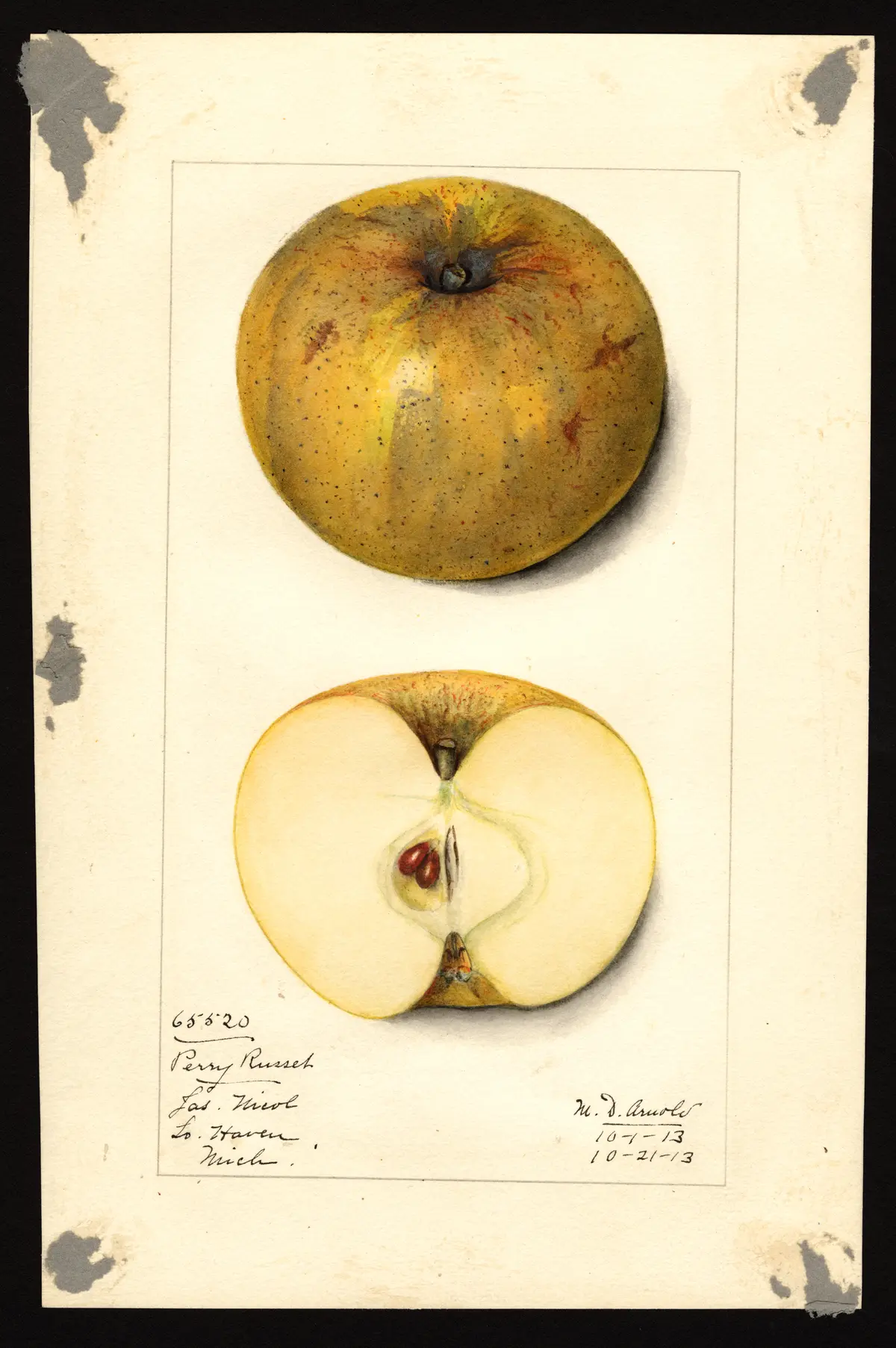
USDA Pomological Watercolor Collection
Perry Russet
Origin / History
The origin of Perry Russet is in obscurity. According to Downing, the variety was many years since carried from Perry, Wyoming County, New York, to the West under the name of Golden Russet, but as it was entirely distinct from the true Golden Russet, it soon became known as the Perry Russet. Hansen and Budd-Hansen likewise give the origin as Perry, New York.
Beach records that the variety has long been cultivated locally in the vicinity of Berwyn, Onondaga County, N. Y., where some trees of it nearly one hundred years old are said to be still very productive. It had always been known there under the name of Rhode Island Russet only, and not until 1904, when it was identified by U. S. Pomologist Brackett, was it discovered to be identical with Perry Russet. The fact that long before it was known as Perry Russet it had the local name Rhode Island Russet indicates that it was probably known in Rhode Island before it was introduced into New York.
Warder's 1867 description was made from a specimen exhibited by Mr. Utters at a meeting of the North-western Fruit Growers in 1850. Willey, writing from Madison, Wisconsin, in 1862, stated: "Perry Russet is a sort sent from the East under various cognomens, as Winter Russet, Poughkeepsie Russet, Golden Russet, etc. It is universally hardy, succeeding in all locations, and much esteemed everywhere. Tree good grower, forms a round even head; fruit large, fair and excellent; keeps well through the winter. Too many cannot be had, as it is the best of all the Russets." Beach notes the variety has also been known under the names Pineapple Russet and Pineapple, per a report by F. Newhall and Sons of Chicago in 1904.
Beach places the variety in the same group as Peck Pleasant, Rhode Island Greening, and Green Newtown. Warder noted in 1867 that it was grown to some extent in the North-west.
Tree
Tree medium to large or eventually very large (Beach); Downing describes a moderate, upright spreading grower, hardy, an early and abundant bearer; Hansen and Budd-Hansen describe moderate, spreading, upright growth. Beach reports the tree is very hardy, healthy, very long-lived, and a reliable cropper, giving good crops biennially or in some cases almost annually. The fruit hangs well to the tree, being borne on slender twigs.
Form symmetrical, roundish or spreading. Twigs medium to short, straight, slender; internodes medium. Young shoots light brownish red (Downing). Bark reddish-brown, lightly streaked with scarf-skin, pubescent. Lenticels scattering, very small, oval. Buds small, plump, obtuse, free, pubescent.
Fruit
Size: Medium to large (Warder); medium (Downing, Lowther, Hansen, Budd-Hansen); above medium to nearly large, pretty uniform in size and shape (Beach); of good size, pretty uniform and fairly attractive in appearance for a yellowish apple (Beach); small (Bunyard).
Form: Oblate, regular (Warder); roundish conical, sometimes a little oblique (Downing); round (Lowther); oblate to roundish oblate, somewhat conical, regular (Hansen, Budd-Hansen); roundish oblate to oblate conic, slightly ribbed (Beach).
Stem: Medium size and length (Warder); short, with cavity narrow, sometimes with a lip (Downing); short to medium (Hansen, Budd-Hansen); often swollen at base, short, thick or moderately so (Beach).
Cavity: Medium, regular or wavy, brown (Warder); narrow, sometimes with a lip (Downing); wide, obtuse, regular, usually with much stellate russet, sometimes lipped (Hansen, Budd-Hansen); very obtuse to acute, shallow to medium in depth, broad, often thinly russeted and with outspreading russet rays, a little wavy and often rather strongly lipped (Beach).
Calyx: Large, closed (Warder); closed (Downing); open, segments divergent (Hansen, Budd-Hansen); medium in size, somewhat open; lobes often separated at the base, narrow, acute to acuminate (Beach).
Basin: Medium, regular, wavy (Warder); abrupt (Downing); medium deep, abrupt, wrinkled, often corrugated (Hansen, Budd-Hansen); medium in depth to deep, medium to rather wide, abrupt, somewhat furrowed, not symmetrical, irregular (Beach).
Skin / Surface / Color: Smooth, yellow, covered with fine russet (Warder); pale yellow, netted with russet on the sunny side, and sometimes brownish (Downing); red-yellow (Lowther); a rich golden yellow, covered more or less with open net-work of russet, some specimens quite free from russet, or at least as grown in the West (Hansen, Budd-Hansen); greenish with spots and fine russet patches (Bunyard); thick, tough, nearly smooth or roughened more or less with russet, rather pale yellow with rather dull blush of bronze or brownish-red and sometimes with obscure dark reddish splashes (Beach); prevailing color yellowish (Beach).
Dots: Minute, scattered (Warder); distinct, many, large (Hansen, Budd-Hansen); very numerous, usually small, sometimes rather large, prominent, russet, irregular and mingled with russet flecks or netted russet (Beach).
Flesh / Flavor: Yellow, fine grained, juicy; flavor acid, rich (Warder); yellowish, rather firm, juicy, brisk subacid, "Good" (Downing); yellow, firm, fine-grained, rich, juicy, brisk subacid, very good (Hansen, Budd-Hansen); whitish a little tinged with yellow, medium to rather fine-grained, moderately tender or somewhat tough, juicy, with an agreeable subacid russet flavor, sprightly, aromatic, good (Beach); excellent flavor (Bunyard); crisp, subacid flavor, easily ranks good in quality for either dessert or culinary purposes (Beach); almost best, for table or kitchen (Warder).
Core / Seeds: Core small, closed, meeting the eye; seeds few, plump, brown (Warder); core closed, barely clasping; cells ovate, axile, slit; tube conical; stamens median; seeds plump, rather small (Hansen, Budd-Hansen); core medium size, axile; cells closed; core lines meeting or slightly clasping; calyx tube rather wide, short, conical; stamens median; carpels broadly ovate, tufted; seeds medium, narrow, rather long, acute to acuminate (Beach).
Season
December and January (Warder); November, December (Downing); winter (Lowther); December to February (Hansen, Budd-Hansen); in season from December to midwinter or later (Beach). Beach notes its commercial limit in ordinary storage is November or December; in cold storage it may be held till March. It does not stand heat well before going into storage. In going down it often shrivels, becomes mealy and goes down quickly. It varies greatly in keeping quality in different seasons and in different localities, and is not regarded favorably for storage purposes. Downing notes it does not keep late, and sometimes drops its fruit from the tree early.
Uses
Table or kitchen (Warder, Downing); family use (Lowther); dessert or culinary purposes (Beach). Beach considers it perhaps worthy of attention for planting in the home orchard where very hardy varieties are particularly desired, but seldom regarded as a profitable commercial variety in New York state. Willey, in 1862, called it "the best of all the Russets."
Subtypes / Variants
Not described in source.
Other
Lowther's tabular notes: "Northern Division: 1 reporting station (also reported in another division)." Bunyard's catalog appends the rating "A. B. H. S."
Book Sources
Described in 6 period pomological works
Nursery Catalog Sources
Found in 2 catalogs (1901–1913) from Illinois
- Benjamin Buckman (personal inventory) , Farmingdale , Illinois — 1901
- Benjamin Buckman (personal inventory) , Farmingdale , Illinois — 1913
View original book sources (7)
— John A. Warder, American Pomology: Apples (1867)Perry Russet.
This variety is grown to some extent in the North-west. The specimen from which the description is made, was exhibited by Mr. Utters, at a meeting of the North-western Fruit Growers, in 1850,
Fruit medium to large, oblate, regular; Surface smooth, yellow, covered with fine russet; Dots minute, scattered. Basin medium, regular, wavy; Eye large, closed.
Fig. 118.—PERRY RUSSET.
Cavity medium, regular or wavy, brown; Stem medium size and length. Core small, closed, meeting the eye; Seeds few, plump, brown; Flesh yellow, fine grained, juicy; Flavor acid, rich; Quality almost best, for table or kitchen; Season, December and January.
— A.J. Downing, The Fruits and Fruit Trees of America (1900)Perry Russet.
Golden Russet.
The origin of this is in obscurity. It was, many years since, carried from Perry, Wyoming Co., N. Y., to the West, under the name of Golden Russet, but as it was entirely distinct from the true Golden Russet, it soon became known as the Perry Russet, which name we continue. It is of "good" quality for table or kitchen, but does not keep late, and sometimes drops its fruit from the tree early. Tree a moderate, upright spreading grower, hardy, an early and abundant bearer. Young shoots light brownish red.
Fruit medium, roundish conical, sometimes a little oblique, pale yellow, netted with russet on the sunny side, and sometimes brownish. Stalk short, cavity narrow, sometimes with a lip. Calyx closed. Basin abrupt. Flesh yellowish, rather firm, juicy, brisk subacid. Good. November, December.
— S.A. Beach, The Apples of New York, Vol. 1 (1905)PERRY RUSSET.
REFERENCES. 1. Willey, Horticulturist, 17:168. 1862. 2. Warder, 1867:468. fig. 3. Downing, 1869:303. 4. Am. Pom. Soc. Cat., 1873. 5. Thomas, 1875:509. 6. Lyon, Mich. Hort. Soc. Rpt., 1890:296. 7. Harris, U. S. Pom. Rpt., 1892:271. 8. Bailey, An. Hort., 1892:246. 9. Hansen, S. D. Sta. Bul., 76:84. 1902. 10. Budd-Hansen, 1903:149. 11. Beach and Clark, N. Y. Sta. Bul., 248:137. 1904.
SYNONYMS. Golden Russet (1, 3), but erroneously. Pineapple. Pineapple Russet. Poughkeepsie Russet (1), but erroneously. Rhode Island Russet. Winter Russet (1).
This variety evidently belongs in the same group as Peck Pleasant, Rhode Island Greening and Green Newtown. The fruit is of good size, pretty uniform and fairly attractive in appearance for a yellowish apple. It has a crisp, subacid flavor and easily ranks good in quality for either dessert or culinary purposes. It is in season from December to midwinter or later. Its commercial limit in ordinary storage is November or December; in cold storage it may be held till March. It does not stand heat well before going into storage. In going down it often shrivels, becomes mealy and goes down quickly. It varies greatly in keeping quality in different seasons and in different localities, and is not regarded favorably for storage purposes. The tree is very hardy, healthy, very long-lived and a reliable cropper, giving good crops biennially or in some cases almost annually. The fruit hangs well to the tree, being borne on slender twigs. It is perhaps worthy of attention for planting in the home orchard where very hardy varieties are particularly desired, but is seldom regarded as a profitable commercial variety in New York state.
Historical. This variety has long been cultivated locally in the vicinity of Berwyn, Onondaga county, N. Y., where some trees of it nearly one hundred years old are said to be still very productive. It has always been known there under the name of Rhode Island Russet only¹ and not until 1904, when it was identified by U. S. Pomologist Brackett, was it discovered that it was identical with Perry Russet. The fact that long before it was known as Perry Russet it had the local name Rhode Island Russet indicates that it was probably known in Rhode Island before it was introduced into New York. Warder (2) publishes a description which was made from a specimen exhibited by Mr. Utters at a meeting of the Northwestern Fruit Growers in 1850. Willey (1), writing from Madison, Wisconsin, made the following statement concerning it in 1862. “ Perry Russet is a sort sent from the East under various cognomens, as Winter Russet, Poughkeepsie Russet, Golden Russet, etc. It is universally hardy, succeeding in all locations, and much esteemed everywhere. Tree good grower, forms a round even head; fruit large, fair and excellent; keeps well through the winter. Too many cannot be had, as it is the best of all the Russets.” We are also informed that it has been known under the names Pineapple Russet and Pineapple.² Downing, in 1869 stated that this variety “ was many years since carried from Perry, Wyoming county, New York, to the West under the name of Golden Russet, but as it was entirely distinct from the true Golden Russet it soon became known as Perry Russet.”
¹ Letters, L. L. Woodford, 1904. ² Report by F. Newhall and Sons, Chicago, Ill., 1904.
TREE.
Tree medium to large or eventually very large. Form symmetrical, roundish or spreading. Twigs medium to short, straight, slender; internodes medium. Bark reddish-brown, lightly streaked with scarf-skin, pubescent. Lenticels scattering, very small, oval. Buds small, plump, obtuse, free, pubescent.
FRUIT.
Fruit above medium to nearly large, pretty uniform in size and shape. Form roundish oblate to oblate conic, slightly ribbed. Stem often swollen at base, short, thick or moderately so. Cavity very obtuse to acute, shallow to medium in depth, broad, often thinly russeted and with outspreading russet rays, a little wavy and often rather strongly lipped. Calyx medium in size, somewhat open; lobes often separated at the base, narrow, acute to acuminate. Basin medium in depth to deep, medium to rather wide, abrupt, somewhat furrowed, not symmetrical, irregular. Skin thick, tough, nearly smooth or roughened more or less with russet, rather pale yellow with rather dull blush of bronze or brownish-red and sometimes with obscure dark reddish splashes. Dots very numerous, usually small, sometimes rather large, prominent, russet, irregular and mingled with russet flecks or netted russet. Prevailing color yellowish. Calyx tube rather wide, short, conical. Stamens median. Core medium size, axile; cells closed; core lines meeting or slightly clasping. Carpels broadly ovate, tufted. Seeds medium, narrow, rather long, acute to acuminate. Flesh whitish a little tinged with yellow, medium to rather fine-grained, moderately tender or somewhat tough, juicy, with an agreeable subacid russet flavor, sprightly, aromatic, good.
— Granville Lowther (ed.), Encyclopedia of Practical Horticulture (1914)Perry Russet. Size: medium. Form: round. Color: red-yellow. Quality: good. Use: family. Season: winter. Northern Division: 1 reporting station (also reported in another division).
— George Bunyard & Co., George Bunyard Fruit Catalogue (1901) (1901)A small yellow apple, greenish with spots and fine russet patches. Excellent flavor. A. B. H. S.
— N.E. Hansen, A Study of Northwestern Apples (1902)Perry Russet—Origin, Perry, New York. Tree moderate, spreading, upright growth.—Fruit medium, oblate to roundish oblate, somewhat conical, regular; surface a rich golden yellow, covered more or less with open net-work of russet, some specimens are quite free from russet, or at least as grown in the west; dots distinct, many, large; cavity wide, obtuse, regular, usually with much stellate russet, sometimes lipped; stem short to medium; basin medium deep; abrupt, wrinkled, often corrugated; calyx open, segments divergent. Core closed, barely clasping; cells ovate, axile, slit; tube conical; stamens median; seeds plump, rather small; flesh yellow, firm, fine grained, rich, juicy, brisk subacid, very good. December to February.
— J.L. Budd & N.E. Hansen, American Horticultural Manual, Part II: Systematic Pomology (1914)Perry Russet. — Origin, Perry, New York; tree of moderate, spreading, upright growth.
Fruit medium, oblate to roundish oblate, somewhat conical, regular; surface a rich golden yellow, covered more or less with open net-work of russet, some specimens are quite free from russet, or at least as grown in the West; dots distinct, many, large; cavity wide, obtuse, regular, usually with much stellate russet, sometimes lipped; stem short to medium; basin medium deep, abrupt, wrinkled, often corrugated; calyx open; segments divergent. Core closed, barely clasping; cells ovate, axile, slit; tube conical; stamens median; seeds plump, rather small; flesh yellow, firm, fine-grained, rich, juicy, brisk subacid, very good. December to February.