Red Canada
Apple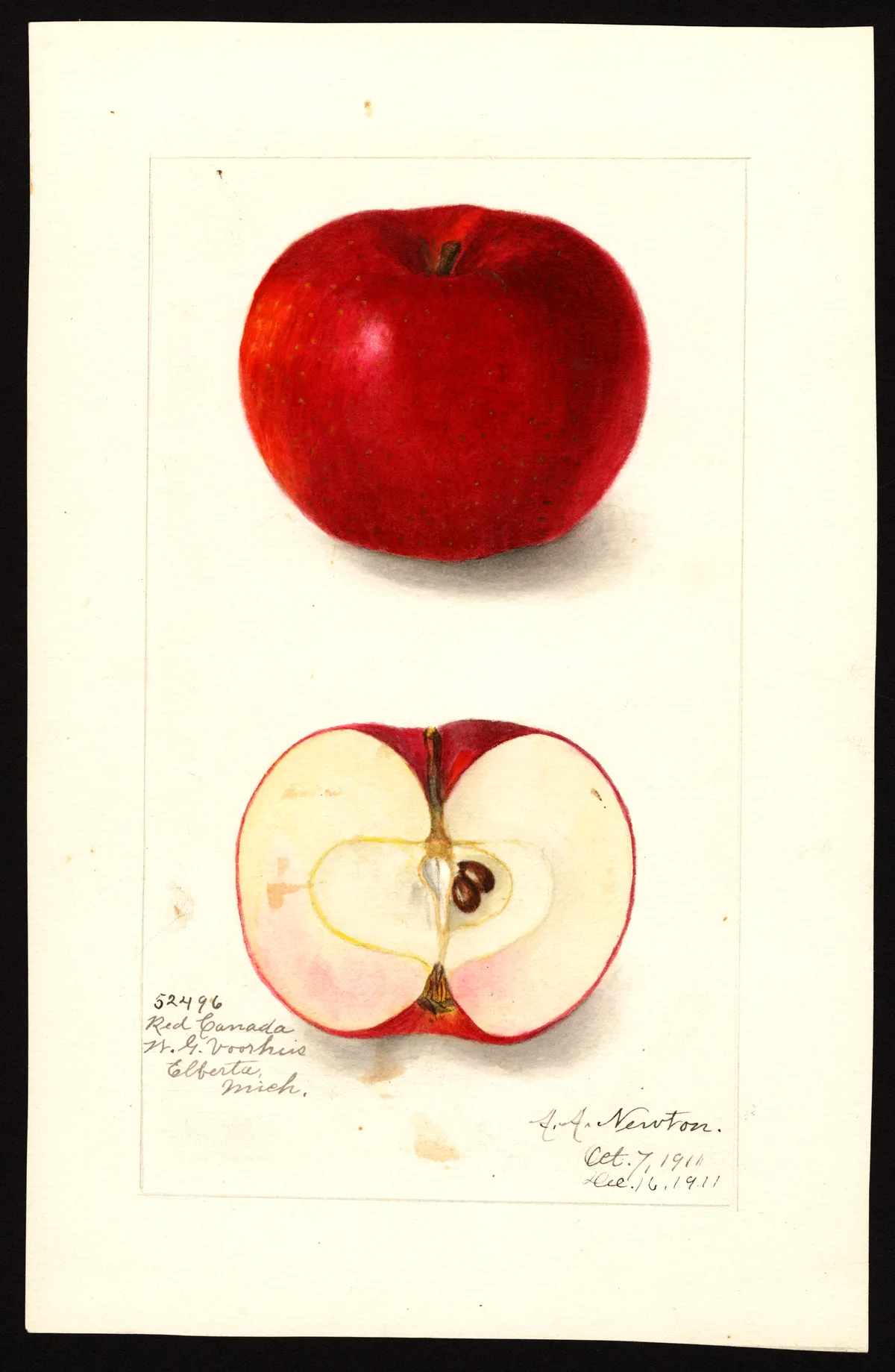
USDA Pomological Watercolor Collection
Red Canada
Origin / History
Red Canada is an old American variety, probably native to New England, with Massachusetts and Connecticut cited as early centers of cultivation. Beach notes that it was brought into Western New York from the vicinity of Toronto, Canada, and afterwards cultivated in that region under the name Canada Red — the earliest mention of the variety under the names Red Canada or Canada Red, which appear to have been used interchangeably, being that of Watts and Downing in 1847. In 1849 Cole described it as the Old Nonsuch. In Michigan it has been often cultivated under the name Steele's Red Winter; in some portions of Eastern New York it is grown under the name Bristol. Hedrick places its origin in New England a hundred or more years ago, with most extensive planting in New England, New York, and Michigan. Downing notes it was formerly much grown in Connecticut and Massachusetts but by 1900 was not much planted on account of its small size and poor fruit, though succeeding well in Western New York, Ohio, and Michigan. Thomas notes the name Red Canada is preferred to avoid confusion with the wholly distinct Nonsuch of England. Beach cites Waugh's recognition of Roseau as the correct name for an apple commonly known in Ontario under the name of Canada Red, which is quite distinct from Red Canada. Fisher (USDA ARS, 1963) records Canada Red as reported by the Agricultural Experiment Station, Pennsylvania State University. Beach places the variety in the same group with Baldwin and Esopus Spitsenburg.
Tree
Tree medium to large; vigor variable across sources — Warder calls it thrifty, healthy, but slender, twiggy; Downing calls it thrifty but of slender growth; Elliott describes slender growth with diverging shoots, requiring rich, strong soil; Beach calls it moderately vigorous to vigorous; Hedrick calls it vigorous and upright; Budd & Hansen describe it as of irregular, slow growth. Productivity is generally noted: very productive (Downing), productive (Warder, Elliott, Budd & Hansen), but Beach and Hedrick note it is sometimes an annual bearer though more often not a sure cropper. Hardiness: Beach says the tree is somewhat lacking in hardiness and is but a moderate grower; Hedrick says trees are precariously hardy, lack vigor, are subject to most troubles that apple flesh is heir to, fastidious as to soils, and seldom sure or annual bearers. To overcome its slender growth, Beach and Budd & Hansen recommend top-working on a hardier and more vigorous variety such as Baldwin, Northern Spy, or Tolman.
Branches short, stout, curved, crooked (Beach, Hedrick). Form upright to roundish, rather dense (Beach); upright (Hedrick). Twigs medium in length, straight or nearly so, rather slender to moderately stout; internodes below medium to long (Beach). Young wood brownish olive (Downing). Bark olive-green tinged with reddish-brown, netted or streaked with thin scarf-skin, slightly pubescent (Beach). Lenticels scattering, not very conspicuous, small, round, slightly raised (Beach). Buds prominent, large to medium, long, narrow, plump, acute, free or nearly so, slightly pubescent (Beach). Leaves medium to broad, rather thin (Beach); broad, thin (Hedrick); wavy (Thomas).
Fruit
Size
Medium (Warder, Downing, Elliott, Thomas, Lowther); medium to nearly large (Beach); medium to large (Budd & Hansen, Hedrick), pretty uniform in size and shape.
Form
Globular-conic, indistinctly angular (Warder); oblate, inclining to conic (Downing); roundish (oblate) (Lowther); roundish conical, flattened at stem end (Elliott); roundish-conical, regular (Thomas); oblate, slightly conical, obscurely angular (Budd & Hansen); roundish inclined to conic and somewhat flattened at the base, nearly symmetrical and pretty regular but sometimes elliptical or obscurely ribbed and with sides a little unequal (Beach); round-conic, flattened at the base, symmetrical and regular, sometimes elliptical or obscurely ribbed and with sides a little unequal (Hedrick).
Stem
Long, inclined (Warder); short, inserted in a broad, deep cavity (Downing); varying from short and stout to slender and long (Elliott); about an inch long (Thomas); short, slender (Budd & Hansen); medium to rather slender, pubescent (Beach); slender, pubescent (Hedrick).
Cavity
Wide, acute, wavy (Warder); broad, deep (Downing); deep, regular, with a touch of light russet (Elliott); very wide and even (Thomas); deep, wide, wavy, russeted (Budd & Hansen); usually large, acuminate, deep, wide, often partly russeted and with radiating green or russet rays, usually symmetrical, sometimes slightly furrowed (Beach); large, acuminate, deep, wide, often russeted and with radiating green or russet rays, symmetrical, sometimes furrowed (Hedrick).
Calyx
Small, closed (Warder, Elliott, Budd & Hansen); closed (Downing); small, closed or partly open, pubescent (Beach, Hedrick). Segments long (Downing, Budd & Hansen). Calyx tube elongated cone-shape or somewhat funnel-form (Beach); elongated-cone-shape (Hedrick); tube conical (Budd & Hansen). Stamens marginal (Beach, Hedrick).
Basin
Shallow, folded (Warder); small, narrow, somewhat irregular (Downing); open, moderate depth, slightly furrowed or uneven (Elliott); nearly even, moderate (Thomas); narrow, abrupt, shallow, slightly wrinkled and irregular (Budd & Hansen); small, usually narrow, shallow to moderately deep and rather abrupt, furrowed and sometimes slightly wrinkled, often somewhat oblique (Beach); small, narrow, shallow, abrupt, furrowed and sometimes wrinkled, often oblique (Hedrick).
Skin
Surface smooth, yellow, covered with mixed and striped bright red (Warder). Skin yellow, mostly shaded with deep red or crimson, somewhat striped or splashed on the sunny side, and thickly sprinkled with gray, and sometimes greenish dots (Downing). Rich, clear yellow ground; when exposed to the sun, overspread with bright handsome red, two shades, light and dark, intermingling or striped; many light gray dots presenting at first sight an appearance of a somewhat rough exterior; skin thin, tender (Elliott). Nearly the whole surface covered with red, interspersed with large and rather indistinct whitish dots (Thomas). Surface smooth, rich yellow, mostly shaded with deep red and crimson, with rather indistinct stripes and splashes on sunny side (Budd & Hansen). Yellow-red (Lowther). Beach: skin tough, nearly smooth especially toward the cavity, slightly rough about the basin, rather clear light yellow or green largely overspread in well-colored specimens with a fine deep red blush, indistinctly striped with deeper red. Hedrick: skin tough, smooth toward the cavity, rough about the basin, light yellow overspread with a deep red blush, indistinctly striped with deeper red. Dots: numerous, gray, indented, elongated near the stem, as in Esopus (Warder); distinct, many, large, gray and yellow (Budd & Hansen); conspicuous, grayish or fawn colored — toward the cavity scattering, large and often elongated as in Baldwin and Esopus Spitsenburg, but as they converge toward the apex more numerous and smaller (Beach, Hedrick). Prevailing effect very attractive bright deep red (Beach, Hedrick).
Flesh and Flavor
Yellowish-white, breaking, crisp, fine-grained, tender, juicy; flavor sub-acid, aromatic, delicious; quality best, for table (Warder). White, tender, crisp, abounding with a brisk, refreshing juice, and retaining its fine, delicate flavor to the last; very good to best (Downing). Yellowish white, crisp, tender, juicy, sprightly, sub-acid, aromatic (Elliott). Fine-grained, compact, with a rich, sub-acid, high and excellent flavor; one of the finest table apples (Thomas). Yellowish white, crisp, fine-grained, tender, juicy, brisk aromatic, subacid, very good to best (Budd & Hansen). Whitish with yellow or greenish tinge, firm, crisp, rather fine-grained, tender, juicy, aromatic, rich, agreeably subacid but becoming rather too mild toward the close of the season; good to best (Beach). Yellow, firm, crisp, fine-grained, tender, juicy, aromatic, rich, agreeably subacid; good to best (Hedrick). Beach notes that quality varies much in different seasons and localities: on heavy clay soils in some seasons quality is decidedly inferior to that of Baldwin and would be rated only fair to good; but when grown on certain fertile soils of a gravelly or sandy nature in favorable seasons it develops color, flavor and quality fully equal to that of Esopus Spitsenburg. Lowther rates quality very good.
Core and Seeds
Core regular, closed, large; seeds imperfect (Warder). Core small, close (Downing). Core small, compact; seeds ovate pyriform (Elliott). Core small, barely clasping, closed; seeds imperfect (Budd & Hansen). Core sessile, axile or nearly so, medium to rather small; cells symmetrical, closed or slit; core lines clasping; carpels usually smooth, roundish, narrowing somewhat toward the apex, mucronate, but slightly emarginate if at all; seeds very numerous, medium to rather large, angular, long, moderately wide, plump, obtuse (Beach). Core sessile, axile, small; cells symmetrical, closed or slit; core-lines clasping; carpels smooth, round, narrowing toward the apex, mucronate; seeds numerous, large, angular, long, wide, plump, obtuse (Hedrick).
Season
December to February (Warder); January to May (Downing); January to April (Elliott); keeps through winter, often keeping late in spring (Thomas); winter (Lowther); all winter (Budd & Hansen); October to March (Hedrick). Beach: season is somewhat variable — the commercial limit in ordinary storage is January or February, and in cold storage April; season for home use usually extends from November to March or later. Beach notes that although the fruit may remain apparently sound it is apt to lose much of its high flavor after midwinter; the fruit stands heat well before going into storage and goes down gradually.
Uses
Table / dessert use (Warder, Thomas — "one of the finest table apples"); kitchen and market (Lowther). Beach: when well grown and in prime condition it is one of the best apples of its season for dessert use on account of its desirable size, attractive form and color and superior quality; well adapted to either general or special markets and often brings more than average prices. Hedrick: were the trees as satisfactory as the fruit, Red Canada would take high rank among the commercial apples of the country.
Subtypes / Variants
Not described in source.
Other
Thomas notes drawbacks on its value: the slender growth of the tree, the frequent scabbiness of the fruit, and its moderate crops in some localities. Beach and Hedrick both emphasize the contrast between the high quality of the fruit and the deficiencies of the tree. Beach references Roseau (page 292) for further consideration of the distinction between Red Canada and the Ontario apple commonly called Canada Red. Thomas illustrates the variety as Fig. 450; Hedrick illustrates as Fig. 46; Elliott references a figure showing the typical stem.
Book Sources
Described in 9 period pomological works
- Beach, The Apples of New York Vol. 1 (1905)
- Budd & Hansen, Systematic Pomology (1914) — listed as Red Canada (Steele's Red Winter)
- Warder, American Pomology: Apples (1867)
- Downing, Fruits and Fruit Trees of America (1900)
- Elliott, The Western Fruit Book (1865)
- Lowther (ed.), Encyclopedia of Practical Horticulture (1914)
- Hedrick, Cyclopedia of Hardy Fruits (1922)
- Thomas, The American Fruit Culturist (1903)
- Fisher, A Survey of Apple Clones in the United States (1963) — listed as Canada Red
Nursery Catalog Sources
Found in 29 catalogs (1864–1921) from Alabama, California, Illinois, Missouri, Oregon, Washington
- St. Helena Nursery , Howell's Prairie, Marion County , Oregon — 1864
- Felix Gillet , Barren Hill Nursery, Nevada City , California — 1884
- Huntsville Wholesale Nurseries (Jessie S. Moss , Proprietor; W.F. Heikes, Manager), Huntsville , Alabama — 1886
- Palouse Nursery and Pleasant Dale Fruit Farm , Colfax, Washington Territory (situated two miles northeast of Colfax) - undated (single-page broadside flyer; "Washington Territory" suggests pre — 1889 — listed as Nonesuch
- California Nursery Co. , Niles , California — 1889
- Puyallup & Yakima Nurseries , Puyallup, Washington (Lock Box 191) and North Yakima , Washington — 1892
- Milwaukie-Canby Nurseries , Canby, OR (and Milwaukie, OR) — 1893
- Sherwood Hall Nursery Co. , Timothy Hopkins (Menlo Park Nurseries), San Francisco / Menlo Park , California — 1893
- Woodburn Nurseries , Woodburn, Marion Co. , Oregon — 1894
- Multnomah Nurseries , Russellville , Oregon — 1894
- Central Experimental Farm , Dominion Department of Agriculture, Agassiz, British Columbia (under test; Bulletin No. 3, Second Series) — 1900
- Washington Nursery Co. , Toppenish , Washington — 1901
- S.L. Watkins , Grizzly Flats, El Dorado County , California — 1901
- Benjamin Buckman (personal inventory) , Farmingdale , Illinois — 1901
- Pacific Nursery Company (W. O. Hudson & A. D. Hudson) , Tangent , Oregon — 1903
- The Dalles Nurseries , The Dalles , Oregon — 1906
- Stark Bros. Nurseries & Orchards Co. , Louisiana , Missouri — 1906
- Washington Nursery Company , Toppenish , Washington — 1909
- Stark Bros. Nurseries & Orchards Co. , Louisiana , Missouri — 1910
- Stark Bros. Nurseries & Orchards Co. , Louisiana , Missouri — 1911
- Pacific Nursery Company , Portland , Oregon — 1912 — listed as Nonesuch
- Washington Nursery Company , Toppenish , Washington — 1912 — listed as Nonesuch
- Pacific Nursery Company , Portland , Oregon — 1912
- Washington Nursery Company , Toppenish , Washington — 1912
- Stark Bros. Nurseries & Orchards Co. , Louisiana , Missouri — 1912
- Benjamin Buckman (personal inventory) , Farmingdale , Illinois — 1913
- Union Nurseries , J.B. Weaver & Sons, Union , Oregon — 1915
- Fancher Creek Nurseries , George C. Roeding, Fresno , California — 1918
- Benedict Nursery Co. , Portland , Oregon — 1921
View original book sources (9)
— John A. Warder, American Pomology: Apples (1867)Red Canada. STEEL'S RED.
Origin New England. Tree thrifty, healthy, but slender, twiggy, productive.
Fruit medium, globular-conic, indistinctly angular; Surface smooth, yellow, covered with mixed and striped bright red; Dots numerous, gray, indented, elongated near the stem, as in Esopus.
Basin shallow, folded; Eye small, closed.
Cavity wide, acute, wavy; Stem long, inclined.
Core regular, closed, large; Seeds imperfect; Flesh yellowish-white, breaking, crisp, fine-grained, tender, juicy; Flavor sub-acid, aromatic, delicious; Quality best, for table; Season, December to February.
— A.J. Downing, The Fruits and Fruit Trees of America (1900)Red Canada.
Old Nonsuch, of Mass. Poland. Richfield Nonsuch. Steele's Red Winter.
An old fruit, formerly much grown in Connecticut and Massachusetts, but is not now much planted, on account of its small size and poor fruit ; succeeds well in Western New York, Ohio, and Michigan. Tree thrifty, but of slender growth ; very productive. Young wood brownish olive.
Fruit medium, oblate, inclining to conic. Skin yellow, mostly shaded with deep red or crimson, somewhat striped or splashed on the sunny side, and thickly sprinkled with gray, and sometimes greenish dots. Stalk short, inserted in a broad, deep cavity. Calyx closed. Segments long, in a small, narrow, somewhat irregular basin. Core small, close. Flesh white, tender, crisp, abounding with a brisk, refreshing juice, and retaining its fine, delicate flavor to the last. Very good to best. January to May.
— S.A. Beach, The Apples of New York, Vol. 1 (1905)RED CANADA.
REFERENCES.
- Thacher, 1822:131. 2. Fessenden, 1828:131. 3. Manning, Mag. Hort., 7:47. 1841. 4. Hovey, Ib., 13:75. 1847. fig. 5. Watts and Downing, Horticulturist, 1:482. 1847. 6. Downing, Ib., 2:289. 1847. 7. Hovey, Mag. Hort., 14:124. 1848. 8. Horticulturist, 2:483, 544. 1848. 9. Thomas, 1849:171. fig. 10. Cole, 1849:127. 11. Emmons, Nat. Hist. N. Y., 3:101. 1851. col. pl. No. 42. 12. Am. Pom. Soc. Cat., 1852. 13. Mag. Hort., 19:68. 1853. 14. Elliott, 1854:102. fig. 15. Hooper, 1857:76. 16. Downing, 1857:97. fig. 17. Warder, 1867:542. 18. Regel, 1868:465. 19. Barry, 1883:353. 20. Wickson, 1889:217. 21. Lyon, Mich. Hort. Soc. Rpt., 1890:296. 22. Bailey, An. Hort., 1892:247. 23. Amer. Gard., 20:104. 1899. 24. Budd-Hansen, 1903:161. 25. Powell and Fulton, U. S. B. P. I. Bul., 48:53. 1903. 26. Beach and Clark, N. Y. Sta. Bul., 248:140. 1904.
SYNONYMS. Bristol of some. Canada Red (25). Canada Redstreak (26). NONESUCH (2). NONSUCH (1, 3, 8, 13). Nonsuch (9). OLD NONSUCH (7, 10). Old Nonsuch (6, 9, 14, 15, 21, of Massachusetts 8 and 16). Red Canada (13, of Western New York 8 and 10). Red Winter (26). Richfield Nonsuch (10, 11, 14, 15, 16, of Ohio 9). Steele's Red Winter (20, 24, 25, 26, of Michigan 16). Steel's Red (17). Winter Nonsuch (10). Not the Canada Red of some portions of Ontario. See Roseau, page 292.
This is a red winter apple which belongs in the same group with Baldwin and Esopus Spitsenburg. When well grown and in prime condition it is one of the best apples of its season for dessert use on account of its desirable size, attractive form and color and superior quality. It is well adapted to either general or special markets and often brings more than average prices. The quality of the fruit varies much in different seasons and in different localities. When grown on heavy clay soils its quality in some seasons is decidedly inferior to that of Baldwin and would be rated only fair to good; but when grown on certain fertile soils of a gravelly or sandy nature in favorable seasons it develops color, flavor and quality fully equal to that of Esopus Spitsenburg. It stands heat well before going into storage and goes down gradually (26). Its season is somewhat variable. The commercial limit in ordinary storage is January or February, and in cold storage, April. Its season for home use usually extends from November to March or later. Although the fruit may remain apparently sound it is apt to lose much of its high flavor after midwinter. The tree is somewhat lacking in hardiness and is but a moderate grower. It should be top-worked on some hardier and more vigorous variety such as Baldwin or Northern Spy. In some cases it is an annual bearer but more often it is not a sure cropper. Waugh recognizes Roseau as the correct name for an apple which is commonly known in Ontario under the name of Canada Red. It is quite distinct from the variety above described.¹ For further consideration of this matter the reader is referred to Roseau, page 292.
[pages 466–467 not available in source OCR]
Historical. …recognized this name for the variety. In 1849 Cole (10) described it as the Old Nonsuch. It appears to have been brought into Western New York from the vicinity of Toronto, Canada, and afterwards cultivated in this region under the name Canada Red. The earliest mention we find of the variety under the name Red Canada or Canada Red, as these names appear to have been used interchangeably, is that of Watts and Downing in 1847 (5). In Michigan it has been often cultivated under the name of Steele's Red Winter. In some portions of Eastern New York it is grown under the name Bristol. It has been pretty generally distributed throughout the state. In some few localities its cultivation in commercial orchards is increasing but seldom has it been planted to any considerable extent, and, generally speaking, it is found only in old orchards.
TREE. Tree medium to large, moderately vigorous to vigorous; branches short, stout, curved, crooked. Form upright to roundish, rather dense. Twigs medium in length, straight or nearly so, rather slender to moderately stout; internodes below medium to long. Bark olive-green tinged with reddish-brown, netted or streaked with thin scarf-skin, slightly pubescent. Lenticels scattering, not very conspicuous, small, round, slightly raised. Buds prominent, large to medium, long, narrow, plump, acute, free or nearly so, slightly pubescent. Leaves medium to broad, rather thin.
FRUIT. Fruit medium to nearly large, pretty uniform in size and shape. Form roundish inclined to conic and somewhat flattened at the base, nearly symmetrical and pretty regular but sometimes elliptical or obscurely ribbed and with sides a little unequal. Stem medium to rather slender, pubescent. Cavity usually large, acuminate, deep, wide, often partly russeted and with radiating green or russet rays, usually symmetrical, sometimes slightly furrowed. Calyx small, closed or partly open, pubescent. Basin small, usually narrow, shallow to moderately deep and rather abrupt, furrowed and sometimes slightly wrinkled, often somewhat oblique. Skin tough, nearly smooth especially toward the cavity, slightly rough about the basin, rather clear light yellow or green largely overspread in well-colored specimens with a fine deep red blush, indistinctly striped with deeper red. Dots conspicuous, grayish or fawn colored. Toward the cavity they are scattering, large and often elongated as in Baldwin and Esopus Spitsenburg, but as they converge toward the apex they become more numerous and smaller. Prevailing effect very attractive bright deep red. Calyx tube elongated cone-shape or somewhat funnel-form. Stamens marginal. Core sessile, axile or nearly so, medium to rather small; cells symmetrical, closed or slit; core lines clasping. Carpels usually smooth, roundish, narrowing somewhat toward the apex, mucronate, but slightly emarginate if at all. Seeds very numerous, medium to rather large, angular, long, moderately wide, plump, obtuse. Flesh whitish with yellow or greenish tinge, firm, crisp, rather fine-grained, tender, juicy, aromatic, rich, agreeably subacid but becoming rather too mild toward the close of the season, good to best.
— Granville Lowther (ed.), Encyclopedia of Practical Horticulture (1914)Red Canada (19) is a medium-sized apple of roundish (oblate) form. Skin color is yellow-red. Quality is very good. Use is both kitchen and market. Season is winter.
— F.R. Elliott, The Western Fruit Book (1865)Red Canada.
Steele's Red Winter of Mich., | Old Nonsuch, Richfield Nonsuch.
American : probably a native of Massachusetts. Tree, slender growth ; shoots diverging ; requires rich, strong soil, when it is productive, and always fair and uniform size of fruit. One of the most valuable for orchard, or garden.
Fruit, medium ; form, roundish conical, flattened at stem end ; color, rich, clear, yellow ground ; when exposed to the sun, overspread with bright, handsome red, two shades, light and dark, intermingling, or striped, many light gray dots, presenting at first sight an appearance of a somewhat rough exterior ; skin, thin, tender ; stem, varying from short and stout to slender and long, usually as seen in our figure ; cavity, deep, regular, a touch of light russet ; calyx, small, closed ; basin, open, moderate depth, slightly furrowed, or uneven ; flesh, yellowish white, crisp, tender, juicy, sprightly, sub-acid, aromatic ; core, small, compact ; seeds, ovate pyriform. January to April.
— John J. Thomas, The American Fruit Culturist (1903)Red Canada.* (Nonsuch, Old Nonsuch of Massachusetts, Richfield Nonsuch of Ohio.) Medium in size, roundish-conical, regular; nearly the whole surface covered with red, and interspersed with large and rather indistinct whitish dots; stalk about an inch long, in a very wide and even cavity; basin nearly even, moderate; flesh fine-grained, compact, with a rich, sub-acid, high and excellent flavor. Keeps through winter. Shoots rather slender, leaves wavy. Productive. Succeeds in New England, New York, and Ohio. This is wholly distinct from the Nonsuch of England, to prevent confusion with which the name Red Canada is preferred. One of the finest table apples, often keeping late in spring. The slender growth of the tree, the frequent scabbiness of the fruit, and its moderate crops in some localities, are the chief drawbacks on its value. Fig. 450.
— J.L. Budd & N.E. Hansen, American Horticultural Manual, Part II: Systematic Pomology (1914)Red Canada (Steele's Red Winter). — An old variety of American origin, formerly much grown in New England and other parts of the East; the tree is of irregular, slow growth and productive in most localities, but to overcome its slender growth should be top-grafted on Northern Spy, Tolman, or other strong-growing variety.
Red Canada.
Fruit medium to large, oblate, slightly conical, obscurely angular; surface smooth, rich yellow, mostly shaded with deep red and crimson, with rather indistinct stripes and splashes on sunny side; dots distinct, many, large, gray and yellow; cavity deep, wide, wavy, russeted; stem short, slender; basin narrow, abrupt, shallow, slightly wrinkled and irregular; calyx small, closed; segments long. Core small, barely clasping, closed; tube conical; seeds imperfect; flesh yellowish white, crisp, fine-grained, tender, juicy, brisk aromatic, subacid, very good to best. All winter.
— U.P. Hedrick, Cyclopedia of Hardy Fruits (1922)RED CANADA. Fig. 46. Canada Redstreak. Red Winter. Steele's Red. Were the trees as satisfactory as the fruit, Red Canada would take high rank among the commercial apples of the country. The apples are characterized by firm, crisp, fine-grained, juicy, aromatic, richly flavored flesh; they are medium to large, shapely, uniform in size and shape, and colored a beautiful fine, deep red, striped with deeper red on a background of yellow, the whole surface being conspicuously marked with large fawn-colored dots. The trees, however, signally fail; they are precariously hardy, lack in vigor, subject to most of the troubles that apple flesh is heir to, fastidious as to soils, and seldom sure or annual bearers. Red Canada probably originated in New England a hundred or more years ago, and has been most largely planted in New England, New York, and Michigan. Tree medium to large, vigorous, upright; branches short, stout, curved, crooked. Leaves broad, thin. Fruit medium to large, uniform in size and shape, round-conic, flattened at the base, symmetrical and regular, sometimes elliptical or obscurely ribbed and with sides a little unequal; stem slender, pubescent; cavity large, acuminate, deep, wide, often russeted and with radiating green or russet rays, symmetrical, sometimes furrowed; calyx small, closed or partly open, pubescent; basin small, narrow, shallow, abrupt, furrowed and sometimes wrinkled, often oblique; skin tough, smooth toward the cavity, rough about the basin, light yellow overspread with a deep red blush, indistinctly striped with deeper red; dots conspicuous, gray or fawn-colored, towards the cavity scattering, large and elongated but towards the apex more numerous and smaller; prevailing effect deep red; calyx-tube elongated-cone-shape; stamens marginal; core sessile, axile, small; cells symmetrical, closed or slit; core-lines clasping; carpels smooth, round, narrowing toward the apex, mucronate; seeds numerous, large, angular, long, wide, plump, obtuse; flesh yellow, firm, crisp, fine-grained, tender, juicy, aromatic, rich, agreeably subacid; good to best; October to March.
— H.H. Fisher (USDA ARS), A Survey of Apple Clones in the United States (1963)Canada Red. Reported by the Agricultural Experiment Station, Pennsylvania State University, University Park, Pennsylvania.