Belmont
Apple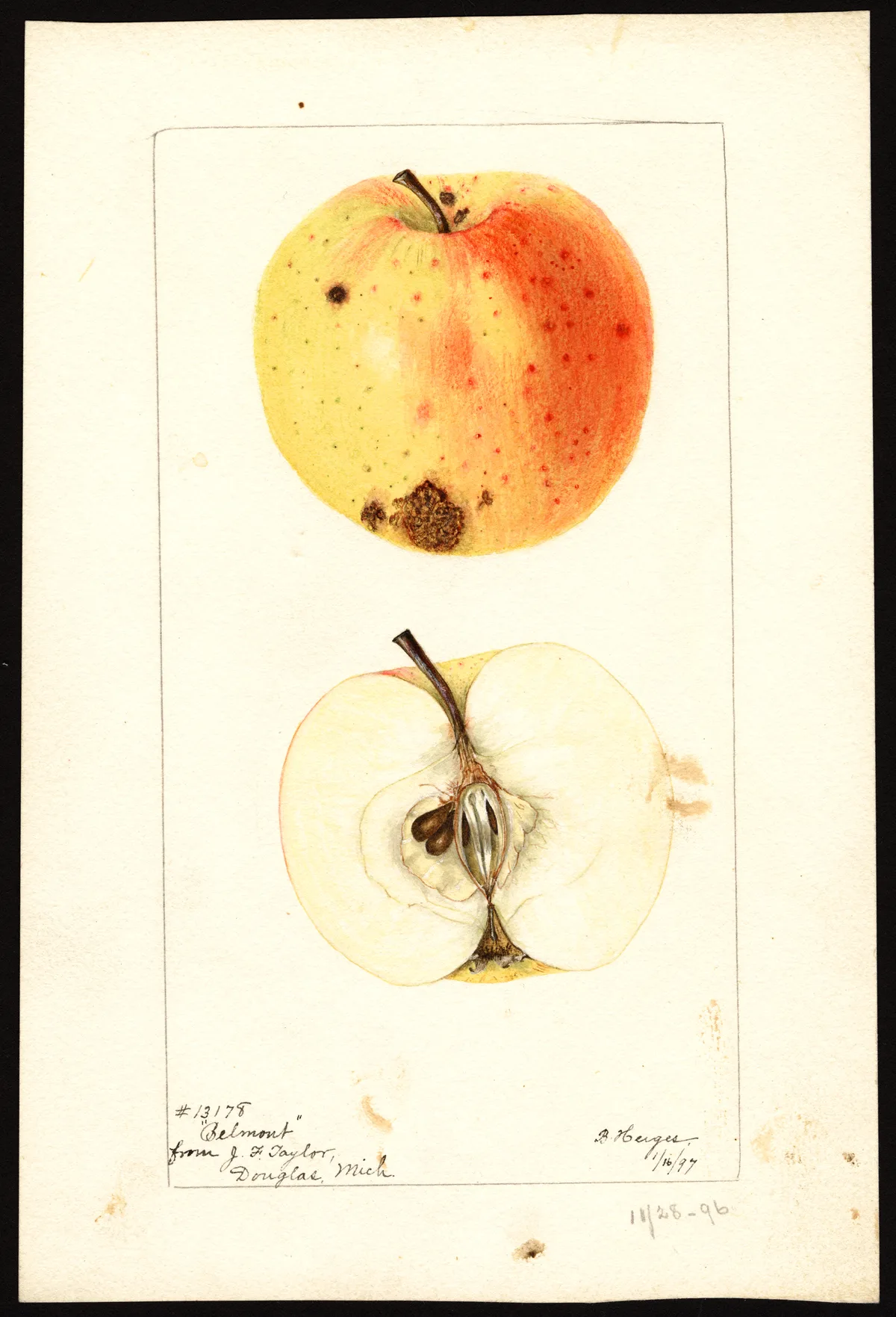
USDA Pomological Watercolor Collection
Belmont
Origin / History
Belmont is of American origin, with sources giving differing accounts of its exact birthplace. Warder (1867) reports it was believed to be of Virginia origin, but was brought into public notice and notoriety in Belmont County, Ohio, whence its name; he also notes it was supposed to be the same as the Waxen of Coxe, which Coxe referred to Virginia. Elliott (1865) records that "By some stated to have originated in Virginia, by others, in Pennsylvania, and, on the authority of Prof. Kirtland, Mr. Downing, in his first edition of 'Fruits and Fruit Trees,' made it synonymous with the 'Waxen' of Coxe."
Downing (1900), Beach (1905), and Hedrick (1922) give the corrected and now accepted account: the variety originated near Strasburgh, Lancaster County, Pennsylvania, in the garden of a Mrs. Beam, at her gate — hence the early names "Gate Apple" and "Mamma Beam." Hedrick dates the origin to about 1800. It was taken to Ohio (Downing names Jacob Neisley, Sen. as the carrier) and became very popular in Belmont County, from which the now-universal name is retained. Budd & Hansen (1914) simply give the origin as Lancaster Co., Pennsylvania.
Beach notes the historical confusion: Downing at first regarded Belmont as identical with Waxen of Coxe, but in the first revised edition corrected this error and gave the Beam/Strasburgh origin.
Hedrick (1922) observes that Belmont "seems on the way to oblivion in the East, but is still rather commonly grown in the Pacific states as Waxen." Beach notes that, while known in various parts of New York, Belmont is grown to a limited extent only in New York commercial orchards, owing to its tender skin, susceptibility to bruising, inconsistent keeping, occasional small or second-class fruit when trees are overloaded, and the availability of other commercial sorts that are larger in tree and fruit, more reliable croppers, and less subject to scab.
Tree
Vigorous, healthy, and very productive (Downing, Budd & Hansen). Warder describes the tree as vigorous, spreading, productive, and not hardy. Elliott calls it healthy, vigorous, spreading, a good bearer, that does not succeed on the alluvial soils of the West but on all high, warm, or limestone soils does finely and makes a large tree. Thomas calls it a profuse bearer, "Excellent in New York, Michigan, and Northern and Central Ohio—worthless at Cincinnati. Tender at the West."
Beach describes the tree as medium size, usually moderately vigorous, in some places rather dwarfish, but on rich soils and in favorable locations becoming large; form upright spreading; generally hardy except in the more elevated or more northern portions of New York, where in trying locations it is sometimes injured by sunscald or canker; usually bears biennially and yields good to heavy crops; the fruit hangs well to the tree. Hedrick concurs: medium size, upright-spreading, vigorous, but not reliably fruitful and subject to sun-scald and canker.
Wood / Twigs / Bark. Warder: twigs light olive. Downing: wood smooth, light reddish brown. Elliott: wood yellowish. Beach: twigs medium in length or rather short, rather slender; bark light reddish-brown or olive-green becoming rather dark, partly covered with gray pubescence.
Leaves. Thomas: leaves crenate.
Fruit
Size. Medium to large (Downing, Budd & Hansen, Elliott); large (Warder); medium or above, sometimes large, fairly uniform in size and shape (Beach); medium or large, uniform in size and shape (Hedrick); rather large (Thomas). Beach notes that when trees are overloaded a good deal of the fruit is either too small for market or grades second class in size, and Hedrick notes that the fruits lack uniformity in size. Elliott adds that South it grows very large, and also West on new rich soils in Wisconsin, but grown South its delicacy, fine grain, and flavor are lost.
Form. Warder: oblate-conic, often angular. Downing: globular, a little flattened and narrower towards the eye, sometimes oblong. Budd & Hansen: globular, a little flattened, somewhat conical, sometimes oblong. Elliott: irregular, usually roundish, sometimes oblong rounded. Thomas: roundish-conical or ovate-conical, apex usually narrow, but sometimes quite obtuse; faintly ribbed, smooth. Beach: varies from rounded oblong to oblate conic but is usually roundish, somewhat broadly and indistinctly ribbed, somewhat irregular. Hedrick: round-oblong to oblate-conic, broadly and indistinctly ribbed, irregular.
Stem / Stalk. Warder: long. Downing: short. Budd & Hansen: medium to long. Elliott: medium length, projecting slightly beyond the surface, always slender. Thomas: varying from half an inch long and stout, to an inch or more long and slender. Beach: medium to short, often slender. Hedrick: short, slender.
Cavity. Warder: wide, wavy, brown. Downing: generally large. Budd & Hansen: generally large, wide, wavy, brown. Beach: rather large, acute to acuminate, rather deep, moderately broad, wavy, irregular, usually with thin brown russet, sometimes lipped. Hedrick: large, acuminate, deep, broad, wavy, irregular, usually with thin brown russet, sometimes lipped.
Calyx / Eye. Warder: eye small, closed. Downing: calyx usually closed. Budd & Hansen: calyx small, usually closed. Elliott: varying from small and close to open and reflexed. Thomas: not described as such (basin description below). Beach: rather small, usually closed. Hedrick: small, closed.
Basin. Warder: regular or wavy, not deep. Downing: rather deep, corrugated. Budd & Hansen: wavy or corrugated, medium. Elliott: from shallow to rather deep, always furrowed. Thomas: "in conical specimens, narrow and shallow; in obtuse specimens, narrow and deep, with an obtusely ribbed rim." Beach: rather shallow to deep, moderately abrupt to abrupt, furrowed and wrinkled. Hedrick: shallow to deep, abrupt, furrowed and wrinkled.
Skin / Surface. Warder: surface very smooth, waxen-yellow, often faintly blushed orange, and spotted red. Downing: light, waxen-yellow, often with a bright vermilion cheek. Budd & Hansen: very smooth, light waxen yellow, often with blushed orange and bright red cheek. Elliott: skin thin, smooth, glossy, or oily; color rich clear light yellow; at South with a few dark brown specks, and North with a clear vermillion red cheek, with carmine spots; South slight russet marblings, and much of mould or fungus. Thomas: clear pale yellow, with sometimes a light vermilion blush, and rarely with large thinly scattered carmine dots. Beach: skin thick, tough, smooth, waxen, clear bright yellow with bright orange-red blush; prevailing color yellow, not striped. Hedrick: skin thick, tough, smooth, waxen, clear bright yellow with bright orange-red blush; prevailing color yellow.
(Note: Elliott calls the skin "thin," while Beach and Hedrick describe it as "thick, tough." Beach observes that the fruit is waxen, yellow with beautiful bright blush, makes a fine appearance on the tree but appears somewhat dull in the barrel or package, and that because of its tender skin and delicate color it shows bruises readily; Hedrick likewise notes that the fruits bruise readily.)
Dots. Warder: minute, scattered. Budd & Hansen: minute, few. Thomas: rarely with large thinly scattered carmine dots. Beach: whitish with minute russet point, often submerged, on the blushed portion becoming red areolar. Hedrick: whitish with minute russet point, often submerged, on the blushed portion becoming red areolar.
Flesh / Flavor. Warder: yellow, tender, fine-grained, juicy; flavor mild sub-acid, refreshing, very agreeable; quality nearly best. Downing: yellowish, crisp, tender, juicy, sometimes almost melting, of a mild agreeable flavor; very good. Budd & Hansen: yellow, crisp, tender, fine-grained, juicy, mild subacid, nearly best. Elliott: yellowish white, fine-grained, very tender, juicy, sprightly, sub-acid. Thomas: yellowish white, compact, crisp, becoming quite tender, with a mild, rich, sub-acid, fine flavor. Beach: tinged with yellow, firm, moderately fine, crisp, tender, moderately juicy, mild subacid, very good. Hedrick: yellow, firm, fine, crisp, tender, juicy, mild, subacid; very good.
Core / Seeds. Warder: core wide, regular, somewhat open, clasping; axis short; seeds numerous, large, flat. Budd & Hansen: core wide, regular, somewhat open, clasping, axis short; seeds many, large, flat. Elliott: core rather large; seeds ovate pointed, abundant, brownish red. Beach: core medium to rather large, axile, sometimes closed; core lines clasping; carpels roundish, pointed cordate, tufted; seeds rather long, acute, tufted; calyx tube long, elongated cone-shape or funnel-form; stamens marginal. Hedrick: core large, axile, sometimes closed; core-lines clasping; carpels round-cordate, tufted; seeds long, acute, tufted; calyx-tube long, elongated-cone-shaped; stamens marginal.
Season
Warder: October to December. Downing: November to February. Budd & Hansen: November to February. Elliott: November to February (October to January in South-Western States). Thomas: Early winter. Beach: October to February. Hedrick: October to February.
Uses
Table, kitchen, market (Warder). Cooking and dessert — Beach lists cooking, dessert, and local market. Hedrick calls it a beautiful and choice cooking and dessert apple. Beach notes it is excellent either for dessert or cooking; it is handled satisfactorily in local markets but is not a good shipper, since its tender skin and delicate color show bruises readily and it is apt to be damaged in appearance with ordinary methods of handling. It has not always kept well (Beach; Hedrick echoes that the fruits do not keep well).
Subtypes / Variants
Not described in source.
Other
Beach (1905) provides an extensive reference list documenting Belmont in pomological literature from Downing 1845 through Budd-Hansen 1903, including Emmons's Natural History of New York (1851, with figures and color plate No. 76), and reports in the Country Gentleman (1885), Michigan Horticultural Society Report (1890), Bailey's Annual of Horticulture (1892), Barry (1896), Vermont Station Annual Report (1901), and Thomas (1903).
Elliott notes regional performance differences: at the South the apple's "delicacy, fine grain, and flavor are lost"; at the South the skin shows "a few dark brown specks" and "slight russet marblings, and much of mould or fungus," whereas at the North it shows "a clear vermillion red cheek, with carmine spots." Thomas similarly observes it is "Excellent in New York, Michigan, and Northern and Central Ohio—worthless at Cincinnati. Tender at the West." Warder simply classifies the tree as "not hardy." Beach states it is generally hardy in New York except in the more elevated or more northern portions, where in trying locations it is sometimes injured by sunscald or canker — a susceptibility Hedrick repeats.
Warder's classification places Belmont in Class II (Conical Apples), Order II (Irregular), Section 2 (Sour), Sub-section 1 (Self-colored or Blushed).
Book Sources
Described in 7 period pomological works
- Warder, American Pomology: Apples (1867)
- Beach, The Apples of New York Vol. 1 (1905)
- Elliott, The Western Fruit Book (1865)
- Hedrick, Cyclopedia of Hardy Fruits (1922)
- Budd & Hansen, Systematic Pomology (1914) — listed as Belmont (Waxen)
- Downing, Fruits and Fruit Trees of America (1900)
- Thomas, The American Fruit Culturist (1903)
Nursery Catalog Sources
Found in 5 catalogs (1892–1913) from Illinois, Missouri, Washington
- Puyallup & Yakima Nurseries , Puyallup, Washington (Lock Box 191) and North Yakima , Washington — 1892
- Central Experimental Farm , Dominion Department of Agriculture, Agassiz, British Columbia (under test; Bulletin No. 3, Second Series) — 1900
- Benjamin Buckman (personal inventory) , Farmingdale , Illinois — 1901
- Stark Bros. Nurseries & Orchards Co. , Louisiana , Missouri — 1912
- Benjamin Buckman (personal inventory) , Farmingdale , Illinois — 1913
View original book sources (7)
— John A. Warder, American Pomology: Apples (1867)CLASS II.—CONICAL APPLES.
ORDER II.—IRREGULAR.
SECTION 2.—SOUR.
SUB-SECTION 1.—SELF-COLORED OR BLUSHED.
Belmont.
GATE—MAMMA BEAN, ETC.
This beautiful apple is believed to be of Virginia origin, but was brought into public notice and notoriety in Belmont County, Ohio, whence its name. It is supposed to be the same as the Waxen of Coxe, which that author refers to Virginia.
Tree vigorous, spreading, productive, not hardy; Twigs light olive.
Fruit large, fair, oblate-conic, often angular; Surface very smooth, waxen-yellow, often faintly blushed orange, and spotted red; Dots minute, scattered.
Basin regular or wavy, not deep; Eye small, closed.
Cavity wide, wavy, brown; Stem long.
Core wide, regular, somewhat open, clasping; Axis short; Seeds numerous, large, flat; Flesh yellow, tender, fine-grained, juicy; Flavor mild sub-acid, refreshing, very agreeable; Quality nearly best; Use, table, kitchen, market; Season, October to December.
— A.J. Downing, The Fruits and Fruit Trees of America (1900)Belmont Gate. White Apple. Mamma Beam. Waxen of some. Golden Pippin of some. Kelley White.
Origin, near Strasburgh, Lancaster Co., Pa., in the garden of Mrs. Beam, at her gate, hence the names "Gate Apple," and "Mamma Beam." It was taken to Ohio by Jacob Neisley, Sen., and became very popular in Belmont Co., and we retain this name as being the most universal one. Tree vigorous, healthy, and very productive. Wood smooth, light reddish brown.
Fruit medium to large, globular, a little flattened and narrower towards the eye, sometimes oblong. Color light, waxen-yellow, often with a bright vermilion cheek. Stalk short. Cavity generally large. Calyx usually closed. Basin rather deep, corrugated. Flesh yellowish, crisp, tender, juicy, sometimes almost melting, of a mild agreeable flavor. Very good. November to February.
— S.A. Beach, The Apples of New York, Vol. 1 (1905)BELMONT.
REFERENCES. 1. Downing, 1845:142. 2. Thomas, 1849:177. 3. Cole, 1849:120. 4. Emmons, Nat. Hist. N. Y., 3:80. 1851. figs. and col. pl. No. 76. 5. Hooper, 1857:16. 6. Downing, 1857:74. 7. Elliott, 1858:69. fig. 8. Warder, 1867:529. fig. 9. Chamberlain, Country Gentleman, 1885:1054. 10. Lyon, Mich. Hort. Soc. Rpt., 1890:288. 11. Bailey, An. Hort., 1892:235. 12. Barry, 1896:342. 13. Waugh, Vt. Sta. An. Rpt., 14:288. 1901. 14. Thomas, 1903:337 fig. 15. Budd-Hansen, 1903:45.
SYNONYMS. BELMONT LATE (4). Belmont (1). Gate (1, 6, 7, 8, 11, 12). Gait (13). Golden Pippin of some (6, 7). Kelley White (6, 7). Mamma Beam (6, 7). Mamma Bean (8). WAXEN APPLE (1, 4). Waxen of some (6, 7). White (6). White Apple (7).
Fruit waxen, yellow with beautiful bright blush; excellent either for dessert or cooking. It makes a fine appearance on the tree but appears somewhat dull in the barrel or package. It is handled satisfactorily in local markets but it is not a good shipper. Because of its tender skin and delicate color it shows bruises readily, so that with ordinary methods of handling it is apt to be damaged in appearance. It has not always kept well. When the trees are overloaded, a good deal of the fruit is either too small for market or grades second class in size. For these reasons and because there are other commercial sorts larger in tree and in fruit, more reliable croppers and less subject to scab, Belmont, although it is known in various parts of the state, is grown to a limited extent only in New York commercial orchards. The tree is generally hardy except in the more elevated or more northern portions of the state. In trying locations it is sometimes injured by sunscald or canker. It usually bears biennially and yields good to heavy crops. The fruit hangs well to the tree.
Historical. Downing at first regarded Belmont as identical with Waxen of Coxe (1), but in the first revised edition this error is corrected with the statement that the variety originated in the garden of a Mrs. Beam, near Strasburgh, Lancaster county, Pennsylvania, from whence it was taken to Belmont county, Ohio, where it became very popular and received the name of Belmont.
TREE.
Tree medium size, usually moderately vigorous, in some places rather dwarfish but on rich soils and in favorable locations it becomes large. Form upright spreading. Twigs medium in length or rather short, rather slender. Bark light reddish-brown or olive-green becoming rather dark; partly covered with gray pubescence.
FRUIT.
Fruit medium or above, sometimes large; fairly uniform in size and shape. Form varies from rounded oblong to oblate conic but is usually roundish, somewhat broadly and indistinctly ribbed, somewhat irregular. Stem medium to short, often slender. Cavity rather large, acute to acuminate, rather deep, moderately broad, wavy, irregular, usually with thin brown russet, sometimes lipped. Calyx rather small, usually closed. Basin rather shallow to deep, moderately abrupt to abrupt, furrowed and wrinkled. Skin thick, tough, smooth, waxen, clear bright yellow with bright orange-red blush. Dots whitish with minute russet point, often submerged, on the blushed portion becoming red areolar. Prevailing color yellow, not striped. Calyx tube long, elongated cone-shape or funnel-form. Stamens marginal. Core medium to rather large, axile, sometimes closed; core lines clasping. Carpels roundish, pointed cordate, tufted. Seeds rather long, acute, tufted. Flesh tinged with yellow, firm, moderately fine, crisp, tender, moderately juicy, mild subacid, very good. Season October to February.
Uses. Cooking, dessert and local market.
— F.R. Elliott, The Western Fruit Book (1865)Belmont.
Gate, Golden Pippin of some, Kelly White, Mamma Beam, White Apple, Waxen of some.
American. By some stated to have originated in Virginia, by others, in Pennsylvania, and, on the authority of Prof. Kirtland, Mr. Downing, in his first edition of "Fruits and Fruit Trees," made it synonymous with the "Waxen" of Coxe.
Tree, healthy, vigorous, spreading, wood yellowish, good bearer, does not succeed on the alluvial soils of the West, but on all high, warm, or limestone soils does finely, and makes a large tree.
Size, medium to large ; form, irregular, usually roundish, sometimes oblong rounded. South it grows very large, and also West, on new rich soils in Wisconsin ; but grown South its delicacy, fine grain, and flavor are lost. Skin, thin, smooth, glossy, or oily ; color, rich clear light yellow ; at South with a few dark brown specks, and North with a clear vermillion red cheek, with carmine spots : South slight russet marblings, and much of mould or fungus ; stem, medium length, projecting slightly beyond the surface, always slender ; calyx, varying from small and close to open and reflexed ; basin, from shallow to rather deep, always furrowed ; flesh, yellowish white fine-grained, very tender, juicy, sprightly, sub-acid ; core rather large ; seeds, ovate pointed, abundant, brownish red. November to February, October to January in South-Western States.
— John J. Thomas, The American Fruit Culturist (1903)Belmont.* Rather large, roundish-conical or ovate-conical, apex usually narrow, but sometimes quite obtuse; faintly ribbed, smooth; color clear pale yellow, with sometimes a light vermilion blush, and rarely with large thinly scattered carmine dots; stalk varying from half an inch long and stout, to an inch or more long and slender; basin in conical specimens, narrow and shallow; in obtuse specimens, narrow and deep, with an obtusely ribbed rim; flesh yellowish white, compact, crisp, becoming quite tender, with a mild, rich, sub-acid, fine flavor. Leaves crenate. Early winter. A profuse bearer. Excellent in New York, Michigan, and Northern and Central Ohio—worthless at Cincinnati. Tender at the West. Fig. 466.
— J.L. Budd & N.E. Hansen, American Horticultural Manual, Part II: Systematic Pomology (1914)Belmont (Waxen).—Origin, Lancaster Co., Pennsylvania; tree vigorous, very productive. Fruit medium to large, globular, a little flattened, somewhat conical, sometimes oblong; surface very smooth, light waxen yellow, often with blushed orange and bright red cheek; dots minute, few; cavity generally large, wide, wavy, brown; stem medium to long; basin wavy or corrugated, medium; calyx small, usually closed. Core wide, regular, somewhat open, clasping, axis short; seeds many, large, flat; flesh yellow, crisp, tender, fine-grained, juicy, mild subacid, nearly best. November to February.
— U.P. Hedrick, Cyclopedia of Hardy Fruits (1922)BELMONT.
Golden Pippin. Waxen.
This beautiful and choice cooking and dessert apple seems on the way to oblivion in the East, but is still rather commonly grown in the Pacific states as Waxen. Its chief faults are in the fruits, which bruise readily, do not keep well, and lack uniformity in size; but the trees fail also in that they are not reliably fruitful and are subject to sun-scald and canker. Belmont originated in the garden of a Mrs. Beam, Lancaster County, Pennsylvania, about 1800, but was introduced and named many years after from Belmont County, Ohio.
Tree of medium size, upright-spreading, vigorous. Fruit medium or large, uniform in size and shape, roundoblong to oblate-conic, broadly and indistinctly ribbed, irregular; stem short, slender; cavity large, acuminate, deep, broad, wavy, irregular, usually with thin brown russet, sometimes lipped; calyx small, closed; basin shallow to deep, abrupt, furrowed and wrinkled; skin thick, tough, smooth, waxen, clear bright yellow with bright orange-red blush; dots whitish with minute russet point, often submerged, on the blushed portion becoming red areolar; prevailing color yellow; calyx-tube long, elongated-cone-shaped; stamens marginal; core large, axile, sometimes closed; core-lines clasping; carpels round-cordate, tufted; seeds long, acute, tufted; flesh yellow, firm, fine, crisp, tender, juicy, mild, subacid; very good; October to February.