Holland Pippin
Apple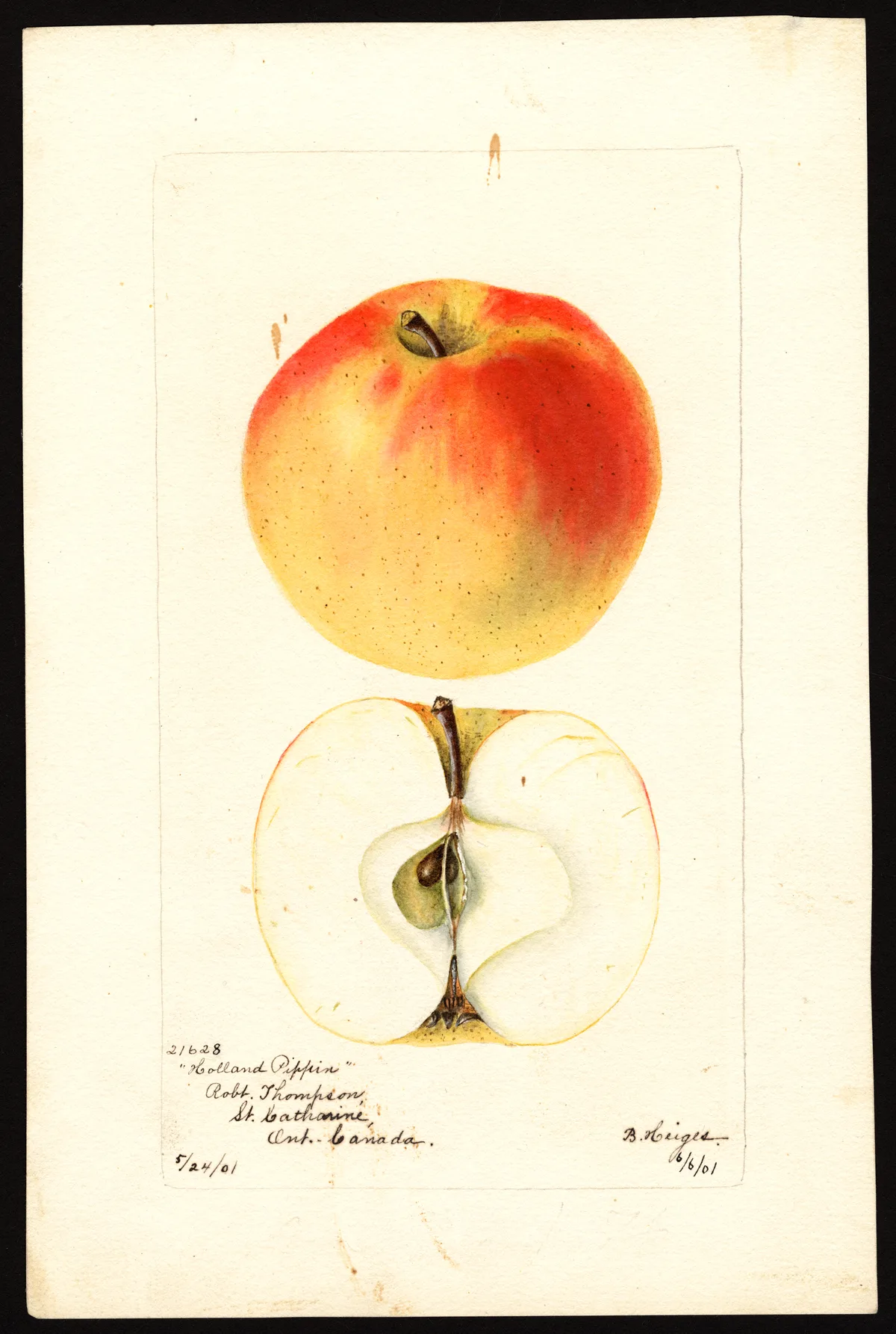
USDA Pomological Watercolor Collection
Holland Pippin
Origin / History
The origin of Holland Pippin is unknown. It is an old variety that has long been in cultivation in New York and adjoining states; the earliest published reference is Coxe (1817), and by Hedrick's account (1922) it had been grown in America for over a century, with its culture extending from the Atlantic coast westward to Michigan and Indiana. It was still listed by nurserymen in the early twentieth century but was not being planted to any considerable extent (Beach).
Holland Pippin has historically been confused with two other varieties: the Fall Pippin and the Holland Winter apple. Downing noted in 1848 that Holland Pippin and Fall Pippin "are of the same origin." Hedrick emphasized that all three are distinct: Holland Pippin is a fall apple, while Holland Winter is in season in winter; Holland Pippin is a culinary fruit, while Fall Pippin is a choice dessert apple.
Beach observed that two varieties circulate in New York under the name Holland Pippin: one is a winter apple in season from late autumn to April or May (described separately under the name Holland Winter), and the other — the variety treated here — begins to ripen earlier than Fall Pippin and is in season during September and October.
Downing provided the following comparison of Holland Pippin and Fall Pippin in 1848: "The Holland Pippin, though considerably resembling this apple in the growth of the tree, and size and shape of the fruit, is a totally distinct apple from the Fall Pippin. In fact, while the Fall Pippin is one of the best autumn table apples (at least in this district), the Holland Pippin is of very inferior quality for dessert, and is, in fact, only a cooking apple. As a kitchen fruit, however, it is one of the most valuable summer fruits we know — for it bears regularly and well, comes into use at the beginning of August, and continues fit for pies, tarts, and sauce, until October, when the Fall Pippin begins to ripen. The Holland Pippin is fit for use while the skin is quite green, but the Fall Pippin, not until it turns quite yellow. Finally, the stalk of the Holland Pippin is short, and set in a wide cavity, while that of the Fall Pippin is large, and set in a cavity often narrow, and comparatively shallow. With these points of difference, these two apples ought not to be confounded."
Hedrick (1922) similarly distinguished Holland Pippin from Fall Pippin on the following points: Holland Pippin is the earlier of the two, going out of season soon after Fall Pippin begins to ripen; Holland Pippin is the greener fruit, Fall Pippin being fit to use only when it has turned a golden yellow; and the stalk of Holland Pippin is short and set in a wide cavity, while that of Fall Pippin is long and set in a narrow cavity. Hedrick notes that "the trees of both varieties are much the same in habit and both are exceptionally satisfactory."
Tree
The tree is large or moderately large (Beach) — large and vigorous (Hedrick). Form spreading or roundish (Beach), described by Hedrick as spreading or round-topped. Twigs medium to long, curved, stout, with medium internodes (Beach). Bark dark brown, heavily coated with gray scarf-skin; pubescent (Beach). Lenticels scattering, small to medium, oval, not raised (Beach). Buds medium size, plump, obtuse, free, pubescent (Beach).
The tree is a good grower, hardy or nearly so, healthy, pretty long-lived, and generally quite productive, yielding moderate to heavy crops biennially or sometimes annually (Beach).
Fruit
Size
Very large (Downing). Usually large or very large, sometimes medium; pretty uniform in size and shape (Beach). Hedrick agrees: large or very large, uniform in size and shape.
Form
Downing describes the form as roundish, "a little more square in outline than the Fall Pippin, and not so much flattened, though a good deal like it, a little narrowed next the eye." Beach gives the form as roundish, often decidedly flattened at the end, varying to oblate-conic, obscurely ribbed. Hedrick: round or oblate-conic, obscurely ribbed.
Stem
Downing gives the stalk as half an inch long, thick, and deeply sunk. Beach describes the stem as medium to short, usually rather slender. Hedrick likewise gives it as short, usually slender. Beach and Hedrick thus disagree with Downing on thickness; all agree the stem is short.
Cavity
Downing describes the stalk as deeply sunk but does not describe the cavity surface. Beach gives the cavity as acute or sometimes acuminate, medium in width to broad, moderately shallow to deep, usually covered with thick outspreading russet. Hedrick gives it as acute, medium in width, shallow, usually covered with thick outspreading russet. Beach and Hedrick disagree on depth: Beach gives moderately shallow to deep, while Hedrick gives shallow.
Calyx
Downing: small, closed, moderately sunk in a slight plaited basin. Beach: pubescent, medium to small, closed or partly open; lobes rather long, acute. Hedrick: pubescent, small, closed or partly open; lobes long, acute. Hedrick additionally gives the calyx-tube as wide and broadly conical, with stamens median.
Basin
Downing: moderately sunk, slight, plaited. Beach: usually rather shallow but varying to moderately deep, medium in width to rather narrow, abrupt to somewhat obtuse, ridged and wrinkled. Hedrick: shallow to deep, narrow, abrupt to obtuse, ridged and wrinkled.
Skin
Beach: thin, tough, nearly smooth, rather pale yellow or greenish, with more or less of a brownish-red blush that is conspicuously marked with large, irregular, areolar dots; dots numerous, large and small, often submerged and greenish. Hedrick: thin, tough, smooth, pale yellow with a brownish-red blush conspicuously marked with large, irregular, areolar dots; dots numerous, large and small, often submerged. Downing describes the skin as greenish yellow or pale green, becoming pale yellow when fully ripe, washed on one side with a little dull red or pale brown. Downing characterizes the dots as "a few scattered, large, greenish dots" — in conflict with Beach and Hedrick, who both describe the dots as numerous. The fruit is fit for use while the skin is still quite green (Downing).
Flesh / Flavor
Hedrick: flesh white, coarse-grained, crisp, tender, very juicy, brisk subacid; good to very good. Downing rates it "Good" as a kitchen apple but notes it is "of very inferior quality for dessert." Beach provides no direct flesh description.
Core / Seeds
Core large, abaxile; cells unsymmetrical, open; core-lines meeting or clasping; carpels broad, narrowing toward base and apex, emarginate, tufted; seeds narrow, acute (Hedrick). Not described by Downing or Beach.
Season
Downing states the fruit begins to fall from the tree and is fit for pies about the middle of August, and from that time to the first of November is one of the very best kitchen apples. Beach and Hedrick both give the season as September to October. The crop ripens unevenly: some apples ripen early and are correspondingly short-lived, while others ripen later and keep correspondingly longer. The fruit varies greatly in keeping qualities in different seasons, some years keeping well until late fall or early winter (Beach).
Uses
Holland Pippin is exclusively a kitchen apple. Downing is explicit: it is "of very inferior quality for dessert, and is, in fact, only a cooking apple." From roughly mid-August through October it is fit for pies, tarts, and sauce, and during that window Downing rates it "one of the very best kitchen apples." The fruit is fit for use while the skin is still quite green (Downing). It is grown to a limited extent for market and appears to be more valued for that purpose in certain portions of the Hudson valley than in other sections of New York state. The fruit is large and, when kept free from scab, its general appearance is good for a green apple (Beach).
Subtypes / Variants
Beach notes that two distinct varieties circulate in New York under the name Holland Pippin: (1) a winter apple in season from late autumn to April or May, described separately under the name Holland Winter; and (2) the fall variety treated here, in season during September and October.
Book Sources
Described in 3 period pomological works
View original book sources (3)
— A.J. Downing, The Fruits and Fruit Trees of America (1900)Holland Pippin.
Reinette d'Hollande. Summer Pippin. Pie Apple.
This and the Fall Pippin are frequently confounded together. They are indeed of the same origin. One of the strongest points of difference lies in their time of ripening.
The Holland Pippin begins to fall from the tree and is fit for pies about the middle of August, and from that time to the first of November is one of the very best kitchen apples.
Fruit very large, roundish, a little more square in outline than the Fall Pippin, and not so much flattened, though a good deal like it, a little narrowed next the eye. Stalk half an inch long, thick, deeply sunk. Calyx small, closed, moderately sunk in a slight plaited basin. Skin greenish yellow or pale green, becoming pale yellow when fully ripe, washed on one side with a little dull red or pale brown, with a few scattered, large, greenish dots. Good.
— S.A. Beach, The Apples of New York, Vol. 2 (1905)HOLLAND PIPPIN.
References. 1. Coxe, 1817:109. fig. 2. Downing, 1845:86. 3. Ib., Horticulturist, 3:345. 1848. 4. Thomas, 1849:156. fig. 5. Cole, 1849:110. 6. Downing, Chas., Horticulturist, 8:196. 1853. 7. Elliott, 1854:138. 8. Hovey, Mag. Hort., 22:555. 1856. fig. 9. Hooper, 1857:45. 10. Gregg, 1857:37. 11. Am. Pom. Soc. Cat., 1862. 12. Warder, 1867:506. 13. Wickson, 1889:244. 14. Lyon, Mich. Hort. Soc. Rpt., 1890:292. 15. Bailey, An. Hort., 1892:241. 16. Beach and Clark, N. Y. Sta. Bul., 248:124. 1904.
Synonyms. Fall Pippin (1). French Pippin (7). Holland Pippin (1, 2, 3, 4, 5, 6, 7, 8, 9, 10, 11, 12, 13, 14, 15, 16). Pie Apple (2, 7, 8). Reinette d'Hollande (2). Reinette d'Holland (7). Summer Pippin (2, 7, 8).
There are two varieties in cultivation in New York under the name Holland Pippin. One is a winter apple in season from late autumn to April or May which has already been described under the name Holland Winter, Vol. I., page 159. The other begins to ripen earlier than Fall Pippin and is in season during September and October. This variety was formerly confused by some with the Fall Pippin. The following comparison of the two varieties was given by Downing in 1848 (3). "The Holland Pippin, though considerably resembling this apple in the growth of the tree, and size and shape of the fruit, is a totally distinct apple from the Fall Pippin. In fact, while the Fall Pippin is one of the best autumn table apples (at least in this district), the Holland Pippin is of very inferior quality for dessert, and is, in fact, only a cooking apple. As a kitchen fruit, however, it is one of the most valuable summer fruits we know — for it bears regularly and well, comes into use at the beginning of August, and continues fit for pies, tarts, and sauce, until October, when the Fall Pippin begins to ripen. The Holland Pippin is fit for use while the skin is quite green, but the Fall Pippin, not until it turns quite yellow. Finally, the stalk of the Holland Pippin is short, and set in a wide cavity, while that of the Fall Pippin is large, and set in a cavity often narrow, and comparatively shallow. With these points of difference, these two apples ought not to be confounded."
Holland Pippin is grown to a limited extent for market. It appears to be more valued for this purpose in certain portions of the Hudson valley than in other sections of the state. The fruit is large and when kept free from scab its general appearance is good for a green apple. The crop ripens unevenly. Some of the apples ripen early and are correspondingly short-lived while others ripen later and keep correspondingly later. It varies greatly in keeping qualities in different seasons, some years keeping well till late fall or early winter (16). The tree is a good grower, hardy or nearly so, healthy, pretty long-lived and generally quite productive yielding moderate to heavy crops biennially or sometimes annually.
Historical. Origin unknown. It is an old variety which has long been in cultivation in this and adjoining states. It is still listed by nurserymen but it is not being planted to any considerable extent.
Tree.
Tree large or moderately large, vigorous. Form spreading or roundish. Twigs medium to long, curved, stout; internodes medium. Bark dark brown, heavily coated with gray scarf-skin; pubescent. Lenticels scattering, small to medium, oval, not raised. Buds medium size, plump, obtuse, free, pubescent.
Fruit.
Fruit usually large or very large, sometimes medium, pretty uniform in size and shape. Form roundish often decidedly flattened at the end varying to oblate conic, obscurely ribbed. Stem medium to short, usually rather slender. Cavity acute or sometimes acuminate, medium in width to broad, moderately shallow to deep, usually covered with thick outspreading russet. Calyx pubescent, medium to small, closed or partly open; lobes rather long, acute. Basin usually rather shallow but varying to moderately deep, medium in width to rather narrow, abrupt to somewhat obtuse, ridged and wrinkled. Skin thin, tough, nearly smooth, rather pale yellow or greenish with more or less of a brownish-red blush which is conspicuously marked with large, irregular, areolar dots. Dots numerous, large and small, often submerged and greenish.
— U.P. Hedrick, Cyclopedia of Hardy Fruits (1922)HOLLAND PIPPIN. French Pippin. Summer Pippin. Holland Pippin is often confused with Holland Winter and Fall Pippin. The following differences distinguish it from these two: Holland Pippin is a fall apple, while Holland Winter is in season in winter. Holland Pippin is a culinary fruit, while Fall Pippin is a choice dessert apple. Of the two, Holland Pippin is the earlier, going out of season soon after Fall Pippin begins to ripen. Holland Pippin is the greener fruit of the two, Fall Pippin being fit to use only when it is a golden yellow in color. The stalk of Holland Pippin is short and set in a wide cavity, while that of Fall Pippin is long and set in a narrow cavity. The trees of both varieties are much the same in habit and both are exceptionally satisfactory. The origin of Holland Pippin is unknown, but it has been grown in America over a century, its culture extending from the Atlantic westward to Michigan and Indiana. Tree large, vigorous, spreading or round-topped. Fruit large or very large, uniform in size and shape, round or oblate-conic, obscurely ribbed ; stem short, usually slender ; cavity acute, medium in width, shallow, usually covered with thick outspreading russet ; calyx pubescent, small, closed or partly open ; lobes long, acute ; basin shallow to deep, narrow, abrupt to obtuse, ridged and wrinkled ; skin thin, tough, smooth, pale yellow with brownish-red blush which is conspicuously marked with large irregular, areolar dots ; dots numerous, large and small, often submerged ; calyx-tube wide, broadly conical ; stamens median ; core large, abaxile ; cells unsymmetrical, open ; core-lines meeting or clasping ; carpels broad, narrowing toward base and apex, emarginate, tufted ; seeds narrow, acute ; flesh white, coarse-grained, crisp, tender, very juicy, brisk subacid ; good to very good ; September to October.